Monthly Archives: September 2023

Brian Gavin, ‘Death Watch at the Nursing Home’

Two rows of heads puffed white for show
are turned to watch the gurney go
parade-like down the hall and through
the double doors, and out of view.

They linger, as the swinging doors
are gazed to stillness, and intercourse
is but the mingling of silhouettes.
Beyond the tumults of regret

and wonder, they are elsewhere, all
their architecture of recall
connecting lives to family plots,
or maybe – further back – in what

may be a keepsake memory – light
parade, perhaps – a child’s delight
in clowns and cotton candy, high
and wispy as puffed hair. Friends die

often, but not in violence –
not here, where death comes to the sense
in not-quite-joy, and not-quite-grief,
but trembling, lightly, like a leaf

that might be blown, or not, or light
as dandelion fields puffed white
and wispy, wavering. In slow surmise
they gaze on quiet with quiet eyes,

filling the hall with noiselessness,
and dreaming but to acquiesce
to dream, and but to linger some
in thrall to stillness yet to come.

*****

Brian Gavin writes: “My poem sort of rips off (shamelessly!) the form and rhyme scheme of the famous A E Housman poem ‘To An Athlete Dying Young‘. It is, however, about a different kind of death – extreme old age – and the gentleness of it. It’s based on something I actually saw in a nursing home, when white heads once leaned out of their rooms to see a friend taken away on a gurney. The image of a parade struck me, and the heads of puffed white hair reminded me of cotton candy at the parades of my youth. Eventually the images of puffed hair and puffed candy morphed into a field of puffed white dandelions wavering in the wind.
I almost left the title at ‘Death Watch‘ – which I kind of preferred for the double meaning – but opted to add the rest of it for the sake of clarity. This piece ran in my collection Burial Grounds.”

Brian Gavin is a retired Distribution Manager who started writing poetry 10 years ago. His poems have appeared in The Journal of Formal Poetry, Peninsula Poets and Snakeskin Magazine, and in the Potcake Chapbook ‘Careers and Other Catastrophes. He lives in Lakeport, Michigan, USA, with his wife Karen. ‘Burial Grounds’ is available from Kelsay Books.
You can see more of his work at briangavinpoetry.com

Photo: “Dandelions Gone to seed, Dandelion puff ball seeds weeds lawn infestation roundup herbicide Pics by Mike Mozart of TheToyChannel and JeepersMedia on YouTube #Dandelions #Weeds #DandelionSeeds #Lawn #DandelionFlowers #Dandelion” by JeepersMedia is licensed under CC BY 2.0.

Excerpt: ‘You, Yes You’

You, yes you, contain multitudes, conflicted mobs-–
the adroit who holds two jobs,
the maladroit who fails and sobs,
the shortcut thug, dacoit, who simply robs-–
you’ve urges to protect and to exploit:
be just! (but help yourself when you’ve the chance
and no one’s there to look at you askance.)
Priests educate, instruct and rape their flock
as farmers care for, milk and eat their herd
and statesmen love the country they extort.

*****

This is (apparently) the most interesting excerpt from a longer rant that was more than the Rat’s Ass Review wanted. Thanks Roderick Bates for selecting this piece!

Disagreement” by Petri Damstén is licensed under CC BY-NC-ND 2.0.

Marcus Bales, ‘Sailing to Margaritaville’

That is the country we go to, all of us
Made young again by music, smooth with oil
And lust, all generations generous
With youth and laughter. Couples coil
And uncoil, casually amorous,
With booze in the blender and shrimp beginning to boil.
Everybody dreams they have the chance
To chase the charms and challenge of romance.

A laughing bard is the essential thing.
A patterned shirt, an old six-string guitar,
Who urges us to sing and louder sing
And clap and dance and order from the bar,
And thank hard-working servers as they bring
The stuff that lubricates this whole bazaar.
And though the bard is covering the bill,
Tip well when you’re in Margaritaville.

Oh, parrotheads — imagination’s fire
Illuminates the marvel of it all,
And conjures every sorcery we require,
The call to the response, response to call,
A consummation fevered with desire,
Beatified by the local alcohol.
The song creates the dream. The dream creates
Another song the dreamer celebrates.

And once reality is far away,
Our youth returned, our stamina restored,
We eat and drink and sing and dance and play
And manifest ourselves within each chord
As if we might entrance ourselves to stay
Within this reverie we’ve found aboard
The magic vessel Margaritaville,
Distilling what distillers can’t distill.

*****

Marcus Bales writes: “Someone immediately floated a raft of shit my way over this poem, claiming, in a local Cleveland group generally given to local music, that I’m normalizing alcoholism. I know — it’s an astonishing misinterpretation, but there it is. And in spite of my protestations, he insisted on shouting that I was a lush, a drunk, and an idiot for promoting and approving a disease. Well, it’s not as if poets aren’t used to being misunderstood.

The odd thing to me about this is that I work hard to trigger people through poetry. That’s what art does, in my view, confront us with our frauds and foibles, and makes us look at them in detail. If, of course, we read poetry at all. There must be some corollary to Murphy’s Law that states that when a poem can be misinterpreted it will be misinterpreted. Normally I’m delighted by responses to my poems that are outraged and offended, because normally those responses are from the people I’m trying to outrage and offend. But this blindsided me. The entire Jimmy Buffett phenomenon was built on the fantasy of sun and sand and sea, which is only tangentially alcohol-fueled. No doubt alcohol plays a role in lubricating the enchantment, but it’s the enchantment people go for, not alcoholism.

And that enchantment is powerful. It makes people wear loud clothes and play loud music. But the central lure is that we can think of ourselves as all multi-talented and tanned, slim and young and horny. It’s not the lure of tales of drunkenness and cruelty on a summer afternoon, but rather the opposite: tales of slightly disreputable fun, but tales of the lure of the freedoms from regimentation for the freedoms of a more relaxed like-minded culture where everyone is youthfully attractive and eagerly lascivious.

And what a lure! Even those of us whose only encounter with youthfully attractive and eagerly lascivious were our own dreams had those dreams. And with Jimmy Buffett the price of admission was a seducing tune and a clever lyric. You didn’t need a white sportcoat, much less a pink crustacean. All you needed was a sense of lockstepness of the modern bourgeoisie and a desire to escape it. The whole thing is all in your mind. You create your own sensitive young poet self in a lubricious setting among the young and eager to love you. It’s thrilling, it’s fulfilling, it’s art.”

*****

(Editor’s note: From the title, to the ottava rima form, to the themes, ‘Sailing to Margaritaville’ pays homage to Jimmy Buffett by riffing on W.B. Yeats’ ‘Sailing to Byzantium‘. Beginning with Yeats’ opening words, “That is no country for old men” and all the way through, Bales echoes and plays with Yeats’ words, bringing everything to Buffett’s Margaritaville.)

Not much is known about Marcus Bales except that he lives and works in Cleveland, Ohio, and that his work has not been published in Poetry or The New Yorker. However his ‘51 Poems‘ is available from Amazon. He has been published in several of the Potcake Chapbooks (‘Form in Formless Times’).

Photo: “Wasting away again in Margaritaville……..” by efleming is licensed under CC BY 2.0.

Using form: Ottava Rima: Max Gutmann, ‘Life, That Hack!’ (from Don Juan Finish’d)

If we could but instill in Life–that hack!–
The element’ry rules of composition,
Prevent the crude and sloppy maniac
From spoiling every scene with his tradition
Of shouting in our faces like a pack
Of drunken sailors wailing their rendition
Of “Captown Races” or “My Drawlin’ Clementime,”
Their rhythmic belching almost keeping them in time.

For Life to utilize the art of Art
Could help in many ways that we could mention.
Some structure and suspense would be a start.
To get us upright in our seats, fists clenchin’,
A little rising action would be smart
(Or something that would help us pay attention,
Instead of simply zoning out a lot
And missing half the details of the plot).

But Life, I fear, shall never learn to craft
A decent tale. (It hasn’t that ambition.)
It uses characters extremely daft,
And wastes far too much time in exposition.
It never bothers to revise a draft,
Too taken with its own first thoughts. Perdition!
Each aspect of the story is a shame–
And worst, the ending’s always just the same.

Max Gutmann writes: “Don Juan Finish’d fancifully completes Lord Byron’s unfinished comic epic. Excerpts have been contributed to Light, Lighten Up Online, Orbis, Slant, Think, the website of the Byron Society, and Pulsebeat, where ‘Life, That Hack!’ is among the excerpts to have appeared. The complete poem is still unpublished, though I privately printed some copies to share with friends and colleagues.
Like Byron’s poem, Don Juan Finish’d is often philosophical, at times facetiously, as here.”

Editor’s note: As with Byron’s original, Gutmann’s Don Juan Finish’d is written in ottava rima: eight-line stanzas in iambic pentameter rhyming ABABABCC, with the final line or two typically used to humorously deflate whatever more high-sounding statements were made earlier in the stanza.

Max Gutmann has worked as, among other things, a stage manager, a journalist, a teacher, an editor, a clerk, a factory worker, a community service officer, the business manager of an improv troupe, and a performer in a Daffy Duck costume. Occasionally, he has even earned money writing plays and poems.

Photo: “comedy/tragedy masks, waterfall” by milagroswaid is licensed under CC BY-SA 2.0.

Poem on Poetry: ‘Poets Do Tricks With Words’

Poets do tricks with words,
play games, weld rhyme,
but we don’t do this nicely all the time–
we’ve also anger at unfairness, anger hot-white
at wasteful power, at greed and spite,
where fear meets selfishness, drives right and left
to persecution, torture, war and theft.

Each trick sticks bricks, fixed and unfixed,
into an apartheid verbal wall
that warbles claims to separate
sense from nonsense–though we appreciate
all’s one, all’s all the same,
word walls are just a Jenga game,
and all bricks fall.

We can play games with words,
thread and unthread them in a silly tangle,
loom and illuminate light warp, dark weft,
wrong them and wring them ringing through a mangle
as sometimes the only way
to find a new way to say
things said ten thousand times before:
how brightness has a rightness,
whether in the sky, the sea, a face or an idea.

So cook with words, mix, bake,
packing in raisins, nuts, half cherries for a cake
with flour just enough for a pretence
that it’ll hold together and make sense.

*****

Formal? Free? The arguments about the appropriate structure for poetry in English never seem to end. The semi-formal compromise has been around for a long time: take the rhythmic, rhyme-rich ramblings of Arnold’s ‘A Summer Night’ from 170 years ago, or Eliot’s ‘Prufrock’, written in 1911. To me, the test of good verse is that it is easy to memorise and recite: the ideas and imagery have to be memorable, but so does the expression, word for word. The tricks may vary by language and culture, but whatever tricks the poet can manage to achieve memorableness are legitimate.

‘A Summer Night’ was in my English A Level curriculum <cough> years ago, and the middle section which I still know by heart encouraged me to run away from school. (I was found trying to sleep in a phone booth while waiting for a morning train, and brought back to school at 2 in the morning.) The poem’s semi-formal structure has always appealed to me with its rhetorical power, and over the years I’ve often used that freedom when writing about poetry, as in ‘Some Who Would Teach‘ and ‘Inspiration 2‘ and ‘Memorableness‘.

‘Poets Do Tricks With Words’ has just been published in Orbis, edited by Carole Baldock.

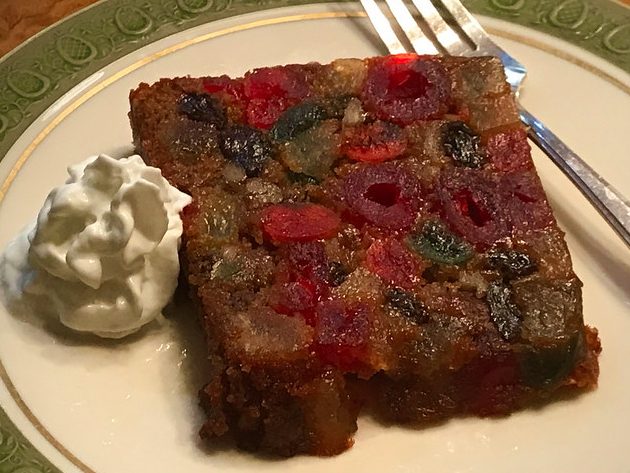
Photo: “National Fruitcake Day” by outdoorPDK is licensed under CC BY-NC-SA 2.0.

Marcus Bales, ‘Labor Day 2023 – RIP Jimmy Buffett’

He died on Labor Day, the end of summer,
And left us going back to work or school.
The days are shorter, now, the parties glummer,
Less heat and light, less beat and life, less cool.
We fall back on our favorite expressions
Of what it means to be young, tan, and free,
And weigh the anchors of adult discretions
Imagining we sail a sapphire sea.
The songs he sang, those figurative vacations,
Have turned our water into stronger stuff.
We toast each other, changing our frustrations
With dailiness to fantasizing fluff,
And drink the happy liquor we distil
From metaphoric Margaritaville.

*****

Marcus Bales writes: “My favorite Jimmy Buffett songs are ‘A Pirate Looks At Forty‘ and ‘Tin Cup Chalice‘, but I think his best song is ‘Margaritaville.’ I’m not as fond of ‘He Went To Paris‘ or ‘Death of an Unpopular Poet‘ as other celebrants of his work, and ‘Why Don’t We Get Drunk and Screw‘ is certainly the best of the more raucous end of his oeuvre.

Like many other singer-songwriters Buffett seemed to me to work without an editor, possibly because the music business is such that even when you find a peer-group that you trust to say this or that just ain’t right, it’s hard to get the group together often enough, and for long enough, for the trust to re-blossom so that real reflection and re-working of lyrics can happen.

Those circumstances lead a lot of singer-songwriters, I think, to something that is not exactly laziness, and not quite smugness, but rather perhaps more like a sense that they’re the only ones whose taste they trust to judge their own work. Then they slide into a state where they are not themselves as critical of their own work as they once were. They get a good idea and a good line or two in the chorus, and the rest of it gets sort of clamped and glued together without a final planing, sanding, and paint job. The music is well-arranged and well-performed because you can’t fool musicians about music, but the lyrics tend to seem a little hasty, a little down-at-heels, a little scratch-and-dent. It’s too bad because their early work is almost always lyrically inventive and musically simple, while their later work is musically slick and lyrically spotty.

When I first heard A1A in 1978 I was entranced. No one else that I knew of was trying to sketch people and places from the point of view of a sort of scruffily aimless charmer. Oh, there was Tom Waits, but that was more noir and Bukowski than charming. Buffett’s work was entrancing, a refreshing way to write songs and perform them. A lot gets forgiven in the enchantment of the charm, but eventually the clanker lines and the narratives that don’t quite hold together accumulated, and I started to notice the tarnish more than the shine.

So the later work did not grip me as the early work had, and for most of the last 40 years, as the work drifted into crowd-pleasing medium-tempo rockers with a cheery tale told by a richer, more self-congratulatory narrator offering a smoother sail in a bigger boat crewed by professionals, I became less and less interested in what I had come to view as a pervasive sloppiness in the contemporary singer-songwriter tradition. It seemed to affect them all as they worked longer in the business, except perhaps for Paul Simon. But Buffett, Diamond, Prine, Browne, just to name a few, seemed all to become more facile than artful And Buffett in particular seemed to have decided to pursue sing-along music for the car instead of headphone music for the chair, and it started him on the path to wealth. And good for him.

But what I celebrate overall, and I hope in this poem, is the work that tried to be more than a pop song, that was striving, even if slyly and beneath the listener’s first perceptions, to be art. That’s what entranced me at the beginning, and that’s what I want to remember most fondly.”

Editor’s note: Jimmy Buffett died on the night of September 1st, and the news came out over the Labor Day weekend.

Not much is known about Marcus Bales except that he lives and works in Cleveland, Ohio, and that his work has not been published in Poetry or The New Yorker. However his ‘51 Poems‘ is available from Amazon. He has been published in several of the Potcake Chapbooks (‘Form in Formless Times’).

Short poem, ‘Vetch in the Spring’

Love comes back like vetch in the Spring:
You knew it was there, but it’s still a surprise –
The flower is lovely, but wildly unwise.
Love comes back like vetch in the Spring,
You keep pulling it out but you’re never free;
You think it’s gone, but it won’t ever be.
It just comes back like vetch in the Spring.
Love’s just a thing.

*****

With a bit more attention, this poem might have made a satisfactory rondelet (like the previous post by Susan McLean)… but it’s in the form that it occurred to me and, like vetch, it’s just there in its undisciplined fashion. Published this month in Allegro Poetry Magazine, edited by Sally Long.

Photo: “vetch flower and tendril, with ant” by Martin LaBar is licensed under CC BY-NC 2.0.

Using form: Susan McLean, ‘What Goes: A Rondelet’

You were the one
who always told me what to do.
You were the one
who said I ought to buy a gun.
So when you said that we were through,
one of us had to go. I knew
you were the one.

*****

Susan McLean writes: “I have to credit Allison Joseph for introducing me to the rondelet, a French repeating-form poem that has not been in fashion for a very long time. She was teaching a workshop on repeating forms at the West Chester University Poetry Conference, and I was one of the students. The rondelet is a short form with such short lines and so many repetitions of the first line that it doesn’t give the writer much wiggle room for an interesting twist in the meaning of the repeated line. I settled on “you were the one” as my repeated line, because it is associated with the standard swoony romantic line, but it could easily change its meaning depending on the context. Once I chose “gun” as a possible rhyme for “one,” that word suggested to me a scenario in which the controlling partner in a relationship comes to regret influencing his partner to arm herself. The poem’s title is a pun. At first, it looks as though naming the form in the title is just an effort to identify an unfamiliar form, but if you say it aloud, it evokes the common phrase “what goes around comes around,” suggesting that the man’s comeuppance is partly his own fault. In French, “rondelet” means “a little circle.” This poem first appeared in New Trad Journal and was later published in my second poetry book, The Whetstone Misses the Knife.

Susan McLean has two books of poetry, The Best Disguise and The Whetstone Misses the Knife, and one book of translations of Martial, Selected Epigrams. Her poems have appeared in Light, Lighten Up Online, Measure, Able Muse, and elsewhere. She lives in Iowa City, Iowa.
https://www.pw.org/content/susan_mclean

Photo: “#Siena #streetart #guns #woman” by Romana Correale is licensed under CC BY-ND 2.0.

Tom Vaughan, ‘Swot’

It’s time to hunker down and swot
with coffee as my only friend

and each dawn closer to the end
which in the distance I can spot:

the happiness which lies ahead
when I’ll have passed with flying colours

and on a day unlike all others
will saunter through the streets instead.

I won’t be bored, I tell myself:
the world will sparkle, and the hours

will sprinkle down in golden showers.
I won’t need anything – my wealth

will be the knowledge I’ll forget
and which I haven’t learnt as yet.

*****

Tom Vaughan writes: “Swot was inspired by coming across this sonnet form in a collection of poems – This Afterlife – by AE Stallings. It was – at first – simple imitation of her layout. But then I came to like – and to feel – the tension between the couplet form and the cross-couplet rhyming, as if the poem wasn’t sure it was a sonnet. I like things which pull against one another, and most of all I like doubt.
It was subsequently heartening to learn, in June, that she had been elected as the new Oxford Professor of Poetry, given her combination of massive formal skills and deep classical culture, plus her sharp contemporary voice and relevance. So there’s still hope . . . “

Editor’s note: Some non-Brits may only connect the word “swot” with SWOT Analysis (Strengths, Weaknesses, Opportunities, Threats), but Vaughan is using it as the perjorative verb to study hard for an exam or, disapprovingly as a noun, a person who studies hard and avoids other activities. Swot was published in this month’s Snakeskin.

Tom Vaughan is not the real name of a poet whose previous publications include a novel and two poetry pamphlets (A Sampler, 2010, and Envoy, 2013, both published by HappenStance). His poems have been published in a range of poetry magazines, including several of the Potcake Chapbooks:
Careers and Other Catastrophes
Familes and Other Fiascoes
Strip Down
Houses and Homes Forever
Travels and Travails.
He currently lives in Brittany.
https://tomvaughan.website

Photo: “The Studious One” by Szoki Adams is licensed under CC BY-NC-ND 2.0.

Sonnet: ‘Parking Lot’

Although not of their class, I went to church
with Bryce and Nicky in the congregation.
In a shop’s parking lot and in the lurch
I asked Bryce for a job, loan, or donation.
Then Nicky’s car came up and Bryce got in,
the bastards swerved to hit me, ran me down;
when I got up, they ran me down again,
hit the wall with their car, left with a frown.
They don’t apologise, don’t feel the need –
“You caused it all ill-manneredly,” they say.
“Our car was damaged too.” (But did they bleed?)
I bothered them; they wanted me away.
The congregation says “Forgive, forget.”
Decades have passed. Forget? Forgive? Not yet.

*****

This Shakespearean sonnet (iambic pentameter, rhyming ABAB CDCD EFEF GG) has just been published in this month’s Snakeskin. Editor George Simmers expressed concern that it might be a true story… let me reassure everyone, I neither attend church nor get hit by cars. The poem is at most a parable, a parabolic approach to events.

Photo: from Snakeskin.