Monthly Archives: March 2025

Using form: Pantoum: Brian Allgar, ‘And then I told you’

We kissed. And then I told you (it was over
dinner at some fancy restaurant)
I loved you, but I couldn’t live like this,
meeting from time to time; I needed more.

Dinner at some fancy restaurant,
and timid sex at your place; that was all, each
meeting. From time to time, I needed more
than you were ready for, so reticent

and timid. Sex at your place – that was all. Each
meeting’s end, I tried not to ask more of you
than you were ready for. So, reticent,
I touched your face in silence, lovingly.

Meetings end. I tried not to ask more of you;
I loved you, but I couldn’t live like this.
I touched your face. In silence, lovingly,
we kissed, and then I told you it was over.

*****

Brian Allgar writes: “In general, I don’t much care for poetic forms, such as the triolet and the villanelle, with repeated lines. But I was attracted by the pantoum’s requirement that the repeated lines, though containing exactly the same words, should somewhat change in meaning each time.”

‘And then I told you’ was first published in Snakeskin.

Brian Allgar was born a mere 22 months before Adolf Hitler committed suicide, although no causal connection between the two events has ever been firmly established. Despite having lived in Paris since 1982, he remains immutably English. He started entering humorous competitions in 1967, but took a 35-year break, finally re-emerging in 2011 as a kind of Rip Van Winkle of the literary competition world. He also drinks malt whisky and writes music, which may explain his fondness for Mendelssohn’s Scottish Symphony. He is the author of The Ayterzedd: A Bestiary of (mostly) Alien Beings and An Answer from the Past, being the story of Rasselas and Figaro. He is also the co-author, with Marcus Bales, of Baleful Biographica, all published by Kelsay Books and available from the publisher or from Amazon.

Photo: “French restaurant with Jean” by obvio171 is licensed under CC BY-SA 2.0.

Weekend read: Cherokee myth: “Nursery Rhyme for Lazy Children” by Jennifer Reeser

They live at bottom of the deep
In ocean waters or in fresh.
They feed with greed on human flesh.
They kill the ones who oversleep.

You never will be fully grown.
They shoot with arrows while you dream,
Then drag you down like cod or bream,
But first replace you with a clone.

They leave it sleeping in your tent.
It has your eyes. It has your cheeks.
It wakes up early and it speaks.
The tribe won’t wonder where you went.

It does your chores and may amaze.
Like you, it plays and even thinks
But very soon, your double shrinks
And it will die in seven days.

Your people will not ever know.
You’ll never love. You’ll never marry.
Your twin’s the one that they will bury
For you’ve gone where the fish bones go.

But if you listen you will thrive:
Get out of bed and brush your hair.
The hunter’s coming. Be aware
Lest you be swallowed up, alive.

*****

Jennifer Reeser’s ‘Nursery Rhyme for Lazy Children’ was first published in New Verse Review. She cites the following Cherokee myth, ‘The Water Cannibals‘:

Besides the friendly Nûñnë’hï of the streams and mountains there is a race of cannibal spirits, who stay at the bottom of the deep rivers and live upon human flesh, especially that of little children. They come out just after daybreak and go about unseen from house to house until they find some one still asleep, when they shoot him with their invisible arrows and carry the dead body down under the water to feast upon it. That no one may know what has happened they leave in place of the body a shade or image of the dead man or little child, that wakes up and talks and goes about just as he did, but there is no life in it, and in seven days it withers and dies, and the people bury it and think they are burying their dead friend. It was a long time before the people found out about this, but now they always try to be awake at daylight and wake up the children, telling them “The hunters are among you.”

This is the way they first knew about the water cannibals: There was a man in Tïkwäli’tsï town who became sick and grew worse until the doctors said he could not live, and then his friends went away from the house and left him alone to die, They were not so kind to each other in the old times as they are now, because they were afraid of the witches that came to torment dying people.

He was alone several days, not able to rise from his bed, when one morning an old woman came in at the door. She looked just like the other women of the settlement, but he did not know her. She came over to the bed and said, “You are very sick and your friends seem to have left you. Come with me and I will make you well.” The man was so near death that he could not move, but now her words made him feel stronger at once, and he asked her where she wanted him to go. “We live close by; come with me and I will show you,” said the woman, so he got up from his bed and she led the way down to the water. When she came to the water she stepped in and he followed, and there was a road under the water, and another country there just like that above.

They went on until they came to a settlement with a great many houses, and women going about their work and children playing. They met a party of hunters coming in from a hunt, but instead of deer or bear quarters hanging from their shoulders they carried the bodies of dead men and children, and several of the bodies the man knew for those of his own friends in Tïkwäli’tsï. They came to a house and the woman said “This is where I live,” and took him in and fixed a bed for him and made him comfortable.

By this time he was very hungry, but the woman knew his thoughts and said, “We must get him something to eat. She took one of the bodies that the hunters had just brought in and cut off a slice to roast. The man was terribly frightened, but she read his thoughts again and said, “I see you can not eat our food.” Then she turned away from him and held her hands before her stomach–so–and when she turned around again she had them full of bread and beans such as he used to have at home.

So it was every day, until soon he was well and strong again. Then she told him he might go home now, but he must be sure not to speak to anyone for seven days, and if any of his friends should question him he must make signs as if his throat were sore and keep silent. She went with him along the same trail to the water’s edge, and the water closed over her and he went back alone to Tïkwäli’tsï. When he came there his friends were surprised, because they thought he had wandered off and died in the woods. They asked him where he had been, but he only pointed to his throat and said nothing, so they thought he was not yet well and let him alone until the seven days were past, when he began to talk again and told the whole story.

*****

Jennifer Reeser is the author of seven books of poetry. She is an author with Penguin Random House, London’s “Everyman’s Library” series, and Able Muse. Her poems, translations, essays and critical reviews have appeared internationally in POETRY, The Hudson Review, RATTLE, and elsewhere, with new work forthcoming in Nimrod from the University of Tulsa. She divides her time between her Gulf Coast estate and home on the Cherokee reservation in Indian Country, Oklahoma.

It’s too late to take up ‘sleeping in’ kid, time for school 🙂” by Brent Halstead is licensed under CC BY-NC 2.0.

Using form: Quatrains with refrain: Jerome Betts, ‘Plus ça change. . .’

If, as a child, he had a spreading rash,
The squitters, then, far worse, was constipated,
Or boasted big blue bruise and graze and gash,
A doctor murmured, “Yes, it’s age-related.”

When, in mid-life, and seeking novel thrills,
He got a dose of something best not stated
So had to suffer jabs and bitter pills,
A doctor murmured, “Yes, it’s age-related.”

Come his declining years, which tax most brains,
His wits would wander, now grown antiquated,
And while he rambled down his memory’s lanes
A doctor murmured, “Yes, it’s age-related.”

Until, one day of flowers and muffled peals,
Cause of demise at last certificated,
As up the aisle he rolled, worm-food on wheels,
A doctor murmured, “Yes, it’s age-related.”

*****

Jerome Betts writes: “Hearing a phrase new to you can start some process in the brain leading toa piece of verse. Here it was my GP saying of some minor ailment It’s age-related. It stuck in my mind, and I think triggered a recollection of a Thomas Hood poem, The Doctor, its seven stanzas all ending with the refrain Yes, yes, said the Doctor, / I meant it for that!, the dodgy physician’s unvarying response to reports of the disastrous effects, even death, of his prescriptions. Not long after, the sight of a hearse on wheels rather than on bearers’ shoulders entering a Devon church provided the idea for the last stanza of this essay in black humour which appeared in Snakeskin.

Jerome Betts lives in Devon, England, where he edits the quarterly Lighten Up Online. Pushcart-nominated twice, his verse has appeared in a wide variety of UK publications and in anthologies such as Love Affairs At The Villa NelleLimerick Nation, The Potcake Chapbooks 1, 2 and 12, and Beth Houston’s three Extreme collections. British, European, and North American web venues include Amsterdam QuarterlyBetter Than StarbucksLightThe Asses of ParnassusThe HypertextsThe New Verse News, and  Snakeskin.

Illustration: “Great Grandfather and Child” by Melissa Flores is licensed under CC BY-NC-ND 2.0.

Melissa Balmain: ‘A Super-Subtle Metaphor’

(For my son)

Dear Unruly Backyard Maple:
I’ve been clipping you for years,
convinced that efforts to reshape’ll
pay for one who perseveres.

But now I get it, stubborn maple –
though I’ve trained your docile peers,
my double-bladed snip and scrape’ll
never give you classic tiers.

And I am seeing, steadfast maple,
how your tousled crown endears:
you shelter birds; come spring, your drape’ll
glow just like a chandelier’s.

So please forgive me, patient maple,
if it’s not too late, for here’s
my blessing, solemn as the papal.
Grow your way.
                        Love, Pruning Shears

*****

Melissa Balmain writes: “Looking back at poems I’ve written for and about my family, I realize many are metaphorical. I suspect that metaphor–like rhyme and meter–helps steer me toward interesting thoughts and away from over-sentimentality. (Whether my son agrees has yet to be seen!)”

‘A Super-Subtle Metaphor’ is the lead poem in the current issue of Lighten Up Online.

Melissa Balmain’s third poetry collection, Satan Talks to His Therapist, is available from Paul Dry Books (and from all the usual retail empires). Balmain is the editor-in-chief of Light, America’s longest-running journal of light verse, and has been a member of the University of Rochester’s English Department since 2010. She is a recovering mime.  

Photo: “Red Maple Tree” by Stanley Zimny (Thank You for 52 Million views) is licensed under CC BY-NC 2.0.

Max Gutmann, ‘Spring Villanelle’

Sandro Botticelli. (Alessandro di Mariano di Vanni Filipepi) 1444-1510.Florence. La Naissance de V?nus. Florence. Le Printemps. 1480. Florence. Mus?e des Offices.

Plants flower, swallows sing, and bunnies boff.
All nature gleams with joy. But time’s a sprinter.
When spring arrives, can winter be far off?

Take care. The festive glass from which you quaff–
at least half empty–soon will freeze and splinter,
though tulips bloom, swifts fly, and bunnies boff.

I glance away, then clear my throat and cough
to see you celebrating spring, that minter
of tender babes whose end is not far off.

You’ll soon require that heavy coat you doff,
eyes glinting so. Each year I see that glint err
as pansies flare, doves coo, and bunnies boff.

A peak makes more acute the coming trough.
Life’s script is not by Disney; it’s by Pinter:
one knows a heavy pause is not far off.

This bitter wisdom’s scorned, but, though you scoff,
each spring remains a harbinger of winter.
The primrose shines, wrens chirp, and bunnies boff,
all certain signs that winter’s not far off.

*****

Max Gutmann writes: “In this one, I tried to balance newness and repetition, like spring.”

‘Spring Villanelle’ was originally published in Light.

Max Gutmann has contributed to New StatesmanAble MuseCricket, and other publications. His plays have appeared throughout the U.S. (see maxgutmann.com). His book There Was a Young Girl from Verona sold several copies.

Photo: “IMG_6269A Sandro Botticelli. (Alessandro di Mariano di Vanni Filipepi) 1444-1510.Florence.” by jean louis mazieres is licensed under CC BY-NC-SA 2.0.

Weekend read: Odd poem: French President Emmanuel Macron, ‘Pour Sophie’

On a trip to Paris one day, little Sophie
Met a giant lady lighting up the night sky.
“What’s your name, you magical monster?”
“My many visitors call me the Eiffel Tower.”
“In all your attire, don’t you sometimes tire
Of being seen only as a humdrum tower?
You, a dragon, a fairy watching over Paris,
An Olympic torch held aloft in grey skies?”
“How you flatter me! So few poets these days
Ever sing the praises of my Parisian soul,
As did Cocteau, Aragon, Cendrars,
Trénet and Apollinaire… Since you’re so good
At seeing beneath the surface, you could
– If you like, when you’re back from France –
Take up your pen and write down
Why you like me – it would be nice and fun!”
“You can count on me! There’s so much to say!
I’ll write twenty lines… but who will read them?”
“Well, I know a man who’ll read your verse.”
“Really? Who?”
“The President of France.”

En voyage à Paris, la petite Sophie
Croisa une géante illuminant la nuit.
“Comment t’appelles-tu, monstre surnaturel?”
“Mes nombreux visiteurs m’appellent Tour Eiffel.”
“N’es-tu pas parfois lasse, avec tes mille atours
Que l’on ne voie en toi qu’une banale tour?
Toi le dragon, la fée, qui veille sur Paris,
Toi, immense flambeau planté dans le ciel gris!”
“Quel plaisir tu me fais! Ils sont devenus rares
Ceux qui comme Cocteau, Aragon ou Cendrars,
Trenet, Apollinaire, avaient su célébrer
Mon âme parisienne aux charmes singuliers.
Puisque tu sais si bien percer les apparences,
Tu pourrais, si tu veux, à ton retour de France,
Prendre à ton tour la plume et conter en anglais
(It would be nice and fun) ce qui chez moi te plaît!”
“Tu peux compter sur moi! Il y a tant à dire!
Je t’écrirai vingt vers… Mais qui voudra les lire?”
“Oh, moi j’en connais un qui lira ton cantique.”
“C’est?”
“Monsieur le président de la République.”

*****

This poem by French President Emmanuel Macron is in French alexandrine: 12 syllable lines, rhyming couplets. The translation is either by him (he is fluent in English) or by the French Embassy in London, as the poem was written for the English girl Sophie’s 13th birthday. She herself had initiated everything with the poem below, which she had sent in April 2017 to the French President… at that time the President was François Hollande, but Macron won the presidency later that year, and responded for Sophie’s birthday on November 1st. Her poem was 20 lines long, written out on her drawing of the Eiffel Tower; his response is also 20 lines long (counting the final question and answer as a single line, which it clearly is by metre and rhyme).

Here is 12-year-old Sophie’s ‘Centre of Attention’:

She has four beautiful legs,
Which help her stand proud,
She looks over everyone,
With her head in the clouds,
She is elegant and tall,
Wears a pretty, lacy skirt,
Whilst staring at her in awe,
Your eyes will not avert,
Her spine is amazingly straight,
Whilst her head touches the sky,
People look up and take pictures of her,
As they are passing on by,
You need to tilt your head up,
To be able to see all of her,
But when you do,
She is as pretty as a picture,
She is the centre of attention,
Noticed by everyone.
She is the Eiffel Tower,
She is second to none.

Macron created a nice circularity with his response to Sophie’s poem, by pretending it was written first and caused Sophie’s poem, rather than the other way round. All very playful.

Photo: “170714-D-PB383-151” by Chairman of the Joint Chiefs of Staff is licensed under CC BY 2.0.

Short poem: RHL, ‘Brave Crab’

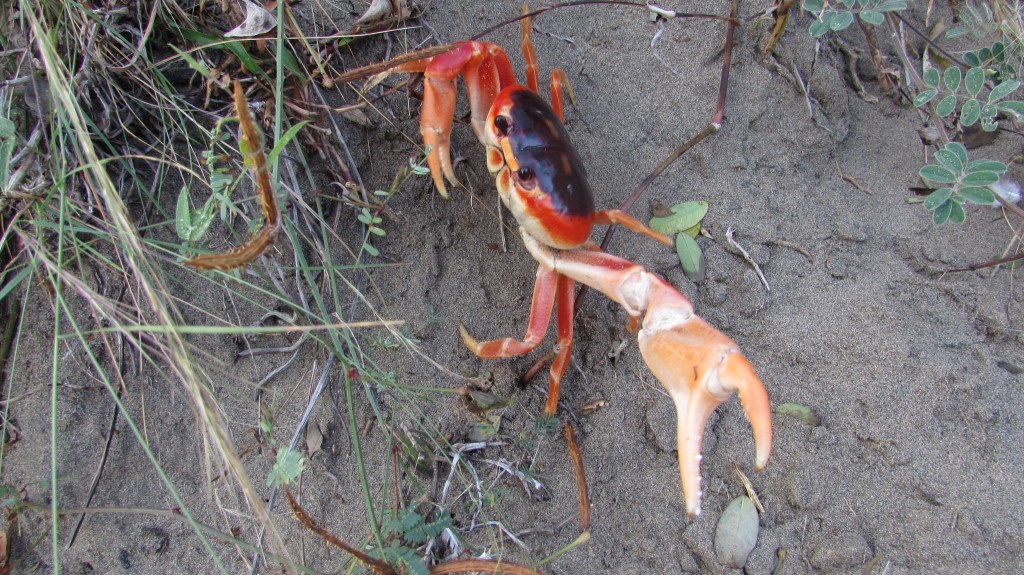
The little land crab stands right in the road,
Waving his big red claw.
Almost hit by a car rushing past –
Another, then one more.
The little crab stands fearless and alone,
He just won’t back away
And all the other crabs beside the road
Call out “¡Olé! ¡Olé!”

*****

This little poem was recently published in Rue Scribe, “an online journal for small literature”. Thanks, Eric Luthi!

We’re just coming up to the time of year when there are big crabs crawling in the bush (and getting taken by people for food), followed by lots of little crabs crossing the road (and the ones that get hit by cars becoming food for birds).

Photo: “bermuda land crab, blackback land crab, black land crab, common land crab, orange halloweenkrabbe, red land crab, rote landkrabbe, schwarze landkrabbe” by La Mancha en Movimiento is licensed under CC BY-NC 4.0.

Richard Fleming, ‘Sunset’

At sunset he ascends the crooked hill
to ruminate on times past and to weep
for friends long dead and lost friends living still.
Each time he climbs this hill it grows more steep.

A day’s end is somehow akin to death
as time bleeds out and cannot be revived.
He stands on the hill’s summit, out of breath
and wonders how on earth he has contrived

to be the last survivor of his peers,
avoided heart attack or foul disease.
The red sky is a bonfire of his years.
Pure luck, the answer whispers in the breeze.

*****

Richard Fleming is an Irish-born poet (and humorist) currently living in Guernsey, a small island midway between Britain and France. His work has appeared in various magazines, most recently Snakeskin, Bewildering Stories, Lighten Up Online, the Taj Mahal Review and the Potcake Chapbook ‘Lost Love’, and has been broadcast on BBC radio. He has performed at several literary festivals and his latest collection of verse, Stone Witness, features the titular poem commissioned by the BBC for National Poetry Day. He writes in various genres and can be found at www.redhandwriter.blogspot.com or Facebook https://www.facebook.com/richard.fleming.92102564/

Photo: Richard Fleming post

Susan McLean, ‘Anagram: A Pallor, An Edge’

Late at night, I saw a glowing,
as if realms beyond our knowing
kindly solace were bestowing.
Could this phantom be my wife?
 
But the gleam, as I drew nearer,
taking form and growing clearer,
was my visage in the mirror,
and the figure held a knife.
 
“Fool,” said I, “your idle dreaming
on some insubstantial seeming
is some demon’s way of scheming
to mislead your soul to hell.

“Melancholy, doom-and-glooming,
pining, horror, guilt, exhuming,
Nevermore and Ulalume-ing –
write your angst out: that could sell.”

*****

Susan McLean writes: “This poem was inspired by a 2019 competition at The Spectator to write a poem in the style of a famous author and to have its title be an anagram of the poet’s name. I was a big fan of the poetry and short stories of Edgar Allan Poe when I was a teen, so I investigated words that I could draw from his name that would have strong associations with his work. Poe married his thirteen-year-old cousin, Virginia Clemm, who died of tuberculosis eleven years later. Many of his poems and stories concern mourning for the death of a beautiful woman, including his most famous poem, “The Raven.” This poem borrows the trochaic meter and some elements of the rhyme scheme of that poem. It also alludes to a number of Poe’s favorite themes, and echoes some of his lines. It was not among the winners at The Spectator, but I later reworked it, and it recently appeared in Lighten Up Online.”

Susan McLean has two books of poetry, The Best Disguise and The Whetstone Misses the Knife, and one book of translations of Martial, Selected Epigrams. Her poems have appeared in Light, Lighten Up Online, Measure, Able Muse, and elsewhere. She lives in Iowa City, Iowa.
https://www.pw.org/content/susan_mclean

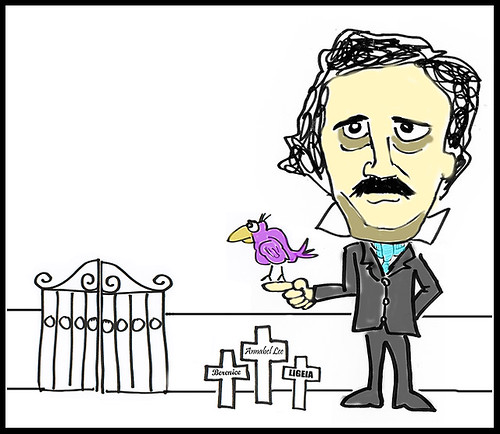
Edgar Allan Poe (ilustración off topic)” by El Humilde Fotero del Pánico is licensed under CC BY-NC 2.0.
Weekend read and listen: RHL, 3 audio + text poems

iamb – poetry seen and heard” is the creation of Mark Antony Owen, showcasing poets with their readings of three of their poems. Begun in 2021, Mark describes his project as “part library of poets, part quarterly journal, iamb is where established and emerging talents are showcased side by side. Not just their words, but their readings of them. Expect new poems, every three months, free to your device of choice.”

Accompanied by an out-of-date photograph, three of my poems are available here. They are not among my most recent work, but they are favourites and I chose them for their very different moods, themes, and forms: ‘Camelot at Dusk’, ‘Old Sailors’, and ‘This Ape I Am’. And their use of form sets them apart from all the other poems in this 21st ‘wave’ of iamb. I can’t decide if I am stuck in the past, or write in the style of the only verse that has a chance of being remembered in 100 years. But maybe that’s not an either/or – maybe only verse that is rooted in the historical rhythms of the language will last. So I suspect.

Auditions will reopen in September for next year’s waves.