Monthly Archives: April 2025

Michael R. Burch, ‘Funding Fundamentals’

“I found out that I was a Christian for revenue only and I could not bear the thought of that, it was so ignoble.” — Mark Twain

Making sense from nonsense is quite sensible! Suppose
you’re running low on moolah, need some cash to paint your toes …
Just invent a new religion; claim it saves lost souls from hell;
have the converts write you checks; take major debit cards as well;
take MasterCard and Visa and good-as-gold Amex;
hell, lend and charge them interest, whether payday loan or flex.
Thus out of perfect nonsense, glittery ores of this great mine,
you’ll earn an easy living and your toes will truly shine!

*****

Originally published by Lighten Up Online. NOTE: A flex loan is a payday loan with a “personal line of credit” that makes it even harder to pay off than traditional payday loans. Caveat emptor.

Michael R. Burch writes: “Living in allegedly ‘Christian America’ where 80% of evangelicals voted for the Antichrist Trump, I am forced to resort to foxhole humor. ‘Funding Fundamentals’ is tongue-in-cheek foxhole humor, but I think we would be better off forming our own religions than donating money to false profits like the bible-hawking Trump and his cronies.”

Michael R. Burch’s poems have been published by hundreds of literary journals, taught in high schools and colleges, translated into 22 languages, incorporated into three plays and four operas, and set to music, from swamp blues to classical, 61 times by 32 composers. He is also the founder and editor-in-chief of The HyperTexts.

Ruth S. Baker, ‘Moneykind’

That kind of money is swishy and flashy.
That kind of money’s a bore, I find;
That kind of money is fishy and splashy.
That kind of money is not my kind.

My kind of money is somewhat quieter.
My kind of money won’t hog the stage.
My kind of money’s a long-term dieter:
My kind of money is slim for its age.

That kind of money is horribly tethering.
That kind of money one’s better without.
My kind of money’s enough for anything.
(Anything more I’ve forgotten about.)  

*****

‘Moneykind’ was originally published in The Asses of Parnassus. Ruth S. Baker writes: “It was triggered really just by catching myself out trying to feel superior to people with that kind of money!  As for bio, I’ve published in a few journals on line, mostly on animals and visual art.”

Photo: “Cooperate game companies have too much money and control of the market” by The People Speak is licensed under CC BY-NC 2.0.

Brooke Clark, ‘Letter from an Unknown Writer’

We met one night at a book launch,
we drank, we talked, we laughed,
I said, “I’m writing a novel,”
and you said, “Send me a draft.”

So I sent it to your address
hoping a well-placed word
from you would get me started;
I waited, but never heard.

Now you’ve published your latest
and the critics fellate you in print,
it’s a runaway bestseller
and Hollywood’s taken the hint.

I read it myself last weekend
and my entrails turned to stone—
my book, but so badly rewritten
you’d almost made it your own.

*****

Brooke Clark writes: “This two-liner by Martial (Epigrams I.38) is the basis of my poem:
quem recitas meus est, o Fidentine, libellus:
sed male cum recitas, incipit esse tuus.
(The book you’re reciting is mine, Fidentinus; but when you recite it badly, it begins to be yours.)
Originally read in Wheelock’s Latin, I think, when I was learning the language, this was one of the first versions of Martial I did that I was happy with. I obviously expanded it greatly (I hadn’t learned to appreciate Martial’s concision) but I liked the swingy rhythm and the treatment of it as a mini-narrative that I landed on. Also one of the first epigrams I published, in Light, which gave me some confidence that the project of turning ancient epigrams into contemporary poems might be worth pursuing.”

Brooke Clark is the author of the poetry collection Urbanities and has published work in ArionLiterary ImaginationTHINKThe WalrusLA Review of Books, and other places. He is also the editor of the online epigrams journal The Asses of Parnassus and the book reviews editor at Able Muse.
Twitter: @thatbrookeclark
Bluesky: @brookeclark.bsky.social

Photo: “Treasures of Ushaw Book Launch in Westminster” by Catholic Church (England and Wales) is licensed under CC BY-NC-SA 2.0.

Political poem: Janet Kenny, ‘Broken’

The pig smashed the music
and turned off the sun.
As the pig couldn’t use it
nor should anyone.

O remember the time when the violins played
and the meadows were blooming and we, unafraid
dared to splash in the river and lie in the grass.
But they’re mowing the field now and scattering glass.

The mother in China,
the daughter in Spain,
must learn to design a
new habit again.

The athletes are anxious, the singers are dumb,
the children are fractious and calling for Mum.
Now Dad is in futures and selling his shares
and his foreign computers are yesterday’s wares.

Who let the pig loose
in the garden? and why
have we cooked our own goose?
I await a reply.

*****

This poem was originally published on Facebook. Concerning the trigger for creating it, Janet Kenny writes: “The only event was the world economy being interfered with by the folly of one awful man. One ignorant bully can dismantle the world.”

Janet Kenny left New Zealand to pursue a career as an operatic and concert singer in London, then settled in Sydney, Australia, where she worked in the anti-nuclear movement and jointly compiled, wrote and edited a book about the nuclear industry, Beyond Chernobyl, published by Envirobook in 1993.

Her poems have been published in printed and online journals, including AvatarThe ChimaeraFolly14 by 14Iambs & TrocheesThe Literary ReviewMi PoesiasThe GuardianThe SpectatorThe New FormalistThe Barefoot MuseThe Raintown ReviewThe Shit Creek ReviewSnakeskinLavender ReviewSoundz ineVictorian Violet PressThe Susquehanna Quarterly and Umbrella. Her work is in the collections The Book of Hope and Filled With Breath: 30 sonnets by 30 poets and in the Outer Space anthology, Cambridge University Press. She shared an anthology of bird poems, Passing Through, with Jerry H. Jenkins. She has received three Pushcart nominations.

Her latest book, Whistling in the Dark (2016, Kelsay Books) can be ordered from https://www.amazon.com/Whistling-Dark-Janet-Kenny/dp/1945752092. Her previous book, This Way to the Exit (White Violet Press), can be ordered from http://www.amazon.com/This-Way-Exit-Janet-Kenny/dp/0615615937. You can read several poems from her books at https://janetkenny.netpublish.net/

Photo: “Pig-hog” by Kusukhtak is licensed under CC BY 3.0.

Using form: Couplets/Sonnet: Gail White, ‘Prayer Updated’

To Anyone who still may be
attentive from Infinity,
we bless you from our dot in space
and thank you for our privileged place.

Give us this day on which to feed
a bit more gluten than we need,
and when we’re adequately fed,
help us to get and stay ahead
and save for our retirement
enough plus twenty-five per cent.

May old age find us cheerful still,
our life in order like our will,
with neither pain nor care nor debt.
Thy kingdom come, but not just yet.

*****

Gail White writes: “Religion and irony are not incompatible I find that a good deal of poetry comes from taking a speculative or questioning view of Bible stories (e.g, how did Adam and Eve react to the murder of Abel by Cain? We don’t hear a peep out of them about it.) And I’ve often said that if God hadn’t wanted at least one cynical feminist poet, I wouldn’t exist.”

‘Prayer Updated’ was published in the current issue of Lighten Up Online.

Gail White is the resident poet and cat lady of Breaux Bridge, Louisiana. Her books ASPERITY STREET and CATECHISM and the chapbook SONNETS IN A HOSTILE WORLD are available on Amazon. She is a contributing editor to Light Poetry Magazine. “Tourist in India” won the Howard Nemerov Sonnet Award for 2013. Her poems have appeared in the Potcake Chapbooks ‘Tourists and Cannibals’, ‘Rogues and Roses’, ‘Families and Other Fiascoes’, ‘Strip Down’ and ‘Lost Love’.

Illustration: “Global Prayer” by thorntonsdigital is licensed under CC BY-ND 2.0.

Tom Vaughan: ‘Is This It?’

Well if it is, and this is it
then what will be will be
and time will toil and time will tell
if there’s a guarantee

that at the least and at the last
the daily here and now
which now and here are thick as thieves
will be transformed, somehow

and either way, here’s my advice –
lie back and think of all
the ups which came between the downs
before your curtain call.

*****

Tom Vaughan writes: “There was no particular trigger for this poem, apart from my fitful attempts to be Stoical about the state – and weirdness – of the world. But just at the moment the anger occasioned by the former keeps breaking through.”

‘Is This It?’ was published in the current Lighten Up Online.

Tom Vaughan is not the real name of a poet whose previous publications include a novel and three poetry pamphlets (A Sampler, 2010, and Envoy, 2013, both published by HappenStance; and Just a Minute, 2024, from Cyberwit). His poems have been published in a range of poetry magazines, including several of the Potcake Chapbooks and frequently in Snakeskin and Lighten Up Online. He currently lives in Brittany.
https://tomvaughan.website

Photo: “man-relaxing-in-the-grass_8954-480×359” by Public Domain Photos is licensed under CC BY 2.0.

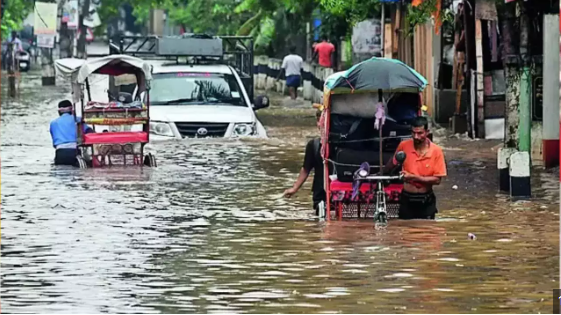
Shamik Banerjee, ‘Memories of a Flood’

For one full week, the sun was dead,
     unloosening the gray,
wild clouds that swamped each paddy bed—
     the plowman’s great dismay.

The regal night sky, once agleam,
     was purloined of its stars.
Each lane became a water stream.
     Dinghies replaced the cars.

Mazdoors, waist-hidden, waded to
     their distant factory sites.
The Tongas‘ (since they were a few)
     demand reached greater heights.

But our town did what it does best—
     it kept the hoo-ha going.
In every church and temple’s chest,
     hope’s candles were still glowing.

On the roadside estaminets,
     sports went with malt whisky,
and there were pleasant tête-à-têtes
     on every balcony.


Mazdoor: an unskilled labourer
Tonga: a light horse-drawn two-wheeled vehicle
‘Memories of a Flood’ was first published in the San Antonio Review..

Shamik Banerjee is a poet from Assam, India. Some of his recent publications include Spelt, Ink Sweat & Tears, St. Austin Review, Modern Reformation, San Antonio Review, The Society of Classical Poets, Third Wednesday, California Quarterly, and Amethyst Review, among others.

Photo: Times of India, July 5, 2024