So, to be fair: the AI doesn’t care. Drop your intransigence; forget belligerence: the universe just wants intelligence. Be glad amoebas, dinosaurs, don’t take pride of place; they were supplanted by the human race… but we are clearly not the end. Be glad we’ve helped the next in line ascend.
Those who strive may fail; those with no drive may still prevail. So just enjoy the view… let AI keep us as their little zoo.
*****
Happy New Year! May your life be enjoyable as well as interesting, as we move into the ever more rapidly evolving future.
‘When AI Rules’ was first published in Bewildering Stories. Thanks, Don Webb and John Stocks.
Look at all the work the universe has done. It makes the most of ordinary light from new moon to full moon, from sun to setting sun.
It does the work of all the worlds rolled up into one mind-boggling miracle of space and time and light. Look at all the work the universe has done.
Will we ever know for certain how the universe was begun? Will we ever learn the reason for all this lovely light from new moon to full moon, from sun to setting sun?
Much of what we think we see, we know in fact is gone. Stars do die out long before we catch their traveling light. Look at all the work the universe has done.
Now look at all the works of man, the wealth of our creation. There are still no substitutes for heat and light… from new moon to full moon, from sun to setting sun.
I’m ready to quit my day jobs now; to leave them, one by one. All I want is to make the most of ordinary light, to look at all the work the universe has done from new moon to full moon, from sun to setting sun.
***
Peggy Landsman writes: “I had been up all one long winter night with a group of friends in Buffalo, NY, in the mid-1970s. At one point, sitting around the kitchen table, I suddenly noticed daylight coming through the window. I had a moment of epiphany and blurted out: “Look at all the work the universe has just done!” After I went home and got some sleep, I started the work of writing the poem.”
“Light Villanelle” was first published in a now defunct online journal, Bringing Sonnets Back.
Peggy Landsman is the author of the full-length poetry collection, Too Much World, Not Enough Chocolate (Nightingale & Sparrow Press, 2024), and two poetry chapbooks: Our Words, Our Worlds (Kelsay Books, 2021) and To-wit To-woo (Foothills Publishing, 2008). She lives in South Florida within a short drive of a good library and a beautiful beach. A selection of her online publications is available on her website: peggylandsman.wordpress.com
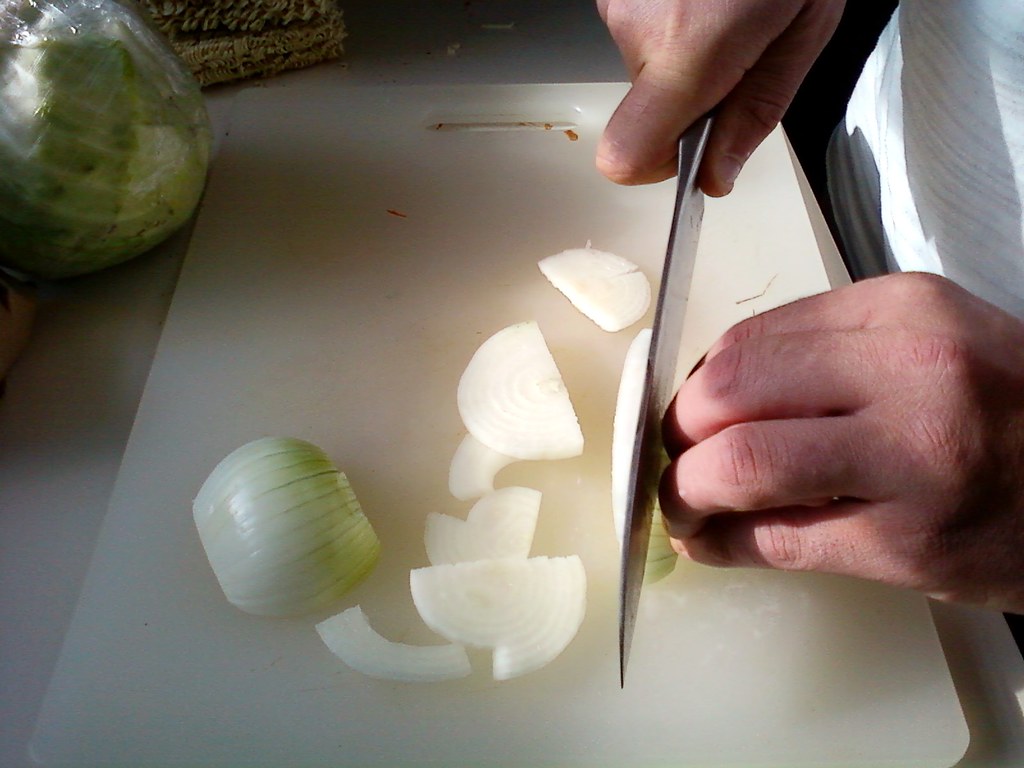
Do you have a poem for an old man making chili for lunch? Like watery eyes from onion crunching–sneezing from pepper thrown… email from Dad 5/5/05
He shoves the onion pieces in a pile to one side as he chops and chops some more. This cutting board has lasted quite a while through salty tears of choppers gone before, but no use buying new equipment now. Sometimes there’s comfort in a kitchenette that holds what downsized spaces will allow of former habits. He will not forget those other hands that held this knife and chopped for slaw and meatloaf, casseroles and stew, and apple walnut salad. When they stopped, he stepped up, making chili, making do, sneezing on pepper, living on his own. He cooks for one, but never eats alone.
*****
Barbara Loots writes: “Almost any story can be told in the compass of a sonnet. This one became an elegy cooked up in the mundane of a real moment.”
This sonnet was collected in ‘Road Trip’ (Kelsay Books, 2014)
After decades of publishing her poems, Barbara Loots has laurels to rest on, but keeps climbing. The recent gathering at Poetry by the Sea in Connecticut inspired fresh enthusiasm. Residing in Kansas City, Missouri, Barbara and her husband Bill Dickinson are pleased to welcome into the household a charming tuxedo kitty named Miss Jane Austen, in honor of the 250th birthday year of that immortal. She has new work coming in The Lyric, in the anthology The Shining Years II, and elsewhere. She serves as the Review editor for Light Poetry Magazine (see the Guidelines at lightpoetrymagazine.com)
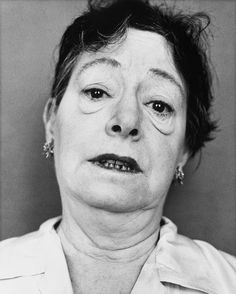
When I was young and bold and strong, Oh, right was right, and wrong was wrong! My plume on high, my flag unfurled, I rode away to right the world. “Come out, you dogs, and fight!” said I, And wept there was but once to die.
But I am old; and good and bad Are woven in a crazy plaid. I sit and say, “The world is so; And he is wise who lets it go. A battle lost, a battle won– The difference is small, my son.”
Inertia rides and riddles me; The which is called Philosophy.
*****
Dorothy Parker (August 22, 1893 – June 7, 1967). The source of innumerable witty, caustic poems and quotable squibs. Her philosophical stance is one of Cynicism and Idealism; Socialism, Feminism and Civil Rights; and Literary American Modernism. She was wonderful.
It matters to me, much more than it should, that drinking glasses stand sorted by size, that bowls are neatly nested, that my good dessert plates sparkle in their stack. The prize that perfect order grants is hard to name. It isn’t peace, exactly, but a sort of temporary triumph in a game that never ends, played not on field or court but on these shelves, a three-dimensional ungridded Scrabble board where dishes make the words, unspellable but meaningful; a plate misplaced means an unsettling break in symmetry and sense. Neatness may not win much, but there are times it’s all I’ve got.
*****
Jean L. Kreiling is the author of four collections of poetry, most recently Home and Away (2025). Her work has been awarded the Able Muse Book Award, the Frost Farm Prize, the Rhina Espaillat Poetry Prize, and the Kim Bridgford Memorial Sonnet Prize, among other honors.
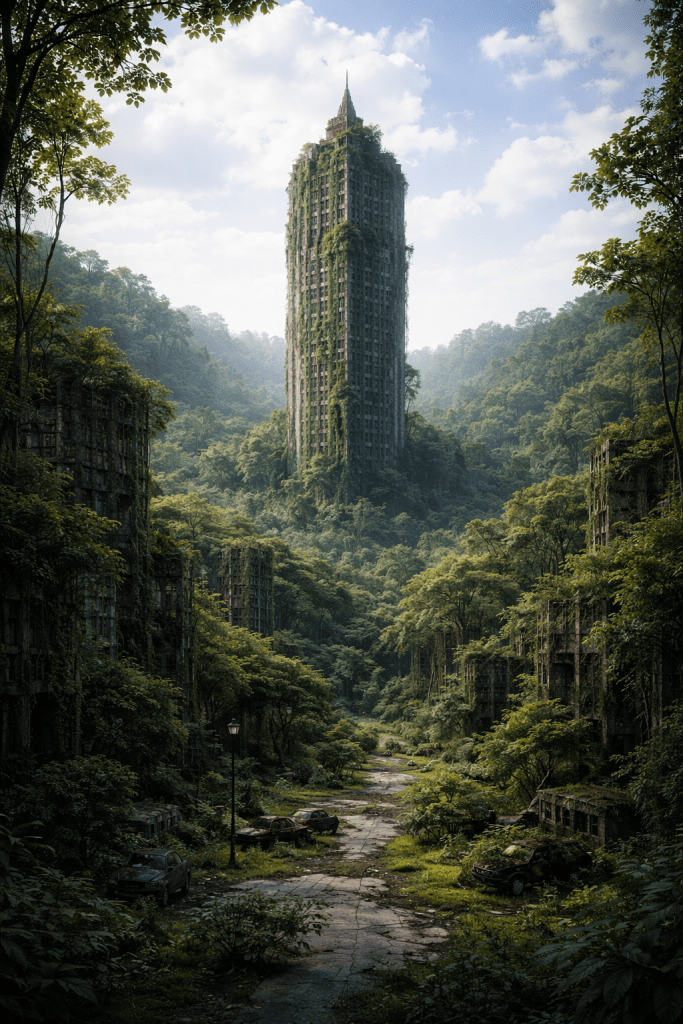
When The End came, it was not the end– it never is; the universe continues. The millions died; I stand alone, no friend; alone, but healthy in my bones and sinews. One keeps on, staunchly, soldierly at post, your day-to-day as other days have been… though the past world (or you) is just a ghost, a relic, fragment, hint, more felt than seen. I’ve lived beyond my time; my world has gone, my car-charged streets, my teeming meeting rooms, the close-packed skyline-scrapers now redrawn as nascent forest, trees standing as tombs where flocks of birds replace friends whose lives fled, with ghostly unseen me alone not dead.
*****
‘Last Building Standing’ is a Shakespearean sonnet, first published by The Orchards Poetry Journal. The Winter 2025 issue is now live on Amazon, as well as the Kelsay Books website.
Night-train noises, muffled and low, nights when the Northern Limited left. Midnights, we’d hear its strange chord blow, a distant dissonance, treble-cleft. Languid in summer, dulled in snow, it spoke to me calmly: Trust and rest. The night world works on a steady clock. The barges ride on the river’s crest; at port in Duluth, the grain ships dock, and a streetlamp lit at the end of the block looks in at the window’s blind from the west–
I never learned: Did the schedule skew departure times into daylight hours, or did neighbors grouse, as neighbors do, that living close to a loud sound sours tempers and lives? I never knew, but it’s not there now, though we still see track. The freeway sound and the freeway grime color the nights. The snow turns black, and the block club frets over rising crime, and the sweet illusion of changeless time, though I wish for it fiercely, will not come back.
*****
Maryann Corbett writes: “When I wrote this poem, I was still participating on online poetry boards. I recall that there was a certain amount of argument about what a train–horn or whistle?–actually sounds like. The disappearance of the nightly sound has, in fact, a prosaic explanation: the schedule did change, and the station itself was moved to a downtown location. The name of the train route is fictional, chosen for alliterative purposes.”
‘Lament for the Midnight Train’ was first published in The Times (UK, online); appeared in the chapbook ‘Dissonance’; and is collected in ‘Street View’.
Maryann Corbett earned a doctorate in English from the University of Minnesota in 1981 and expected to be teaching Beowulf and Chaucer and the history of the English language. Instead, she spent almost thirty-five years working for the Office of the Revisor of Statutes of the Minnesota Legislature, helping attorneys to write in plain English and coordinating the creation of finding aids for the law. She returned to writing poetry after thirty years away from the craft in 2005 and is now the author of two chapbooks and six full-length collections, most recently The O in the Air (Franciscan U. Press, 2023). Her work has won the Willis Barnstone Translation Prize and the Richard Wilbur Award, has appeared in many journals on both sides of the Atlantic, and is included in anthologies like Measure for Measure: An Anthology of Poetic Meters and The Best American Poetry.
Melissa Balmain’s third poetry collection, Satan Talks to His Therapist, is available from Paul Dry Books (and from all the usual retail empires). Balmain is the editor-in-chief of Light, America’s longest-running journal of comic verse, and has been a member of the University of Rochester’s English Department since 2010.
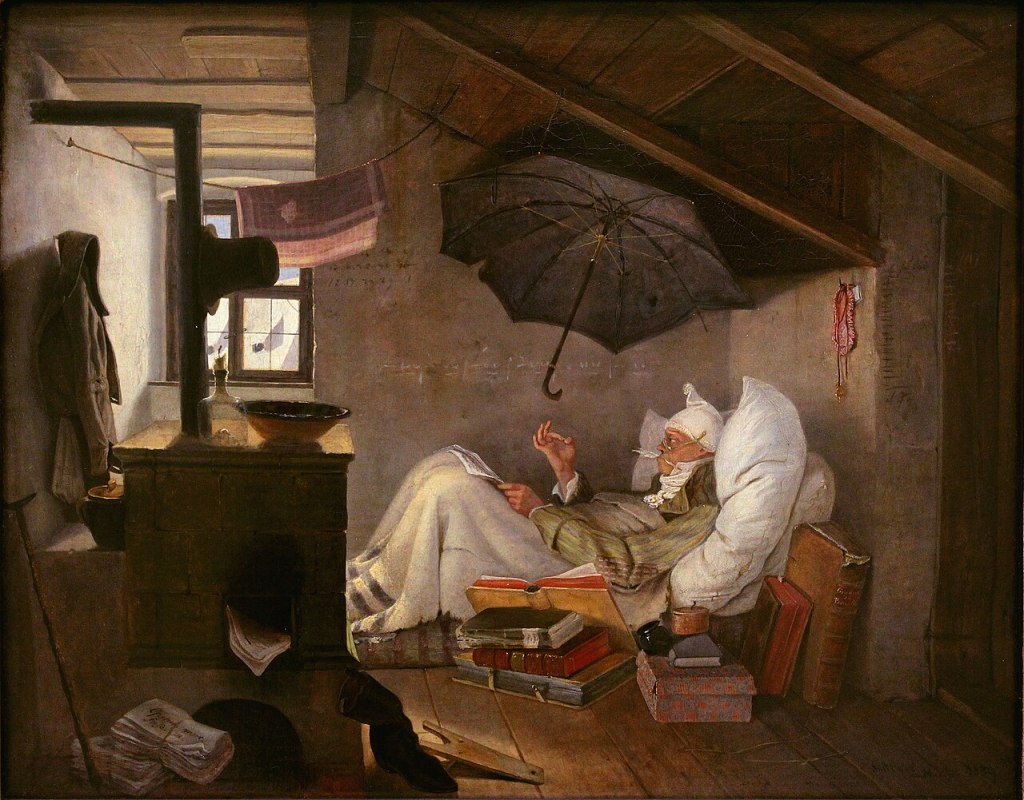
Der Arme Poet (best-known painting by Carl Spitzweg, 1839)
If only I can hatch a heartfelt rhyme, (with thought and frowns, it can’t be very hard), I’ll take my rightful place with the sublime.
O, gradus ad parnassum. One quick climb. I’ll be crème de la crème and avant-garde, if only I can hatch a heartfelt rhyme.
Top hat, cravat and walking stick meantime are ready—attributes to reap regard. I’ll take my rightful place with the sublime.
No more damp attic life; no fleas or grime. My poem will be perfection—a petard! If only I can hatch a heartfelt rhyme.
My peers will shout, “Alors, a paradigm! Such lofty wit, a wise camelopard.“ I’ll take my rightful place with the sublime.
I bite my quill: crime, slime, Mülheim, enzyme. The world will bow, salute and call me bard. If only I can hatch a heartfelt rhyme, I’ll take my rightful place with the sublime.
*****
Janice D.Soderling writes: “This poem is ekphrastic, generated from a preceding work of art. “About the mysterious motor that generates, I can say little. But no composer, artist, poet, sculptor works ex nihilo. Earliest man, woman, looked at their handprint, their footprint, and a thought rose, an urge to express what they felt – a primitive fear of death perhaps – and off they went to the caves to imprint their hand, or to carve a footprint on the rockface by the sea. A shout-out that Kilroy was here. “We hear music in the babbling brook, in the sighing wind, in the raindrop falling from leaf to leaf and plopping into the puddle below. There is poetry in the emotive sounds we make and hear: tinkling laughter, cooing seduction, growling rage, keening sorrow, barking grief. Of such, language is made; of language Shakespeare made Sonnet 73. “All art is imitation, from birdsong to a symphony orchestra, from the walking stride to the metrical verse. All art is a denial of death. Even the comic art.“
Janice D. Soderling is an American–Swedish writer who lives in a small Swedish village. Over the years, she has published hundreds of poems, flash and fiction, most recently at Mezzo Cammin, Eclectica, Lothlorien Poetry Journal and Tipton Poetry Journal. Collections issued in 2025 are The Women Come and Go, Talking (poems) and Our Lives Were Supposed to Be Different (short stories).
‘The Poor Poet’ was originally published in American Arts Quarterly, and republished in the current Well Met, where links at the bottom will take you to other poets in the issue.
Pic credit: Carl Spitzweg, The Poor Poet (via Wikipedia)
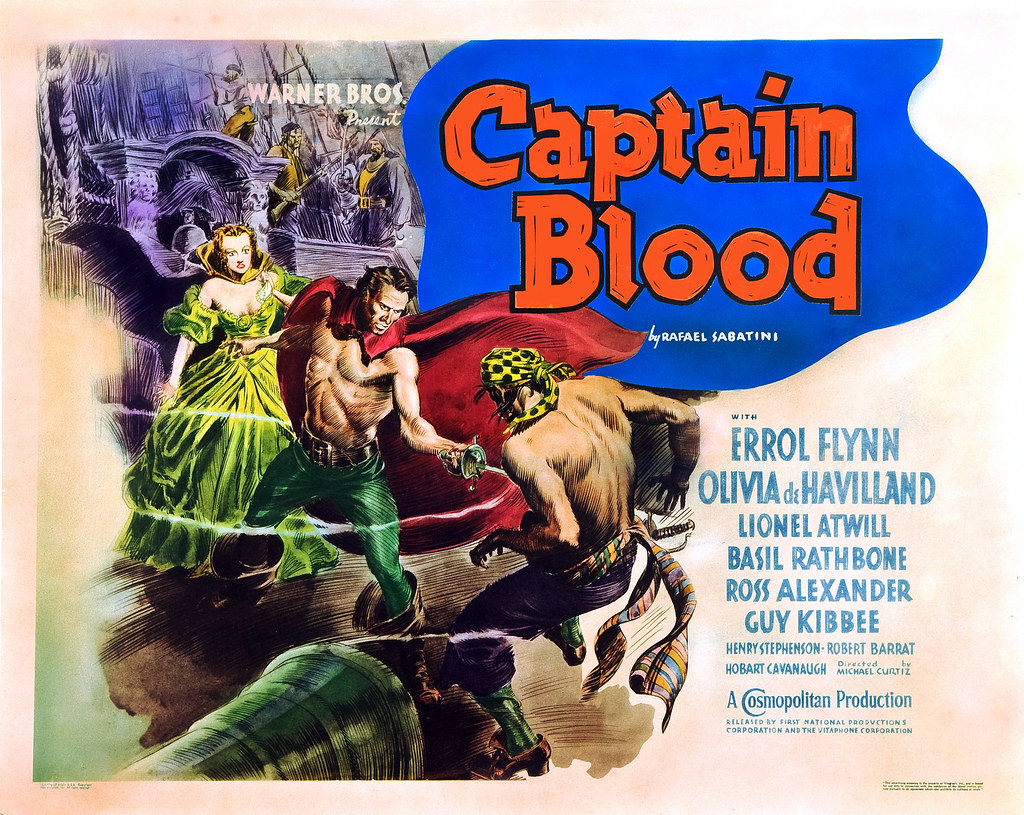
I have never in my lives Met a girl named Arabella – Captain Blood, the lucky fella, Took them all to be his wives.
I have never been reborn As a pirate quartermaster – Long John Silver, lucky bastard, Shouldered me aside with scorn.
I had never – strange but true – Had a chance to rape and pillage; Takes a crew to burn a village, Takes much gold to get that crew.
So for now let’s all enjoy Cold and wet northeastern snow, How and why – we’ll never know… Yahrr, my mates, and chips ahoy.
*****
Vadim Kagan writes: “We were visiting BVI, and I had this wonderful morning ritual – walking along the beach to the coffee shop, and then dragging a beack chair to the water so that my feet were in the surf… and coming up with a poem or two watching the sun rise and the clouds change colors. Since childhood I’ve been a huge fan of Rafael Sabatini’s “Captain Blood” novels, so the first two lines just happened, and then the rest kinda followed. I think back home the forecast called for snow that day, so the contrast was again already there for me to make use of.”
Vadim Kagan writes poetry and prose in English and Russian. Vadim’s poems, bringing together traditions of Russian and English metered verse, have been put to music and performed by local and international artists. His poems have been published in The Lyric, Founders Favorites, The Road Not Taken, the Lost Love chapbook and recently in the Maryland Bards Poetry Review 2025. Vadim lives in Bethesda, MD, where he runs an AI company providing advanced technology capabilities to Fortune 500 companies and government agencies.




 Form in Formless Times