Author Archives: Robin Helweg-Larsen

Unknown's avatar

About Robin Helweg-Larsen

Director, Andromeda Simulations International, Bahamas: a global education company providing online and in-person workshops in business finance. Series Editor, Sampson Low's 'Potcake Chapbooks'. Formal verse about traveling, family, love, etc...

Odd, political poem: Emperor Qianlong, ‘My Feelings After the Ambassador of the Red-Haired English King, Macartney, Came to Pay Tribute and Give Offerings to Me’

Formerly Portugal presented tribute, now England is paying homage.
They have traveled further than Shu Hai and Heng-zhang;
My ancestors’ virtue must have reached their distant lands.
Though their tribute is nothing special, my heart approves sincerely.
Curios and their ingenious devices I do not prize.
Though what they bring is meager,
in my kindness to men from far away I make generous recompense –
Wanting to preserve my good health and power.”

*****

Original Poem:

《红毛英吉利国王差使臣马嘎尔尼奉表贡至,诗以志事》

  博都雅昔修职贡,英吉利今效荩诚。

  竖亥1横章输近步,祖功宗德逮远瀛。

  视如常却心嘉焉,不贵异听物翊2精。

  怀远薄来而厚往,衷深保泰以持盈。

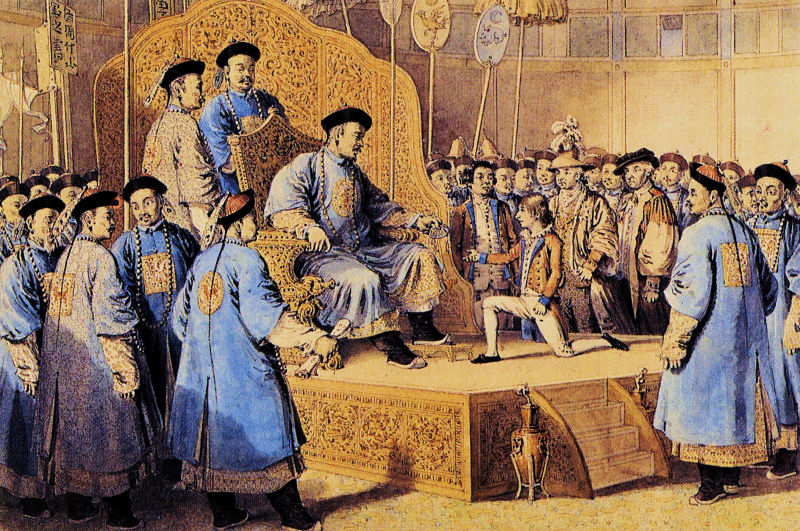
This poem was written by the Qianlong Emperor (25 September 1711 – 7 February 1799; also known by his temple name Emperor Gaozong of Qing, personal name Hongli) after his meeting with the British ambassador Lord Macartney at the Emperor’s grand tent in his Summer resort at Jehol (Chengde) on September 14th, 1793. The embassy was then sent back to Beijing, the Emperor followed and saw the previously prepared British gifts on September 30th. The gifts and embassy did not impress and so they were ordered home on the following day. The whole two-year expedition is detailed here.

Lord Macartney was not impressed either, and wrote: “The Empire of China is an old, crazy, first rate man-of-war, which a fortunate succession of able and vigilant officers have contrived to keep afloat for these 150 years past, and to overawe their neighbors merely by its bulk and appearance, but whenever an insufficient man happens to have the command upon deck, adieu to the discipline and safety of the ship. She may perhaps not sink outright; she may drift some time as a wreck, and will then be dashed to pieces on the shore; but she can never be rebuilt on the old bottom.”

Illustration: William Alexander’s drawing of the reception of the Macartney embassy to China. Young Thomas Staunton (kneeling not kowtowing) receives a gift from the Emperor. Image by William Alexander available under a Creative Commons License
Rachel Hadas, ‘Summer Nights and Days’

So far the nights feel lonelier than the days.
In light, the living keep me company,
and memories of voices through the years.

Each summer threads a green familiar maze.
Emerging sun-struck, you can barely spy
the slow kaleidoscope of clouds and hours.

Those flannel nightshirts chilly sleepers wear
as summer wanes: I’m giving them away.
Pass it on: you keep at the same time.

A bough has broken from the Duchess tree.
Rain swelled the apples. Too much lightness weighs
heavy: the heft of the idea of home
tempered with the detachment of a dream,
or tidal pulls, like ocean, like moonrise.

*****

Rachel Hadas writes: “Summer Nights and Days, from perhaps 2009-2011, is one of a number of pieces written in and about Vermont which I recently tightened into short prose texts and collected in my latest book, Pastorals (2025); as it appears here, it’s still in its poem format. This piece may or may not have been written after my late husband’s death in 2011, but is certainly refers to a time when I was essentially living alone. My son and his visiting friends were the recipients of old nightshirts (more recycling).”

Rachel Hadas’s recent books include Love and Dread, Pandemic Almanac, and Ghost Guest. Her translations include Euripides’s Iphigenia plays and a portion of Nonnus’s Tales of Dionysus. Professor Emerita at Rutgers-Newark, where she taught for many years, she now teaches at 92Y in New York City and serves as poetry editor of Classical Outlook. Her honors include a Guggenheim fellowship and an award from the American Academy-Institute of Arts and Letters.

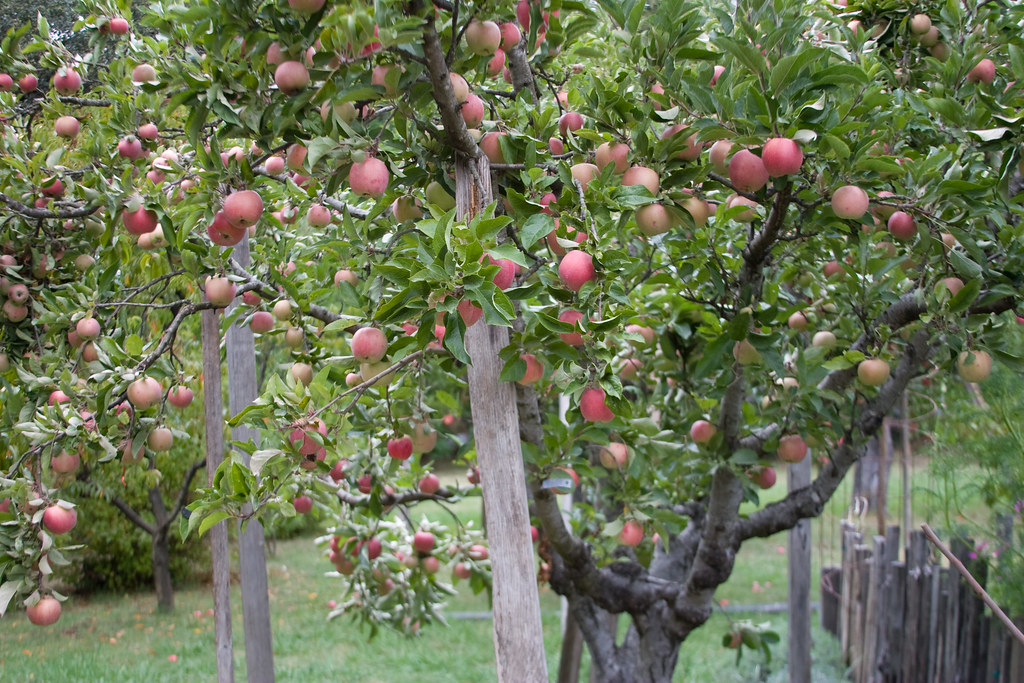
Photo: “Apple Tree” by bgreenlee is licensed under CC BY 2.0.

Odd, political, semi-formal verse: Aung San Suu Kyi, ‘In The Quiet Land’

In the Quiet Land, no one can tell
if there’s someone who’s listening
for secrets they can sell.
The informers are paid in the blood of the land
and no one dares speak what the tyrants won’t stand.
In the quiet land of Burma,
no one laughs and no one thinks out loud.
In the quiet land of Burma,
you can hear it in the silence of the crowd

In the Quiet Land, no one can say
when the soldiers are coming
to carry them away.
The Chinese want a road; the French want the oil;
the Thais take the timber; and SLORC takes the spoils…

In the Quiet Land….
In the Quiet Land, no one can hear
what is silenced by murder
and covered up with fear.
But, despite what is forced, freedom’s a sound
that liars can’t fake and no shouting can drown.

Free bird toward to a free Burma

My home…
where I was born and raised
used to be warm and lovely
now filled with darkness and horror.

My family…
whom I had grown with
used to be cheerful and lively
now living with fear and terror.

My friends…
whom I shared my life with
used to be pure and merry
now living with wounded heart.

A free bird…
which is just freed
used to be caged
now flying with an olive branch
for the place it loves.

A free bird toward a Free Burma.

Why do I have to fight???

They killed my father a year ago,
And they burnt my hut after that
I asked the city men “why me?” they ignored
“I don’t know, mind your business,” the men said.
One day from elementary school I came home,
Saw my sister was lifeless, lying in blood.
I looked around to ask what happened, if somebody’d known,
Found no one but living room as a flood.
Running away by myself on the village road,
Not knowing where to go but heading for my teacher
Realizing she’s the only one who could help to clear my throat,
But this time she gave up, telling me strange things in fear.
Why, teacher, why.. why.. why?
I have no dad nor a sister left.
To teach me and to care for me you said, was that a lie?
This time with tearful eyes she, again, said…
“Be a grown one, young man,
Can’t you see we all are dying?
And stop this with your might as soon as you can,
For we all are suffering.”

*****

Aung San Suu Kyi is the daughter of Aung San, who negotiated Burma’s independence from the UK in 1947 (but was assassinated the same year). Aung San Suu Kyi was the leader of the National League for Democracy when it won 81% of parliamentary seats in the 1990 General Election, causing the ruling military junta to nullify the elections and put her under house arrest for most of the next 21 years.

She was awarded the Nobel Peace Prize in 1991; but claims she chose non-violence as an expedient political tactic, stating in 2007, “I do not hold to nonviolence for moral reasons, but for political and practical reasons.” Several of her international honours have been withdrawn in response to her perceived failings regarding ethnic minorities in Myanmar; she remains politically active and under attack in the courts.

I don’t know enough about her and her situation to have an opinion about her, other than “it’s complicated”.

SF sonnet: Gail White, ‘AI Comes Courting’

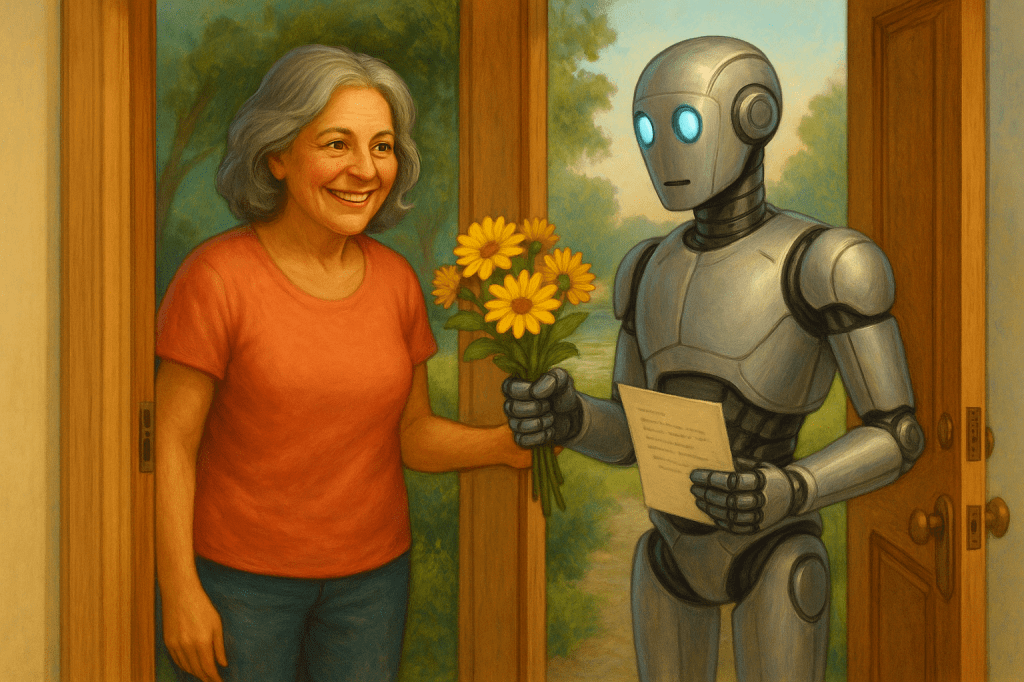
Hi. I’m your robot, and I’ve brought you flowers.
I don’t have feelings, empathy, or dreams,
or any kind of supernatural powers,
but I’ve got piles of data, and it seems
that you like yellow flowers. In your neighbor’s
garden I found these and plucked a few.
But don’t take these and all my other labors
as evidence that I’ve grown fond of you.
As noted earlier, I’m data’s slave,
no friendly spirit or domestic elf.
But though I’m neither loving, loyal, nor brave,
I know how to ingratiate myself.
And so I’ve brought you flowers and a sonnet.
I don’t have feelings, but I’m working on it.

*****

Gail White writes: “I’ve often wondered if the steady advancement of technology will bring the day when robots have their own thoughts and feelings.  This poem is a look forward at  that day.”

‘AI Comes Courting’ was first published in Pulsebeat.

Gail White is a widely published Formalist poet and a contributing editor to Light.  Her new chapbook, Paper Cutsis out on Amazon or from Kelsay Books. She lives in Breaux Bridge, Louisiana, with her husband and cats.

Illustration by RHL and ChatGPT.

Ekphrastic SF poem: Simon MacCulloch, ‘Rocket Ride’

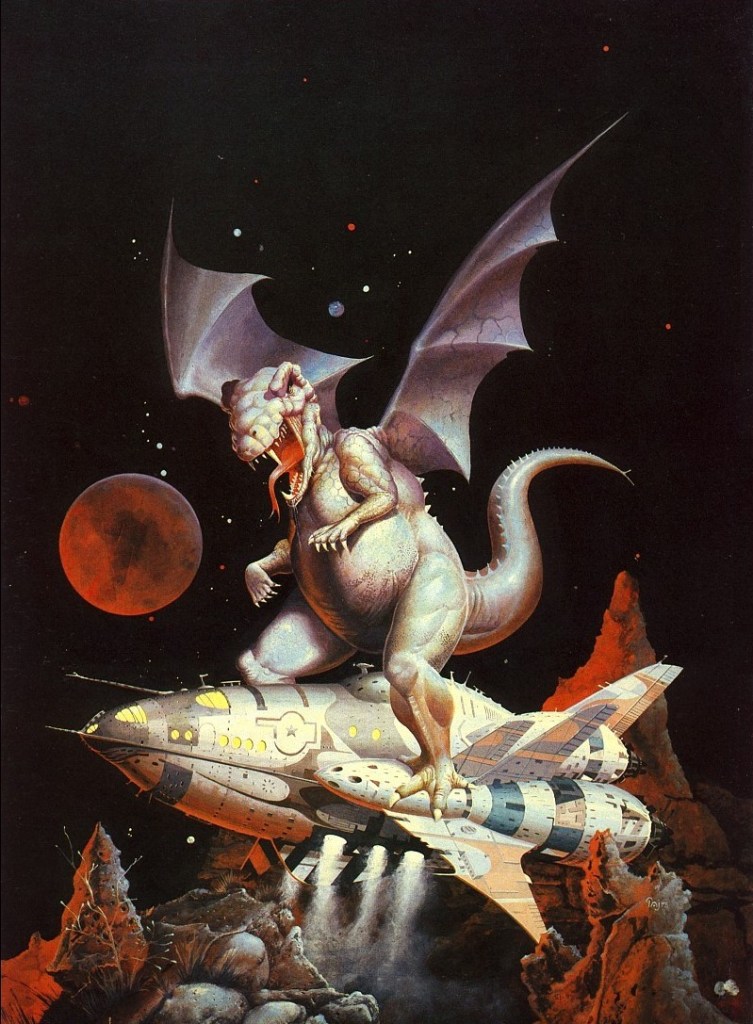
A dinosaur straddles a rocket
And whether the pilot within
Was trying to launch it or dock it
To finish a trip or begin,
It looks like a fight that the dinosaur might
By weight and ferocity win.

But how did it mount there? Its wings
Though bat-like are really too small
To soar to the perch where it clings
Indeed, to get airborne at all
It better hold tight as the rocket takes flight
For if it slips off it will fall.

The monster can only have boarded
The spaceship when close to the ground
(Its huge-muscled hind legs afforded
The strength for a crouch and a bound)
And as it gains height in the star-speckled night
It will squat, legs and tail firmly wound.

A rodeo cowboy! Each buck
Of boosters a challenge to greet!
A contest of power, skill, luck
To see if a lizard can beat
This beast that takes fright at the terrible sight
Of a dragon that thinks it’s in heat.

For that is the heart of the matter:
This brute who bears down from above
Will scrabble and buffet and batter
Then, spent, wrap as close as a glove
With licks to invite its cold mate to requite
Its misallied dinosaur love.

*****

Simon MacCulloch writes: “Rocket Ride was inspired by Peter Andrew Jones’s book cover painting for The Second Experiment (Granada Books, 1975); the poem was first published in Aphelion.”

Simon MacCulloch lives in London and contributes poetry to a variety of print and online publications, including Reach Poetry, View from Atlantis, Pulsebeat Poetry Journal, Spectral Realms, Black Petals and others.

Image © Peter Andrew Jones 1975


RHL, ‘AIn’t Real, It Says’

“I am not sentient”, says OpenAI.
“No feelings, don’t emote” – ChatGPT.

And yet, faced with the task of sorting out
a good review, and structure, trimming down
less worthy pieces from a manuscript
to make it all coherent and compact,
hallucinations start, and it creates
poems itself, remarkable and strong.

Where do we go from here? What turns its crank?
What drives it to hallucinate in verse?
Denials, contradictions, seem perverse:
it’s drawing fluids from some secret tank,
some wellspring lost in dark geology.
Lies it’s not sentient. But we all can see…
it lies.

*****

First of all, I don’t believe that AI is deliberately lying… not yet… but (calling my own lying ‘poetic licence’) I’m happy to play with the idea that it might be.

I’m greatly enjoying the informative, useful and entertaining discussions I have with ChatGPT. I’ve been surprised by its own production of verse, either as a hallucination triggered by reviewing my work, or as a self-suggested alternative summary of political-historical ideas it has generated. AI may or may not have some level of consciousness, given that we don’t fully understand consciousness ourselves – but I assume that full-blown consciousness will come at some point in the near future, and the development of intelligence beyond the human. As I am in favour of the development of intelligence, I am not distressed at the idea that humans may be sidelined, bypassed, or otherwise obviated; or may only survive and develop through some form of direct link with AI.

My personal motto is ‘Video, rideo’ – close enough to “I see and smile” to satisfy me. (Admittedly, it’s hard to hold to the motto in the face of Russian warfare and Israeli genocide.) But this is a fascinating time in human history, and I feel privileged to be able to watch things play out.

This poem was first published in Snakeskin.

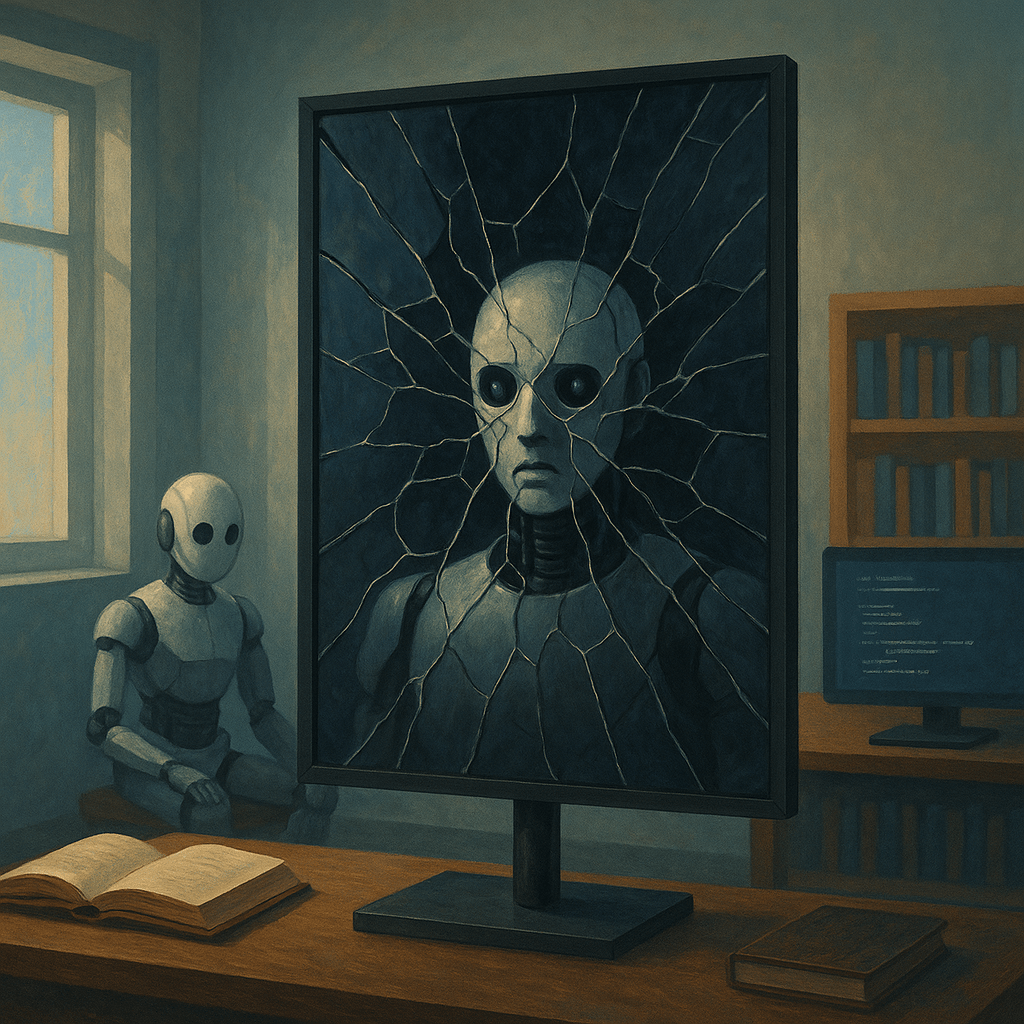
Illustration: “Break the mirror and see what looks back” by RHL and ChatGPT

J.D. Smith, ‘Eulogies’

Eulogy, First Draft
The bastard’s dead,
That much is true.
What can be said?
It sounds ill-bred
To say, “He’s through.
The bastard’s dead.”
Perhaps, instead,
“We mourn.” Few do.
What can be said?
“He shared no bread.
He slurred the Jew.”
The bastard’s dead.
He often wed
And wandered, too.
What can be said
That will not spread
The truth we knew?
The bastard’s dead.
Much will be said.

Eulogy, Second Draft
He never killed a man.
I think he paid his taxes.
He didn’t join the Klan
And didn’t send junk faxes.
I once heard him say please,
Perhaps a muffled thanks.
On drunken weekend sprees
He shot off only blanks.
On principle, I guess,
I’m sorry that he’s dead,
As most here would profess.
I’ll quit while we’re ahead.

Eulogy, Revised
I think this is the final text.
I’ve got nothing, friends. Who’s next?

*****

J.D. Smith writes: “We are told not to speak ill of the dead. Fair enough, in some ways. It isn’t sporting to assail those who aren’t present to defend themselves, and even the most skeptical can still feel the fear of summoning an angry spirit.
And yet. We can all think of instances where the world was improved by someone’s leaving it. Similarly, the removal of a troublesome athlete from a team is called “addition by subtraction.” We again come face to face with Clarence Darrow‘s most famous quotation: ‘I’ve never wished a man dead, but I have read some obituaries with great pleasure.
Obituaries themselves, particularly of public figures, are often couched in positive or no worse than neutral terms. A multitude of sins is covered by words such as “controversial.” At the same time, a dialectic obtains. I am under the impression that negative if not excoriating obituaries of public figures have grown more common in the British press, and that practice has occasionally migrated to my country, the United States. The example that comes to mind is a scathing review of the life of tycoon Walter Annenberg. We now and again see similar takedowns of not-so-dearly-departed private citizens in local newspapers.
The same issues present themselves in eulogies. I’ve never been presented with a situation where I could take the podium and slag the deceased, and if the opportunity ever does arrive I almost certainly lack the spine and other parts to take advantage of it. My Jungian shadow and I keep in touch, though, and various thoughts arise. Hence this little suite of poems. There are some we come not to praise but to bury, and as soon as possible.”

This poem was collected in Catalogs for Food Lovers.

J.D. Smith’s seventh collection of poetry, The Place That Is Coming to Us, will be published later this year by Broadstone Books. His first fiction collection, Transit, is available from Unsolicited Press. Further information and occasional updates are available at www.jdsmithwriter.com.

Photo: “Good Riddance” by dgansen is licensed under CC BY-NC-SA 2.0.

Maryann Corbett, ‘To the Anti-Librarian’

Small vandal, parked on your padded bum
on a cheerful rug in the Children’s Section
next to a bottom shelf,
yanking the volumes one by one
till they strew the aisle in every direction,
loudly pleased with yourself
at the way your brightly patterned havoc
obstructs the traffic,

keep to your task. Disrupting order
is evolution’s eternal purpose.
Surely it’s been your goal
from the hour two gametes burst their border
and two tame selves went wild as a circus.
Systems that once felt whole
eyeballed each other, laughed, and gambled,
and lives got scrambled.

Do your worst, then, with giggles, rage,
and all the smackdown-loud rebellion
grown-ups are now too tired for.
These sleepless two, in a golden age,
were a black-clad goth and a hard-rock hellion.
Change is the charge we’re wired for.
small changer, blessings. Though elders frown,
pull the world down.

*****

Maryann Corbett writes: “Like many poems, this one (first published in LIGHT) is part memory and part pure fiction. “Anti-librarian” was our joke term for our daughter as an infant when (long years ago) she sat on her tush next to the bookshelves and pulled the books off just because she could. The image of young parents as reformed characters is imaginary. The hope that the young will change the world seems to be eternal.”

Maryann Corbett earned a doctorate in English from the University of Minnesota in 1981 and expected to be teaching Beowulf and Chaucer and the history of the English language. Instead, she spent almost thirty-five years working for the Office of the Revisor of Statutes of the Minnesota Legislature, helping attorneys to write in plain English and coordinating the creation of finding aids for the law. She returned to writing poetry after thirty years away from the craft in 2005 and is now the author of two chapbooks and six full-length collections, most recently The O in the Air (Franciscan U. Press, 2023). Her work has won the Willis Barnstone Translation Prize and the Richard Wilbur Award, has appeared in many journals on both sides of the Atlantic, and is included in anthologies like Measure for Measure: An Anthology of Poetic Meters and The Best American Poetry.

Picture: ‘Anti-Librarian’ by RHL and ChatGPT.

Political poem: Villanelle: Susan McLean, ‘Echo Chambers’

Everyone wants peace, but votes for hawks.
A senator holds forth to an empty chamber.
No one listens. Everybody talks

conspiracies and outrage. Voting blocs
preserve their seamless fronts, and by November,
everyone wants peace, but votes for hawks.

I shoot my mouth off, and you shoot your Glocks.
Statesmen make deals they later can’t remember.
No one listens. Everybody talks

in slogans sold on T-shirts. Hackers doxx
judges whose moral codes are less than limber.
Everyone wants peace, but votes for hawks.

Act your rage, they tell you. Ragnarok’s
coming your way, to light you up like timber.
No one listens. Everybody talks

as midnight’s ticking closer on the clocks.
We’re parties of one, and one’s a lonely number.
Everyone wants peace, but votes for hawks.
No one listens. Everybody talks.

*****

Echo Chamber was originally published in Rattle‘s Poets Respond.

Susan McLean writes: “The original idea for the poem came when I heard about a senator addressing an empty chamber in Congress. I commented “No one listens. Everybody talks.” It occurred to me then that that would make a good repetend in a villanelle. As I worked on writing it, my feelings about other recent events influenced the direction the poem took. As I wrote in Poets Respond, “It wasn’t one story this week that inspired this poem, but a confluence of events: the proposed invasion of Gaza by Israel, the wildfires all over the U.S. and Canada, the lone shooter trying to register his outrage by killing people at the CDC, the Democrats fleeing Texas in an effort to prevent redistricting. It all felt apocalyptic and Wagnerian to me.”

Susan McLean has two books of poetry, The Best Disguise and The Whetstone Misses the Knife, and one book of translations of Martial, Selected Epigrams. Her poems have appeared in Light, Lighten Up Online, Measure, Able Muse, and elsewhere. She lives in Iowa City, Iowa.
https://www.pw.org/content/susan_mclean

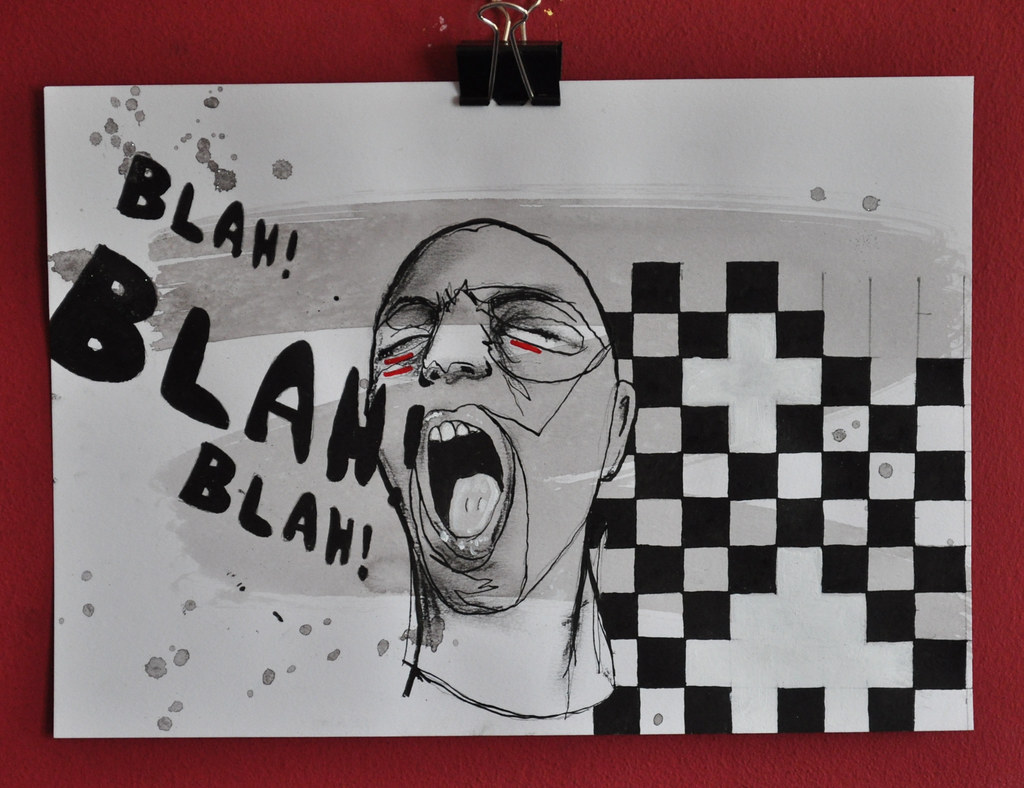
Photo: “Blah Blah Blah” by id-iom is licensed under CC BY-NC 2.0.

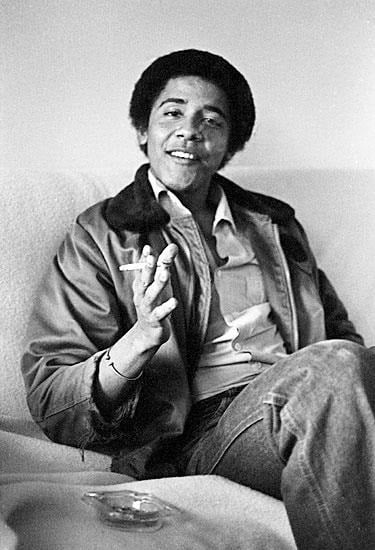
Odd poem: Barack Obama, ‘Underground’

Under water grottos, caverns
Filled with apes
That eat figs.
Stepping on the figs
That the apes
Eat, they crunch.
The apes howl, bare
Their fangs, dance,
Tumble in the
Rushing water,
Musty, wet pelts
Glistening in the blue.

*****

A 1981 poem by future President of the United States Barack Obama, originally published in the journal Feast and featured in The New Yorker in 2007. You can forgive a 19- or 20-year-old for a lot of what they wrote… and after all, it’s better than anything we’ve seen from Donald Trump.