Author Archives: Robin Helweg-Larsen

Unknown's avatar

About Robin Helweg-Larsen

Director, Andromeda Simulations International, Bahamas: a global education company providing online and in-person workshops in business finance. Series Editor, Sampson Low's 'Potcake Chapbooks'. Formal verse about traveling, family, love, etc...

Potcake Poet’s Choice: Vadim Kagan, ‘You Are Changing’

You are changing from day to day
And from night to night
You are changing before I say
Let there be light
You are changing your smile, your hair
And even your eyes
You are changing what isn’t there
Making truth of lies

You are changing the coins you bet
And the games you win
You are changing what has been set
Outside and in
You are changing from old to new
And again to old
You are changing all that we knew
But were never told

You are changing along the way
And across the sea
You are changing the things that may
Be the last we see
You are changing your blood to sweat
And yourself to me
So keep changing but don’t forget
How it used to be

Vadim Kagan writes: “Life is all about changes. People change, countries change, the world changes. Are we walking in circles or are we ascending (or descending) some universal helix? Opinions differ but as I got older I realized that to me it matters less where we are going than where we came from. This poem was written during a tumultuous time in my life, when I realized that, no matter how well I try to plan,  tomorrow will be different from what I imagined. The poem was, in a way, a kind of therapy – and is probably even more relevant than several years ago. It is also more musical than many of my poems, and made a great (if little known) song.”

Vadim Kagan writes poetry and prose in English, Russian and, occasionally, a combination of both languages. He runs an AI company in Bethesda, MD and is a member of the DC Poetry Collective. His poems have been published in The Lyric, The Road Not Taken, Founder’s Favorites, DC Poetry Collective Inkblots anthologies and the latest Potcake Chapbook, ‘Lost Love’. He often posts on Facebook (@vadimkagan) and Instagram (@wines_and_rhymes.)

Launch: Potcake Chapbook 11, ‘Lost Love’

‘Lost Love – poems of what never happened, and of the end of things that did’… how bittersweet; but what a collection of poets, and what a diversity of stories and observations!

Seventeen poets are packed into this chapbook. Seven have appeared before: Marcus Bales, Melissa Balmain, Michael R. Burch, Vera Ignatowitsch, Martin Parker, Gail White and myself. Ten are new to the series, with wicked little pieces from Brooke Clark, Cody Walker and three from Wendy Cope, and with longer poems from N.S. Thompson, James B. Nicola, Mary Meriam, Helena Nelson, David Whippman, Richard Fleming and Vadim Kagan. Bios, photos and links to read more of their work can all be found on the Sampson Low site’s Potcake Poets page, while all the chapbooks in the series, showing which poets are in which, are here. Each of the 11 chapbooks is profusely illustrated (of course) by Alban Low, and can be yours (or sent to an ex) for the price of a coffee.

Heartbreak has never had a happier manifestation!

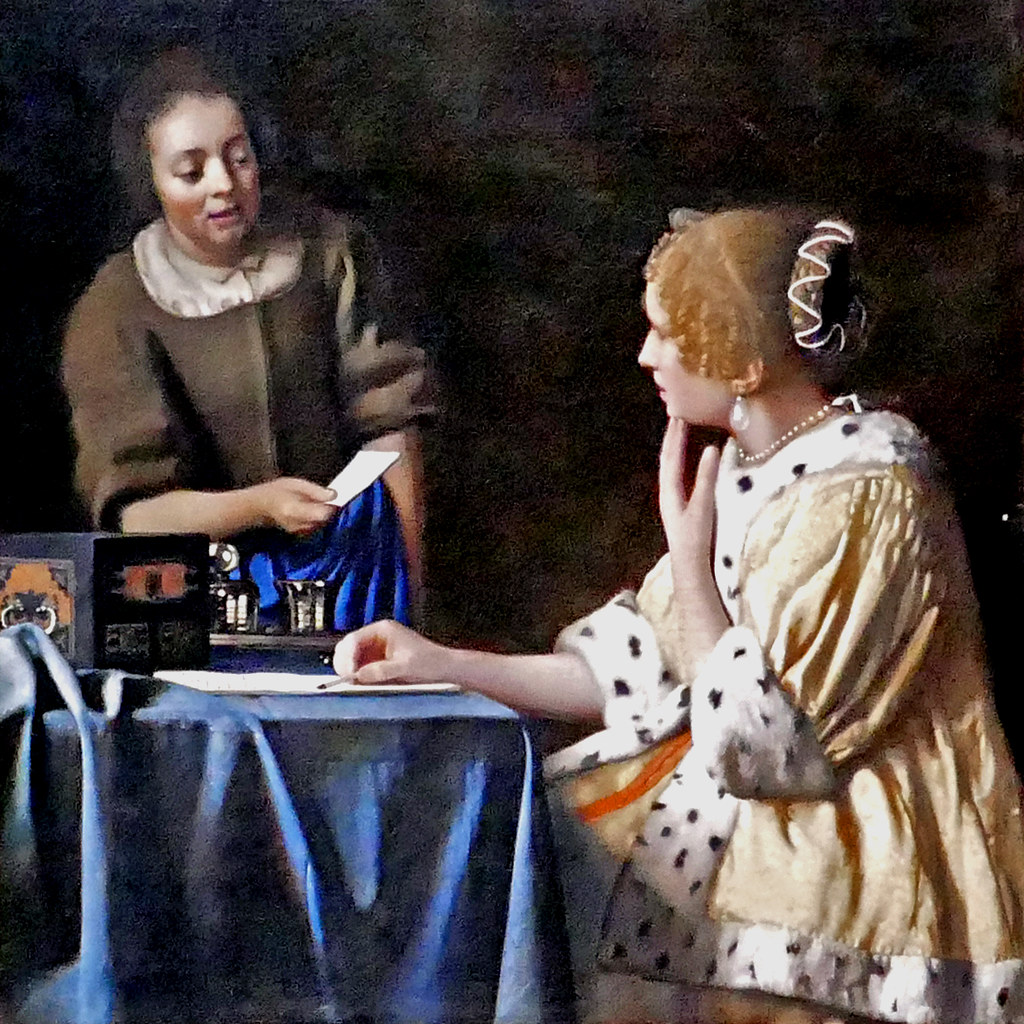
Potcake Poet’s Choice: N.S. Thompson, ‘The Women in Delft’

Johannes Van Der Meer, (Vermeer), 17th Century

We look at them expectantly: a room
With balance held, a string of pearls, a hand
Placed on the virginal, or there a letter
Clutched to the breast; these women keep
The gentle art of looking artfully
Revealed, yet hidden in the art of space.

They seem absorbed in it and yet leave space
For eyes to linger on them in that room
And wonder what the painter artfully
Kept in or out, things under hand
Or underhand? The surfaces still keep
Us guessing. What could be in that one’s letter

Or that one’s balance? And why does he let her
Appear to weigh up in that pregnant space
Such a wealth of meaning only to keep
It from us in that sunlit room?
Are we – the viewers – meant to have a hand
In them and come to see what artfully

Has been concealed? That View of Delft is artfully
Conceived yet not depicted to the letter
But deftly rearranged, the painter’s hand
Adding the unknown of space,
A brooding sky providing all the room
To rise above the secrets buildings keep…

Or take elsewhere that crenellated keep
Of brick (its outside walls so artfully
Salt-leached) allowing us again the room
To wonder if they hold that letter
Or else the string of pearls in all that space
Held in The Little Street. Whose was the hand

That let the children out of doors or hand
That pressed the collars, urging them to keep
The clothes clean, as she hurriedly made space
To meet the lover artfully
Returned from sea or merchant whose last letter
Had news that left her trembling in that room?

How artfully he let us have a hand
In them and keep us guessing in the space
Between a letter and a sunlit room.

N.S. Thompson writes: “I have always admired the sestina and for years thought about writing one before I finally did. What intrigued me was the way the six words at the ends of lines could be worked into a sensible whole; indeed, made into a resonant whole while yet showing the variety of meanings those words could take. It seemed the perfect vehicle for exhibiting, as it were, a gallery of pictures as we see in Vermeer’s several depictions of women going about their everyday activities, each different but forming a whole. A view of life that was both evident to the observer and yet at the same time hidden. What were those women thinking as they went about their business? What was fascinating was the mystery he created in the representation of everyday life.
The nearest analogy I can think of in visual terms to reading a sestina is the way a kaleidoscope works, even if there the succession of patterns there is endless, but the variation is surprising and pleasurable. It is also playful. There are little touches in the poem of such playfulness, as in “deftly” in the fourth stanza which is an anagram of Vermeer’s home town of Delft “adding the unknown”, which is the “y” (as in algebra).
And it took a long time to get right. I first produced a version after watching a television programme about Vermeer. I jotted down my six end words and quickly filled out the six stanzas, then the three last lines incorporating the six words again, hopefully with yet another semantic turn on them. I felt very pleased with myself until I read the result the next day. It then took several years of careful homing, plus several changes of end words until it finally seemed to be a natural expression that did not call attention to itself as a deliberate construct. This seems to me the necessary requirement of a sestina. Other repetitive forms can flaunt their patterns overtly, but for me the sestina has to be more subtle and almost disguise itself until the reader finally notices the form.”

N.S. Thompson lives near Oxford, UK. A poet, critic and translator, he is also the non-fiction editor for Able Muse. Two recent pamphlets are After War (New Walk Editions) and Ghost Hands (Melos Press), and he has a poem in the imminently available latest Potcake Chapbook, ‘Lost Love’. ‘The Women in Delft’ is published in the poet’s collection Mr Larkin on Photography and Other Poems (Red Squirrel Press, 2016).

Photo: “Vermeer” by pom’. is marked with CC BY-SA 2.0.

Potcake Poet’s Choice: Helena Nelson, ‘On Gloom and Proper Respect’

He doesn’t exactly blame her for it. No,
it’s not her fault. She is the way she is—
incorrigibly optimistic. But
the strain of her unbridled cheerfulness

must tell. His gloom requires due diligence.
It’s there to serve a need, and needs a slow
and proper processing. That’s it—a proper pro-
cessing. To this he must commit, and hence

his necessary isolation. No,
he is not depressed. He’s just process-
ing. Some ‘thing’ is passing through. It will go
eventually, but it must run its course.

The weight of doom would be a minor stress
if she would just dispense with cheerfulness.

Helena Nelson writes: “This poem is part of a book-length sequence telling the story of an ordinary, conventional marriage (albeit a second marriage for each partner). It’s about love that struggles to survive the difficulties of aging, loss and illness. The husband, Mr Philpott, has always suffered from anxiety but he has bouts of depression too, when he withdraws into himself. In fact, he might fairly be described as a ‘difficult’ man, though he can’t help it. Here the sonnet form reflects his need for tight control, repressing his anxiety about depression, which gets squeezed uncomfortably across the line breaks. There’s humour here, too. Because how absurd it is, surely, to wish your wife were less cheerful? And yet he does. He certainly does.” 

Helena Nelson runs HappenStance Press and sometimes writes poems, one of which appears in the soon-to-be-released latest Potcake Chapbook, ‘Lost Love’. She has been writing the story of Mr and Mrs Philpott for over twenty years, and it can finally be found in its complete form as Pearls (The Complete Mr and Mrs Philpott Poems)

Sonnet: “What Will You Be When You Grow Up?”

Historically, this never was a thing.
You did what you were born to do, were told,
Fitting yourself into your parent’s mold,
A farmer’s son a farmer, king’s son a king,
A girl to be a mother and a wife.
But then came education, travel, choice,
Awareness of the wishes you could voice,
Countries, careers, sex partners — it’s your life!
And though just who you are you cannot know,
Nor what you want, yet all is your decision.
You’ll make mistakes, find failures and derision,
But life is long: so have another go . . .
Retry, and then try something else; take; give.
Do what you love. You die, regardless. Live!

This sonnet is a mirror of the short poem I posted most recently – and I’m happy to see that my outlook has a certain consistency, even over a 50 year period.

The sonnet has just been published in the formal verse section of the current Better Than Starbucks – thanks, Vera Ignatowitsch!

Photo: “career choices” by Jerome T is marked with CC BY-NC-ND 2.0.

Short poem: ‘Remember’

Remember the whole world’s in your range,
When all your strength is gone.
If you can’t accept, then rearrange;
Can’t rearrange, move on.

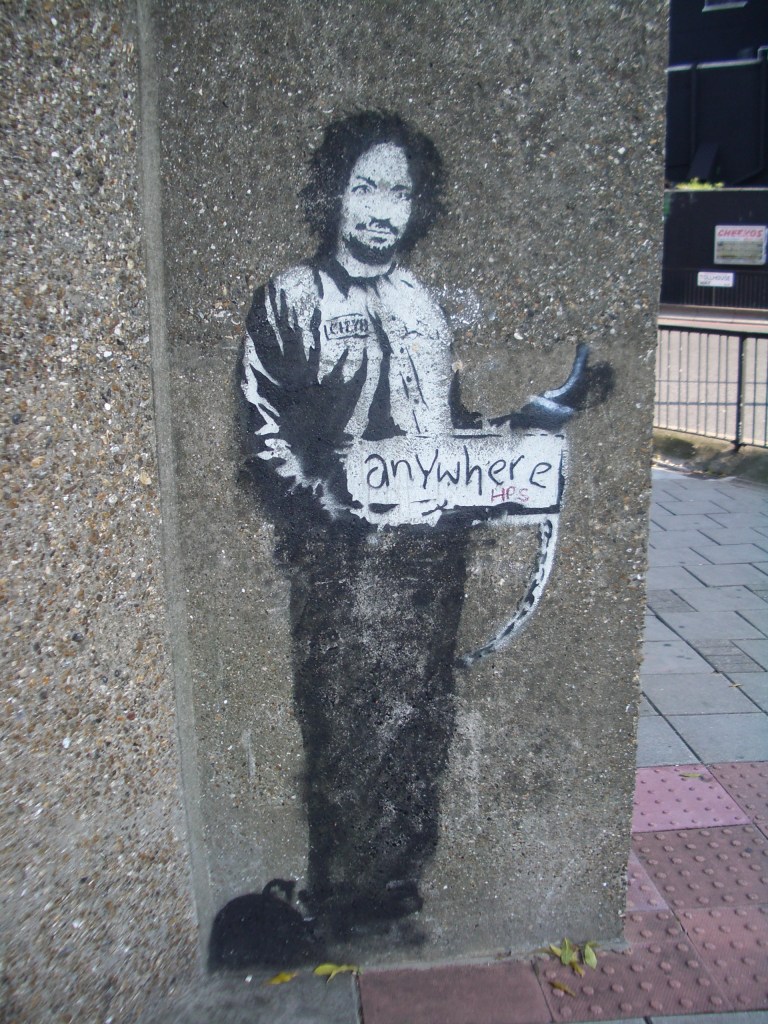
I wrote this little poem when I was a very unsettled and directionless 20-year-old, and I lived by its tenets for several years, constantly changing jobs, countries and relationships. Eventually I slowed down, only changing jobs, countries and relationships once every few decades. But I still hold to the principle that you have no obligation to stay in an unsatisfactory situation, that you should actively try to identify what makes you happiest at the deepest level and then change your life in that direction. And sometimes random change is an appropriate if temporary solution.

This poem was finally published, decades later, in The Asses of Parnassus.

Photo: “File:Banksy Hitchhiker to Anywhere Archway 2005.jpg” by User:Justinc is marked with CC BY-SA 2.0.
Epigram: ‘Bit with Bite’

I think I’ve blinked
At what you write:
Edgy, succinct–
A bit with bite.

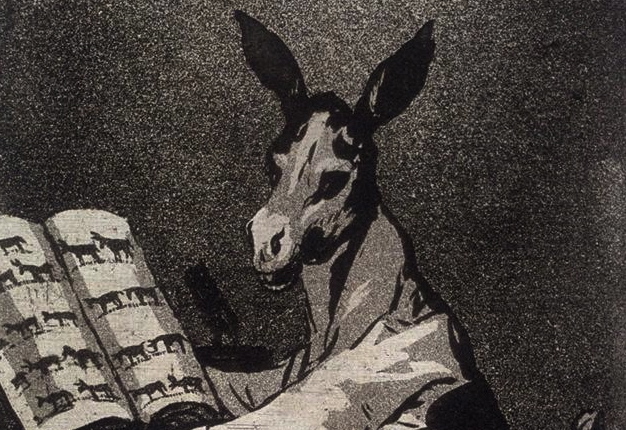
This is in the spirit of a homage to The Asses of Parnassus, in which the poem found a home. Editor Brooke Clark has created a tumblr account that for the past few years has been posting “Short, witty, formal poems” on an occasional (i.e. erratic) basis, much in the spirit of Latin and Greek epigrams (and often translations of them, or modern retellings).

This poem itself is not particularly noteworthy – but I enjoyed rhyming ‘blinked’ with ‘succinct’, as well as the ‘think/blink’ and ‘bit/bite’ pairings. Wordplay is at the heart of poetry, from Anglo-Saxon alliteration to modern rap, from nursery rhymes to Shakespearean sonnets. Wordplay is memorable, and sharpens the pain of an epigrammatic jab. Use it, if you want your barbs to be effective.

Kyrielle: ‘Desire is the Last Domino to Fall’

Religion starts as trying to explain,
Progresses to high priests’ financial gain.
I’ve tried religions, and seen through them all;
Desire is the last domino to fall.

Explore the world – well, fifty lands’ enough;
Novelty fades; folks are just folks; stuff’s stuff.
I’ve seen both rich and poor round this blue ball;
Desire is the last domino to fall.

And I’ve gone barefoot, and I’ve gone first class:
The trinkets pall beside bare feet on grass.
Markets go up and down and they too pall;
Desire is the last domino to fall.

The fearful right, the overtrusting left:
Politics, history, both of sense bereft.
Reagan’s road leads to Trump and hits a wall;
Desire is the last domino to fall.

My arts expression’s been in writing verse–
The arse end, clearly, of the universe.
There’s rarely silver in the nets I haul;
Desire is the last domino to fall.

I’ve had my fill of sex – but when I see
A vibrant youth, my thoughts are freshly free.
I want, though why I want I mayn’t recall…
Desire is the last domino to fall.

This poem, published by George Simmers in April’s Snakeskin, flowed straight out of a comment by Jackson Browne in a Guardian article on his latest album, ‘Downhill From Everywhere’. My thanks go to Mindy Watson, creator of poems in every form she hears of, for identifying this one as a kyrielle. I hadn’t set out to write within a specific form, I merely wrote a poem that used a repeating last line of the stanza. And this highlights one of the things about form: form follows function, in poetry as in architecture. Metre, rhyme scheme, line length, all these are chosen for their appropriateness for the mood and content of the poem. Ballads, sonnets, couplets, villanelles, each type finds its best use in a different situation, each evolved to provide a good expression of a different mood, each became popular as its expressive strength was demonstrated.

A kyrielle seems to me a natural poetic construct for an expression of prayer or despair or wherever all avenues of thought lead back obsessively to the same essential fact or wish. It was formalised in the time of the troubadours, and its name derives from the Late Latin phrase “kyrie eleison“, “Lord, have mercy”. Very appropriate.

Photo: “Where It All Began” by mckinney75402 is marked with CC BY 2.0.

Potcake Poet’s Choice: Jerome Betts, ‘Morning Calls’

Though buds, light-headed, arrow to the sun,
Wood-pigeons cautiously descend to drink
As through the roof the first faint cheepings run
From half-fledged nestlings in some straw-warm chink,
While welling far and near − to float and sink
Like spidery fibre silvered on the lawn −
Mercurial lark song trails out link by link,
Rocking serrated-throated crows have drawn
Their broad indelible raw weals across the dawn.

Jerome Betts writes: “Have only tried the intricate patterning of the ‘Spenserian stanza‘ a couple of times. On the first occasion it seemed to suit a comment on the design of a 4th century Roman mosaic floor and on the second, in ‘Morning Calls’, appearing in Snakeskin, a memory of the rich dawn chorus in rural Herefordshire many years ago. The point of particular interest for me is the phrase ‘rocking serrated-throated crows’ in Line 8, unchanged from one jotted at the time. The words fitted a rocking or bobbing movement, but why ‘serrated-throated’?  This is appropriate for ravens with their ‘shaggy throat feathers’  (RSPB Handbook 2014) but not, I thought, crows. The words resisted attempts at tweaking and the stanza stalled. Some weeks later I saw a crow standing on top of a Devon street light rhythmically calling and rocking . . . and as it did so its neck feathers briefly parted on the upstroke of the movement. The line had preserved an exact observation made when young and then forgotten.”

Jerome Betts edits the quarterly verse webzine Lighten Up Online in Devon. His work has appeared in Amsterdam Quarterly, Angle, Autumn Sky Poetry Daily, Pennine Platform, Light, The Rotary Dial, and Snakeskin, other American, British and Canadian publications and two Iron Press anthologies.
www.lightenup-online.co.uk

Photo: “A Crow calling – gardenDSCN9711” by ianpreston is marked with CC BY 2.0.

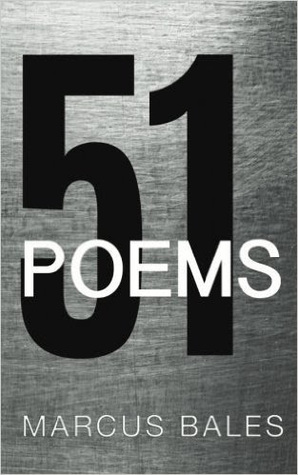
Review: ’51 Poems’ by Marcus Bales

This is poetry as it is meant to be: evocative and word-for-word memorable. Fair disclosure: I am an online friend of Marcus Bales – and I am so because his poetry is evocative, memorable, witty… and it all rhymes and scans in the most natural and elegant way.

His collection of ‘51 Poems‘ contains sections with very different moods. The first ones recapture childhood and wartime experiences and then give way to my personal favourites, a series of poems of love, love that in one way or another is unattained, incomplete: Pre-Flight, “I called goodbye. By then she couldn’t hear.//I pulled the chocks away, and she was gone.” Broken Sunlight “streaming down his face.” Have You Forgotten “it all, and all so soon?” Me and the Moon. Dancing with Abandon. And Precipice: “and knowing everybody knows//I’m dancing on a cliff edge, unaware//of where the precipice gives way to air.”

Others of his poems are portraits of very diverse people, political or social commentary, and (most memorably) flawless parodies of Keats, Poe, W.S. Gilbert, Auden, Shakespeare, Kipling among others. It is in the parodies that he shows the greatest diversity of rhyme and metre, because his ear catches the rhythms of other poets as easily as it understands iambic pentameters.

Online you will find him knocking out sarcastic little quatrains almost daily in Facebook. He was a standard contributor in The Rotary Dial (now sadly defunct), and frequently appears in the Potcake Chapbooks. Read 51 Poems for the wit and the human insights, and you will be rewarded with memorable earworms of wordplay and verbal dexterity.