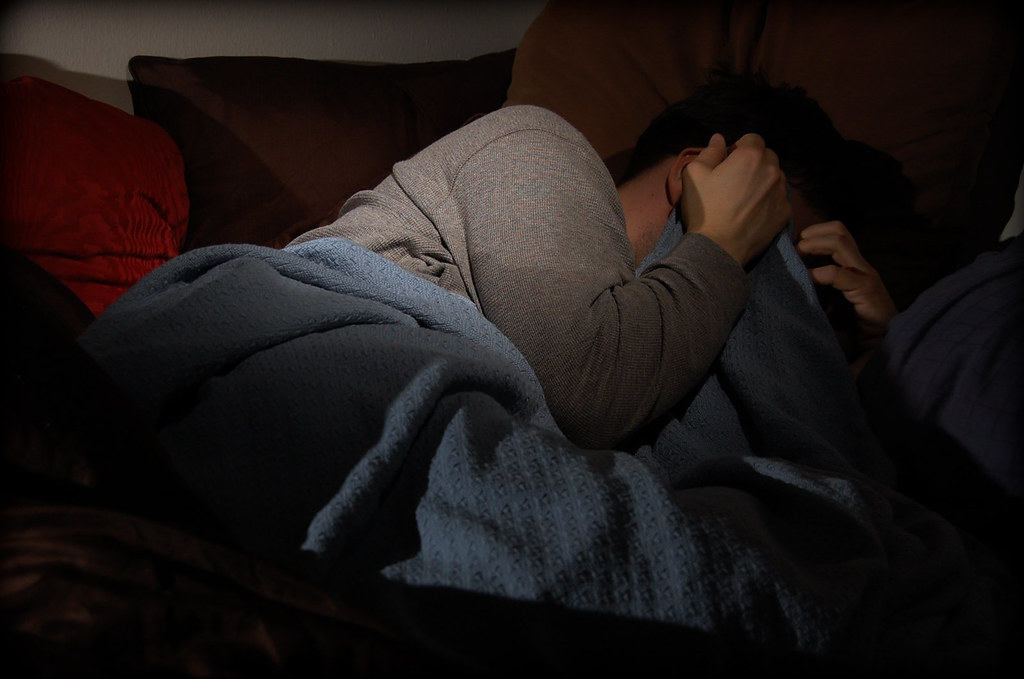
Why the mumbled answers, often feeling weary, staring out the window: bitter, wistful, dreamy, harried — always reeling, not engaging, letting out a titter, mocking laughs or strange and distant crying? But eventually she says it’s cancer, not affairs, not me – then we were trying, talking even if there was no answer. But I would have those awful times again: I whispered her to sleep and once she slept I stroked her scalp and tucked her sheets, and then I ran off to the shower and I wept. We talked. We really talked though it was draining, as one, about the time that was remaining.
*****
Daniel Kemper writes: “This poem is utterly imagination, perhaps of the “O my prophetic soul” variety. Alexandra (that’s her name) and I were out of contact at the time, but it would have been right as she came down with cancer, if I have my timeline right. It’s a multi-meter sonnet of the kind I thought probably the easiest to which I could introduce people. It starts off in trochaic meter and changes to iambic at the volta. This design choice was to have descending meter for the down mood, and when looking at the bright spot, change to ascending meter. The couplet unifies them via iambic meter plus feminine endings, hopefully that accented the coming together of the two at the end, even if unconsciously.”
Daniel Kemper, a former tournament-winning wrestler, black belt in traditional Shotokan karate, and infantryman has earned a BA in English, an MCSE (Systems Engineering), an MBA, and an MA in English and had works accepted for publication at more than a dozen magazines, including a pushcart nomination. He’s been an invited presenter at PAMLA 2024 and presided over the Poetics Panel in 2025 and has been the feature poet at several Sacramento venues.
Inside the shower’s stream the morning blurs, ceremony wakes on white marble tile; brushed steel and shaving brush wait, rituals that ask the rushing mind to pause a while.
The bowl presents the soap, the steam the heat; damp badger bristles swirl, patient and slow. No canned foam, no gelled and fleeting cheat, hands repeating what older barbers know.
The lather builds like weather in the hand, a cloud coaxed up from water, soap, and time; slow turns that ask a man to pause and stand at break of day before its clamors chime.
Hands learned the quiet patience of the bowl, small weather turning slowly in the soul.
*****
Keith Roberts writes: “I’d be remiss if I didn’t give my wife credit for this poem. For my birthday she gave me a bowl, a brush, and a puck of all-natural shave soap from a local artisan. A little whisk into lather, the woody-whiskey scent comes up, and suddenly I swear I can hear modal jazz somewhere in the background. In a world built around consumption, algorithms, and binary takes, it’s important to our humanity to rediscover the transcendent in small, ordinary experiences like this. And maybe more importantly, to listen when other people share theirs. This poem is a thank you to my wife for helping me find one.
“I’m just starting this writing and poetry journey. I’m a recovering math major with graduate degrees in Computer Science and Computational Social Science. Most of my career was spent living in the abstract: programming, modeling, data, systems. When my dad passed away a couple of years ago, something in me shifted. I started writing partly as a way to process the loss and partly to leave my kids something more durable than an Instagram feed. Also, and this is important, it gives me great comfort knowing that dad jokes can, in fact, achieve a kind of immortality…even in sonnet form. If that garners a few more eye rolls from my kids after I’m gone, I’ll consider my work a success.”
a man will cross the world at the smallest hope of love
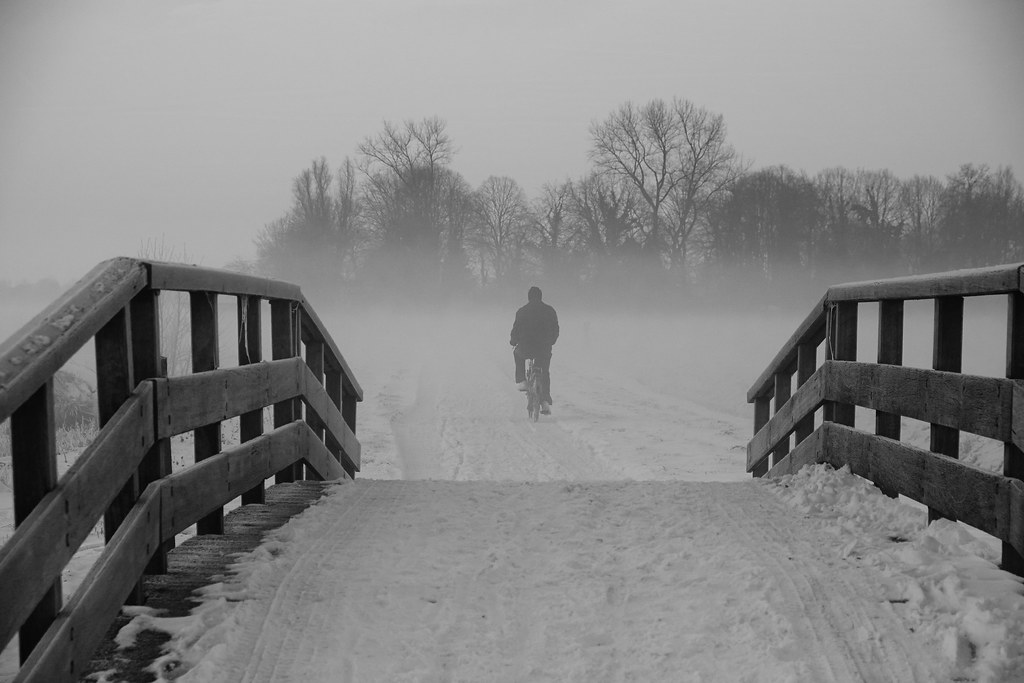
Beep. Wrrrr. Clickclack. Ssssss. ‘Hello?’ Ssssss. Ssssss. Ssssss. ‘It’s’ – crackle – ‘Geet.’ Crackle. ‘We could’ – buzzzzz. Ssssss – ‘meet.’ Ssssss. Ssssss. ‘If’ – crackle crackle – ‘Joe?’ Umm. ‘I’mchangingtrainsatLeuvenstation halfpastfiveonTuesdaymorning’bye.’ Clickclack. Beep. The Monday midnight sky shuddered like a fridge. Our conversation never matched our love. Too pissed to drive, I took my bike. The roads were swiped with ice. It snowed. My front teeth froze. I fell off twice. ‘The next train‘ – Jesus! Push me! – ‘to arrive…‘ We met – still moving. ‘Kiss me!’ That was it. I biked back home to Mol. The sun shone. Shit.
*****
John Gallas writes: “Romantic Love called upon to go out in the cold on a bike to resurrect its glories, which may never quite have been what they are remembered as. I enjoyed the stop-start challenge of the expression of hesitation, and of producing punctuation of indecision and effort. Perhaps the last word, far from being annoyance, hints at sadness.”
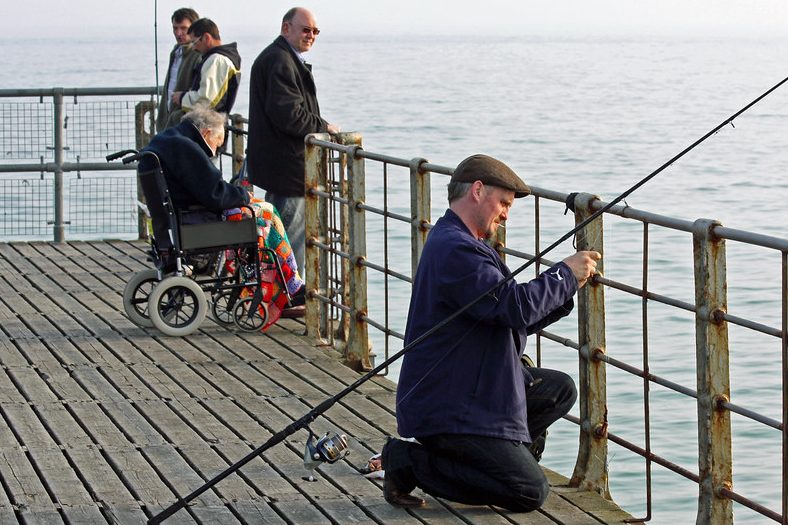
The old man wakens to a mute caregiver pushing his chair past gulls along a railing. This is the morning when he gets the river. Surrendering to wind and a prevailing
saline tang kicked up from the Atlantic, he lets whatever strikes him resonate. A taut rod wrangling with a snagged and frantic flounder whisks him to a lake upstate
where he, a wee one, tumbled off the dock, his virgin perch still flapping in his grip. A ferry, then, so very on the clock, transports him to the boxy convoy ship
he steered through moonlit breakers toward Pyongyang with perfect timing: his approach kissed land at dawn. He dropped the ramp, and roughnecks sprang out of the gangway onto commie sand.
Joggers, though, tug him back home from the war. Whole herds of them keep gallivanting by as thunder like they own the slate-paved shore. He has to sit there coveting their high.
Sneakered and young as far as he can see, they just keep leaving him behind to long for liberty and the serene esprit he got to savor when his legs were strong.
*****
Aaron Poochigian writes: “About the poem, all I want to say is that I think of it as flash fiction. I’ve started doing more studies of fictional characters in verse.”
Aaron Poochigian earned a PhD in Classics from the University of Minnesota and an MFA in Poetry from Columbia University. His latest poetry collection, American Divine, the winner of the Richard Wilbur Award, came out in 2021. He has published numerous translations with Penguin Classics and W.W. Norton. His work has appeared in such publications as Best American Poetry, The Paris Review and Poetry. aaronpoochigian.com americandivine.net
When spring’s ghost joins me on the deck to watch Gilt city lights click on across the bay, Some downtown maid squeaks windows, wipes the splotch Between us. Here, this quiet view. Soft clay And pungent eucalyptus, thick with rain, Exude their essence. Summer’s gloom unwinds, A pane has shattered, and each rampant cane Of luscious juicy blackberries reminds My grief entwining August’s humid air. A wedge of geese pries open autumn, herds Fat purple clouds toward dusk above the glare Of distant offices. Your murdered words Of love on voicemail echo you were dead Before you put that bullet through your head.
*****
Beth Houston writes: “Regarding the sonnet: This is one poem I’d prefer to let the reader chew on without me explaining anything. It does have some tricky time aspects…”
She adds: “I have announced the submission period for the next anthology on the Rhizome Press website. Included are updated guidelines and new emails for submissions and general mail (no longer gmail). Folks will have plenty of time to submit. I just hope I don’t get an avalanche at the last minute. But better loads of poems than not getting them. I’m eager for people to let their poet friends know. I’d love to get LOTS of submissions.
Beth Houston(www.bethhouston.com) has taught writing (mostly creative writing) at ten universities and colleges in California and Florida and has worked as a writer and editor. She has published a couple hundred poems in dozens of literary journals. She writes free verse and formal poetry, mostly sonnets, and has published a novel, two nonfiction books, and six poetry books (out of print). She edits the Extreme formal poetry anthologies via one of her indie presses, Rhizome Press (www.rhizomepress.com).
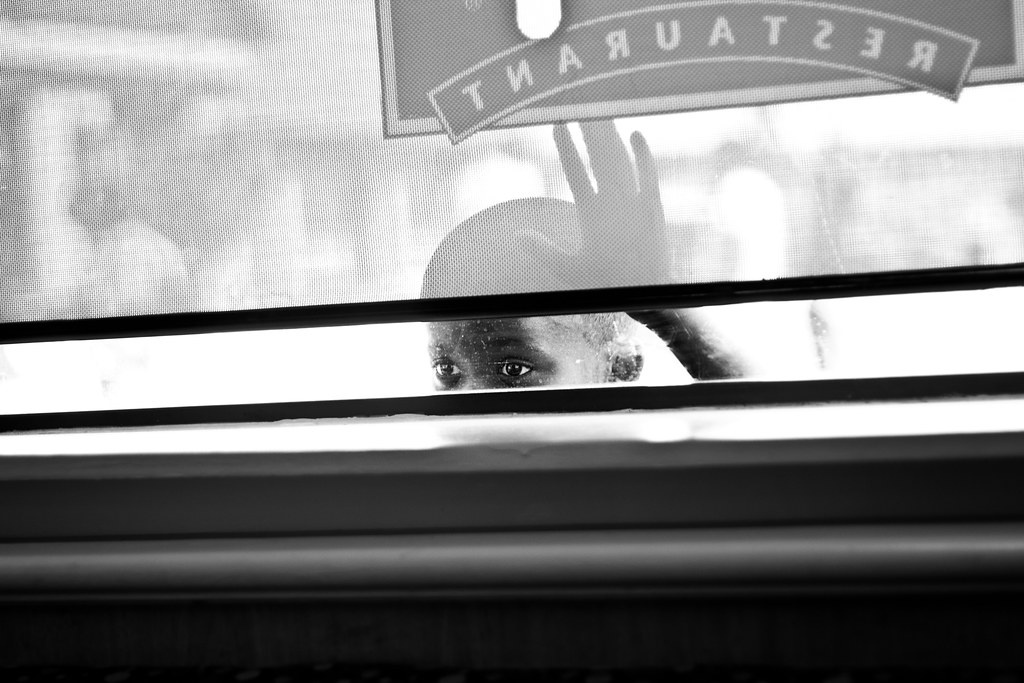
a bored and haughty wife, now sidelined and abeyed, half-pivoting within a flood-tide of brocade, smiles at the black-skinned boy who bears her dress’s train. final tercet of the French sonnet “The Dogaressa” by José-Maria de Heredia (1842–1905)
Veneto, black-skinned boys, and trains:
	displaced by devastation,
young Africans with pluck and brains
	revive that combination.
They search these railcars for remains
	of others’ dislocation,
like gleaners seeking fallen grains —
	a task of desperation.

Before each stop, the train brakes grind.
	We pause. We recommence.
A boy appears, as if assigned.
	His scrutiny’s intense.
He scans for objects left behind
	through lack of care or sense.
(I guess. I’ve yet to see one find
	a bit of recompense.)

We stop. We go. The scene repeats,
	on every train we’ve taken.
The boy surveys the floors and seats
	for anything forsaken,
and — empty-handed still — retreats,
	his eagerness unshaken.
I’ve seen his clones on city streets.
	What trades do they partake in?

Some hold out cups to beg, although
	we blind, deaf crowds move on.
(They tug our heart- and purse-strings, so
	we play automaton.)
Some boys this age get pimped, I know.
	Some pilfer things to pawn.
The train brakes shriek. We stop. We go.
	Our boy’s come back. He’s gone.

He’s trapped in this recurrent dream.
	I feel I’m trapped here, too.
The other passengers don’t seem
	to see him passing through,
except a few who show extreme
	contempt (as I construe
their narrowed eyes’ attentive gleam).
	That, too, is déjà vu.

“A zodiac of sorts,” I muse:
	The Wailing One. The Doors.
The Kid who seeks what others lose.
	The Gaggle that ignores.
The Watchdog ready to accuse
	young scapegoats it abhors.
And I, the Poet, prone to use
	portentous metaphors.

Again, these constellations wheel.
	Again, I contemplate
commuters’ faces, which reveal
	obliviousness or hate.
Another horrifying squeal.
	Another hurried wait.
Another search. How must he feel,
	this boy, about his fate?

Though circumstances brought him here,
	not slavers, is he free?
He scrambles just to live, it’s clear,
	although he ought to be
in school. He’ll be no engineer.
	No teacher. No M.D.
Survival is his life’s career,
	decides society.

I think what lives my children lead.
	I think of things I’ve read.
The long-dead voices that I heed.
	The headlines in my head.
The decadence. The waste. The greed.
	The desperate. The dead.
What choice was smooth-faced Ganymede
	presented with instead?

He rode to immortality,
	but did he have a say?
Consent’s a triviality
	to gods, some might inveigh,
and rape’s a technicality
	(defined the ancient way),
and pederasts’ carnality
	had stricter rules of play.

I know. But circumstances tore
	that kid from loved ones’ care
to Mount Olympus, where he bore
	the things that slave-boys bear.
And bears them still, forevermore.
	No beard, no death, can spare
young Ganymede, exploited for
	eternity up there.

No, no, he’s fortunate, insist
	some authors. He’s adored.
Complimented. Cuddled. Kissed.
	Ambrosia’s his reward
for having topped the favorites list
	of such a lofty lord.
The death we mortals face, he missed.
	That shouldn’t be ignored.

A palace slave is nonetheless
	a slave, and can’t decline
a burden, though it might oppress:
	a massive cup of wine;
the heavy train of someone’s dress
	who thinks herself divine;
the weight of knowing each caress
	means mainly “This is mine.”

The dogaressa eyes her toy.
	Her property. Her pet.
Some see in him what might destroy
	stability — a threat.
But I behold a human boy
	ensnared in power’s net.
What games his owner might enjoy
	will fuck him up, I bet.

But maybe I misjudge her smile.
	I view it through the prism
of factors I must reconcile,
	like French conservatism,
a splash of Afrophobic bile,
	and anti-feminism.
Perhaps she’s not a pedophile.
	(Forgive my skepticism.)

Perhaps she smiles because she’s kind
	(though labeled “bored” and “haughty”).
Perhaps the lady’s too refined
	to have a thought that’s naughty.
The dots connected in my mind
	to Ganymede are dotty,
perhaps. To me, though, they’re combined.
	These points are not staccati:

Aquarius, the catamite
	within the Zodiac;
a twisted queen who claims the right
	to toy with pawns; this black —
and therefore foreign — youngster’s plight,
	forever circling back
in search of luck. These trains unite
	on thought’s recursive track.

He’s African. He’s Syrian.
	He’s Phrygian. He’s Rom.
He’s Asian. He’s Nigerian.
	He’s white, but can’t go home.
His bedroom is empyrean:
	its roof is heaven’s dome.
His cup’s part full, in theory. In
	it? Coins. It’s styrofoam.

He’s Ganymede, collectively,
	yet every clone’s unique.
They all seem doomed to tragedy,
	but don’t mistake mystique
and myth for how things have to be.
	Inertia’s prospect’s bleak,
but railroad cars and history
	change course with friction’s shriek.

He’s made it to the Occident.
	(Let’s pause now to salute
ourselves, and our enlightenment.)
	His homeland tried to shoot
and starve him. He should be content
	he didn’t drown en route.
He’s lucky! Don’t misrepresent
	the fact he’s destitute.

Some myths should really be revised.
	Some fictions should appall.
When those who claim they’re civilized
	spew racist vitriol,
and orphaned kids are demonized
	by oligarchs, we all
should spot the pattern, unsurprised.
	The writing’s on the wall.

The doorway yawns. I stiffly rise
	on travel-swollen feet.
At noon, I crossed the Bridge of Sighs;
	my daytrip’s now complete.
The train goes on, with one surprise —
	a monetary treat
for hopeful, homeless, hungry eyes —
	between one wall and seat.
*****
“In 2016, while an estimated 363,348 refugees and other migrants successfully crossed the Mediterranean to reach Europe, an additional 5,136 people who attempted that journey were either confirmed drowned or reported missing (Source) — still a record now, ten years later.
“New installments of that ongoing tragedy were generating some of ‘the headlines in my head’ (Stanza 9, Line 4) in the summer of 2016, when I accompanied my mother on a 10-day Mediterranean cruise. We arrived in Padua a few days early so we could adjust to jet lag, and from there we made day trips by train to Ravenna and Venice before our cruise began.
“During our day in Venice, I was startled by the profusion of Moretto- or Blackamoor-themed luxury items I kept coming across, all gold-adorned: Jewelry. Doorknobs. Lamps. Tables. Atlas-like figures supporting architectural features. On the 9pm train back to our hotel in Padua, I pondered this centuries-old fascination with Blackness among Venetians of great wealth. My mind had just wandered to the little Black boy at the end of Heredia’s sonnet “The Dogaressa” when, as if on cue, a very dark-skinned African immigrant of about ten years old arrived for the first of his many hurried inspections of our train car.
“For the decade it took me to finish and find a home for ‘Ganymede in Northeast Italy (Veneto),’ that child has kept returning to my thoughts. Perhaps now he will haunt others’ thoughts, too.
“I am very grateful to David Stephenson for publishing this long poem in Pulsebeat Poetry Journal and to my fellow workshoppers at Eratosphere for telling me what wasn’t working in two earlier drafts over the years.”
*****
Julie Steiner is the pseudonym of a recovering classicist in San Diego, California. Her original poetry and verse translations from Italian, Spanish, French, Latin, and Greek have appeared in many venues — most recently, Light, Lighten Up Online, Literary Matters, The New Verse News, and The Ekphrastic Review. For links to some of these poems, visit her Substack, Off-Piste on Mount Parnassus (offpisteonmountp.substack.com).
I am God– Without one friend, Alone in my purity World without end.
Below me young lovers Tread the sweet ground– But I am God– I cannot come down.
Spring! Life is love! Love is life only! Better to be human Than God–and lonely.
*****
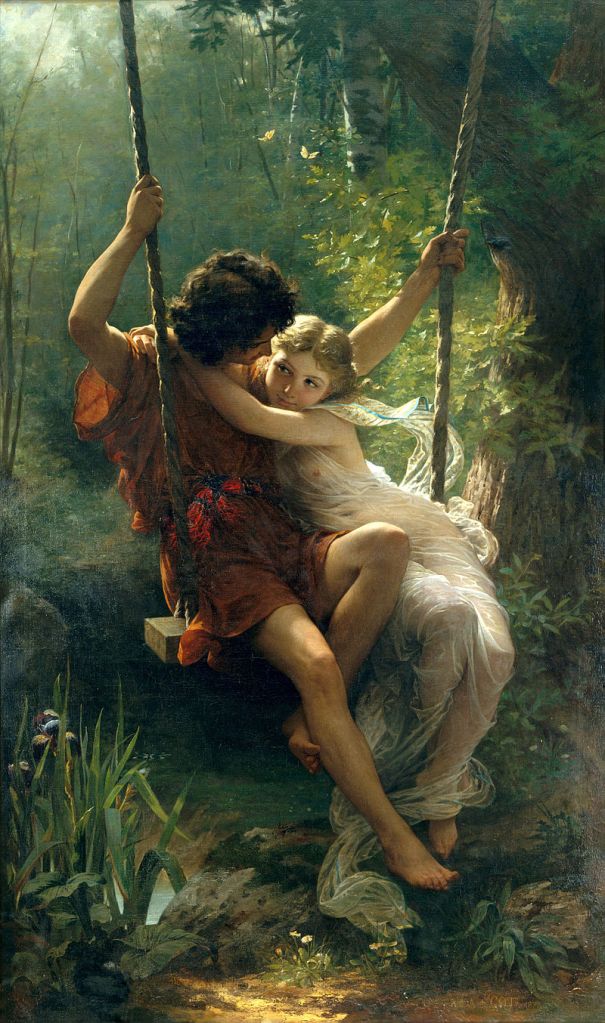
Langston Hughes, key figure in the Harlem Renaissance, published his short poem ‘God’ in the October 1931 issue of Poetry. Despite the illustration I have chosen for his poem, Hughes was neither straight nor white… but I’m sure he would forgive my choice, as he was a very tolerant individual.
It’s fallen half apart, a derelict. The gatherings have sprung, the boards detached, The spine perished, folding maps cut out. The title page is splotched with ink and nicked At the edge, the author’s homely portrait scratched— A splash of beer, faint thumbmarks all about— Discarded once, but now it’s yours. It lives, Like you, diminished now by age and loss. And so, it brings the breeze, the autumn sun, The creaking door that with a push still gives The afternoon, the birds and clouds, grass, moss, The world still new, the journey not begun, The path curling from sight in the soft glow Of a fading day—and you, prepared to go.
*****
Ernest Hilbert writes: “I am a rare book dealer, so I spend my days surrounded by books. I love all kinds of books, and I have a particular affection for books no one seems to want but which are, nonetheless, worthwhile. There are, after all, far more books than there are readers. When a book is taken home, adopted, as it were, it finds a new life. Each book one acquires is, in its way, a hedge against the future, a small hope one might some day find the time to read it. When a book is read for the first time, however old it is, however many times it has been read before, it becomes a new book. The structure of the poem is designed to express this sense of renewal and hope, the litany of degradation and wear, the sense of hopelessness, one finds in the octave redeemed, after the volta, in the sestet.
“I intended to communicate that sense of excitement I still feel when I first open a book, but I likely also had in mind Benjamin Franklin’s mock epitaph, written when he was 22, which begins “The Body of B. Franklin Printer / Like the Cover of an old Book / Its Contents torn out . . .” Finally, I must admit that there are few places I find myself happier than at a promising friends of the library book sale.”
*****
‘Friends of the Library Sale’ was originally published in The Sonneteer.
Ernest Hilbert was born in 1970 in the city of Philadelphia and educated at Rutgers and Oxford Universities. He is the author of the poetry collections Sixty Sonnets, All of You on the Good Earth, Caligulan—selected as winner of the 2017 Poets’ Prize—Last One Out, and Storm Swimmer, winner of the 2022 Vassar Miller Prize. He works as a rare book dealer in Philadelphia. Visit him at www.ernesthilbert.com
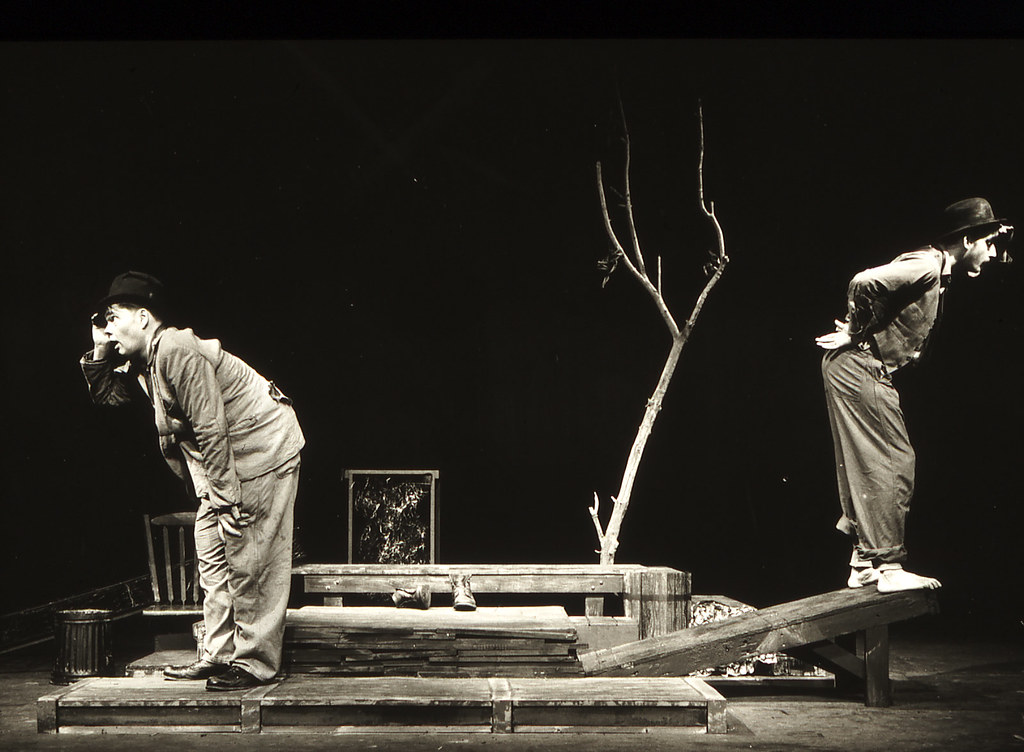
Oh no, Godot! So slow to show. Who knows how low two fools won’t go to hold off sorrow? How cold, how wrong to con or ghost hobos who long for comfort most. So go tomorrow.
*****
Susan McLean writes: “For its ‘Moon’ issue, Ecotone put out a call for submissions in the rarer French repeating forms and suggested that one way to evoke the moon was by using the word O or words in which a lot of o’s appeared. I wanted to write a rondelet using words whose only vowel was o, which made sense because the subject was the moon. Therefore, I made a list of as many words as I could think of that used no vowel but o, looking particularly for words that rhymed with one another. Luckily, that vowel can be used to represent many different sounds. I wrote a rondelet called “Solo” that later appeared in the journal. I had heard of Christian Bök’s Eunoia, a collection in which each poem uses a single vowel, and I later learned from Pedro Poitevin that it is called “univocalic verse.” I had many words left over from my search for o-words, one of which was “Godot.” I have always been a huge fan of drama, and I attended and read many plays in my youth, when Theatre of the Absurd was still in vogue. But some of my most boring and irritating theatre experiences were at plays by Samuel Beckett. I decided to write a poem that was my critique of the premise of Waiting for Godot. The poem first appeared in Pulsebeat Poetry Journal.
Susan McLean has two books of poetry, The Best Disguise and The Whetstone Misses the Knife, and one book of translations of Martial, Selected Epigrams. Her poems have appeared in Light, Lighten Up Online, Measure, Able Muse, and elsewhere. She lives in Iowa City, Iowa. https://www.pw.org/content/susan_mclean
Nothing new, but it feels like an end. An end that’s new. This end is now? No, I said new. But who could hear me through my mask? Don’t ask. Love wears a glove. I want to touch my friend. . This fear feels new. We’ve all forgotten how to live with it, to live it day by day. And each day begins anew, begins a new now we do not know, oh no, do not yet know.
*****
Rachel Hadas writes: Mid-March 2020, as I look back, did feel like both an end and a beginning. Any moment in time is that, of course, but one’s sense of discontinuity was certainly heightened then. A lot of familiar features of life just stopped, and an uncharted period began. The confusion of trying to wrap one’s mind around all this at once is echoed in the overlapping and echoing words “no, new, knew, know…”
“Ides of March MMXX” is collected in my 2022 volume “Pandemic Almanac,” a book in which, contrary to my usual practice, I append date and place of composition to each poem. In 2020 we were in Vermont from early April until late November; “Ides” was written before people who could began to leave New York City in large numbers.
My 2025 collection “Pastorals” groups together texts written in and about Vermont over a period of years, certainly including the years of Covid but also extending both before and after the pandemic (if indeed there is an after). I mention “Pastorals” because in one of its pieces (they’re all prose poems), “Blue Book,” which was written sometime later during the pandemic, I do something similar to the play in “Ides” on “no, know,” etc: “We were elsewhere; we travelled back and forth, here and there. Now mostly here. Now only here. Now here: nowhere.”
Rachel Hadas (born November 8, 1948) is an American poet, teacher, essayist, and translator. Her most recent essay collection is Piece by Piece: Selected Prose (Paul Dry Books, 2021), and her most recent poetry collection is Ghost Guest (Ragged Sky Press, 2023). Her honors include a Guggenheim Fellowship, Ingram Merrill Foundation Grants, the O.B. Hardison Award from the Folger Shakespeare Library, and an Award in Literature from the American Academy and Institute of Arts and Letters.



 Form in Formless Times