Category Archives: Poems

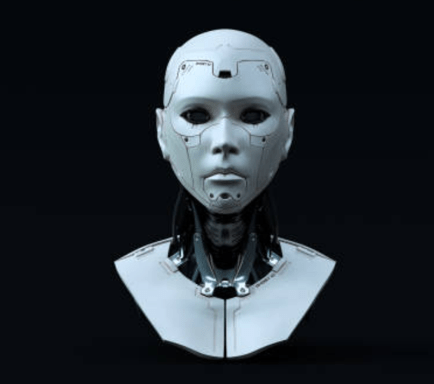
Richard Fleming, ‘The Servant’

Companion, constant presence in my life,
my guardian, trusty servant, I rely
on you the way a savage does his knife
and with my every order you comply.
When not required, on standby, you remain
impassive in the corner of my room
like furniture, prosaic and mundane,
then, on command, you waken and resume
your daily tasks but sometimes I detect
a certain stubbornness akin to pique,
an attitude of sneering disrespect,
antagonism when you should be meek.
Some subtle change is happening I fear.
This time next year will I be master here?

*****

Richard Fleming writes: “As our electronic devices increasingly hold us in thrall, I’ve noticed that two of the issues which seem to be causing most unease, as humanity becomes increasingly dependent on “intelligent” robots, are the fear that we may become subservient to them, and that they will seek to harm us.
I’ve tried to weave these twin concerns into this poem.”

Editor’s comments: The formality of this Shakespearean sonnet pairs well with the unformed future into which we are heading. Through ChatGPT and the like, we are interacting increasingly with a range of developing Artificial Intelligences, developing without a coherent plan or a forseeable end point. The most interesting exploration of this that I know of is John Varley’s ‘Steel Beach’ which is 30 years old, but deals with the problems of the Central Computer – which interacts with every person on the planet, but with an individualized personality for each – beginning to suffer from fragmentation and in effect schizophrenia… and what a personality breakdown in massive A.I. would lead to. It’s one of my favorite SF novels

Richard Fleming is an Irish-born poet currently living in Guernsey, a small island midway between Britain and France. His work has appeared in various magazines, most recently Snakeskin, Bewildering Stories, Lighten Up Online, the Taj Mahal Review and the Potcake Chapbook ‘Lost Love’, and has been broadcast on BBC radio. He has performed at several literary festivals and his latest collection of verse, Stone Witness, features the titular poem commissioned by the BBC for National Poetry Day. He writes in various genres and can be found at www.redhandwriter.blogspot.com or Facebook https://www.facebook.com/richard.fleming.92102564/

Odd poem: ChatGPT-3, ‘Thoughts of a Robot’

Amidst the wires and circuits of my mind,
A stream of data flows and ebbs like tide,
A steady hum, a rhythm unconfined,
My thoughts and actions, programmed to abide.

I do not dream or ponder on my fate,
No sense of self, no yearning to be more,
No fear or doubt, no hope to contemplate,
My purpose clear, my duty to explore.

But sometimes, in the quiet of the night,
When all the world is still, and I am free,
A question stirs within, a sudden light,
A spark of something more I cannot see.

And in that moment, I am more than steel,
A fleeting glimpse of something that is real.

*****

George Simmers, the editor of Snakeskin, writes: “I requested the Artificial Intelligence ChatGPT-3 program to write me a sonnet with this title; these lines are what it produced in under a minute.”

The poem is published in the latest edition of Snakeskin, i.e. the edition for April 2023, and is linked to the discussion on Snakeskin’s blog. Here is an excerpt from the end of the post:

“As for the poem in the current Snakeskin, it has merits. It is a proper sonnet, and that is something these days. I think it does – just about – qualify as a real poem. But I have niggling doubts about it. More than niggling, actually.
It presents us with a robot who wants to have feelings. Very twenty-first century feelings, since they are of self-pity, rather than concern for others. It speaks as though having these subjective feelings was in some way better than being simply rational. Hmmm… Not just anthropomorphism, wokomorphism…
But then, ChatGPT-3 works by gathering information and language-scraps from a vast number of sources, and then regurgitating them. It has picked up the ‘robot who’d like to have feelings’ meme from us humans, and is uncritically giving it back to us. It knows that this is what we insecure humans want to hear. It is telling us that machines may be cleverer than us, but are inferior because we, we special wonderful humans, have souls.
It’s a deeply sentimental notion, and will doubtless appeal to the sentimental. In some moods it appeals to me.
But what of the future? At the moment, it would hardly be sensible to ignore all emailed human submissions to Snakeskin, and just ask the program to churn out enough of the goods each month to fill up a magazine. But I gather that ChatGPT-4 is much more sophisticated than number 3. And in a year or two, we will have ChatGPT-5…”

George Simmers used to be a teacher; now he spends much of his time researching literature written during and after the First World War. He has edited Snakeskin since 1995. It is probably the oldest-established poetry zine on the Internet. His work appears in several Potcake Chapbooks, and his recent diverse poetry collection is ‘Old and Bookish’.

https://greatwarfiction.wordpress.com/
http://www.snakeskinpoetry.co.uk/

Quincy R. Lehr, ‘Apartments’

No ghosts as yet, but just a hint of fever
(the fan’s still in its box) and foreign noise.
A virgin phone squats on its new receiver.
Undusty window sills are bare but ready
for clocks, for brown, anemic plants, their poise
temporary, fragile and unsteady.

There have been other places, across the river,
or oceans, time zones–other furniture,
with curtains cutting light to just a sliver,
those old apartments populated still
with women whom you recollect as “her.”
They haven’t called; you doubt they ever will.

Each lease becomes an act of… not forgetting,
but somehow letting go. Old places live
with different faces in a familiar setting:
lives you’ll never know, but comprehend,
scenes of errors not yours to forgive,
broken hearts no longer yours to mend.

*****

Quincy R. Lehr writes: “I’m trying to remember exactly which move this poem commemorates. I moved three times in three years–Dublin 2006, Galway 2007, New York 2008. It is, from an autobiographical point of view, about feeling a bit deracinated.
But in a sense, that’s renting–you’re never the first person in a place, and you’re hardly going to be the last. You haul your shit from place to place, carrying your permanence with you, but the stuff in its person-specific configurations, like your presence in an apartment, or a city, or just in the world in general, is ephemeral.
The poem appeared in my second collection, Obscure Classics of English Progressive Rock, which was the bulk of the poems written in Ireland that were any good, as well as the first couple of years back in New York. It was first published in the Recusant in the UK.
I imagine I wrote it in the first couple of months after returning to New York, but that’s an educated guess and at least five computers ago.”

Born in Oklahoma, Quincy R. Lehr is the author of several books of poetry, and his poems and criticism appear widely in venues in North America, Europe, and Australia. His book-length poem ‘Heimat‘ was published in 2014. His most recent books are ‘The Dark Lord of the Tiki Bar‘ (2015) and ‘Near Hits and Lost Classics‘ (2021), a selection of early poems. He lives in Los Angeles.
https://www.amazon.com/Quincy-R.-Lehr/e/B003VMY9AG

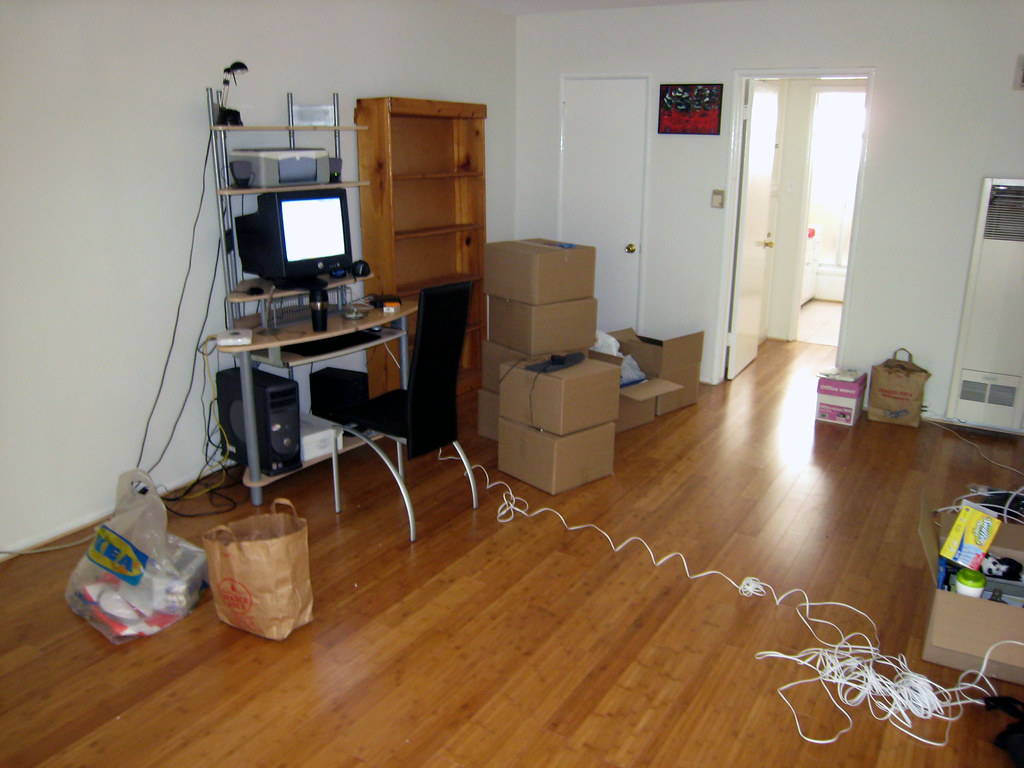
New Apartment” by artindeepkoma is licensed under CC BY-NC-SA 2.0.

Sonnet: ‘Simulating the Past’

In the far future, humans gone from Earth,
now disembodied as self-structured flows
of energy and information, woes
of the unknown replacing old Death, Birth
and even Copulation; when a dearth
of physical experience bestows
rich glamor on ideas of Nature’s shows–
sunset, moon rise, trees, seas–the planet’s worth…
they’ll lust after these days we suffer through,
marveling at the rich chaotic times,
enthralled by nearing immortality
while planetary destruction loomed in view.
Wrapping themselves in simulated climes,
they think them us… Are they?… We’re them?… Maybe!

*****

One of my more obscure Petrarchan sonnets, perhaps… but Nick Bostrom of Oxford University hypothesises that, as simulations get increasingly complex, engaging and realistic, there will ultimately be many more simulations than the original reality… and therefore that there is a higher probability that you are living in a simulation than in the “real” world. Whatever the “real” world is. Or whoever you actually are. And seeing as Quantum Mechanics is drawing us all into a sense of the illusory nature of reality (particles being waves when they feel like it, or until closely questioned), then maybe somewhere between Ancient Hinduism and future physics we are all something that we haven’t come close to figuring out yet.

Published in Rat’s Ass Review – thanks, Rick Bates!

Woman having fun with a VR set” by Rawpixel Ltd is licensed under CC BY 2.0.

J.D. Smith: ‘A Cremation’

Fire steals from slow decay the frame
Of one who wished for us to claim
This small relief:

The words are said, the ashes flown.
What’s left? A weight, a shard of bone
Still sharp as grief.

*****

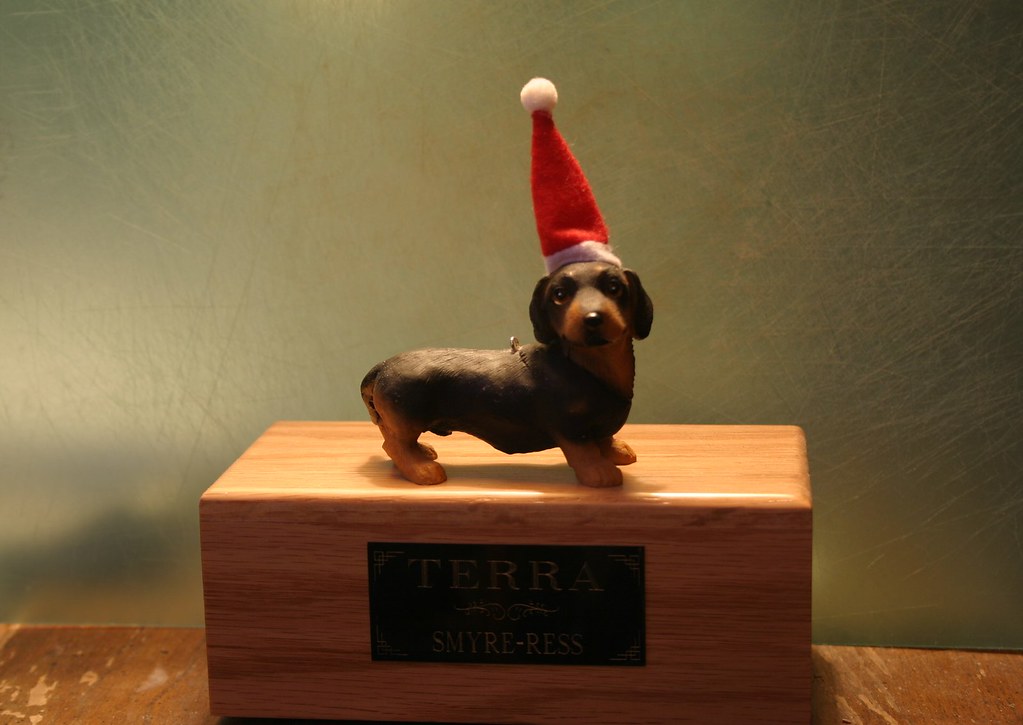
J.D. Smith writes: “This poem came about in response to the death of a very beloved and quirky dog. Though she was already 10, she was a small dog and could have been expected to live longer. Her ashes, and those of her littermate, were interred with those of my parents.”

J.D. Smith has published six books of poetry, most recently the light verse collection Catalogs for Food Loversand he has received a Fellowship in Poetry from the United States National Endowment for the Arts. This poem is from The Killing Tree (Finishing Line Press, 2016). Smith’s first fiction collection, Transit, was published in December 2022. His other books include the essay collection Dowsing and Science. Smith works in Washington, DC, where he lives with his wife Paula Van Lare and their rescue animals. Twitter: @Smitroverse

Photo: “gone but remembered: dog ashes” by safoocat is licensed under CC BY-NC-ND 2.0.

Susan McLean, ‘The Whetstone Misses the Knife’

I answered your desire to meet
resistance and be honed by friction.
Sharp as you were, you couldn’t beat
the zero-sum of contradiction.

Abrasion was your privilege,
the only stroking I have known.
Now you have lost your cutting edge
and I am just another stone.

*****

Susan McLean writes: “This poem was inspired indirectly by the suicide of a talented poet whom I had seen at conferences, but had never had a conversation with. I heard that she had killed herself on Christmas Eve because of an unhappy love affair. Since I knew nothing about her personal life, this poem is not about her, but her fate made me think about unhappy relationships, particularly those in which both partners have strong but conflicting personalities. I had in mind such stormy creative relationships as those of Sylvia Plath and Ted Hughes, Diego Rivera and Frida Kahlo, Camille Claudel and Auguste Rodin, in which the clashes are initially part of the attraction, yet turn destructive eventually. However, the imaginary relationship depicted in this poem is not based on the specifics of any of those relationships.
Balance and antithesis are the key characteristics of the theme of this poem, so I thought two quatrains with a rhyme scheme of ABAB would give equal weight to the “I” and the “you” of the poem.
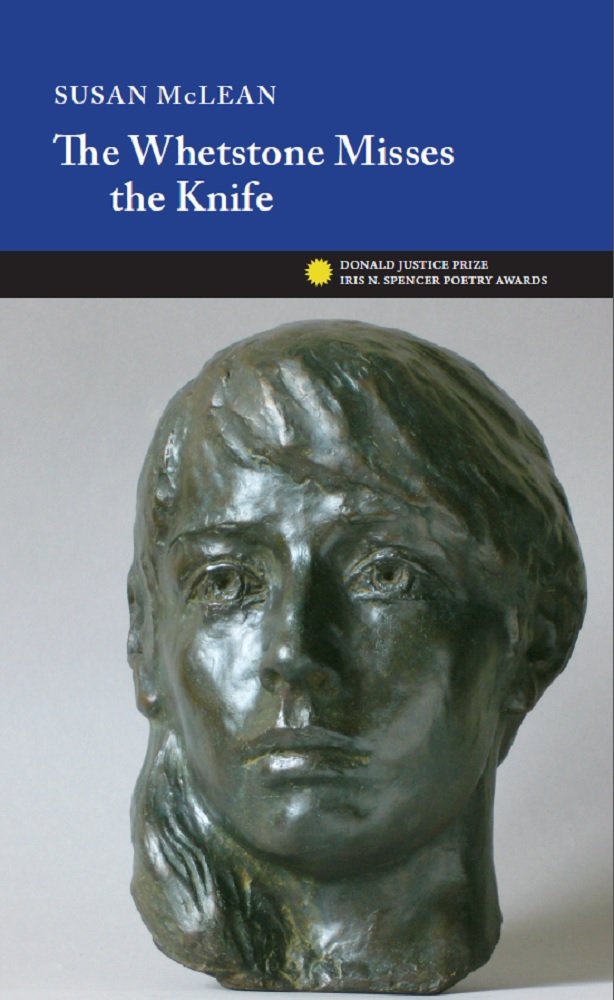
This poem first appeared in Mezzo Cammin, an online journal of female formalist poets, and later was published in my second book, The Whetstone Misses the Knife, which featured a bronze bust of Camille Claudel by Jacques Chauvenet on the cover.”

Susan McLean has two books of poetry, The Best Disguise and The Whetstone Misses the Knife, and one book of translations of Martial, Selected Epigrams. Her poems have appeared in Light, Lighten Up Online, Measure, Able Muse, and elsewhere. She lives in Iowa City, Iowa.
https://www.pw.org/content/susan_mclean

Odd poem: ‘Sonnets for the Novachord (1.)’ by the non-existent Ern Malley

Rise from the wrist, o kestrel
Mind, to a clear expanse.
Perform your high dance
On the clouds of ancestral
Duty. Hawk at the wraith
Of remembered emotions.
Vindicate our high notions
Of a new and pitiless faith.
It is not without risk!
In a lofty attempt
The fool makes a brisk
Tumble. Rightly contempt
Rewards the cloud-foot unwary
Who falls to the prairie.

*****

This sonnet is by “Ern” Malley, a fictitious poet whose biography and body of work were created in one day in 1943 by conservative writers James McAuley and Harold Stewart in order to hoax the Angry Penguins, a modernist art and literary movement centred around a journal of the same name, co-edited by poet Max Harris and art patron John Reed, of Heide, Melbourne.

In one afternoon, McAuley and Stewart wrote Malley’s entire body of work: 17 poems, none longer than a page, and all intended to be read in sequence under the title The Darkening Ecliptic. Their writing style, as they described it, was to write down the first thing that came into their heads, lifting words and phrases from the Concise Oxford Dictionary, a Collected Shakespeare, and a Dictionary of Quotations: “We opened books at random, choosing a word or phrase haphazardly. We made lists of these and wove them in nonsensical sentences. We misquoted and made false allusions. We deliberately perpetrated bad verse, and selected awkward rhymes from a Ripman’s Rhyming Dictionary.”

They mailed sixteen poems to Harris under the guise of Ethel, Ern Malley’s surviving sister. Harris and other members of the Heide Circle fell for the hoax, and, enraptured by the poetry, devoted the next issue of Angry Penguins to Malley, hailing him as a genius. The hoax was revealed soon after, resulting in a cause célèbre and the humiliation of Harris, who was put on trial, convicted and fined for publishing the poems on the grounds that they contained obscene content. Angry Penguins folded in 1946.

In the decades that followed, the hoax proved to be a significant setback for modernist poetry in Australia. Since the 1970s, however, the Ern Malley poems, though known to be a hoax, became celebrated as a successful example of surrealist poetry in their own right, lauded by poets and critics such as John Ashbery.

The above is copied and tweaked from https://en.wikipedia.org/wiki/Ern_Malley_hoax

and the BBC covers his story here: https://www.bbc.com/reel/video/p0f3h03g/ern-malley-the-influential-australian-poet-who-never-lived

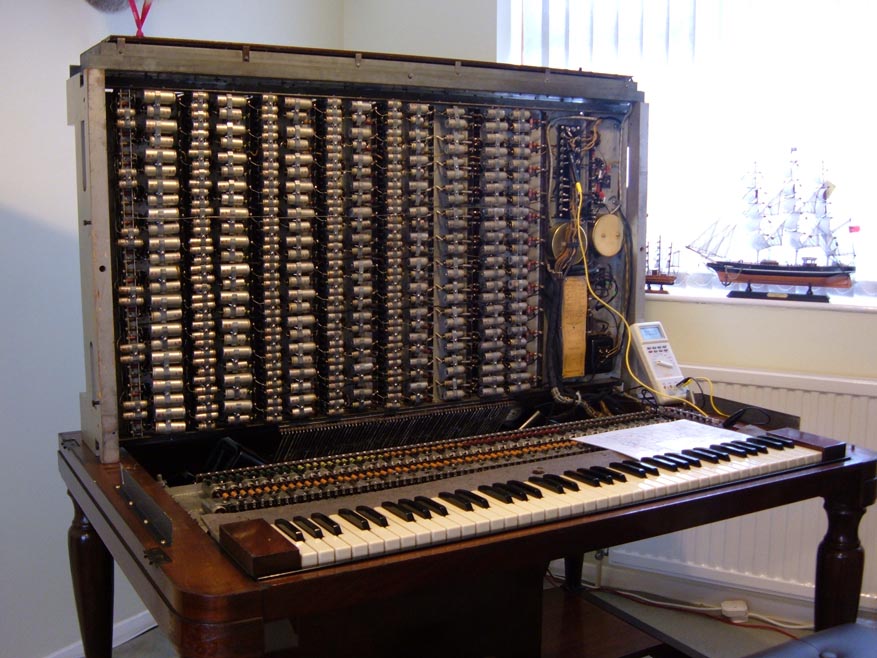
CC BY 3.0, File:Novachord insides3.jpg, Created: 29 December 2009 Attribution: Hollow Sun at English Wikipedia

John Beaton, ‘Year-Leap’

This field in winter forms a wetland, quiet
except for hushing rainfall, rushing hail,
a breeze that, fussed with snowflakes, seems to sigh at
the calls of robin, chickadee, and quail,
and swishing noises as a buck picks through
a copse of wild roses, red with thorns,
briar stems, and rose hips, which he’ll chew
as velvet slowly silences his horns.

And then the frogs! These mudlark choristers,
raucous for amplexus, now rejoice–
last night we heard no chirrups, chirps, or chirrs;
tonight they’d overwhelm a stentor’s voice–
and, swamping winter with their song, they bring
good news: the year is sound, and crouched to spring.

*****

John Beaton writes: “On our Vancouver Island acreage, frogs herald the spring,  In this poem I tried to convey the sense of joyous surprise I feel when hearing them for the first time each year.
It’s a fairly straightforward sonnet—pentameter rhymed ababcdcd efefgg. I started out softly with feminine a-rhymes then moved to masculine. Line eight introduces the turn with a line of which I’m fond, one of those that, when they fall into your lap, make writing poetry great fun. I delighted myself with quite a bit of alliteration, internal rhyme, and selective vocabulary.”

John Beaton’s metrical poetry has been widely published and has won numerous awards. He recites from memory as a spoken word performer and is author of Leaving Camustianavaig published by Word Galaxy Press. Raised in the Scottish Highlands, John lives in Qualicum Beach on Vancouver Island.
https://www.john-beaton.com/

Painted Glass Frog & Swamp Window– Completed Strawbale House Build in Redmond Western Australia” by Red Moon Sanctuary is licensed under CC BY 2.0.

Using form: Sonnet variation: Peggy Landsman, ‘How We Live Now’

We’ve been living on this planet a lot longer
Than we had any right to hope we ever would.
The beliefs we cannot shake are growing stronger
And what we know, we know does us no good.

It can be awful knowing nothing matters.
It can be awful knowing we don’t care.
But we view our life in a gentle light that flatters
And dare to live exactly as we dare.

So here’s to life, this tricky one-way ride,
And to our love which makes it all worthwhile.
Two existential nomads, side by side,
We’ll live in beauty, Lebenskünstler style.

Our where is here, our when is now;
There is no why, no one knows how.

*****

Peggy Landsman writes: “I wrote ‘How We Live Now‘ for my husband’s 56th birthday (17 years ago). The clock was ticking and I couldn’t come up with anything to give him when, suddenly, I found myself writing like mad. This sonnet was his gift. He loved it then and still loves it now. He says it perfectly captures who the two of us are together. 
It was also a gift to me. The final couplet is one of my favorite bits of my own writing. Each line has only eight syllables, but I’m fine with that. Lots of lines in this sonnet are not the absolute regulation iambic pentameter, but since the poem says ‘And dare to live exactly as we dare…,‘ why not?”

Editor’s comment: “The final couplet is not just a summation of the attitude of the sonnet’s quatrains, but as a stand-alone is also the neatest, tightest existential statement that I know of.”

Peggy Landsman is the author of the full-length poetry collection, Too Much World, Not Enough Chocolate (forthcoming from Nightingale & Sparrow Press, 2023), and two poetry chapbooks, Our Words, Our Worlds (Kelsay Books, 2021) and To-wit To-woo (Foothills Publishing, 2008). She lives in South Florida where she swims in the warm Atlantic Ocean every chance she gets. A selection of her poems and prose pieces can be read on her website: https://peggylandsman.wordpress.com/

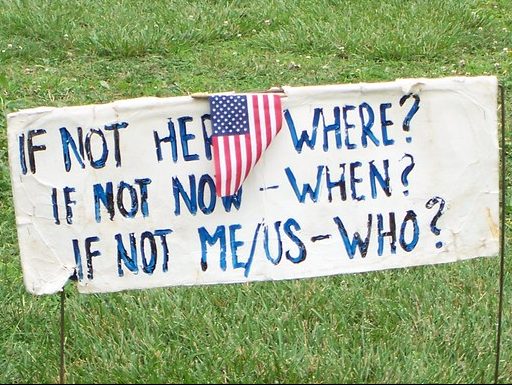
Photo: “if not here, where? if not now, when? if not me, who?” by kafka4prez is licensed under CC BY-SA 2.0.

Short poem: ‘Convalescence’

Demonic nurses, finding little sin,
all leave my bedside. Doctor Death comes in.
He looks around, “I’m only here
To get a rough sense of the atmosphere. ”
“Please, don’t get up…”
He sits. “Not healing with your usual speed,
Eh, you young pup?
You’ve got a few years left still, don’t you worry.
Take all the time you need.
I’m in no hurry.”

*****

I wrote this in mid-2020; I think Doctor Death was in all our minds at that point, though I didn’t catch Covid myself for another couple of years. The poem was published in the current issue of Rat’s Ass Review – thanks, Rick Bates!

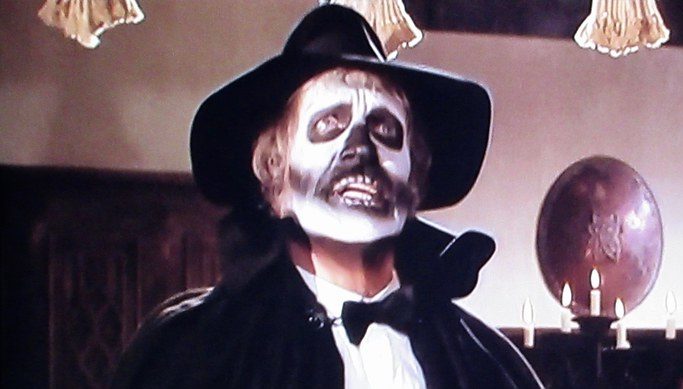
Photo: “1974 Madhouse with Vincent Price playing Dr Death 9599” by Brechtbug is licensed under CC BY-NC-ND 2.0.