Category Archives: Poems

Calling the Poem: 9. ‘The Poem Comes’

Do you see the tigerish poem, or is it seeing you?
Sensing you, sizing up your form…
(You know that lovely feeling, warm,
When you’re stared at by somebody you like…
How creepy though, if someone you dislike…)
Perhaps it will ring true,
Perhaps the lines
Will just ring hollow…
But having offered yourself up like some bonbon,
Prayed at the shrines
Of lares and penates, Mercury, Apollo,
Ganesh and Odin, Legbas Atibon,
Liminal gods of paths and gates,
And stories, lies, poetry and fates,
You have no right, nor no ability,
To choose between rough trade or some civility;
Stared at by god or demon, grand or scum,
You’ve whored yourself to gods. Take what may come.

*****

This is the ninth in the 15-poem series of the ‘Calling the Poem’ e-chapbook that Snakeskin published a couple of years ago. (Unfortunately the Snakeskin Archives are currently down.) It reflects my sense that you can evoke artistry by invoking those unconscious inner forces that can only communicate with your conscious self through dreams and images, hints and melodies, words that well up but are not quite random…

The invocation requires two things to be successful: alertness to your changing moods, and showing respect for whatever “inspiration” you receive by writing it down, sketching it out, formalising it as appropriate – and thereby encouraging further communication.

I’m aware that all this sounds pretentious. But I think that the unconscious mind knows different things, in some ways truer things, than the conscious mind, especially about physical health, mental balance and the process of changes in life. Finding a way to tap into this – through prayer, meditation or the arts – is life-affirming for most people… but perhaps dangerous for a few.

The next poems in this series deal with things going right, going wrong, needing work…

Photo: “Streetart at the state of art #art #streetart #dublin #graffiti #montana #street #woman #beautiful #poetic #inspiring #graffiti #artistic #gorgeous #wall #graff” by Romana Correale is licensed under CC BY-ND 2.0.
NSFW poem: ‘The Zeus Credit Card Company’

Homeless and eyes cast down, young Danae found
the credit card just lying on the ground.
‘Zeus Credit’… with her name on it… and it said
it had no limit. So she thought
‘Why not just try it?’ and she bought
sandals, silk underwear, a dress;
it worked… so then, why not,
a light lunch in the choicest, chicest spot.
It worked again. Its back was odd:
no legalese, just logos, ads…
‘Insert in slot for all dreams to come true.’
Tearful, she checked into Hotel Princess,
went up and had the best bath in some years,
Reading again with happy tears
‘Insert in slot for all dreams to come true’
and thought again ‘Why not?’
and put it in her slot…
in sudden stir
Zeus filled the room and her.

*****

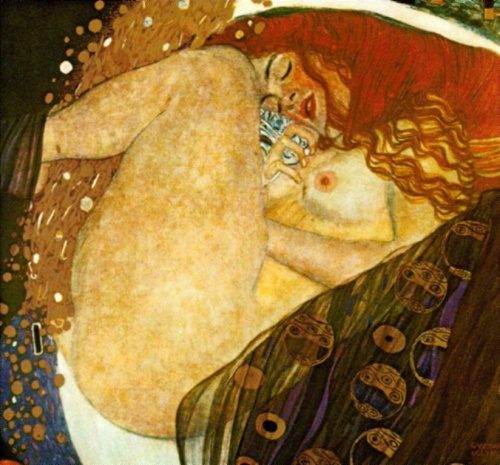
This poem, semi-formal at best, was published in this month’s Snakeskin (thanks, George Simmers!) with the accompanying Gustav Klimt ‘Danae’. I wrote the poem earlier this year but I have very little memory of doing so, and no sense of what triggered it. I put it down to the mysterious workings of the subconscious or whatever else the Muse may be.

This is an appropriate poem to post before I head into the next set of poems from the e-chapbook ‘Calling the Muse’. Is it always correct to offer up art (of any kind) that is edgy? What if the expression is sexist, even obscene? What if the work is irreligious, even blasphemous in the eyes of a believer? Is it enough to say “If you don’t like it, don’t look at it”? Is it enough to post a warning, “NSFW”?

And the Greek gods often tend toward the sexist and the licentious. Zeus is not a clean-living figure. But no one seems to object to his being depicted and popularised, even if he is a rapist. Because “that was then, this is now”? And if the Muse offers you a fresh take on an ancient rape legend, just use it because after all, the Muse must be listened to?

More on this shortly.

Potcake Poet’s Choice: David Whippman, ‘Who Were You?’

I never really found out who you are.
I only saw what I preferred to see.
I realise now it wasn’t meant to be.
I thought you were my one true shining star.
My cordon bleu, champagne and caviar
But really you’re a lukewarm cup of tea.
I thought you cared: you soon enlightened me.
I should have just admired you from afar.

It really was a silly thing to do,
Dropping my guard to let you in my head.
You left such an emotional mess behind.
And now you’re gone, I look around and find
An empty wallet and an empty bed.
And still there is the question: who are you?

*****

David Whippman writes: “As someone who is by aptitude a prose writer (much as I love poetry, both reading and writing it) I gravitate to a structured form of verse because I don’t have that  instinct necessary for writing good free verse. The sonnet form gives a ready-made structure and discipline, but allows some fluidity as well.

David Whippman is British, in his 70s, long retired after a career in healthcare. He writes stories and articles as well as poems. Outside of writing, his hobbies are music, chess and visual art. (And reading, of course.)

Image: “question mark” by WingedWolf is licensed under CC BY-NC-ND 2.0.

Calls for Submission: formal verse

Of the various publication opportunities specifically for formal/traditional poets, three are taking submissions until July 15, and four other formal-friendly publications have submission deadlines of July 31. There is no submission fee for any of them. Here they are – the links are to the submission requirements:

Able Muse (magazine) Deadline, July 15.
Submit one to five metrical poems (or one long poem), rhymed or unrhymed. (A poem of more than 40 lines is considered a “long” poem.)
All types of formal poetry are welcome, from traditional to boundary-pushing. We want well-crafted poems that use meter skillfully and imaginatively (with rhyme or not), in a contemporary idiom that reads as naturally as free verse.

Able Muse Press (book-length manuscript) Deadline, July 15.
At least 50 pages of poems – same preferences as for the magazine.
There’s NO reading fee.
“We respond within 9 months or so.”

Helen Schaible International Sonnet Contest Deadline, July 15.
Categories:
1 Traditional Sonnet – Shakespearean or Petrarchan
2 Modern Sonnet
Open to All. Free. Enter only one poem in either Category #1 or #2, or one poem in each.
Prizes for both categories: First Prize: $50. Second Prize: $30. Third Prize: $20.

Formal-friendly magazines, themed and with July 31 cut-offs:

Snakeskin (short poem issue, nothing over 10 lines). At the link, read the tabs on the left side for submission details. Submit earlier than the very end of July, as publication is scheduled for August 1st. Editor: George Simmers.

Allegro (theme: Freedom) Four poems max. Editor: Sally Long.

Amsterdam Quarterly (theme: City and/or Country) Two poems max. Editor: Bryan R. Monte.

Rat’s Ass Review (unthemed – the editor publishes whatever he damn well feels like publishing, as you might have guessed.) Five poems max. Editor: Roderick Bates.

In addition:

Rhizome Press (not to be confused with Rhizome Books) publishes anthologies of formal verse. Editor Beth Houston is taking submissions of up to 10 sonnets for Extreme Sonnets III, and up to 10 “extreme formal poems of at least twelve lines” for Extreme Formal Poems II. The submission deadlines are not given on the website, but will presumably follow on the publication of Extreme Sonnets II which is currently in the works.

UPDATE from Beth Houston, 11 July 2022: “At long last Extreme Sonnets II is published and available on Amazon! Will there be an Extreme Sonnets III? Likely, but not for awhile. In the meantime I’ll be putting together an anthology of love sonnets—extreme sonnets, of course. I’ll post submission details on the Rhizome Press website soon. All sonnets included in Extreme Sonnets, Extreme Sonnets II, and Extreme Formal Poems will automatically be considered. Stay tuned for more details.”

Calling the Poem: 8. ‘Sacrificing Yourself’

To bring that tiger you’re desiring, fearing,
You place your own self in the clearing,
Tied to a tree, chained at the throat,
A monk who hopes, hopeless and lowly,
A tethered goat,
You bleat your prayers, and wait.
Your offer (“offer” is an offering,
An animal, coin, weapon, ring…
Even yourself, for you are an oblate…
“Offer” is “sacrifice”, “sacrifice” is “make holy”)
Your offer, your self-sacrifice, is still
“Take me, and pay me what you will.”

Begging for the orgasmic lightning bolt
That gods blast blindly towards heath and holt,
You make yourself into a lightning rod
On some high tower to catch those blasts of god.

*****

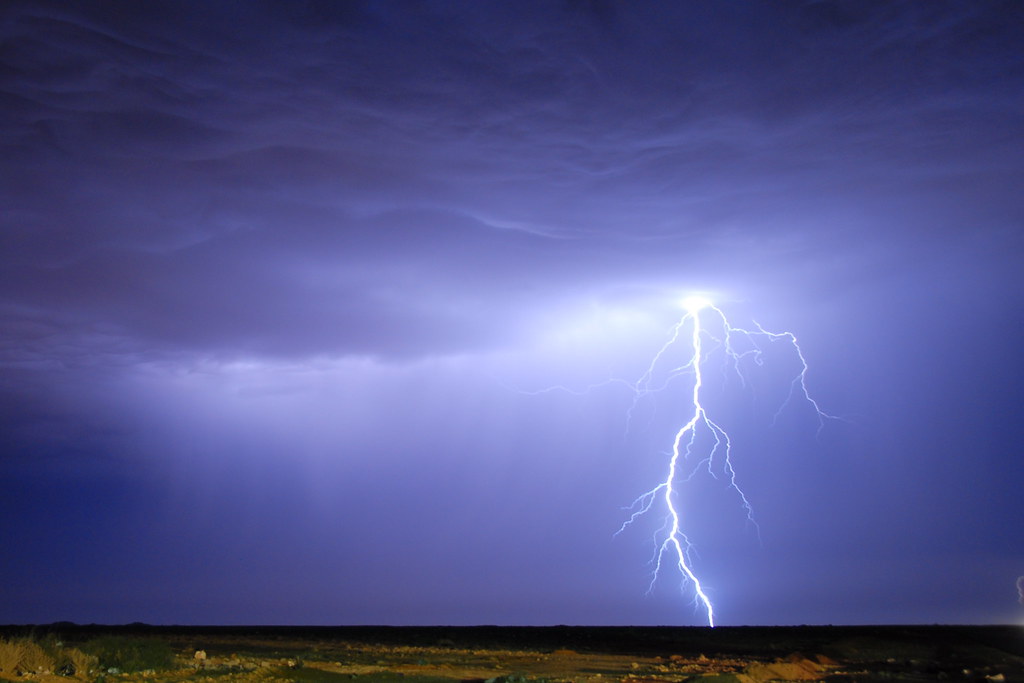
American poet Randall Jarrell defined a poet as “a man who manages, in a lifetime of standing out in thunderstorms, to be struck by lightning five or six times.” Indeed, to be known to posterity for five or six poems is a wonderful achievement – although hopefully you were also doing other worthwhile and fulfilling things with your life. Tennyson, Dickinson, Yeats, Cummings… they may have written hundreds of poems, but very few remain widely known – the average well-read citizen would have a hard time naming more than two or three poems by each.

The artistic sensibility (including the musical, poetic, etc) is very similar to the religious one. For most, the lightning strikes are strictly personal and the payoffs from devotion, openness and sacrifice are largely intangible; but they give a powerful charge, a feeling of the essential within yourself and an understanding of connection to the whole universe.

Photo: ‘Lightning in the Western Sahara’ by Hugo! is licensed under WordPress Openverse.

Calling the Poem: 7. ‘The Tiger’

That wild white wind that whips the world away –
The darkness deep and dread in dazzling day –
The light and dark that fuse with furious force –
The leaping tiger that gives no recourse –
Acknowledge, fear, that lurking tiger’s rage,
The terrifying sense of spring-taut powers,
Menacing, tail-tip twitching while it glowers,
Lethal both to ignore or to engage.
Acknowledge it, succumb: you’ve been rewarded.
And now produce – because the debt’s recorded.

*****

This is the 7th of the 15 poems of the Snakeskin e-chapbook ‘Calling the Poem’. ‘The Tiger’ and the next few poems deal with the difficulties of first begging your Muse for inspiration and then finding that the inspiration is uncomfortable – personally, socially, politically, whatever. Perhaps the inspiration isn’t what you were hoping for… but what are your obligations once you have in effect contracted to receive something unknown?

The Muse, the gods, the unconscious or however you like to think of your source of inspiration is not to be trifled with. It is to be respected if you want to stay on good terms with it and benefit from it.

The word ‘music’, by the way, means Muse-ish, ‘of the Muses’. The following is blended from passages in Wikipedia: According to Pausanias in the later 2nd century AD, there were three original Muses, three original Boeotian muses before the Nine Olympian Muses were founded: Aoidē (“song” or “voice”), Meletē (“thought” or “contemplation”), and Mnēmē (“memory”). Together, these three form the complete picture of the preconditions of poetic art in cult practice.

So song, contemplation and memory are the Muses that together drive poetry. Poetry is totally Muse-ish. Therefore poetry is inherently musical. Its music is essential.

(And it was only after writing this blog that I found that the current Oglaf comic features a tiger…)

Photo: ‘Tiger’ by Captain Chickenpants is licensed under WordPress Openverse.

Potcake Poet’s Choice: Marcus Bales, ‘Cleveland Krater’

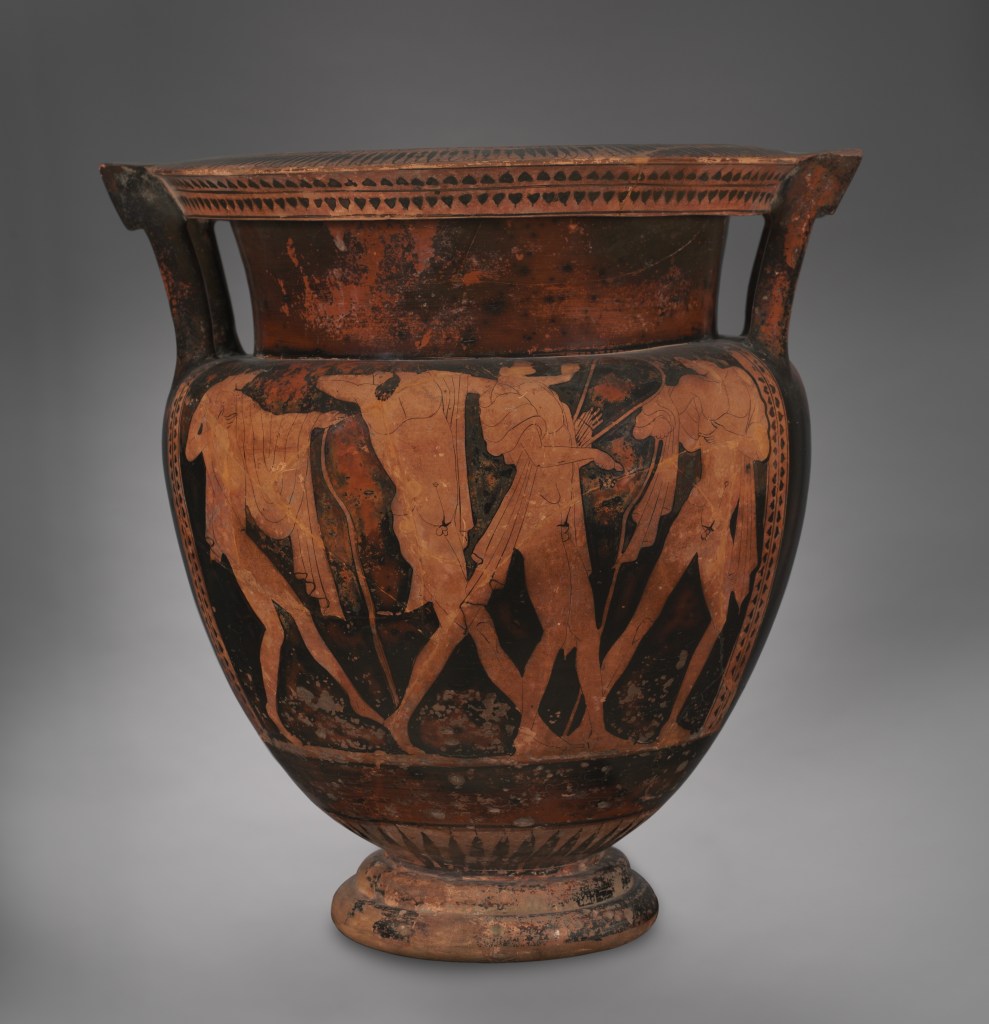
This column krater once held watered wine,
Its figures, red on black, an illustration
Of how it served the daily and divine.
On one side Hera offers a libation
With Artemis, Apollo, and their mother,
While three nude athletes and a bearded man
Are drunk with more than liquor on the other.
I stare through all four panes of glass that ban
All but my eyes from learning every curve,
And I can only dream that luck and nerve
And my own art may earn a chance to feel,
As one of few who cares to understand
That ancient try to make one ideal real,
To feel it push through time with my own hand.

*****

Marcus Bales writes: “A poem is language in meter that evokes emotion in the reader. Those who write to express themselves are doing something other than writing poetry. No reader accomplished enough to be engaged in reading poems is in it for the writer’s blurt. It may be that the writer is trying to evoke the same emotion in the reader that the writer felt in the poem’s circumstances, but the goal remains to evoke that emotion in the reader, not merely recount the writer’s emotion.

Poems that fail to evoke emotion in the reader are failed poems and, alas, every poet has several. They wait patiently like the mythic swordsman in fairytales to keep the protagonist from going through the door behind them. Our hero or heroine arrives in the room, the swordsman puts down Kant’s ‘Critique of Pure Reason’ – in the original German – and smiles, drawing a sword. The writer, however already wounded or tired from the effort of getting there, engages and soon enough, after an elaborate exploration of the waiting swordsman’s skills, is disarmed. The swordsman bows, kicks the writer’s sword back to him, sheathes his own, picks up his book, and sits down again, angles it to the light from the only window, nods goodbye, and resumes his perusal. The writer picks up the disgraced weapon, and trudges back out the way they came in. That poem still does not do what the writer intended to do: evoke emotion in the reader; all it remains as is an account of his or her own emotion.

It is the strength of that felt emotion that keeps the writer coming back to the failed poem, ever hopeful that it is an exception to the unyielding rule that the poem is for the reader, not the poet. Some poets make careers out of performing such things, their agents guaranteeing that the poet will cry during the performance, sure that the promoters are only interested in the performance, not in its effects on the audience. And there are audiences for whom watching the performer fail in their presentation is the point. No one involved in that scenario is there for poetry.

Unfortunately, this poem, ‘Cleveland Krater’ is one of those failed poems. Absent the actual krater, I have finally come to realize, the reader is not going to experience the emotion I did. I have come back and back to this piece, always after having visited the krater again, examining it closely through its Plexiglas box, looking for the clues that moved me and still move me, to try to shove them into words that will bring that impact I felt to the reader. Maybe if I just admit my failure I will get free of the draw of its blade when I arrive at it, again, hoping that this time I’ll do better than the dismissive kick of my sword clattering across the stone floor.”

Not much is known about Marcus Bales except that he lives and works in Cleveland, Ohio, and that his work has not been published in Poetry or The New Yorker. However his ’51 Poems’ is available from Amazon. He has been published in several of the Potcake Chapbooks (‘form in formless times’).

An extensive review of the Cleveland Krater and its creator can be found at https://www.academia.edu/12708103/The_Cleveland_Painter. You don’t need to log in or register, you can simply scroll down to read the entire pdf.

Photo: provided by the Cleveland Museum of Art https://www.clevelandart.org/art/1930.104#

Potcake Poet’s Choice: Richard Fleming, ‘Blackbird’

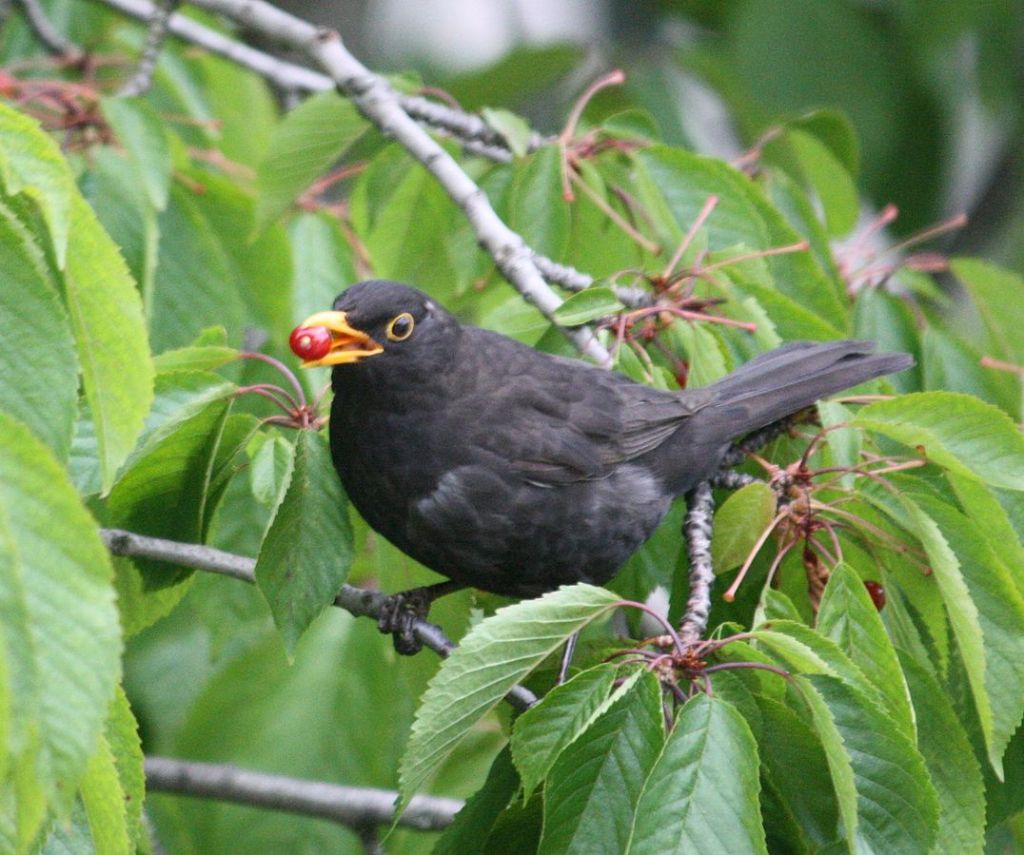
With catapult, once school was finished,
I went to hunt in woodland, high
above the town, in summer light
and heard, among leafed branches spread,
a blackbird, singing like a bell.
I took aim, shot; the missile flew
unerringly, my aim was true,
with awful suddenness it fell,
all broken. Exultation fled,
to be replaced by sickly fright.
I knelt to watch it slowly die.
Within me somewhere, light diminished.

*****

Richard Fleming writes: “I wrote Blackbird, an autobiographical poem, many years ago, with a rhyme scheme that I believed I’d invented. I’ve since learned that the pattern is well established and is known as Chiasmus, the repetition of any group of verse elements in reverse order, such as the rhyme scheme ABCDEEDCBA. Examples can be found in Biblical scripture (“But many that are first / Shall be last, / And many that are last / Shall be first”; Matthew 19:30). The poem records a coming-of-age event and such experiences can sometimes be traumatic.”

Richard Fleming is an Irish-born poet currently living in Guernsey, a small island midway between Britain and France. His work has appeared in various magazines, most recently Snakeskin, Bewildering Stories, Lighten Up Online, the Taj Mahal Review and the latest Potcake Chapbook ‘Lost Love’, and has been broadcast on BBC radio. He has performed at several literary festivals and his latest collection of verse, Stone Witness, features the titular poem commissioned by the BBC for National Poetry Day. He writes in various genres and can be found at www.redhandwriter.blogspot.com or Facebook https://www.facebook.com/richard.fleming.92102564/

Photo: Male common blackbird with feed in Lausanne, Switzerland, by Shantham11, is licensed under CC BY-SA 3.0

Calling the Poem: 6. ‘Of Sacrifice’

You learn to call, to pray, and to invoke
the gods with incense, roasting meat and smoke,
the smell drawing the gods like flies.
They like being honoured, they like gifts and sacrifice.
How do you gift a god of writing? Write!
Write when you have a thought, write day, write night.
How do you sacrifice? Accept this hardship:
you give up all activities
(regardless of your duties, your proclivities,
relationships) – for bardship,
because you don’t have time for them and writing.
Downgrade all love, work, striving, fighting –
for you must write.
You read, read, write, recite,
write and rewrite,
reread and rerecite.
(The modes you read impact the words you write,
impact the thoughts you have, and how they’re phrased.
Read novels, you’ll have thoughts in prose: straight, trite;
read verse, your thoughts will ramble, rhyme, be crazed.)
How bargain with the gods? Well, you can offer.
Can you demand? Well, no; you can’t.
Do they play fair? Take care with what they proffer;
you’re never sure if it’s a loan or grant.
How long will favours last? While you’re in favour;
a god or goddess owns you like a slaver.
And while for them you still produce,
still honour them… you still have use.
So keep on writing until you collapse,
and they’ll continue liking you. Perhaps.

*****

This is the sixth in the 15-poem sequence on Calling the Poem. The basic idea is that if you pay attention to the little scraps of poetry that come your way, in a random rhyme, a stray image; if you write them down and expand on them as you can; if you respect what comes to you, even if it isn’t what you want to hear; if you spend more time immersed in the medium that you want to develop… then you are encouraging the further communication from the mysterious force that provides the insights and images and words, the force that appears to be both inside and outside of you, the force that can be thought of as a muse or god. But the process is unreliable, because gods are unreliable, being inherently uncontrollable by us.

Matthew Arnold has a typically lugubrious and pessimistic overview of ‘The Progress of Poesy’:

Youth rambles on life’s arid mount,
And strikes the rock, and finds the vein,
And brings the water from the fount,
The fount which shall not flow again.

The man mature with labour chops
For the bright stream a channel grand,
And sees not that the sacred drops
Ran off and vanish’d out of hand.

And then the old man totters nigh
And feebly rakes among the stones.
The mount is mute, the channel-dry;
And down he lays his weary bones.

But that’s Matthew Arnold for you. He had a remarkably mournful muse. Perhaps he spent too much time as a responsible Victorian, a dedicated Inspector of Schools, and not enough time in the state T.S. Eliot called the “necessary receptivity and necessary laziness” of the poet. Eliot again: “The progress of an artist is a continual self-sacrifice, a continual extinction of personality.” You are striving to be at the mercy of forces outside your conscious control – there can be no guarantee that it will work out exactly the way you want.

Illustration: “Sacrifice” by Tamara Artis is licensed under CC BY-SA 2.0.

Calling the Poem: 5. ‘Of Muses’

When thoughts, fantastic dreams, bright images,
invade you from inside without relief –
thoughts that aren’t yours, nor come from the outside –
then, heedless of the real world’s scrimmages,
you can’t ignore, forget, refute, refuse.
Forces not you, that ride you and bestride,
when viewed with self-delusion, self-belief,
must therefore be some spirit, god, or muse.

*****

This is the fifth of the 15 poems in the ‘Calling the Poem’ series, published as a Snakeskin e-chapbook. From the awareness of the creative mood to the valuing of an idea, to the attempt at expression, to the crafting and polishing of the item, there are several stages in the creation of a piece of art. I am trying to lay out my sense of this process, and of how any individual can choose to develop it, and produce more and better art.

It’s my belief that many, many people could be the most amazing poets or other creators, but they don’t go down that path because they choose not to pay attention to the stray thoughts and images that come their way. For those of us who try to follow and develop the images, there is always the question of where they come from: from within us, or from the outside? I think humanity’s self-understanding is very primitive so far, and that there are layers under layers still to be peeled back. All our answers are best guesses, working hypotheses, delusions… but they are all we have, and valid and valuable when seen in that light.

Most of the poems in this series are semi-formal – they have enough rhythm and rhyme to facilitate their recitation, but lack the formal structures, the appropriate patterns, that can be aspired to. To me the recitation is key, because poetry is auditory in nature, in its origin, at its heart. It is almost as old as singing, which is in turn almost as old as rhythmic babbling and drumming. The poem printed on the page is not the poem itself, it needs to be read (aloud, or in your mind’s voice) in order to become the poem.

So I don’t have strong opinions on whether to capitalise the first letter of each line of a poem: it doesn’t impact the sound. But if it can help with the reading and comprehension – by not capitalising and thereby showing the flow of the sentence, or by capitalising in order to differentiate from spillover part-lines and thereby retaining the metre or rhythm – then an appropriate choice should be made. The version of this work that I am using is all first-letter capitalised. I’ve modified that today because I felt the poem was more comprehensible when the individual sentences were more clearly marked; the issue isn’t otherwise important.

And, no, I’m not impressed with concrete poems or shape poems as verse, although they can be excellent as jokes and witticisms.

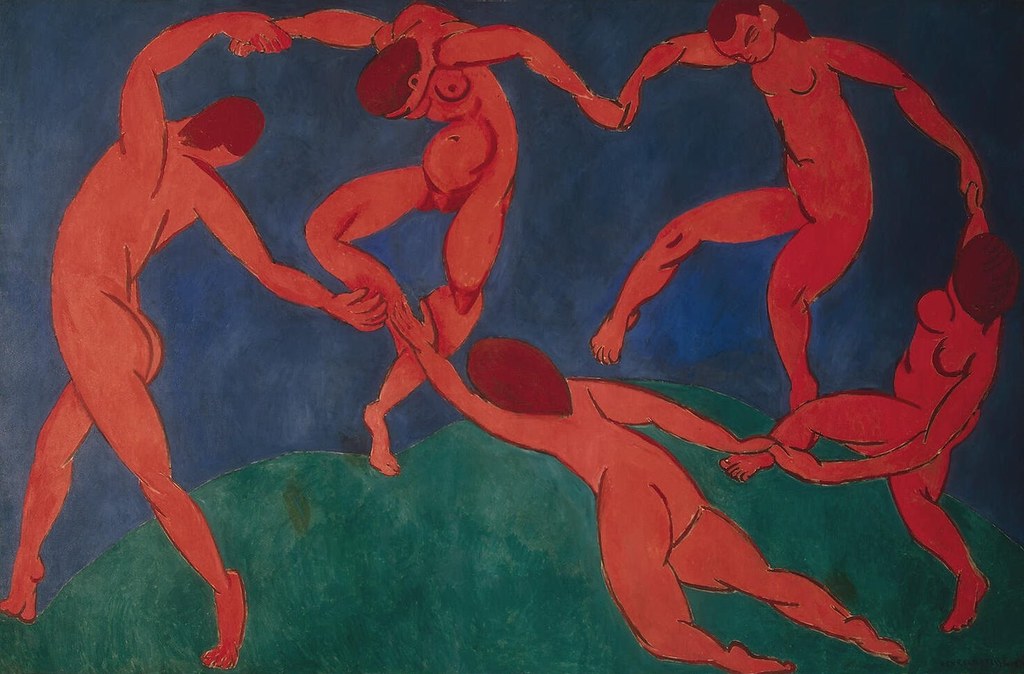
Photo of “Henri Matisse – Dance [1910]” by Gandalf’s Gallery is licensed under CC BY-SA 2.0.