In the winter the Interior stops The shops close Clocks unwind Clothes hang frozen on the line.
With the summer tourists gone Birdsong is ended The water is locked away in the hills And the waterfall hangs suspended.
No one takes down the signs that read “Entering tunnel, remove sunglasses”. Stopped by the wind at the top of the passes We look down On some tiny, frozen, unmoving town, Down on a land without seed.
The city, car-filled, cascading, bickering, Seems so long, long ago. Look down on the river trickling Through the desert dusty with snow – The tracks of coyote and deer Echo the unseen in our own austerity. Will Spring ever come, here? In this desolate clarity? With blossoming fruit trees and softening lakes?
It will, and the snow will be brushed from the sage But until then the only life that we see Is: Giant snowflakes Lily pads of ice Flowing down the Fraser to the sea.
In 1975 I had started living in British Columbia (where every landscape is monumental and dramatic), and I was friends with a young man who was in and out of mental hospitals. Under the stresses of university finals and high parental expectations, he had flipped out: as best I remember, he had boarded an airplane that was being cleaned and tried to hijack it from the cleaning lady with a pocketknife. At the time of writing the poem I believed he would work through his mental breakdown and return to a quiet, charming, intelligent existence. Unfortunately that was happening too slowly, and he died a couple of years later in a fire at a halfway house.
The poem was published in Candelabrum Poetry Magazine, a British publication that appeared twice yearly from April 1970 to October 2010, dedicated to keeping traditionalist poetry alive through those darkest of poetry decades.
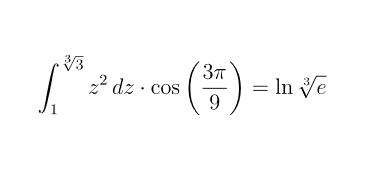
Integral z-squared dz from 1 to the cube root of 3 times the cosine of three pi over 9 equals log of the cube root of ‘e’.
Note that this limerick relies for its rhyme on the American pronunciation of “z” as “zee”. For the “z = zed” half of the world, you can substitute in another letter such as “t”. What it all means is beyond me… however much I had of this in school is long forgotten. I’m much happier with the Mathematical limerick in an earlier blog post.
This limerick appears in a book by Devine and Cohen, ‘Absolute Zero Gravity‘, but it is not clear that any of the poems, jokes and puzzles collected in it actually originate with the authors, as they are all “collected” but unattributed.
A man-like god creates the universe? Two hundred billion galaxies? Each holding a hundred billion stars? And each star moulding its planets into life, teeming, diverse! All this from some bearded old angry face who says “Build me a temple, pray, and pay the priests who’ll guide you onto Heaven’s way, erase your sins . . . or you’ll go in disgrace to torment underground — eternally.” No way your life gains from such small belief, passed on by some royal or holy thief who says “God wants your money, send it me — my palace honours Him . . .” The human lurches fearful, confused, through wastes of wasteful churches.
As social animals, we find our place by walling others out, putting them down: these walls, my family; those walls, my town. Even more walls: tribe, country, faith or race. This atavism’s bad for mental health, supports no sense of personal strengths or meaning, allows no purpose, individual leaning, denies achievement to your inner self. Identity’s reduced to football fan, or something uniformed, or some group prayer; without those — alcohol, drugs or despair, not knowing how to move past Nowhere Man. Know yourself, human, to confront the Void: your proper study’s all that’s anthropoid.
You can think of these two sonnets as the result of ten years of Church of England boarding school–five years in Jamaica, five in England–where Scripture lessons and daily church services were complemented by solid science and rigourous literature. And of course the Church of England recognises no Pope except the man who wrote “Know then thyself, presume not God to scan; the proper study of Mankind is Man.” So here you see the fruits of a well-rounded education.
This poem has just been published in Better Than Starbucks, a remarkably extensive poetry journal (and with some fiction too). The bulk of my BTS-published poems are in the Formal Poetry section, but there are many other sections–it’s a 100-page magazine. The online version is free, and well worth exploring.
That may not look like a limerick to you, but if you read correctly it can be!
A dozen, a gross, and a score Plus three times the square root of four Divided by seven Plus five times eleven Is nine squared and not a bit more.
Leigh Mercer was a very odd character. Born the son of a Church of England pastor in 1893, he said “I have been taught to regard myself as the fool of the family, a professional ne’er-do-well.” From 1910 to 1959 he held between 60 and 85 different jobs: in the engineering shops of 30 motor car companies including Rolls-Royce and Ford, as a nurse to a wealthy invalid, as a Post Office Savings Bank clerk, a pavement artist, a carnival sideshow assistant, an English tutor in Paris…
He loved puzzles and wordplay, especially palindromes. He is best known for creating “A man, a plan, a canal – Panama.” There is an 8-page biography of himhere, including 100 palindromes. Leigh Mercer died in 1977.
Merie sungen the Muneches binnen Ely, Tha Cnut ching reu ther by. Roweth, cnites, noer the land, and here we thes Muneches saeng.
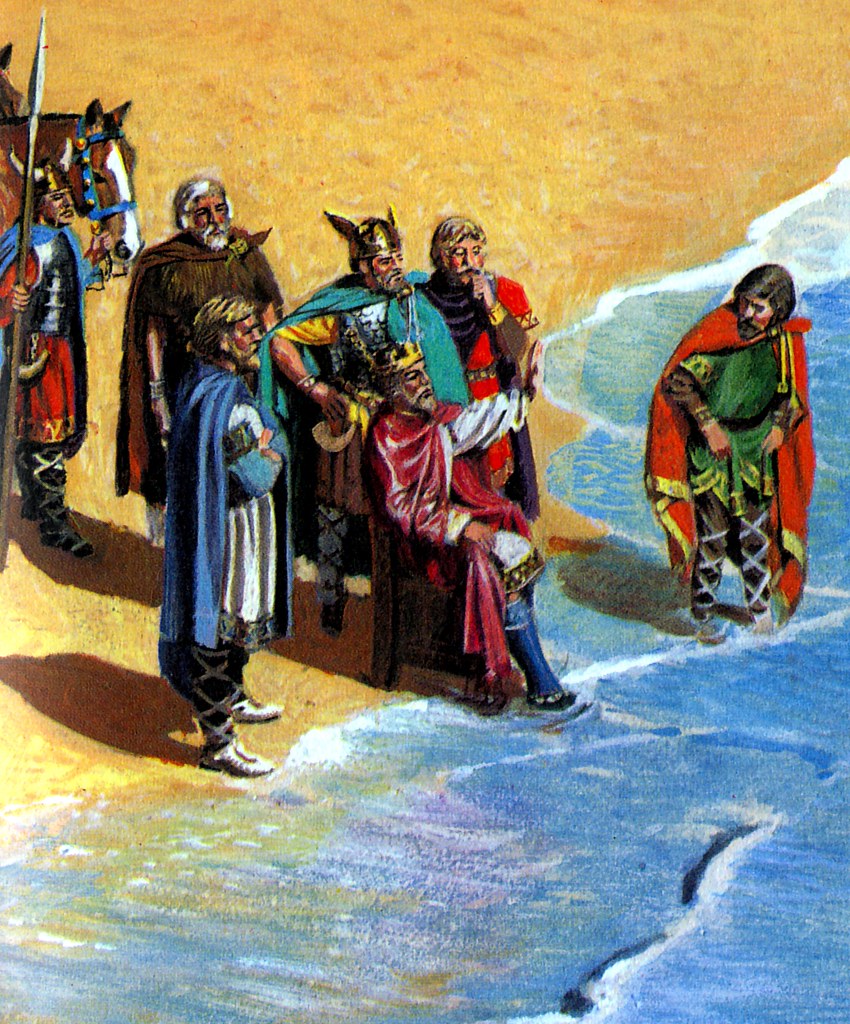
King Canute, on a journey by water to Ely, heard the chanting of monks and at once–according to the 12th century Liber Eliensis, but translated out of the original Latin and Old English–“With his own mouth expressing the joy he felt in his heart, he composed a song in English, in these words, which begins thus:
Merrily sang the monks of Ely As Canute the king rowed there by. Row, knights, nearer the land, And hear we these monks’ song,
and the rest that follows, which to this day is sung at dances among the people and remembered in popular sayings.”
After a rocky beginning, the Danish-born Canute (or Cnut) became a well-loved King of England. Canute’s father Sweyn Forkbeard, King of Denmark, had invaded England twice. The first time was in 1003 to avenge the death of his sister Gunhilde in the St. Brice’s Day general massacre of Danes ordered by the Wessex King Æthelred the Unready (the massacre itself being in response to years of slaughter and pillage by raiding Danes). The second time was in 1013, when he overthrew Æthelred. Sweyn died in 1014, and Æthelred resumed his rule. Sweyn’s son Canute invaded in 1015, Æthelred died in 1016, and Canute the Great ruled England (and Denmark, and latterly Norway) until 1035.
First misconception: Æthelred the Unready doesn’t mean he was ill-prepared. The “red” or “rede” in both his name and his nickname means “advice”, and his pun of a nickname makes him “King Well-Advised the Ill-Advised”.
Second misconception: King Canute wasn’t being foolish in the story of his ordering the incoming tide to stop. He did it to shut up the flattering courtiers who told him he was all-powerful and could do anything. He had his chair set up on the beach and ordered the tide to go back; when the sea soaked him and his courtiers, he made it clear that he wanted truth and not flattery from his advisers.
Canute married King Æthelred the Unready’s widow Emma, perhaps for political reasons and as a way for Emma to protect her sons; it seems that the marriage grew to be very affectionate. Canute was very happy in England, and increasingly relied on the Anglo-Saxon nobility rather than on imported Danes for his control, taxation and administration of the country. Two of his sons followed him as kings of England, and for a while it looked like England might become a permanent part of Scandinavia. And personally, as an Anglo-Dane, I regret this didn’t happen.
“In the beginning was the Word.” What word? Said by what tongue? Indeed, said in what tongue? And by what consciousness was the Word flung Out into Nothing, as from Ark a bird? Nothing will come of nothing, we’ve concurred. A billion galaxies, from Nothing sprung? How “the beginning,” if a lowest rung Requires both ground and ladder? It’s absurd. Religions, sects, philosophies and schools, Simple or complex, always come to grief Because our grasp of Nothingness is flawed. The atheist rightly shows all gods are fools; The agnostic claims that any held belief — Including one in Nothing — is a fraud.
I’ve written poems for and against various religions, depending on my mood and on whatever idea I was exploring. But in the end I come back to disbelief. I’m a militant agnostic: “I don’t know, and neither do you!” And this acknowledgement of ignorance of where the Universe comes from is emphatically NOT an endorsement of any religion. It is an endorsement of the (probably hopeless) search by science for all the answers.
This sonnet, with Petrarchan rhyme scheme ABBA ABBA CDE CDE, was originally published in Bewildering Stories, issue 789. I’ve tinkered with the penultimate line since then, trying to improve the metre.
First: a warning: I haven’t seen the printed version, but I have modified a transcription to try to catch the essence of the various types of wordplay that the poet engaged in, with bold for rhyme and italics for alliteration and repetition. These excerpts are from the earlier parts of her poem, skipping some less poetic portions.
When day comes we ask ourselves where can we find light in this never-ending shade? The loss we carry, a sea we must wade. We’ve braved the belly of the beast. We’ve learned that quiet isn’t always peace. In the norms and notions of what just is isn’t always justice. And yet, the dawn is ours before we knew it. Somehow we do it. … And yes, we are far from polished, far frompristine, but that doesn’t mean we are striving to form a union that is perfect. We are striving to forge our union with purpose. To compose a country committed to all cultures, colors, characters, and conditions of man. And so we lift our gazes not to what stands between us, but what stands before us. We close the divide because we know to put our future first, we must first put our differences aside. We lay down our arms so we can reach out our arms to one another. We seek harm to none and harmony for all. Let the globe, if nothing else, say this is true. That even as we grieved, we grew. That even as we hurt, we hoped. That even as we tired, we tried that will forever be tied together victorious. Not because we will never again know defeat, but because we will never again sow division.
Scripture tells us to envision that everyone shall sit under their own vine and fig tree and no one shall make them afraid. If we’re to live up to her own time, then victory won’t lie in the blade, but in all the bridges we’ve made. That is the promise to glade the hill we climb if only we dare. It’s because being American is more than a pride we inherit. It’s the past we step into and how we repair it. We’ve seen a force that would shatter our nation rather than share it. Would destroy our country if it meant delaying democracy. This effort very nearly succeeded.
Amanda Gorman’s poem for President Biden’s inauguration was an extremely well received performance of Spoken Word. As the Wikipedia entry states, Spoken Word focuses on “the aesthetics of recitation and word play, such as the performer’s live intonation and voice inflection.” With its roots in preliterate societies, it searches for all possible tricks for both capturing the audience’s attention, and making it easier to memorise the words. Amanda Gorman did this extremely well in her recitation, with clarity and with effective pacing, pausing and emphasis, carrying the thoughts along in a chant-like flow of rhymes, half-rhymes, puns and alliteration. It was a superb piece of Spoken Word, and left listeners enthused and uplifted. It was perfect for the mood of the inauguration.
But it wasn’t flawless. In places either the transcription is flawed or the poet has sacrificed meaning for the sake of a rhyme. Take “even as we tired, we tried that will forever be tied together victorious”. There is a flow of suggestion that imparts a meaning, but looked at under a bright light the words sound like those of a drunk.
Or take the rhyme sequence “afraid, blade, made, glade”. OK, but I stumbled over “That is the promise to glade”. Perhaps she means “the promise to make an open clearing through the forested hill we are climbing.” My bias is that I think of a glade as a flat clearing in woodland–I didn’t see the meaning of the verb she created, I didn’t think of a hill being climbed as being forested, but that may all be my problem. Similarly, I like the rhyming of “inherit” with “repair it” and “share it”; but what does this mean: “We’ve seen a force that (…) would destroy our country if it meant delaying democracy.” This is clumsy. It’s not clear exactly what is being said. If “would” means “is intended to”, then presumably she should have inverted the phrase: the force wanted to delay democracy, even if it meant destroying the country. Yet it is clearly all part of a political message: the end of Trump’s deliberate White America divisiveness, a return to the modern world’s multiethnic inclusiveness. As she triumphantly ends her piece:
The new dawn blooms as we free it. For there is always light. If only we’re brave enough to see it. If only we’re brave enough to be it.
So we have an inspiring piece of performance art, of spoken word, by a 22-year-old who has a lot of talent and a great stage presence. I’m sure we’ll hear a lot more from her. But I suspect that if her words are to last, she will have to develop a stronger control of meaning. The jagged nature of her lines is not a problem; the lack of structure to her rhyme is not a problem; in some ways she seems close to Old English and other Germanic poetry with their emphasis on a heavy beat (rather than a set number of syllables), and a long way from the “modern poetry” that, without metre or rhyme, tries to get an effect by being laid out provocatively on a page.
When I was fair and young, and favour gracèd me, Of many I was sought, their mistress for to be; But I did scorn them all, and answered them therefore, ‘Go, go, go, seek some otherwhere, Importune me no more!’
How many weeping eyes I made to pine with woe, How many sighing hearts, I have no skill to show; Yet I the prouder grew, and answered them therefore, ‘Go, go, go, seek some otherwhere, Importune me no more!’
Then spake fair Venus’ son, that proud victorious boy, And said, ‘Fine Dame, since that you be so coy, I will so pluck your plumes that you shall say no more, ‘Go, go, go, seek some otherwhere, Importune me no more!’
When he had spake these words, such change grew in my breast That neither night nor day since that, I could take any rest. Then lo, I did repent that I had said before, ‘Go, go, go, seek some otherwhere, Importune me no more!’
Elizabeth (Ms. Tudor, if you prefer) was born in 1533 and became Queen of England at age 25, in 1558. This poem dates from some three or four years later, and the painting above is from the same time. Given how youthful she looks in her late 20s, the poem may be more playful than self-pitying–but she was also well past the age that sex and marriage would have been expected. As it was she had had to lead an extremely careful life: England was weak and unstable when she came to the throne: her father Henry VIII had broken with the Pope and formed the Church of England; her older sister Mary, on becoming Queen, had turned the country back to Catholicism and Elizabeth had narrowly escaped death as a traitor; Elizabeth inherited a country where people were burnt at the stake for not being of the correct faith… but the correct faith kept changing.
By her late 20s the Court was trying hard to have her married to a powerful European monarch to strengthen the country by alliance. The Catholic Philip II of Spain was one possiblity, the Lutheran Erik XIV of Sweden was another. Again, everything involved a religious balancing act. Meanwhile flattering portraits showing vitality and power were created and exchanged as part of the negotiations–and Elizabeth sent her court painter to Sweden to paint Erik. But for whatever reason she never married. In 1588 Philip attempted a full scale invasion with his Armada, but that failed as well. Elizabeth died in 1603 aged almost 70, still nicknamed (though probably unfairly) ‘the Virgin Queen’.
Regarding the poem: technically, the first three lines of each stanza are in iambic hexameter and are followed by an uneven refrain. The first two lines rhyme, and the third rhymes with the end of the refrain. It looks very singable. There is some unevenness in the scansion, and Elizabeth has marked the midpoint of most of the hexameters with a comma; this divides the line into two natural clauses or parts, and also signals a little pause for the sake of smooth reading–particularly useful in the shortened second line of the third stanza and the lengthened second line of the fourth.
Photo: Painting of Elizabeth I in 1562, probably painted by her court artist Steven van der Meulen, or his workshop.
Poems are merely words you can remember word for word. Question: What makes them so? Think of the earliest nursery rhymes you know, held from child’s January to old December: rhymes, rhythms, imagery—rich as meringues. Then complicate discussion, don’t reduce odd imagery, words foolish, strange, diffuse— aim for rijsttafel with tongue-tingling tangs. Use richness to engage the memory: conflicting quotes from Bible, Shakespeare, Yeats, with Bach-like sense of heaven’s opening gates or hall of mirrors, or sun-scattering sea… Mesmerized readers have to puzzle out in memory mazes what it’s all about.
My firm belief is that poetic structures originate as nothing more than memory aids, so that a work can be recited word for word. This was invaluable in preliterate societies and was used for tribal histories and spiritual revelations (Muhammad was illiterate, and the most powerful passages of the Quran are in strongly rhythmical rhyme) as well as for lullabyes and love songs. But the use of our human love of rhythmic beat, and our enjoyment of rhyme and wordplay, have helped verse develop into elaborate, engaging, memorable forms, varying by culture because of the different opportunities of the different languages. Enjoy the diversity, and the complexity!
This sonnet, like ‘The Four Duties‘, has just been published in the Winter 2020 edition of The Orchards magazine of formal poetry.
It’s coming through a hole in the air From those nights in Tiananmen Square It’s coming from the feel That it ain’t exactly real Or it’s real, but it ain’t exactly there; From the war against disorder From the sirens night and day From the fires of the homeless From the ashes of the gay Democracy is coming to the U.S.A.
It’s coming through a crack in the wall On a visionary flood of alcohol From the staggering account Of the Sermon on the Mount Which I don’t pretend to understand at all; It’s coming from the silence On the dock of the bay From the brave, the bold, the battered Heart of Chevrolet Democracy is coming to the U.S.A
It’s coming from the sorrow in the street The holy places where the races meet From the homicidal bitchin’ That goes down in every kitchen To determine who will serve and who will eat; From the wells of disappointment Where the women kneel to pray For the grace of God in the desert here And the desert far away Democracy is coming to the U.S.A.
Sail on, sail on O mighty ship of state! To the shores of need Past the reefs of greed Through the squalls of hate Sail on, sail on, sail on…
It’s coming to America first The cradle of the best and of the worst It’s here they got the range And the machinery for change And it’s here they got the spiritual thirst; It’s here the family’s broken And it’s here the lonely say That the heart has got to open In a fundamental way Democracy is coming to the U.S.A.
It’s coming from the women and the men Oh baby, we’ll be making love again We’ll be going down so deep The river’s going to weep And the mountain’s going to shout Amen! It’s coming like the tidal flood Beneath the lunar sway Imperial, mysterious In amorous array Democracy is coming to the U.S.A.
The United States is a “flawed democracy” (as defined by The Economist Intelligence Unit, see below). “Democracy” was written by the Canadian poet/singer/novelist Leonard Cohen over three years in the early 1990s. The song as we have it was boiled down from some 60 verses, scattered through seven or eight notebooks. In his book “Songwriters On Songwriting” he explains, “This was when the Berlin Wall came down and everyone was saying democracy is coming to the east. And I was like that gloomy fellow who always turns up at a party to ruin the orgy or something. And I said, ‘I don’t think it’s going to happen that way. I don’t think this is such a good idea. I think a lot of suffering will be the consequence of this wall coming down.'”
There are so many strong lines in this poem that, although written 30 years ago, resonate today. I particularly like
It’s coming from the sorrow in the street The holy places where the races meet
and the mention of America as
The cradle of the best and of the worst
as well as the timeless, human dynamic of
From the homicidal bitchin’ That goes down in every kitchen To determine who will serve and who will eat;
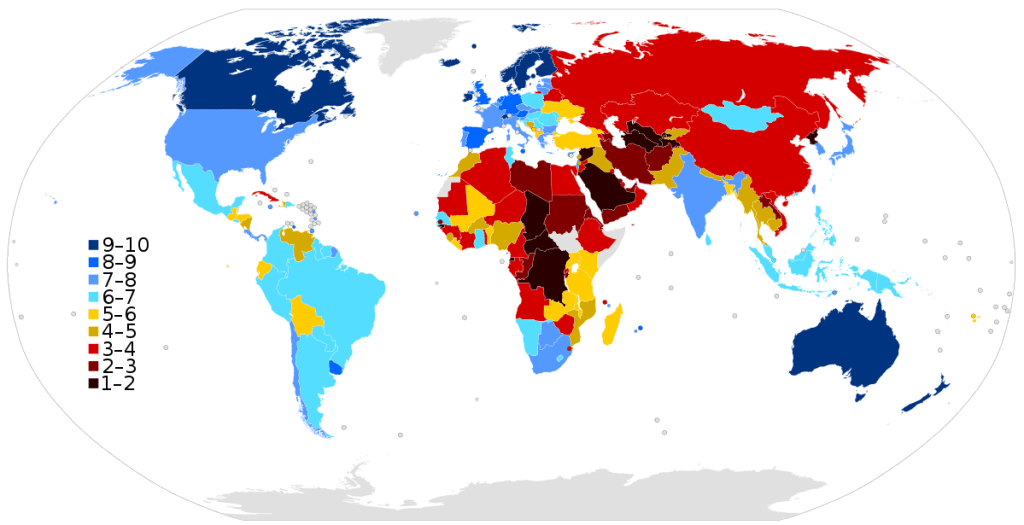
Photo: A map of the world showing the results of The Economist’s Democracy Index survey for 2016. This file is licensed under the Creative CommonsAttribution-Share Alike 4.0 International license. The USA has been stuck in the third tier for the past few years, scoring below 8 on a 10-point scale. Those in the first tier, scoring above 9, are the five Nordic countries plus New Zealand, Australia, Ireland, Canada, Switzerland and the Netherlands.
Note that almost all of the top tier countries use some form of Proportional Representation (PR) to elect their governments. Several of their parliaments include parties with Trump-style xenophobic parties, because it is important to include representatives of all opinions in a democracy. But with PR the most extreme parties of right and left are unlikely to be included in a government, let alone dominate it. With PR the parliament gets the benefit of hearing all concerns and points of view, and the voters get the opportunity to vote more closely for who they want: a choice of libertarian, fundamentalist, green communist, as well as more mainstream conservative, liberal or social democrat. Voter turnout is naturally higher than in a two-party system which fails to address the interests of a large percentage of the population.
Other points that can be made from looking at the truest democracies: 1) Unicameral structures score best, meaning the US could have just the House, no Senate. 2) There is no need for separation of the Executive and Legislative functions; separating them doesn’t provide any benefit, despite the holy mantra of “checks and balances”, it merely destroys efficiency and obfuscates responsibility and encourages confrontation. 3) The Judiciary should not be appointed by the government, it functions best if it is developed with true independence within its own legal system.
The American system is an interesting historical artifact, but long outdated and highly counterproductive to good government. When Americans have written new constitutions for countries that they have taken over, the results have not been good. They should let the Scandinavians do it.
I recommend watching the Danish TV series ‘Borgen‘ (it has English subtitles) for a practical view of a single-chamber, multiparty system of coalition government.






 Form in Formless Times