Category Archives: parody

Marcus Bales, If Elizabeth Browning Had Written “I Will Survive”

How do I love you? Well, not any more —
I love you? Not even to bread slice height
That has been toasted, buttered, rye or white,
And dropped the wrong side down upon the floor.
I love you like a mildew or a spore
Or pestilential fungal blastocyte
That makes one’s breath itself a mortal fight
And living life seem like a choking chore.
I love you? The one who made the try
To break me with goodbye, yet kept that key
Because you thought that I’d lay down and die
If you returned, assuming I’d be free?
Oh no — I snarl and spit, deny your lie,
And save my love for one who’s loving me.

*****

I Will Survive‘ – Song by Gloria Gaynor ‧ 1978 on YouTube

At first I was afraid, I was petrified
Thinking I could live without you by my side
And after spending nights
Thinking how you did me wrong
I grew strong
And I learned how to get along

Now you’re back
From outer space
And I find you here
With that sad look upon your face
I should’ve changed that stupid lock
Or made you leave your key
If I’d’ve known for a second
You’d be back to bother me

Go on, go, walk out the door
Turn around now
You’re not welcome anymore
You’re the one who tried to hurt me with goodbye
Think I’d crumble?
You think I’d lay down and die?

No, not I, I will survive
Long as I know how to love, I know I’ll stay alive
I’ve got my life to live
And all my love to give and
I will survive
I, I, I will survive

It took all my strength not to fall apart
Trying with all my might to mend my broken heart
I spent so many nights feeling sorry for myself
How I cried
But now I hold my head up high

And you see me, somebody new
I’m not that lonely little person
Still in love with you
Now you come droppin’ in
Expectin’ me to be free
Now I’m saving my lovin’
For someone who’s loving me

Go on and go, walk out the door
Turn around now
You’re not welcome anymore
You’re the one who tried to hurt me with goodbye
Thinkin’ I’d crumble
Did you think I’d lay down and die?

No, not I, I will survive
Long as I know how to love, I know I’ll stay alive
I’ve got my life to live, and all my love to give
And I will survive
I, I will survive

Go on, go, walk out the door
Turn around now
You’re not welcome anymore
You’re the one who tried to hurt me with goodbye
Think I’d crumble?
You think I’d lay down and die?

No, not I, I will survive
Long as I know how to love
I know I’ll stay alive
I’ve got my life to live
And all my love to give and
I will survive
I, I, I will survive

Songwriters: Frederick J. Perren / Dino Fekaris

Marcus Bales writes: “It started after I’d posted If Shakespeare Had Written ‘Itsy Bitsy Spider’ to Sonnet Central, and Mike Alexander asked me if I was going to do the entire Mother Goose in Shakespearean sonnets. That sounded too much like real work to me, so I said I hadn’t thought of it, but I did have another “If Shakespeare Had Written” poem, “If Shakespeare Had Written ‘I Will Survive‘”. Looking that up in my files produced “If Yeats Had Written ‘I Will Survive‘”, as well, so I posted both those, and then Milton tapped me on the shoulder and cleared his throat. So I wrote that one. 

“My method is to find a stash or cache of poems by the next poet who seems particularly likely — or unlikely — to have written ‘I Will Survive‘ if they’d been asked, and read through it, looking for characteristic modes, moods, tones, concerns, and sometimes just an old favorite that seems ripe for it. A sort of instant immersion in a poet’s work, and then try to flow into their tonality. Like a singer interpreting a song I try to inhabit the poet’s mise en scene.  Some are more successful than others.”

Marcus Bales has now produced a dazzling array of his “If X Had Written ‘I Will Survive‘”, over 40 and still growing, with a dozen in the current Brazen Head, including this Elizabeth Browning as well as Dorothy Parker, Dylan Thomas, Wendy Cope, Robert Frost and of course Shakespeare. Go ahead, give them a try! – RHL

Not much is known about Marcus Bales, except he lives and works in Cleveland, Ohio, USA, and his work has not appeared in Poetry or The New Yorker. His latest book is 51 Poems; reviews and information at http://tinyurl.com/jo8ek3r

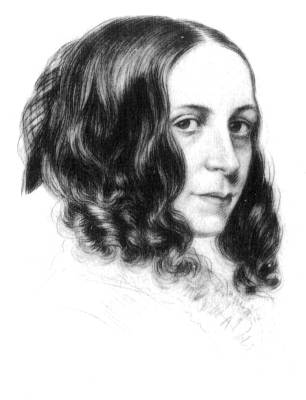
Illustration: Portrait of Elizabeth Barrett Browning in 1859. Public domain

Weekend read: Parody poem: Marcus Bales, ‘Slash Wednesday’

I
Because I do not do the limerick line
Because I do not do
Because I do not do the limerick
Desiring this man’s schtick or that man’s joke
I will stick to knocking out free verse
(If here and there a rhyme so much the worse)
In mournful moans
Presented ragged-right upon the page.

II
There once was a Lady with three
White leopards, a juniper tree,
And a bag full of bones
That sang their sad moans
Of what they had once hoped to be.

III
At every turning of the turning stair,
Your breathing hard, your eyesight edged with dark,
You see the face of hope and of despair.

You breathe the vapor of the fetid air
And toil as if some atmospheric shark
At every turning of the turning stair

Was hunting through the gathering darkness there,
While back and forth across the narrative arc
You see the face of hope and of despair.

At every turning there’s a window where
You contemplate a drop that’s still more stark
At every turning of the turning stair.

Instead you circle upward as you swear
Like you are looking for a place to park.
You see the face of hope and of despair.

You can’t endure the future’s dismal dare
Nor drag yourself to put out your own spark
At every turning of the turning stair.

You’re learning how to care and not to care
And whether you will make or be a mark.
You see the face of hope and of despair
At every turning of the turning stair.

IV
Higgledy piggledy
Here we are all of us
Trudging along where some
Billions have trod

Smelling the flowers and
Trusting religionists’
Tergiversational
Rodomontade.

V
If the word that is lost isn’t lost,
And the word that is spent isn’t spent
Then silence is actually speaking,
And meaning is something unmeant.

If the meaning is what is unheard
And the word is the thing that’s unspoken
Then how do you hear if a word
Has a meaning that hasn’t been broken.

If the unspoken word must be still
And the unheard is what it’s about
To have heard the unhearable meaning
The inside has got to be out.

If the unheard were out of this world
And the light shone in darkness were dark
Then the unlit unheard would be meaning
If the snuffer provided the spark.

If the yadda can yadda its yadda
And the pocus was what hocus took
Then gobble must surely be gobble
Though dee separates it from gook.

VI
Awake! Your hope to turn or not to turn
Is wasting time – but go ahead and yearn
To see the light or hear the word to know
A heaven human beings can’t discern.

There’s nothing there for such as you and me;
We make our meaning up from what we see
And hear and touch and taste and smell and think —
But all there is is fragments and debris.

The steps are just the steps, the stairs the stairs,
The rest is merely human hopes and prayers
That do no more than hopes and prayers can do,
And nothing’s chasing you except your heirs.

No unmoved mover writes upon some slate
That mortals may abate or not abate;
No hope and no despairing of that hope
Reveals what nothing states, or doesn’t state.

Whatever happens happens because of us
We get a muss when we don’t make a fuss
Demanding right from wrong not mere convenience:
We’re all complicit underneath this bus.

Awake! Don’t hope to turn or not to turn,
Don’t pray that this is none of your concern.
Awake! What will it take for you to learn
That if it all burns down you, too, will burn?

*****

Marcus Bales has produced this wonderful set of parodies of the long T.S. Eliot poem ‘Ash Wednesday‘, beginning with a piece in the poem’s style for Part I,
Because I do not hope to turn again
Because I do not hope
Because I do not hope to turn
Desiring this man’s gift and that man’s scope

but then moving into a limerick for Part II’s
Lady, three white leopards sat under a juniper-tree

and a 22-line villanelle for Part III’s
At the first turning of the second stair

and a double dactyl for Part IV’s
Who walked between the violet and the violet

and quatrains for Part V’s
If the lost word is lost, if the spent word is spent
If the unheard, unspoken
Word is unspoken, unheard;

and finally rubaiyat with a strong flavour of FitzGerald’s Omar Khayyam for Part VI’s
Although I do not hope to turn again
Although I do not hope
Although I do not hope to turn

Ash Wednesday‘ has proved one of Eliot’s best-known and most quoted poems, with its signature mixture of Christian mysticism, personal emotion, loose form and scattered rhyme, rich imagery and memorable wordplay. Bales’ ‘Slash Wednesday‘ is an appropriate tour de force of a back-handed homage, mocking Eliot’s ragged rambling with a sampling of forms that could have been used (inappropriately) instead.

Not much is known about Marcus Bales except that he lives and works in Cleveland, Ohio, and that his work has not been published in Poetry or The New Yorker. However his ’51 Poems’ is available from Amazon. He has been published in several of the Potcake Chapbooks (‘form in formless times’).

This is being posted a couple of days late for Ash Wednesday, but as it’s for the already late T.S. Eliot that shouldn’t matter too much…

Photo: “File:T S Eliot Simon Fieldhouse.jpg” by Simon Fieldhouse is licensed under CC BY-SA 3.0.

Using form: Parody: Brian Allgar, ‘Irretrievable Breakdown’

The Owl and the Pussycat went to the Judge,
For they sought to obtain a divorce.
“My dear Sir”, said the Owl, “I’ve no wish to be foul,
Though I fear you’ll consider us coarse.

Our plight’s anatomic; my efforts are comic
To exercise conjugal rights.
With our different bits, there is nothing that fits,
And this failure our happiness blights.”

The Pussycat spoke: “He’s a feathery bloke,
Whereas I’m rather furry and feline.
In vain we have tried to get Owly inside,
So to you we are making a beeline.”

Said her husband: “Your honour, I’ve struggled upon her
And hoped she would prove ‘pussycatable’.
It was useless, of course, and we’re seeking divorce
On the grounds that we’re quite incompatible.” 

So the Judge set a date to determine their fate:
“I’ll decide at the end of next week.”
But the cat came alone, though she carried a bone
And a handful of feathers and beak.

Said the Judge with a scowl: “Where’s your husband, the Owl?
Are you thinking to mock or deride me?”
Then the Pussy confessed:  “I have eaten the rest,
So my husband, at last, is inside me.”

*****

Brian Allgar writes: “What parodist can resist Edward Lear? A gold-mine probably second only to Lewis Carroll.”

Brian Allgar was born a mere 22 months before Adolf Hitler committed suicide, although no causal connection between the two events has ever been firmly established. Despite having lived in Paris since 1982, he remains immutably English. He started entering humorous competitions in 1967, but took a 35-year break, finally re-emerging in 2011 as a kind of Rip Van Winkle of the literary competition world. He also drinks malt whisky and writes music, which may explain his fondness for Mendelssohn’s Scottish Symphony. He is the author of The Ayterzedd: A Bestiary of (mostly) Alien Beings and An Answer from the Past, being the story of Rasselas and Figaro. He is also the co-author, with Marcus Bales, of Baleful Biographica, all published by Kelsay Books and available from the publisher or from Amazon.

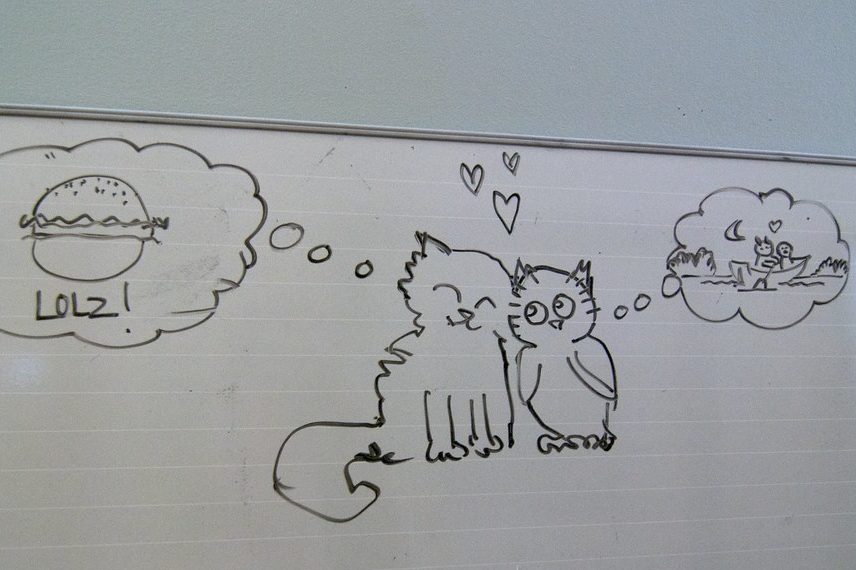
Photo: “What She’s Really Thinking” by lumachrome is licensed under CC BY-SA 2.0.

Using form: Parody with a message: Marcus Bales, ‘The Easy Way Taken’

Two friends diverged in a yelling mood
And sorry I could not keep them both
And still maintain one attitude,
I scrolled down through one’s page, and viewed
Some green and gold of writing growth.

Then saw the other was just as good,
With maybe even a better claim
Because so well misunderstood
Within the writing neighborhood,
Though as for that they’re much the same.

And each that morning equally laid
The blame upon the other’s back.
I had no way to tell who’d made
The first or worst move; I’m afraid
I have no feel for clique or claque.

Online I have too many friends
To keep good track, so, nothing loath
To making enemies or ends
Where there are no real dividends,
I shook my head – and blocked them both.

*****

Marcus Bales writes: “Most of the fraught relationships online are due to people not being able to write very well on one end, or read very well on the other. Stuff that in in-person conversation would go completely unnoticed is taken up as deliberate slighting. Mostly its merely awkward phrasing, or one interlocutor is already two comments past when the reply to the third interaction scrolls by and it’s misinterpreted as an instant response to the most recent reply when it was really intended to answer something two or three comments back.

“Now in the case of political disagreements where the polarized sides are already firmly established and one side or the other or both are determined to fight that’s a whole other thing. There it’s got nothing to do with how well or ill something is read or written and everything to do with the sport of online woofing.

“It’s one of those things where over the years people block and get blocked and complain to their friends about either end of it and then it all goes away pretty fast as the opportunity to be triggered — again at either end — fades with the blocking.”

(The original poem on which this parody is based, for those not familiar with it, is Robert Frost’s ‘The Road Not Taken‘. – RHL)

Not much is known about Marcus Bales except that he lives and works in Cleveland, Ohio, and that his work has not been published in Poetry or The New Yorker. However his ‘51 Poems‘ is available from Amazon. He has been published in several of the Potcake Chapbooks (‘Form in Formless Times’).

Photo: “Yotsuba & Tech Support” by Liberty Photos is licensed under CC BY-NC 2.0.

Weekend read: George Simmers, ‘Hymn’

All things dull and ugly, all creatures gross and squat,
All things vile and tedious, the Lord God made the lot.

He made the sly hyena, the hookworm and the slug,
Your moaning Auntie Margaret and pervy Uncle Doug.

He made that dreary Welshman who so often reads the news,
And he made us, the ragtag lot who worship at St. Hugh’s.

We’re far from high achievers, we don’t have gorgeous bods;
At best you’d call us humdrum, a group of odds and sods.

We’re verging on the useless and we have got a hunch
No deity could think we were a preposessing bunch.

That’s why we’re rarely cheerful, but feel a bit less blue
When thinking how the mighty Lord can be ham-fisted too.

‘Cause frankly we’d be daunted by a more efficient chap.
We feel a lot more comfy with a God who’s slightly crap.

*****

George Simmers writes: “This is a poem that would never have existed had it not been for the Spectator magazine, which each week sets a challenge to its readers, demanding produce a short piece of writing (it might be 16 lines of verse or 150 words of prose) on a particular theme. The task is often a silly one. A couple of years ago the demand was for a hymn beginning ‘All things dull and ugly…’

“Competitive light verse is a tradition that stretches back a long way in Britain. In the early years of the twentieth century Naomi Royde-Smith of the Saturday Westminster Gazette set challenges that were responded to by up-and-coming writers like Rupert Brooke and Rose Macaulay, among others. In the thirties the Weekend Review was notable for its literary competitions, and when that magzine was incorporated into the New Statesman, the comp came with it.

“Those New Statesman competitions became a notable feature of English literary life, producing star writers such as Allan M. Laing, Stanley J. Sharpless, Roger Woddis, E.O. Parrott, Martin Fagg, Bill Greenwell and Basil Ransome-Davies.. look in any good anthology of light verse, and you’ll find glittering examples of some of their work. The Spectator and Punch were later in running competitions that attracted many of the same writers.

“I first entered a New Statesman competition in 1981, earning a pound for a one-line joke. Easy money! I entered a few more, mostly prose, and it was a while before I had a verse winner. Before that my verse writing had been a bit modernist and self-indulgent; no more. To succeed in the comps you need to master rhyme and metre. It’s a great training ground. Wendy Cope, one of the best writers of neat epigrammatic verse today began in New Statesman competitions (Much of her first, and arguably best, book, Making Cocoa for Kingsley Amis, is made up of her competition winners.) At about the same time, D.A. Prince began her competition career, which continues in the Spectator today (and I’m proud to have her as regular poet in Snakeskin.)

“From the thirties to the seventies, the New Statesman was a crucial publication in British culture, with a left-wing front-end but back half that was welcoming to all sorts of attitudes and points of view. A couple of dull editors diminished its appeal and importance in the eighties, but the comps continued to flourish, though in the twenty-first century they mostly seemed to welcome only rather predictable political humour. A few years ago the editor, Jason Cowley arbitrarily cancelled them. I’ve not looked at the magazine since then, but I’m told that it has gone from bad to worse.

“The Spectator, meanwhile, has flourished. My first Spectator winner (which imagined Wordsworth doing a snooker commentary) was in 1983. It was the top winner that week, and in addition to a small cash prize I was sent a very good bottle of wine. Those were the days. At that time the competition was run by James Michie, himself a good poet notable for his translations of Horace and Catullus. His was a generous welcoming personality, and many talents flowered under his watch.

“After him, Lucy Vickery ran the comp for many years, showing good judgement Though when she went away on maternity leave for a while, a substitute was brought in who gave prizes to some very inept stuff. It’s not an easy job. At present Victoria Lane is the adjudicator. I like her, because she has awarded me a good few prizes. Others may have grumbled.

“The Spectator competition is today just about the only forum for light verse in Britain. While the respectable poetry outlets have mostly given up on traditional rhyme and metre (Have you ever tried to read the stuff printed in the heavily subsidised Poetry Review?) the Spectator comp still demands well-formed and witty verse. Bill Greenwell and Basil Ransome-Davies are still star turns, and they have been joined by Adrian Fry, Janine Beacham, Sylvia Fairley, Chris O’Carroll and others.

” ‘All things dull and ugly…’ was a task that appealed to me, because I’ve always been struck by the way church congregations can make even sprightly tunes like ‘All Things Bright and Beautiful’ sound really drab and tedious. The ‘dreary Welshman’ is Huw Edwards, a BBC news-reader whom I had always found obnoxious, especially when toadying to the Royals. I’m rather proud of having had a dig at him in this poem, which pre-dates his fall from grace when he was dismissed after his appalling taste in pornography was discovered.”

George Simmers used to be a teacher; when he retired he then amused himself by researching a Ph.D. on the prose literature of the Great War. He now spends his time pottering about, walking his dog and writing a fair bit of verse. He is currently obsessed by the poetry of Catullus, and may be issuing a volume of translations within the next year or so. He has edited Snakeskin since 1995. It is probably the oldest-established poetry zine on the Internet. His work appears in several Potcake Chapbooks, and his recent diverse collection is ‘Old and Bookish‘. ‘

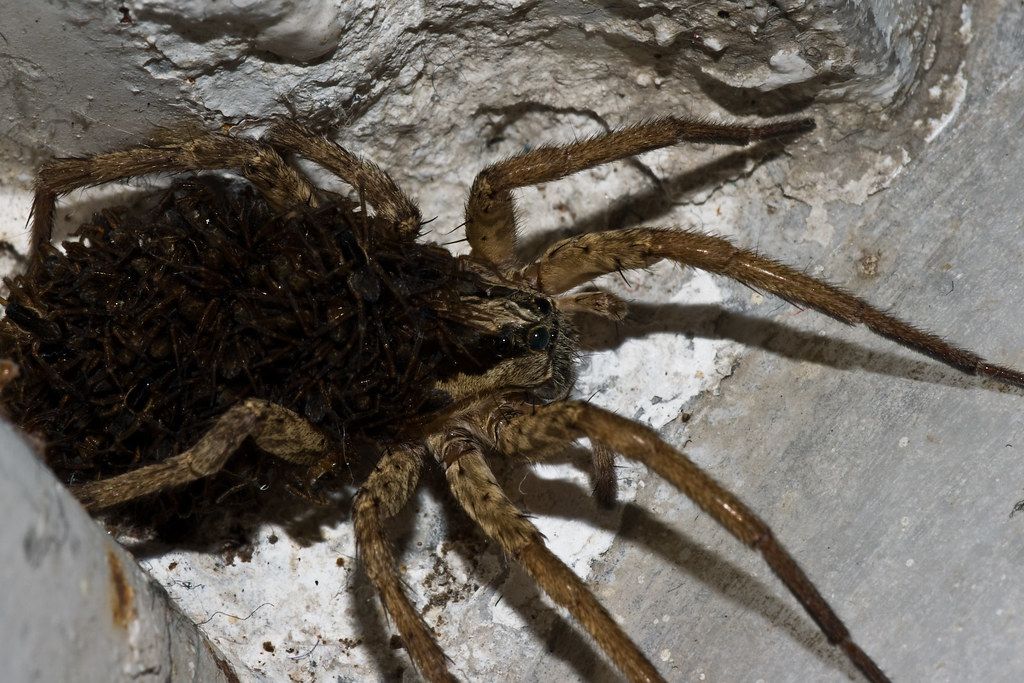
Photo: “Mother Spider” by agelakis is licensed under CC BY-NC-SA 2.0.

Odd poem: Parody of a Self-Parody of a Self-Parody: Melissa Balmain, ‘How Unpleasant to Meet Mrs. Hughes’

From the files of Sylvia Plath

How unpleasant to meet Mrs. Hughes,
Who’s so thoroughly, willfully odd.
It’s a wonder Ted happened to choose
Such a creature. (He’s rather a god.)

Her lipstick is always a mess.
She’ll go on for an hour or three
About Nazis or bees—as you’d guess,
This does not get her asked out to tea.

Her headbands aren’t quite comme il faut.
(They’re a match for her queer Yankee frocks.)
She knows more than a lady should know
Of low-voltage electrical shocks.

Come to think of it, lately she’s been
More appalling than ever before.
She looks sullen and terribly thin;
If you knock, she won’t answer the door.

Her complexion grows whiter and whiter.
She wears the most horrible shoes.
You can certainly tell she’s a writer.
How unpleasant to meet Mrs. Hughes!

*****

Melissa Balmain writes: “I believe this one started when a contest—probably in The Spectator—called for poems riffing on Edward Lear’s self-mocking ‘How Pleasant to Know Mr. Lear’ (and T.S. Eliot’s equally self-mocking parody of it). I found it funny and sad to imagine Sylvia Plath writing about how her English neighbors might see her. The poem was published in Mezzo Cammin.”

Melissa Balmain’s third poetry collection, Satan Talks to His Therapist, is available from Paul Dry Books (and from all the usual retail empires). Balmain is the editor-in-chief of Light, America’s longest-running journal of light verse, and has been a member of the University of Rochester’s English Department since 2010.

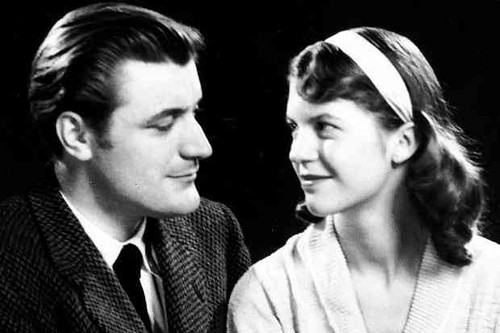
Photo: “TED HUGHES AND SYLVIA PLATH” by summonedbyfells is licensed under CC BY 2.0.

Using form: continued poem: Conor Kelly, ‘Daffodils’

Those daffodils that I recall
While lying on a bed settee
Are faded now, their petals fall
In nature and in memory.

It’s time to rise, to go outside
And head off for a subway ride.
I’m in New York’s YMCA
Undressing for a midday swim;

A poet could not but be gay
With bodies toned up in the gym.
But I am getting no cheap thrills
From dongs like dangling daffodils.

I twinkled at the twinkies there
Tossing their heads in sprightly dance
Or heading for the sauna where
I might get lucky if, by chance,

One of the bronzed and buffed young men
Is eager for my fountain pen.
But, sadly, no one needs to hear
This exiled poet strut his stuff.

I am an old Romantic queer,
Ignored, unloved. I’ve had enough.
I join the hustling New York crowd
And wander lonely as a cloud.

*****

Conor Kelly writes: “Daffodils was submitted as a prompt poem to Rattle (https://www.rattle.com) and was printed in the Summer 2024 issue of the magazine. The prompt was to continue where another poem left off. So I disturbed Wordsworth on the couch where he lay remembering daffodils and sent him on his gay way to modern New York where he had some dubious adventures. I kept the stanzaic form, the metre, the rhyme scheme and even some of the original lines. I left him where he began, wandering lonely as that singular cloud.”

Conor Kelly was born in Dublin and spent his adult life teaching in a school in the city. He now lives in Western Shore, Nova Scotia from where he runs his twitter (X) site, @poemtoday, dedicated to the short poem. He has had poems printed in Irish, British, American, Canadian and Mexican magazines. He was shortlisted for a Hennessy New Irish Writers award. At the ceremony one of the judges, Fay Weldon, asked him, “Where are you in these poems?”  He is still asking himself that same question.

https://www.instagram.com/conorkelly.poems/

Photo: “park, school” by presta is licensed under CC BY-NC 2.0.

Parody: Brian Allgar, ‘If you can …’

If you can make her laugh, that’s half the battle,
Especially if she’s married to a bore;
If you can make her glad to be your chattel,
Yet treat her like a lady, not a whore;
If you can undo bra-straps single-handed
While murmuring enticements in her ear;
If you can make her think you’re being candid
When telling her just what she wants to hear;
If you, my friend, can easily persuade her
To sample things she’s never tried before,
Or if she sighs with pleasure when you’ve laid her,
And smiles as you sneak out by the back door;
If you can tolerate her endless prattle,
(And never tell her “Darling, get a life”),
Her gossip and her foolish tittle-tattle—
Then you’re the bastard who seduced my wife!

*****

Brian Allgar writes: “Written with a particularly amoral friend of mine in mind, although I am glad to say that the narrator is not me.”

Brian Allgar was born a mere 22 months before Adolf Hitler committed suicide, although no causal connection between the two events has ever been firmly established. Despite having lived in Paris since 1982, he remains immutably English. He started entering humorous competitions in 1967, but took a 35-year break, finally re-emerging in 2011 as a kind of Rip Van Winkle of the literary competition world. He also drinks malt whisky and writes music, which may explain his fondness for Mendelssohn’s Scottish Symphony.
He is the author of “The Ayterzedd: A Bestiary of (mostly) Alien Beings” and “An Answer from the Past, being the story of Rasselas and Figaro”, both available from Kelsay Books and Amazon.

Photo: “Making Her Laugh II” by kahala is licensed under CC BY-NC-ND 2.0.

Max Gutmann, “Ozymandias” Meets “Casey at the Bat”

The outlook wasn’t brilliant for the Sandville One that day.
The boundless, barren, lone, and level sands stretched far away.
The traveler who’d tell the tale now gazed on it alone.
A king’s cracked visage lay beside vast, trunkless legs of stone.

His name was Ozymandias, a name of great renown;
Upon his monumental visage glared a potent frown;
A wrinkle curled his lip; he wore a sneer of cold command,
Asserting the calm certainty that he would always stand.

Oh, somewhere in this antique land the sun is shining fair;
Great Works that tower somewhere cause the Mighty to despair;
And somewhere there is more than pedestals and sand about;
But the King of Kings is joyless—mighty Ozy has struck out.

*****

Max Gutmann writes: “This was part of a series of comic pieces crossing famous poems with each other, not a particularly unique idea, as proven by The Spectator, which ran a contest on a similar premise a few months after I wrote the first of the batch. One of the early ones appeared in that Spectator issue. This one appeared in Light.”

Max Gutmann has worked as, among other things, a stage manager, a journalist, a teacher, an editor, a clerk, a factory worker, a community service officer, the business manager of an improv troupe, and a performer in a Daffy Duck costume. Occasionally, he has even earned money writing plays and poems.

Graphic: “The Pharaoh Ozymandias at bat”, Robin Helweg-Larsen and DALL-E.