Category Archives: political poem

Odd poem: Xi Jinping, ‘In Memory of Jiao Yulu’

Ten thousand miles away your soul has flown;
the rivers, mountains and land yearn for your return.
The people mourn the loss of a caring official,
tears flooding under the empress trees you planted.
Having dedicated your life to the desert,
to the betterment of people’s lives, your legacy lives on
no matter how many years come and go.

The moon shining bright as always,
I think of you and your life’s work.
You toiled long and hard, claiming no credit.
Serving and benefiting the people:
such was your ambition and is also mine.
Many a trickle will add a touch of green to the desert
and create a wellspring of hope.”

*****

Xi Jinping, born in 1953, has been the general secretary of the Chinese Communist Party and chairman of the Central Military Commission, and thus the paramount leader of China, since 2012. Since 2013, Xi has also served as the president of China.

Jiao Yulu was a Chinese politician, highly respected for his hard work even as he was dying of liver cancer in his early 40s.

From the Chinese Embassy in the US:
Xi Jinping has always held Jiao Yulu in high esteem and regarded him as a role model. At the time of writing this poem, Xi was the Party Secretary of Fuzhou. One night in July 1990, he read an article entitled “People Yearn for the Return of Jiao Yulu.” The poem was inspired as literary thoughts surrounding the deceased upright man welled up in Xi’s heart. When he inspected Lankao in 2014, Xi recalled emotionally how he learned from the example of Jiao Yulu more than 40 years ago. “On February 7, 1966, the People’s Daily carried a long article by Comrade Mu Qing and others entitled ‘Jiao Yulu: A Model County Party Secretary.’ Back then, I was a grade one student in junior high school. The teacher of political education choked with sobs while reading the article to us. I was deeply moved when I heard Comrade Jiao Yulu kept on working even in the late stage of liver cancer, pressing a stick against his liver to relieve the pain. The pressure from the stick wore a hole into the right side of his rattan chair over time.”

Jiao Yulu is no stranger to the Chinese people. After being appointed Party Secretary of Lankao County, he mobilized the local residents in a great struggle to tackle water-logging, sandstorm, and alkaline soil. Leading by example, he was always at the frontline at the height of sandstorms and in torrential rainfalls to identify the wind corridor, forecast quicksand and gauge flood waters. Amid blinding blizzards, he visited poor families to deliver food and financial relief to their homes. He was devoted entirely to all the people of his county but himself. Despite severe illness, he carried on work till the last moment of his life, and is revered as the “model county Party secretary.”

Rondeau: Political Poem: J.D. Smith, ‘Citizen Vain’

Who burned his sled? That would explain
The wisps of hair coiffed like a mane,
The name writ large on thrusting towers,
His rating of his works and powers.
Who wouldn’t take up his refrain?

A loser, say, without a brain
And envious he can’t obtain
Fresh wives imported like cut flowers.
(Who burned his sled?)

A nation may endure a reign
Of fire once tended with some pain
Outlasting its appointed hours
Yet starved, for all that it devours.
The question holds fast like a stain–
Who burned his sled?

*****

J.D. Smith writes: “I try not to say or write the name of the moral homunculus who is currently the 47th President of my country, lest my words get entangled in his omnipresent branding. That said, in verse I have occasionally renounced him and all his works. This poem was first published during the 2016 primary season, when speculating on how that troubled and troubling man became that way was still an interesting parlor game with low stakes. While others with credentials in psychology have discussed his origin story, perhaps most notably in this book, as a poet I gravitated toward metaphor. As some will ask a badly behaved person “Who broke you?” or “Who hurt you?”, I began to wonder ” Who burned his sled?” in the sense of some analog to the loss of Charles Foster Kane’s sled Rosebud in Citizen Kane. What early personal trauma made the current collective trauma possible?”

J.D. Smith’s seventh collection of poetry, The Place That Is Coming to Us, was published in September by Broadstone Books. His first fiction collection, Transit, is available from Unsolicited Press. Further information and occasional updates are available at www.jdsmithwriter.com.

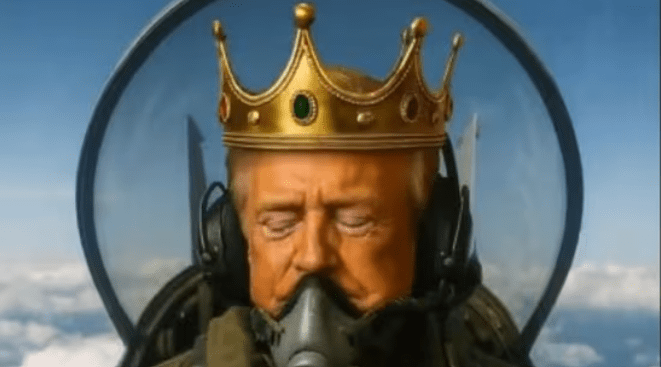
Photo: screenshot from that unbelievably offensive AI-generated video that Trump posted of himself as King Trump in a King Trump fighter-jet, bombing American protesters with his diarrhoea.

Political poem: Matthew King, ‘Incendiary Song’

Baby you’re the Reichstag
I’m setting you on fire
You no longer represent me
I’m immediate desire
Our constitution is suspended
on a fence of barbed wire
Baby you’re the Reichstag
I’m setting you on fire

I’ve cancelled your election
I’ve exposed your fatal flaw
Trapped in your reflection
we argued to a draw
The people want perfection
they love to be in awe
Baby you’re the Reichstag
my will is the law

Our union needs annulment
our wedding was a sham
The preacher stole the word of God
now he’s on the lam
He said he’d bless the devil
he didn’t give a damn
Baby you’re the Reichstag
who do you think I am

Like lightning this befell me
not you but I self-crowned
No court can now compel me
my power is unbound
I dare you try to tell me
my methods are unsound
Baby you’re the Reichstag
I’ll burn you to the ground

I’m rounding up your lovers
each one of them a liar
They tell me they don’t know you
say it’s me they most admire
Now I alone can save them
or throw them on the pyre
Baby you’re the Reichstag
I’m setting you on fire

*****

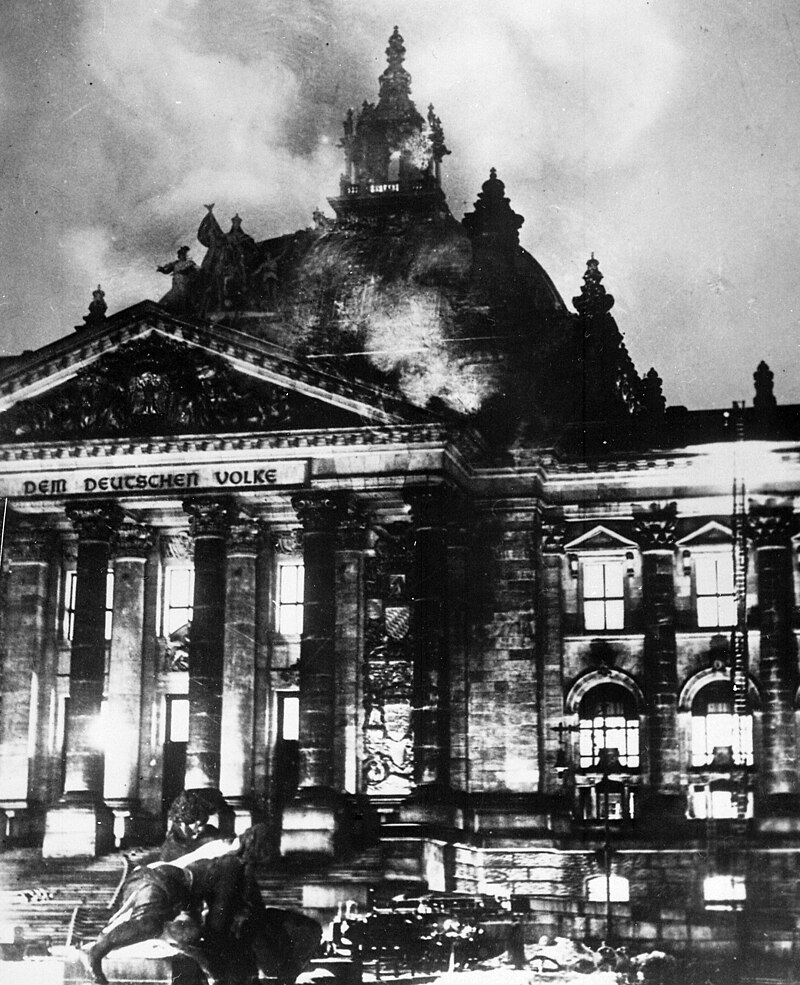
Matthew King writes: “Many, not on only one side of the political divide, have been watching for a “Reichstag Fire moment.” The thing about historical echoes is you’re never sure what you’re hearing is exactly what it sounds like, but with some things sounding like them at all is bad enough. A hat tip to Leonard Cohen, whose shade I seem to be channelling in this poem, and who would have turned 91 on Sept. 21. Leonard! thou shouldst be living at this hour; lucky for you you’re not, I guess.”

‘Incendiary Song’ was first published in New Verse News.

Matthew King used to teach philosophy at York University in Toronto; he now lives in what Al Purdy called “the country north of Belleville,” where he tries to grow things, counts birds, takes pictures of flowers with bugs on them, and walks a rope bridge between the neighboring mountaintops of philosophy and poetry. His photos and links to his poems can be found at birdsandbeesandblooms.com.

Photo: Reichstag Fire, 27 February 1933, public domain.

Odd, political poem: Emperor Qianlong, ‘My Feelings After the Ambassador of the Red-Haired English King, Macartney, Came to Pay Tribute and Give Offerings to Me’

Formerly Portugal presented tribute, now England is paying homage.
They have traveled further than Shu Hai and Heng-zhang;
My ancestors’ virtue must have reached their distant lands.
Though their tribute is nothing special, my heart approves sincerely.
Curios and their ingenious devices I do not prize.
Though what they bring is meager,
in my kindness to men from far away I make generous recompense –
Wanting to preserve my good health and power.”

*****

Original Poem:

《红毛英吉利国王差使臣马嘎尔尼奉表贡至,诗以志事》

  博都雅昔修职贡,英吉利今效荩诚。

  竖亥1横章输近步,祖功宗德逮远瀛。

  视如常却心嘉焉,不贵异听物翊2精。

  怀远薄来而厚往,衷深保泰以持盈。

This poem was written by the Qianlong Emperor (25 September 1711 – 7 February 1799; also known by his temple name Emperor Gaozong of Qing, personal name Hongli) after his meeting with the British ambassador Lord Macartney at the Emperor’s grand tent in his Summer resort at Jehol (Chengde) on September 14th, 1793. The embassy was then sent back to Beijing, the Emperor followed and saw the previously prepared British gifts on September 30th. The gifts and embassy did not impress and so they were ordered home on the following day. The whole two-year expedition is detailed here.

Lord Macartney was not impressed either, and wrote: “The Empire of China is an old, crazy, first rate man-of-war, which a fortunate succession of able and vigilant officers have contrived to keep afloat for these 150 years past, and to overawe their neighbors merely by its bulk and appearance, but whenever an insufficient man happens to have the command upon deck, adieu to the discipline and safety of the ship. She may perhaps not sink outright; she may drift some time as a wreck, and will then be dashed to pieces on the shore; but she can never be rebuilt on the old bottom.”

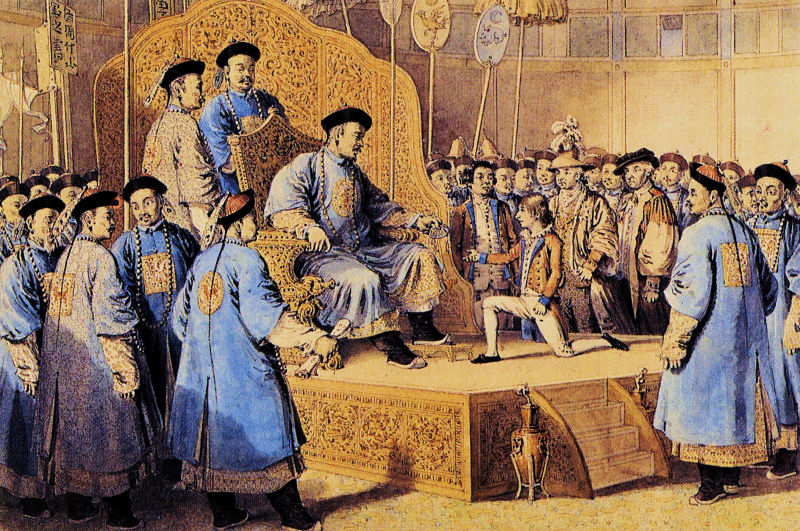
Illustration: William Alexander’s drawing of the reception of the Macartney embassy to China. Young Thomas Staunton (kneeling not kowtowing) receives a gift from the Emperor. Image by William Alexander available under a Creative Commons License

Odd, political, semi-formal verse: Aung San Suu Kyi, ‘In The Quiet Land’

In the Quiet Land, no one can tell
if there’s someone who’s listening
for secrets they can sell.
The informers are paid in the blood of the land
and no one dares speak what the tyrants won’t stand.
In the quiet land of Burma,
no one laughs and no one thinks out loud.
In the quiet land of Burma,
you can hear it in the silence of the crowd

In the Quiet Land, no one can say
when the soldiers are coming
to carry them away.
The Chinese want a road; the French want the oil;
the Thais take the timber; and SLORC takes the spoils…

In the Quiet Land….
In the Quiet Land, no one can hear
what is silenced by murder
and covered up with fear.
But, despite what is forced, freedom’s a sound
that liars can’t fake and no shouting can drown.

Free bird toward to a free Burma

My home…
where I was born and raised
used to be warm and lovely
now filled with darkness and horror.

My family…
whom I had grown with
used to be cheerful and lively
now living with fear and terror.

My friends…
whom I shared my life with
used to be pure and merry
now living with wounded heart.

A free bird…
which is just freed
used to be caged
now flying with an olive branch
for the place it loves.

A free bird toward a Free Burma.

Why do I have to fight???

They killed my father a year ago,
And they burnt my hut after that
I asked the city men “why me?” they ignored
“I don’t know, mind your business,” the men said.
One day from elementary school I came home,
Saw my sister was lifeless, lying in blood.
I looked around to ask what happened, if somebody’d known,
Found no one but living room as a flood.
Running away by myself on the village road,
Not knowing where to go but heading for my teacher
Realizing she’s the only one who could help to clear my throat,
But this time she gave up, telling me strange things in fear.
Why, teacher, why.. why.. why?
I have no dad nor a sister left.
To teach me and to care for me you said, was that a lie?
This time with tearful eyes she, again, said…
“Be a grown one, young man,
Can’t you see we all are dying?
And stop this with your might as soon as you can,
For we all are suffering.”

*****

Aung San Suu Kyi is the daughter of Aung San, who negotiated Burma’s independence from the UK in 1947 (but was assassinated the same year). Aung San Suu Kyi was the leader of the National League for Democracy when it won 81% of parliamentary seats in the 1990 General Election, causing the ruling military junta to nullify the elections and put her under house arrest for most of the next 21 years.

She was awarded the Nobel Peace Prize in 1991; but claims she chose non-violence as an expedient political tactic, stating in 2007, “I do not hold to nonviolence for moral reasons, but for political and practical reasons.” Several of her international honours have been withdrawn in response to her perceived failings regarding ethnic minorities in Myanmar; she remains politically active and under attack in the courts.

I don’t know enough about her and her situation to have an opinion about her, other than “it’s complicated”.

J.D. Smith, ‘Eulogies’

Eulogy, First Draft
The bastard’s dead,
That much is true.
What can be said?
It sounds ill-bred
To say, “He’s through.
The bastard’s dead.”
Perhaps, instead,
“We mourn.” Few do.
What can be said?
“He shared no bread.
He slurred the Jew.”
The bastard’s dead.
He often wed
And wandered, too.
What can be said
That will not spread
The truth we knew?
The bastard’s dead.
Much will be said.

Eulogy, Second Draft
He never killed a man.
I think he paid his taxes.
He didn’t join the Klan
And didn’t send junk faxes.
I once heard him say please,
Perhaps a muffled thanks.
On drunken weekend sprees
He shot off only blanks.
On principle, I guess,
I’m sorry that he’s dead,
As most here would profess.
I’ll quit while we’re ahead.

Eulogy, Revised
I think this is the final text.
I’ve got nothing, friends. Who’s next?

*****

J.D. Smith writes: “We are told not to speak ill of the dead. Fair enough, in some ways. It isn’t sporting to assail those who aren’t present to defend themselves, and even the most skeptical can still feel the fear of summoning an angry spirit.
And yet. We can all think of instances where the world was improved by someone’s leaving it. Similarly, the removal of a troublesome athlete from a team is called “addition by subtraction.” We again come face to face with Clarence Darrow‘s most famous quotation: ‘I’ve never wished a man dead, but I have read some obituaries with great pleasure.
Obituaries themselves, particularly of public figures, are often couched in positive or no worse than neutral terms. A multitude of sins is covered by words such as “controversial.” At the same time, a dialectic obtains. I am under the impression that negative if not excoriating obituaries of public figures have grown more common in the British press, and that practice has occasionally migrated to my country, the United States. The example that comes to mind is a scathing review of the life of tycoon Walter Annenberg. We now and again see similar takedowns of not-so-dearly-departed private citizens in local newspapers.
The same issues present themselves in eulogies. I’ve never been presented with a situation where I could take the podium and slag the deceased, and if the opportunity ever does arrive I almost certainly lack the spine and other parts to take advantage of it. My Jungian shadow and I keep in touch, though, and various thoughts arise. Hence this little suite of poems. There are some we come not to praise but to bury, and as soon as possible.”

This poem was collected in Catalogs for Food Lovers.

J.D. Smith’s seventh collection of poetry, The Place That Is Coming to Us, will be published later this year by Broadstone Books. His first fiction collection, Transit, is available from Unsolicited Press. Further information and occasional updates are available at www.jdsmithwriter.com.

Photo: “Good Riddance” by dgansen is licensed under CC BY-NC-SA 2.0.

Political poem: Villanelle: Susan McLean, ‘Echo Chambers’

Everyone wants peace, but votes for hawks.
A senator holds forth to an empty chamber.
No one listens. Everybody talks

conspiracies and outrage. Voting blocs
preserve their seamless fronts, and by November,
everyone wants peace, but votes for hawks.

I shoot my mouth off, and you shoot your Glocks.
Statesmen make deals they later can’t remember.
No one listens. Everybody talks

in slogans sold on T-shirts. Hackers doxx
judges whose moral codes are less than limber.
Everyone wants peace, but votes for hawks.

Act your rage, they tell you. Ragnarok’s
coming your way, to light you up like timber.
No one listens. Everybody talks

as midnight’s ticking closer on the clocks.
We’re parties of one, and one’s a lonely number.
Everyone wants peace, but votes for hawks.
No one listens. Everybody talks.

*****

Echo Chamber was originally published in Rattle‘s Poets Respond.

Susan McLean writes: “The original idea for the poem came when I heard about a senator addressing an empty chamber in Congress. I commented “No one listens. Everybody talks.” It occurred to me then that that would make a good repetend in a villanelle. As I worked on writing it, my feelings about other recent events influenced the direction the poem took. As I wrote in Poets Respond, “It wasn’t one story this week that inspired this poem, but a confluence of events: the proposed invasion of Gaza by Israel, the wildfires all over the U.S. and Canada, the lone shooter trying to register his outrage by killing people at the CDC, the Democrats fleeing Texas in an effort to prevent redistricting. It all felt apocalyptic and Wagnerian to me.”

Susan McLean has two books of poetry, The Best Disguise and The Whetstone Misses the Knife, and one book of translations of Martial, Selected Epigrams. Her poems have appeared in Light, Lighten Up Online, Measure, Able Muse, and elsewhere. She lives in Iowa City, Iowa.
https://www.pw.org/content/susan_mclean

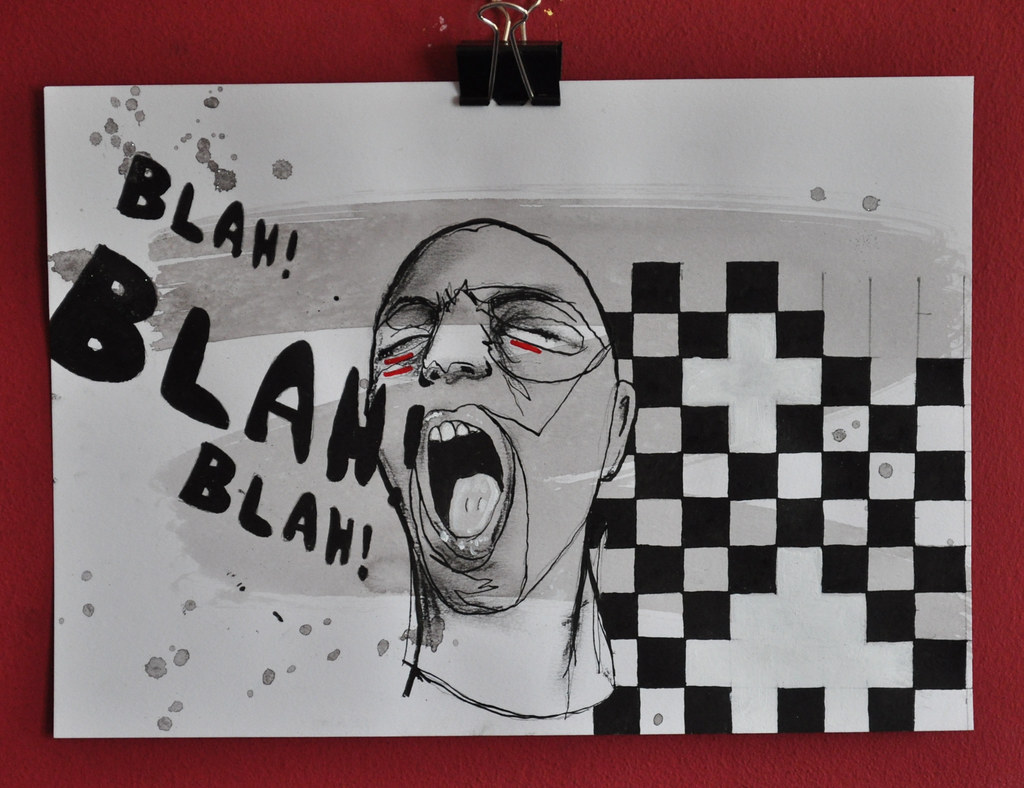
Photo: “Blah Blah Blah” by id-iom is licensed under CC BY-NC 2.0.

Political poem: Melissa Balmain, ‘Evgeny and Evgeniia’s Choice’

“Evgeny and Evgeniia faced an excruciating choice. Immigration and Customs Enforcement officers told the couple they could leave the United States with their child and return to their native Russia, which they had fled seeking political asylum. Or they could remain in immigration detention in the United States — but their 8-year-old son, Maksim, would be taken away and sent to a shelter for unaccompanied children. In the end, they chose the agony of limbo in the United States over a return to a place where they saw no prospect for freedom or any future for their family… The last time Evgeny and Evgeniia saw Maksim was on May 15” The New York TimesAugust 5, 2025. New York Times photo of Evgeny, Evgeniia, and Maksim.

Sophie’s Choice seemed light-years from our time,
a fading tragedy that made us weep
for Streep.

But now with tactics changing on a dime
in brutal ways we thought could not repeat,
sick heat

pervades my belly and begins to climb:
how can we keep denying what it means
when scenes

unspool of parents, guilty of no crime,
compelled to choose the thing that they most fear,
right here?

*****

Melissa Balmain writes: “As the poet Barbara Loots recently put it, what we need right now is a tsunami of truth. I contribute a few drops when I can.”

Evgeny and Evgeniia’s Choice‘ first appeared in New Verse News.

Melissa Balmain’s third poetry collection, Satan Talks to His Therapist, is available from Paul Dry Books (and from all the usual retail empires). Balmain is the editor-in-chief of Light, America’s longest-running journal of comic verse, and has been a member of the University of Rochester’s English Department since 2010.

Photo: New York Times photo of Evgeny, Evgeniia, and Maksim.

RHL, ‘Privelitch’

Some suffer from a travel itch
but I call that a snivel glitch
I only want to travel rich
and love it: it’s my privelitch.
O privelitch, o privelitch!

I only go to schools most rich,
(and only eat foods superrich),
then college has to be Oxbritch,
for that’s my privelitch.
I love you, love you, bitch!

I wear the robes and coronitch,
I swear by God I’ve found my nitch,
for, be I tubby, tall or titch,
I’ve got my privelitch.
O privelitch, o privelitch,
I love you, love you, bitch!

I never on my class would snitch
(or if I do, it’s just a smitch);
I’m faithful – cept for those I ditch,
for that’s my privelitch.
O privelitch, o privelitch!

I down it nail, I up it stitch,
call me a wizard or a witch,
I’ve got it all, with perfect pitch,
for that’s my privelitch.
I love you, love you, bitch!

My life with none I’d ever switch,
I’m over all, no slightest twitch,
and even when I’m in Death’s ditch
my tomb shouts Privelitch!
O privelitch, o privelitch,
I love you, love you, bitch!

*****

Don’t think I’m unaware of my own privilege: white males with above-average education are a privileged minority in any country. But also you reading this, whoever you are, you are privileged to not be a child in Gaza or any of the other hells that humans make for each other on an otherwise beautiful planet; you are privileged to be alive during this affluent and pivotal time in human history. And of course those who in addition have cultivated a taste for poetry… is there maybe a hint of privilege there?

This poem, like Buccaneer, was recently published in Magma.

Photo: “General Election Bullingdon Club Members in 1987, including Boris Johnson and David Cameron” by Diego Sideburns is licensed under CC BY-NC-ND 2.0.

Sonnet: Maryann Corbett, ‘Saturday Edition’

Page one, above the fold: the world in flames.
A luxury hotel gapes like a sore.
In mammoth type, the headlines yell the names
of prophets stoking hells of holy war.

In Business, meanwhile, there is calm discussion
of sales rates for the sexy underclothes
pitched by Victoria’s Secret, and a fashion
for surgical revision of the nose.

It isn’t news to those who sell the paper:
their readers can take only so much hell.
They proffer me the surgeon and the draper
as pastures where my bovine brain may dwell,

ignoring, while it chews on this confection,
the screams of children from the other section.

*****

Maryann Corbett writes: “My records tell me that ‘Saturday Edition’ is one of my very earliest sonnets and very earliest acceptances, appearing in The Barefoot Muse in 2007 and included in Mary Meriam’s Irresistible Sonnets in 2014. It was among the poems that gave me the lightbulb realization that I tend to write sonnets when I’m angry.”

Maryann Corbett earned a doctorate in English from the University of Minnesota in 1981 and expected to be teaching Beowulf and Chaucer and the history of the English language. Instead, she spent almost thirty-five years working for the Office of the Revisor of Statutes of the Minnesota Legislature, helping attorneys to write in plain English and coordinating the creation of finding aids for the law. She returned to writing poetry after thirty years away from the craft in 2005 and is now the author of two chapbooks and six full-length collections, most recently The O in the Air (Franciscan U. Press, 2023). Her work has won the Willis Barnstone Translation Prize and the Richard Wilbur Award, has appeared in many journals on both sides of the Atlantic, and is included in anthologies like Measure for Measure: An Anthology of Poetic Meters and The Best American Poetry.

Photo: “UN School in Gaza Attacked” by United Nations Photo is licensed under CC BY-NC-ND 2.0.