Category Archives: quatrains

Lindsay McLeod, ‘Harvest’

There’s just so many nows in forever
if we’re apart or together as one,
we’d better cherish them all if we’re clever
make the most of our time in the sun,

‘coz it’s where we are led whether up or in bed
there’s one funeral we all must attend,
because somewhere ahead the sea kisses the sky
and the name of that place is the end.

*****

Lindsay McLeod writes: “‘Harvest’ was made as an end piece for the second book I wrote for my daughter.” It was originally published in Grand Little Things.

Lindsay McLeod currently lives by the sea on the Southern edge of the world, where he trips over the offing every morning. He has been published here and there in the past and won a few awards. He has started messing about with words again lately after a few necessary years away. You might expect him to know better by now, but oh no.

Photo: “Another Timor Sea sunset from Casuarina Beach, Darwin, NT, Australia” by Geoff Whalan is licensed under CC BY-NC-ND 2.0.

Anushka Sen, ‘Good Neighborhood’

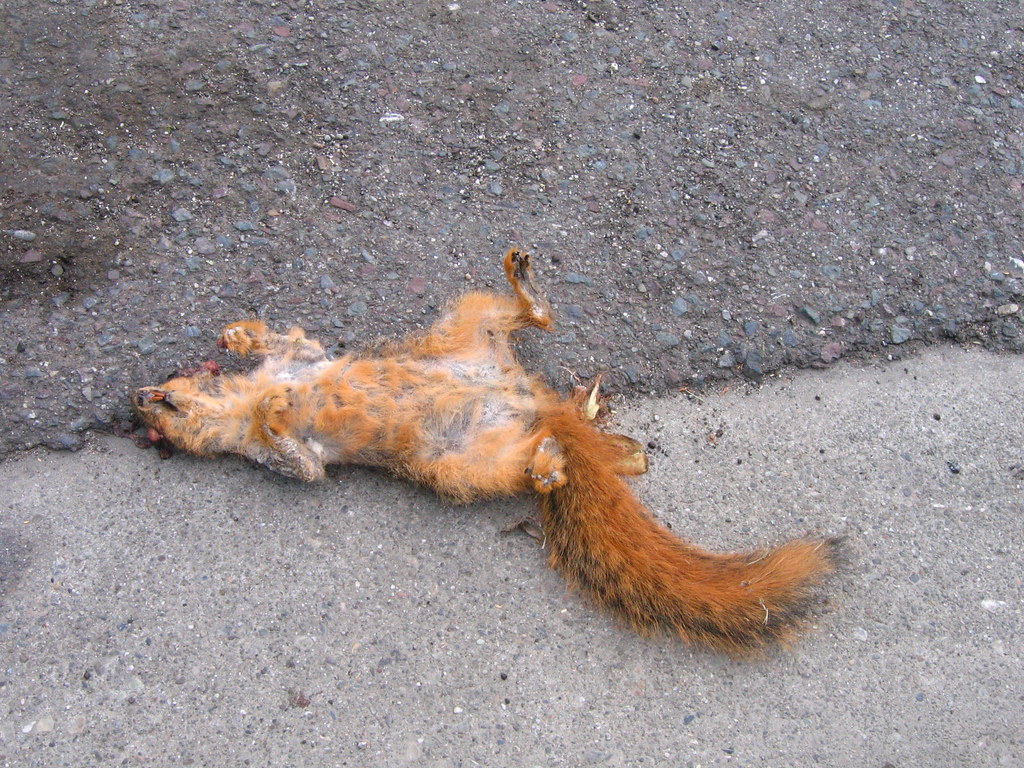
Another poisoned squirrel hits the street,
stopping short your jaunty midday tread.
The city lays its secrets at your feet.
 
It rots more still and slow than fallen leaves;
the resting pose as definite as lead.
Another poisoned squirrel hits the street.
 
Classic mixup: rat for squirrel, bait for feed.
POISON, posters scold, PROTECT YOUR PET.
The city lays its secrets at your feet.
 
Someone went too far, we all agreed,
and left the vermin running wild instead!
And yet, a poisoned squirrel hits the street,
 
so stiff, so angular, no longer sweet,
the stare indecent on the outsize head.
The city lays its secrets at your feet—
 
you learn how light your step is, how discreet,
how intricate the alleys of your dread.
Another poisoned squirrel hits the street.
The city lays its secrets at your feet.

*****

Anushka Sen writes: “This poem was inspired by a rat-induced furore in Rogers Park, my Chicago neighborhood. Someone (or some people) had finally flipped a switch and started putting out rat poison indiscriminately. The poem takes off from that point. It seems relevant to me all over again, since I’m now encountering a slew of dead birds. Residential life is built on a gnarly underbelly.”

‘Good Neighborhood’ was originally publlished in the current Rat’s Ass Review.

Anushka Sen is originally from Kolkata, India and now teaches English Literature at Loyola University, Chicago. She is drawn to musicality, animals, and a strong sense of place in art. She occasionally translates from Bengali to English and her poems (original and translated) have been published in Rust and Moth the Asymptote blog, and Eunoia Review, among other places.

Photo: “Alvin? Alvin? Alvin?” by lionelvaldellon is licensed under CC BY-NC 2.0.

Odd poem: Sir Arthur Conan Doyle, ‘A Reminiscence of Cricket’

Once in my heyday of cricket,
One day I shall ever recall!
I captured that glorious wicket,
The greatest, the grandest of all.

Before me he stands like a vision,
Bearded and burly and brown,
A smile of good humoured derision
As he waits for the first to come down.

A statue from Thebes or from Knossos,
A Hercules shrouded in white,
Assyrian bull-like colossus,
He stands in his might.

With the beard of a Goth or a Vandal,
His bat hanging ready and free,
His great hairy hands on the handle,
And his menacing eyes upon me.

And I – I had tricks for the rabbits,
The feeble of mind or eye,
I could see all the duffer’s bad habits
And where his ruin might lie.

The capture of such might elate one,
But it seemed like one horrible jest
That I should serve tosh to the great one,
Who had broken the hearts of the best.

Well, here goes! Good Lord, what a rotter!
Such a sitter as never was dreamt;
It was clay in the hands of the potter,
But he tapped it with quiet contempt.

The second was better – a leetle;
It was low, but was nearly long-hop;
As the housemaid comes down on the beetle
So down came the bat with a chop.

He was sizing me up with some wonder,
My broken-kneed action and ways;
I could see the grim menace from under
The striped peak that shaded his gaze.

The third was a gift or it looked it-
A foot off the wicket or so;
His huge figure swooped as he hooked it,
His great body swung to the blow.

Still when my dreams are night-marish,
I picture that terrible smite,
It was meant for a neighboring parish,
Or any place out of sight.

But – yes, there’s a but to the story-
The blade swished a trifle too low;
Oh wonder, and vision of glory!
It was up like a shaft from a bow.

Up, up like a towering game bird,
Up, up to a speck in the blue,
And then coming down like the same bird,
Dead straight on the line that it flew.

Good Lord, it was mine! Such a soarer
Would call for a safe pair of hands;
None safer than Derbyshire Storer,
And there, face uplifted, he stands

Wicket keep Storer, the knowing,
Wary and steady of nerve,
Watching it falling and growing
Marking the pace and curve.

I stood with my two eyes fixed on it,
Paralysed, helpless, inert;
There was ‘plunk’ as the gloves shut upon it,
And he cuddled it up to his shirt.

Out – beyond question or wrangle!
Homeward he lurched to his lunch!
His bat was tucked up at an angle,
His great shoulders curved to a hunch.

Walking he rumbled and grumbled,
Scolding himself and not me;
One glove was off, and he fumbled,
Twisting the other hand free.

Did I give Storer the credit,spo
The thanks he so splendidly earned?
It was mere empty talk if I said it,
For Grace had already returned.

*****

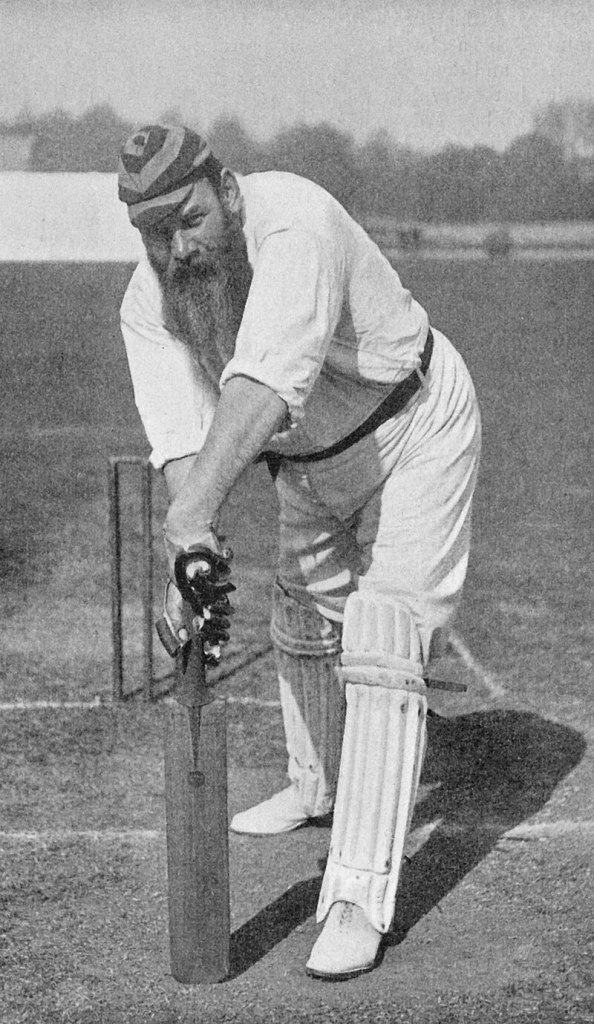
A Reminiscence of Cricket is a poem written by Arthur Conan Doyle. On 23-25 August 1900, Conan Doyle played in a first class cricket match against W.G. Grace where he scored 4, and took the wicket of Grace who had scored 110.

The creator of Sherlock Holmes, Sir Arthur Ignatius Conan Doyle played in ten first-class matches, mainly for the MCC, between 1900 and 1907. As a lower-order right-handed batsman and occasional slow bowler, he scored 231 runs, average 19.25, in 18 innings with a top score of 43. His only first-class wicket came against London County at Crystal Palace on 25 August 1900 when he had WG caught by the wicket-keeper off a skier for 110.

I found this poem with an extensive commentary by someone called Shamanth: “I’ve loved it primarily because of the allure of an amateur lifestyle that it portrays – an age where you could study medicine, play first class cricket, referee boxing bouts and marathons, and still produce brilliant literature, when you could live without sacrificing any dimension of your life, without putting your head down to specialize in any one field, when you did something simply because you loved it without having to forfeit other aspects of your life that you loved just as much. It makes you long for a lifestyle with such freedom.”

Credit: “From photo by E. Hawkins & Co., Brighton” – K. S. Ranjitsinhji, The Jubilee Book of Cricket Third Edition
Marcus Bales, ‘Rule Number One’

For Linda, who said it first

 If you’re going to have a reading
then no matter where you are
for a minimum of breeding
you have got to have a bar.

You will fill up all the seating,
they will come from near and far,
if the best part of your greeting
is “Why, yes we have a bar!”

But the evening will be fleeting
even if you’ve booked a star
when it’s alcohol they’re needing
and you do not have a bar.

They will freeze in scanty heating
and they’ll swelter till they char
if you advertise by leading
with the fact you have a bar.

Though it’s raining or it’s sleeting
if you offer them a jar
they’ll be aleing, beering, meading,
and absinthing at the bar.

But when poetry starts bleeding
out of every scab and scar
all you’ll see is me retreating
if you haven’t got a bar.

*****

Marcus Bales writes: “For an interesting while I had an art gallery in a downtown mall in Cleveland. The mall rules said it had to be open on Saturdays — when there was no mall traffic and so no real reason to be open. So I held the Every Saturday at Noon in the Galleria Poetry Reading. Dramatically unsuccessful at first it eventually found its audience and we had a good time. But in talking about why, serving only coffee, Linda pointed out that if we could serve alcohol attendance would improve. Since it was an art gallery, and there is a tradition in art galleries of serving wine at openings, I changed the title to the Poetry Reading Art Opening and said wine and coffee would be available in limited quantities. That did the trick. It quickly became the best-attended poetry reading in the city, any day, any time. Then the authorities got wind of it and someone from the city visited and pointed out gently that while it was a tradition to serve wine at art openings in art galleries, it is technically illegal by state law, even if it is free, and they cited the appropriate code. In the end it didn’t matter much, since even the most successful poetry readings count their audiences in the low-to-mid-tens of people, and by then people had got in the habit of Saturday At Noon, and kept coming anyway even after we stopped serving wine. But the idea for the poem had formed.” 

Not much is known about Marcus Bales except that he lives and works in Cleveland, Ohio, and that his work has not been published in Poetry or The New Yorker. However his ‘51 Poems‘ (which includes the above) is available from Amazon. He has been published in several of the Potcake Chapbooks – Form in Formless Times.

Photo: “Open Bar” by Trevor Benedict – MrEcho is licensed under CC BY-NC-ND 2.0.

Quatrains: D.A. Prince, ‘Weeds’

for Helena Nelson

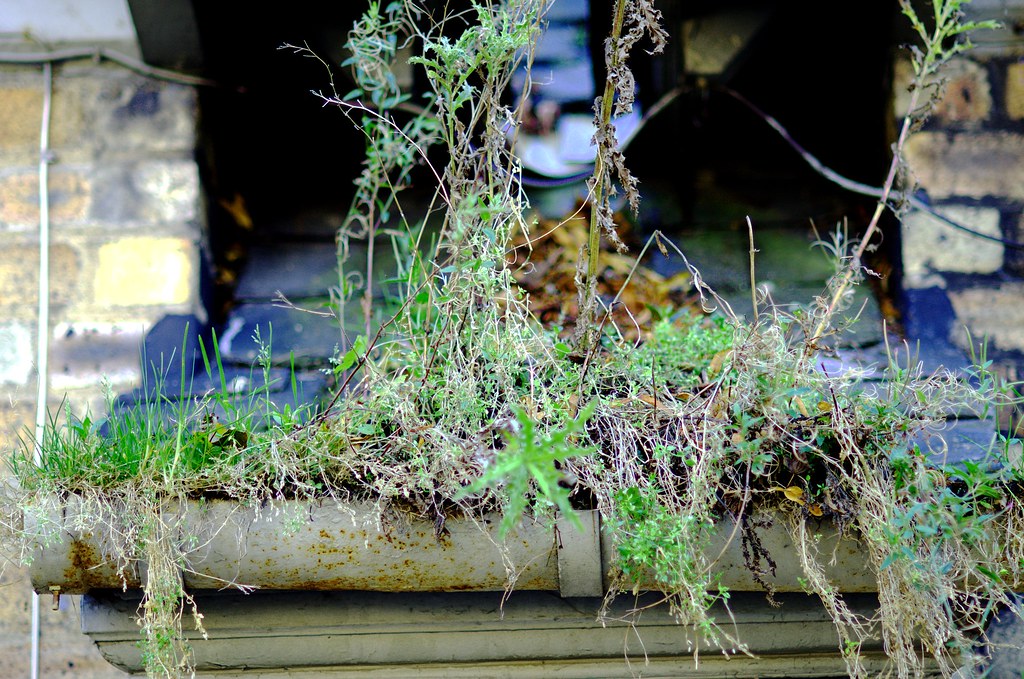
Let’s celebrate those seeded in guttering
high overhead — bird-dropped or wind-blown
in shy, shaded corners, not cluttering
the road-edge like litter or casually sown

on the garden’s margins. Buddleia, birch —
slender and whippy, fretful and restless,
only a small claw-hold on their high perch,
a loose version of themselves in endless

inventive air. No one, much, bothers them,
leaving their roots exploring the secret cracks
between bricks and flashing. Unless a stem
strangles a cable or a branch unpacks

some weathered pointing, troubling it, they’re safe:
every airhead, living only to dance
the delights of lightness, each sinuous waif
born from easy freedom, sun and rain and chance.

*****

D.A. Prince writes: “There’s a tradition of poets printing some of their work privately for circulation to friends. Now that Helena Nelson (aka HappenStance Press) is making more time for her own writing she has created a series of pamphlets about those unregarded — and usually unloved — plants generally dismissed as ‘weeds’, in which each is accorded its own sonnet. Richard Mabey’s Weeds: The Story of Outlaw Plants is the source for the botanical information while she brings a poet’s attention to what makes each one individual. She has sent these pamphlets to friends so, for the moment, only a few of us have seen them.

“I don’t habitually write poems dedicated to named people: this is, I think, the first time I’ve done it but I wanted to respond, as a way of thanking her both for long friendship and for all the poetic ongoings we’ve shared. I asked her, somewhat cautiously, if she’d agree to a dedication, then — later — if she’d agree to the poem appearing in a pamphlet.

“Her poems were sonnets so if I’d written a sonnet it could have looked competitive — and that wasn’t the point. Four quatrains, rhymed, seemed to suit the subject. In its original layout it appeared as a solid sixteen-line block but when we were working on the poems that make up my latest pamphlet (Continuous Present, New Walk Editions, 2025) Nick Everett, my editor, suggested that setting it in quatrains would suit the air and space those rooftop-rooted weeds have around them, and to my mind that’s lifted the poem in a way it needed. 

“As for gardening, I’m now very happy to let the weeds flourish.”

D.A. Prince lives in Leicestershire and London. Her first appearances in print were in the weekly competitions in The Spectator and New Statesman (which ceased its competitions in 2016) along with other outlets that hosted light verse. Something closer to ‘proper’ poetry followed (but running in parallel), with three pamphlets, followed by a full-length collection, Nearly the Happy Hour, from HappenStance Press in 2008. A second collection, Common Ground, (from the same publisher) followed in 2014 and this won the East Midlands Book Award in 2015. HappenStance subsequently published her pamphlet Bookmarks in 2018, with a further full-length collection, The Bigger Picture, published in 2022. New Walk Editions published her latest pamphlet, Continuous Present, in 2025.

*****

Photo: “guttered” by bigbahookie is licensed under CC BY-NC-ND 2.0.

Semi-formal quatrains: Rachel Hadas, ‘Roadblock’

Call me the bee buzzing in the museum.
The younger sister fussing through a house
still stiff with loss.
The meddling goblin in the mausoleum.

My dream: with three in the front seat, we drive
under a bridge and halt. A huge gray bus
blocks the whole road, including us,
the only travelers who are left alive.

It’s drizzling; the windshield wiper blades
busily gesture, yet we’re nearly blind.
You two seem not to mind
blank windows, pulled-down shades.

I mind. I want to get out and explore,
to move around
the deathly obstacle. “Don’t make a sound,”
you say. (Who are you?) “Don’t go near that door.”

Our mountain drive last month—that wasn’t dreamed.
We three again. We ran a dog down. I
alone looked back, alone let out a cry.
I saw it lying in its blood and screamed.

So tell me what these images portend.
Am I a noisy bird of evil omen
or just a person, apprehensive, human,
moving ahead, kid sister into woman,

stonewalled by death each time she rounds a bend?

*****

Rachel Hadas writes: ” ‘Roadblock’ is an older poem, inspired by a visit to my sister and her then husband  years ago.  Our drive, and running over the dog really happened, as did the dream…but which came first?  And another question: would I have remembered either the car accident or the dream had I not written them into a poem?  Dreams still figure often in my poems.  And the fact that I’ll always be a younger sister, while it doesn’t get mentioned all that frequently, is a permanent feature of my consciousness that probably works its way into many of my poems however subliminally. The bee buzzing: my sister once complained that going to a museum with me was like going to a museum with a bee, a comment I’d forgotten until rereading this poem brought it back.  And those “blank windows, pulled-down shades”: doesn’t poetry often strive to pull the shades up?”

‘Roadblock’ is collected in ‘Halfway Down the Hall: New and Selected Poems’ (Wesleyan University Press, 1998)

Rachel Hadas’s recent books include Love and Dread, Pandemic Almanac, and Ghost Guest. Her translations include Euripides’s Iphigenia plays and a portion of Nonnus’s Tales of Dionysus. Professor Emerita at Rutgers-Newark, where she taught for many years, she now teaches at 92Y in New York City and serves as poetry editor of Classical Outlook. Her honors include a Guggenheim fellowship and an award from the American Academy-Institute of Arts and Letters.

Photo: “Bus Crash at Ladprao-Chokchai4” by isriya is licensed under CC BY-NC 2.0.

Susan Jarvis Bryant, ‘Once Upon a Tortured Trope’

Don’t ever judge crooks by their lovers, they say  
On book covers nailed to the wall.
The frog sends his kiss at the bend of the day
To Belle who is beast of the ball. 

As tough as a cucumber, cool as old boots, 
An untroubled damsel of flair
Is shooting for stars. When the pussy-owl hoots
She snares a short prince with blonde hair. 
  
They sail inky skies on a silver-lined dream
To greener scenes up in the hills.
But honey and moons aren’t as sweet as they seem 
When cats and dogs reign and milk spills.

His rose bears a thorn and his shoulder, a chip. 
Hyenas have stolen his laughter.
All charm hits the skids as she grapples to slip 
The grip of his gripe ever after.

*****

Susan Jarvis Bryant writes: “I really don’t have anything to say about the poem, other than I had huge fun writing it. It’s the same with all of my poems – I never suffer for my art, which makes me reluctant to call myself a poet. I’d like to say I write my poems in a tearstained, whisky-soaked haze while my Muse tangos with the ghost of Dylan Thomas through Welsh valleys, but this is not so.  I just snigger away as the ink flows like a bad comedienne laughing at her own jokes.”

‘Once Upon a Tortured Trope’ was originally published in Snakeskin.

Susan Jarvis Bryant is originally from the U.K. and now lives on the coastal plains of Texas. Susan has poetry published on The Society of Classical Poets, Lighten Up Online, Snakeskin, Light, Sparks of Calliope, and Expansive Poetry Online, The Road Not Taken, and New English Review. She also has poetry published in The Lyric, Trinacria, and Beth Houston’s Extreme Formal Poems and Extreme Sonnets II anthologies. Susan is the winner of the 2020 International SCP Poetry Competition and was nominated for the 2022 and 2024 Pushcart Prize. She has published two books – Elephants Unleashed and Fern Feathered Edges.

Art: AI + RHL

Using form: iambic trimeter: Janet Kenny, ‘Stars’

Look at the stars, she said.
Just look how cold and bright!
And most of them are dead
though brightening the night.
Time lives and dies like stars.
The past is death of now.
Impermanence that scars
our fleeting human hour.
The world inside a mind
that dies when we die too
leaves others left behind
resigned without a clue.
Forget me nots deceive
and daisy chains depend
on children who believe
our world will never end.

*****

Janet Kenny writes: “The poet is very old and has been confronted inescapably with the mortality of all things.”

Janet Kenny left New Zealand to pursue a career as an operatic and concert singer in London, then settled in Sydney, Australia, where she worked in the anti-nuclear movement and jointly compiled, wrote and edited a book about the nuclear industry, Beyond Chernobyl, published by Envirobook in 1993. Janet lived for many years in Sydney with her husband and visiting currawongs. She now lives in Hervey Bay, Queensland, with visiting butcher birds, spangled drongos, ospreys, pelicans, assorted honeyeaters and flying foxes.

Her poems have been published in printed and online journals, including AvatarThe ChimaeraFolly14 by 14Iambs & TrocheesThe Literary ReviewMi PoesiasThe GuardianThe SpectatorThe New FormalistThe Barefoot MuseThe Raintown ReviewThe Shit Creek ReviewSnakeskinLavender ReviewSoundz ineVictorian Violet PressThe Susquehanna Quarterly and Umbrella. Her work is in the collections The Book of Hope and Filled With Breath: 30 sonnets by 30 poets and in the Outer Space anthology, Cambridge University Press. She shared an anthology of bird poems, Passing Through, with Jerry H. Jenkins. She has received three Pushcart nominations.

A selection of her poems, and links to her poetry collections Whistling in the Dark (2016, Kelsay Books) and This Way to the Exit (White Violet Press), are on her website https://janetkenny.netpublish.net/index.htm

Photo: “Sizzling Remains of a Dead Star” by Euclid vanderKroew is licensed under CC BY-NC-SA 2.0.


RHL, ‘In the Spring’

In the spring, an old man’s fancy
ruefully reviews his youth;
thinks of girls both past and present,
wonders can he hide time’s truth.

His always googly gardening eyes
all ever which ways scan and glower
at the bud-bursting blossoming girls
exploding in their flower of power.

What is this green and noisy growth
that’s flourishing, fresh and unkempt?
Old’s good, so’s young… could one be both?
O Fates! from fate make me exempt!

*****

‘In the Spring’ was published in Bewildering Stories, an online weekly of Speculative Fiction, Poetry, Art, etc. Thanks, Don Webb!

at the museum” by derpunk is licensed under CC BY-NC-SA 2.0.

Political poem: A.E. Stallings, ‘An American Wakes Up in Athens, Greece After the 2024 Elections’

I wake up in the dark.
In dark I went to sleep.
There is a kind of stark
Accounting of lost sheep.

The day breaks with a dawn
So much like yesterday’s.
I turn the kettle on
And brew a dark malaise.

Things go from bad to worse,
Let’s call it entropy.
The blessing is a curse,
And treachery goes free

Or something. Never mind,
Here in the cradle of
Democracy I find
There’s history enough —

There on the shining rock
The entasis of state,
The subtle curves that lock
The crooked to the straight.

The centuries were slow
Where stood its solid scenes,
It took one night to blow
The roof to smithereens.

It boasts of Marathon,
It boasts of Salamis
Five generations on,
Of hemlock’s bitterness,

Between, the city nations
Of Greeks warred tribe with tribe
Why trouble with invasions?
It’s easier to bribe.

We still read Athens’ versions,
As though the Spartans lost,
As though the prudent Persians
Did not know what they cost.

Pericles died of plague,
And Phidias in prison.
Division’s sown, and vague
Suspicions have arisen.

It took nine years to build
Those columns in the air,
But half its marbles spilled,
Over fifty to repair.

It’s like a foundered ship,
That ruin on the hill.
It makes my heartbeat skip.
I’m afraid it always will.

*****

A.E. Stallings writes: “I [wrote this] poem the day after the elections. It was written on the fly, and has not been revised.”

‘An American Wakes Up in Athens, Greece After the 2024 Elections’ was originally published in Liberties Journal.

A.E. Stallings is the current Oxford Professor of Poetry. This Afterlife: Selected Poems was published in 2022. Her forthcoming book is Frieze Frame: How Poets, Painters, and their Friends Framed the Debate Around Elgin and the Marbles of the Parthenon

Photo: “Parthenon” by R~P~M is licensed under CC BY-NC-ND 2.0.