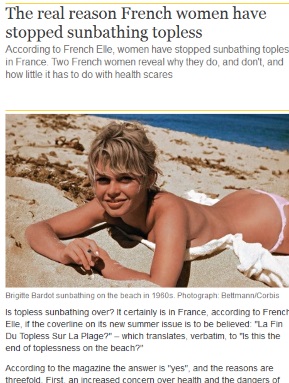
Conor Kelly, ‘On Reading the Guardian News Item: France falls out of love with topless sunbathing’

Now planes are falling from the sky
brought down by bombs or storms of sand
and bodies flying through the air,
incinerated where they land.
Now drones are flying over towns
and villages where families lie
scattered upon the blood-dimmed earth
rent by a missile from on high.
 
    In times like these, it’s good to know
    successors to Brigitte Bardot,
    whose breasts were often on display,
    are covering up in Saint-Tropez.
 
Now children on a blood-strewn yard
lie dying in a UN school
and learn, too late, that modern war
is subject to no human rule.
Now girls asleep in their school dorm
are woken, kidnapped, taken deep
into impenetrable land
while parents, friends and teachers weep.
 
    At times like this it’s good to know
    what may be à la mode, although
    French women think it is passé
    to bare their breasts in Saint-Tropez.
 
Now drive-by shootings in the hood
leave strangers dying, one by one,
and children other children kill
when they discover Daddy’s gun.
Now vigilantes late at night
who stand their ground while they patrol
can shoot the mad, the drunk, the strange,
disdaining talk of gun-control.
 
    At times like this it’s good to know
    bikini tops are now on show
    as toplessness is now risqué
    upon the beach at Saint Tropez.
 
Now new and old diseases take
their toll on those who try to cure
the sad, the suffering, the sick,
when each prognosis is unsure.
Now chemists working in a lab
and patients undergoing trials
are seeking what alleviates
from what are merely fads, lifestyles.
 
    At times like this it’s good to know
    that suntanned breasts no longer glow
    and fashion fans are now au fait
    with what is chic at Saint Tropez.

*****

Conor Kelly writes: “Tragedy and comedy, war and peaceful sunbathing, gunshots and film shoots, dead bodies and bare bodies, vigilantes and voyeurs, the consequential and the chic, the chemical and the comical, the bad and the fad; this poem is based on a fundamental contrast between the fatal depravities of the modern world as outlined in the longer stanzas and changing trends in body images as outlined in the refrain. Despite the serious subject matter, it is not to be taken too seriously. The poem was originally published in the September 2014 issue of Snakeskin (https://www.snakeskinpoetry.co.uk/210topless.html)”

Conor Kelly was born in Dublin and spent his adult life teaching in a school in the city. He now lives in Western Shore, Nova Scotia from where he runs his twitter (X) site, @poemtoday, dedicated to the short poem. He has had poems printed in Irish, British, American, Canadian and Mexican magazines. He was shortlisted for a Hennessy New Irish Writers award. At the ceremony one of the judges, Fay Weldon, asked him, “Where are you in these poems?”  He is still asking himself that same question.

https://www.instagram.com/conorkelly.poems/

Photo: from Snakeskin

Sonnet: Melissa Balmain, ‘Memo to Self, in Bed’

Don’t think, while you are holding him, of deadlines,
of monster Visa bills you haven’t paid,
of NPR reports on gangs and breadlines
and kooks with nukes available for trade.

Don’t think of whom you owe a three-course dinner,
of editors you wish you had impressed,
of whether you should be two sizes thinner
and twice as nice to look at when undressed.

Above all, never think of how time’s racing
toward commonplaces you’re afraid to name–
white halls, bleak calls, the foregone mortal ending;

how you or he (which one?) will soon be facing
long nights where solitaire’s the only game.
Don’t think: just wink at him and keep pretending.

*****

From Walking in on People © Melissa Balmain, 2014. Used by permission of Able Muse Press.

Melissa Balmain writes: “Like many formalist poets, I miss the Nemerov Sonnet Award (for which this poem was a finalist). The Nemerov spurred many of us to write more sonnets, and gave us terrific ones to read when the winners and finalists appeared in The Formalist and, later, Measure. Other contests have emerged to fill the post-Nemerov void, including the wonderful Kim Bridgford Memorial Sonnet Contest, sponsored by Poetry by the Sea. Still, I’d love to see the Nemerov come back somehow–the more good sonnets, the merrier.”

Editor’s comment: In addition to the sonnet’s expected rhymes at the end of each line, Melissa Balmain has thrown in a bonus internal rhyme at the beginning of the last line of each quatrain and tercet. It is quietly done, but adds lightness to a poem that is both light and dark in subject matter.

Melissa Balmain’s third poetry collection, Satan Talks to His Therapist, is available from Paul Dry Books (and from all the usual retail empires). Balmain is the editor-in-chief of Light, America’s longest-running journal of light verse, and has been a member of the University of Rochester’s English Department since 2010.

Photo: “New Bedding!” by Andrew Love is licensed under CC BY-NC-SA 2.0.

Using form: Short poem: Helena Nelson, ‘Duel’

Your false self says to my true self, Hate.
My true self says to your false self, No.

Your false self says to my false self, Shit.
My false self says to your false self, Go.

Your true self says to my false self, Love.
My false self says to your true self, Late.

Late, too late, too late, too late.
My true self sings to your true self, Wait.

*****

Helena Nelson writes: “I can’t explain this easily. It’s both simple and obscure, like a sealed box holding the idea of opposition: a duel between two people, a duet; dual positions. Then there’s the idea of a two-sided self: the true or authentic self versus the manipulative side, the side that does deliberate damage. I don’t even believe in ‘the true self’; but I do in this poem. And I recognise a dispute where one person (especially if for some reason acting from twisted emotion) can push another to come back from that same position, even when they don’t want to. From experience, I’ve known this. The rhyming words trace the development. The slant rhyme between Hate and Shit, for me, has a dark twist. Hate is powerful but Shit is horrible. Late is potentially the last word. The poem could end there, but it doesn’t. Each of these two people summons a ‘true self’. Each dismisses the ‘false’. ‘Late, too late, too late, too late’ is the line that breaks the pattern. No direct speech in that line, perhaps because it’s not a spoken statement but a feeling experienced by both. For me, there’s intense sadness at this point, and the shadow of death too, and because of this—just in time—true speaks to true. Only seventy words in the whole thing but most repeated several times. If you go by unique usage, fifteen words in total. It reminds me of one of R. D. Laings’ Knots. The switch from ‘says’ to ‘sings’ at the end? Yes—significant.”

Helena Nelson runs HappenStance Press (now winding down) and also writes poems, one of which is ‘Duel’. It was originally published in PN Review, collected in Plot and Counter-Plot, Shoestring Press, 2010, and was reprinted in the Potcake Chapbook ‘Lost Love’. Her most recent collection is Pearls (The Complete Mr and Mrs Philpott Poems). She reviews widely and is Consulting Editor for The Friday Poem.

Photo: “Argument” by helena_perez_garcia is licensed under CC BY-NC-ND 2.0.

Short poem: RHL, ‘Ghosts Twitter’

Ghosts twitter in my head like the memory of predawn birds.
Digging below my present house I find
a structural supportive past with rock veins to be mined.
Upstairs the future isn’t fully built or roofed.
Has someone goofed?
The Architect is vague on final thirds.

*****

I am finding many ways to say I don’t understand existence at all; this is one of them.

This short, semi-formal poem was published recently in The Lyric.

Photo: “unfinished house” by Lodigs is licensed under CC BY-NC-ND 2.0.

Sonnet: Gail White, ‘The Way It Ended’

So time went by and they were middle-aged,
which seemed a cruel joke that time had played
on two young lovers. They were newly caged
canary birds – amused, not yet afraid.
A golden anniversary came around
where jokes were made and laughing stories told.
The lovers joined the laugh, although they found
the joke – though not themselves – was growing old.
She started losing and forgetting things.
Where had she left her keys, put down her comb?
Her thoughts were like balloons with broken strings.
Daily he visited the nursing home
to make her smile and keep her in their game.
Death came at last. But old age never came.

*****

Gail White writes: “Time is the strangest of the conditions we live in.  Scientists, essayists, and poets can ring endless changes on this theme.  Time has devastated the lives of the couple in this sonnet, but as Solomon told us long ago, love is as strong as death.”

Gail White is the resident poet and cat lady of Breaux Bridge, Louisiana. Her books ASPERITY STREET and CATECHISM are available on Amazon. She is a contributing editor to Light Poetry Magazine. “Tourist in India” won the Howard Nemerov Sonnet Award for 2013. Her poems have appeared in the Potcake Chapbooks ‘Tourists and Cannibals’, ‘Rogues and Roses’, ‘Families and Other Fiascoes’, ‘Strip Down’ and ‘Lost Love’. ‘The Way It Ended’ was first published in 14 by 14 (which has also ended…) and is collected in her chapbook, ‘Sonnets in a Hostile World‘, also available on Amazon.

Photo: “young couple being photographed at the beach” by phlubdr is licensed under CC BY 2.0.

Weekend read: Quincy R. Lehr, ‘Thud!’

There’s thudding from the floor above that never seems to stop.
I’m trying to sleep, or waiting for the other shoe to drop
as midnight clomps toward 2 AM and hours of darkness dwindle
into the gray of going to work. This rent’s a fucking swindle.

Where’s my damn connection gone? The internet’s too slow.
Get me Jobs or get me Gates. Those bastards need to know.

I called her on a Friday, and we swore that we would meet.
I hailed a taxi, ended up along a different street —
similarly named, but swathed in layers of graffiti.
A drip of sweat ran down my neck; the air was cold and sleety.

Where’s that old-time romance gone? Who will sigh and blubber
over at hers at 3 AM with a lavatory rubber?

I saw a TV talking head while ordering a bagel
who talked about the budget mess — but then he quoted Hegel
about the end of history. Some Weltschmerz is okay,
but save it for the pop songs, man, and don’t get in the way.

Where’s my hometown paper gone? The owner’s on the run
from ranters on the blogosphere. Something must be done.

He met my eyes and shook my hand, and though you wouldn’t know it,
that jerk-off in a business suit calls himself a poet/
critic/impresario and manages quite well.
He smiled and quoted Dante, but I only thought of Hell.

Where’ve our tortured artists gone, Catullus or Syd Barrett?
Chasing after the latest grant and following the carrot.

The upstairs stomps are quicker now and spreading to the hall.
My head’s beneath the pillow. Damn it — won’t she ever call?
I half hope that she’s safe in bed and blithely fast asleep,
but fantasize her all alone and looking up mid-weep.

Where’s the just comeuppance gone? What happened to bad karma?
It got renamed and bottled up and bought out by Big Pharma.

There’s violence in the movies, and there’s violence on TV;
there’s violence on the city streets…. Fuck off! Don’t talk to me!
There’s anger in the headlines, and there’s fury in the verse
spat out at downtown open mikes. I don’t know whom to curse.

Where’ve the old-time standards gone? The censors look forlorn
from hip hop, emo, techno, goth. What happened to the porn?

Times Square’s gone all Disneyfied. The red-light district’s blue.
Godspeed to all you chicks with dicks, and hello, Scooby-Doo.
Farewell, Adult Emporium! You’re now a clothing store,
maybe a Planet Hollywood — and God knows which sucks more.

Where’s my filthy city gone? They smothered it in bleach,
hired a doorman, raised the rent, and placed it out of reach.

What’s to blame? Is it our greed or lack of common sense?
Is it violence in our past, or just incompetence?
Perhaps it’s economic or the crush of circumstance.
Or was it just a thwarted wish to get into her pants?

Where’s that upstairs thumping gone? The silence settles deep
into the still and humid air. I still can’t get to sleep.

*****

Quincy R. Lehr writes: “Thud! is a New York City madsong, with gentrification, insomnia, political decay, and urban loneliness mixing together in a sort of minestrone soup of misery that is also, I think, pretty funny.”

Born in Oklahoma, Quincy R. Lehr is the author of several books of poetry, and his poems and criticism appear widely in venues in North America, Europe, and Australia. ‘Thud!‘ was first published in Measure and was reprinted in the Potcake Chapbook ‘City! Oh City!‘ His book-length poem ‘Heimat‘ was published in 2014. His most recent books are ‘The Dark Lord of the Tiki Bar‘ (2015) and ‘Near Hits and Lost Classics‘ (2021), a selection of early poems. He lives in Los Angeles.
https://www.amazon.com/Quincy-R.-Lehr/e/B003VMY9AG

Photo: “sleepless” by ebrkut is licensed under CC BY-ND 2.0.

Odd poem: Light verse: Richard Fleming, ‘The Equestropede’

George, wishing to proceed at speed,
built the world’s first Equestropede.
This fusion of a horse and cart,
a tribute to the welder’s art,
had a strong engine, 12 hp,
which meant George travelled speedily.
It ran on oats and gasoline,
a strange concoction, unforeseen
by Elon Musk and the X folk
who would have seen it as a joke.
George, Michelangelo reborn,
treated the neigh-sayers with scorn.

*****

Richard Fleming writes: “The Equestropede, when it was first unveiled at the Exposition Universelle in 1901, proved to be the centaur of attraction. I post a rhyming poem every day on my Facebook page https://www.facebook.com/richard.fleming.92102564/ and accompany it with a quirky image that I’ve found online. Does the poem precede the image or vice versa? That depends. In the case of ‘The Equestropede’ the strange image definitely preceded the rhyme and fairly begged to be ‘poeticised’. The Equestropede name, however, is purely my invention as is its unveiling at the Exposition Universelle.”

Richard Fleming is an Irish-born poet (and humorist) currently living in Guernsey, a small island midway between Britain and France. His work has appeared in various magazines, most recently Snakeskin, Bewildering Stories, Lighten Up Online, the Taj Mahal Review and the Potcake Chapbook ‘Lost Love’, and has been broadcast on BBC radio. He has performed at several literary festivals and his latest collection of verse, Stone Witness, features the titular poem commissioned by the BBC for National Poetry Day. He writes in various genres and can be found at www.redhandwriter.blogspot.com or Facebook https://www.facebook.com/richard.fleming.92102564/

Semi-formal poem: RHL, ‘Layered Understanding’

The Universe with which we grapple
searching for structure, meaning, is no apple
with glossy skin outside, substance beneath,
where deep within its core it meets our needs
to find its meaning: seeds.
No, it’s an onion – peel off the outer sheath
of sensory impressions,
and you uncover explanations
coming first from mystic revelations
and then from faith’s and Science’s professions.
Research from Galileo through to Quantum realms
reveals, and contradicts, and overwhelms
until you take away the final layer
and find: there’s nothing there.

*****

I’m a Militant Agnostic: “I don’t know, and neither do you!” We keep searching and probing, the certainties get disproved, new lines of enquiry open up… and off we go again, Quixote-like, because we’re humans.
This poem rhymes irregularly, and is in iambics of different line lengths. Semi-formal.

‘Layered Understanding’ was first published in the Shot Glass Journal #43.

Photo: “half onion peeled” by Hanna Khash is licensed under CC BY 2.0.

Shamik Banerjee, ‘A Summer Evening’

The sky begins to cloak its face,
Removing every streak of red.
Above, two weary fliers trace
The way back to their bough-held bed.

A boy, awash with joy, returns
Soil-vested from a football field.
To celebrate the victory earned,
He swaggers with his pride revealed.

Along the lined tobacco stands,
Pen-pushers at long last release
Workloads with cigarettes in their hands,
Exhaling little rings of peace.

Now earthen lamps begin to glow
In homes–it’s time for evening prayer.
Sweet wafts of scented incense flow,
Cleansing the jaded summer air.

*****

‘A Summer Evening’ was first published in 3rd Wednesday.

Shamik Banerjee is a young poet from Assam, India where he resides with his parents. His poems have been published by The Society of Classical Poets, The Hypertexts, Third Wednesday, Thimble, Ink Sweat and Tears, Shot Glass, and The Pierian, among others.

Photo: “Purity and” by HumanityAshore is licensed under CC BY-NC-ND 2.0.

Weekend read: Using form: Nonce form: Benjamin Cannicott Shavitz, ‘The Subway 2023’

“I just need help,” the homeless man announces to the train
And, somehow, to himself as well.
And everybody cares,
Though no one makes a move.

“I just need help.” He mumble-shouts again his one refrain.
And everybody sees his hell,
Despite our downward stares.
But how can we improve

His plight when I still can’t afford both surgery and food,
And you live drowned in college debt
And she just froze her eggs
For when the rent hikes stop?

“I just need help,” he tries once more. Our eyes stay navel-glued.
We want to fill his need and yet
Just what’s the help he begs
For? Should we call a cop?

We know the way that that has gone before.
We know he’d simply suffer even more.
We know he’s not what cops are really for.
We hope we’re wrong, but we just see no choice,
Except to steel our ears against his voice
And, staidly silent, mourn inside
As though he had already died.

*****

‘The Subway 2023’ was first published in The Lyric. Benjamin Cannnicott Shavitz writes:

  1. The entire poem is in iambs. 
  2. Every line rhymes with at least one other line.
  3. In the first four stanzas, the rhyme scheme is ABCDABCD repeated twice. 
  4. In each of the first four stanzas, the line lengths are as follows: line 1: seven feet; line 2: four feet; line 3: three feet; line 4: three feet. 
  5. In the last stanza, the rhyme scheme is AAABBCC. 
  6. In the last stanza, the line lengths are as follows: lines 1-5: five feet each, lines 6-7: four feet each. 
  7. Points (3)-(6) create a pattern in which any lines that rhyme are of the same length as each other. 

    “Some background about my approach to form:
    I received my PhD in linguistics last year and I have been using my knowledge of language structure and the math background I have from my undergraduate engineering studies to innovate and sometimes re-conceptualize form in poetry. As I’m sure you know, the past century has seen a massive decline in knowledge of how form works in general. What you may be less aware of is that that same period has seen major developments in linguistics that can be brought in to expand our understanding of form. Most people know nothing about form anymore and the few people who do are working with an understanding that, while based on a lot of sound information, would benefit from being updated by the last century’s developments in linguistics research. There is an expansive future for formal verse ahead of us if we not only revive interest in form but also recognize that we are still learning about it. Form is not just tradition. It is an aspect of nature and there is a lot more we haven’t done with it yet. There is an essay in the back of two of my books that deals with the way formal verse and its history have been mischaracterized by proponents of free verse, I have developed a short course for teaching formal verse writing from a linguistically informed perspective, and I hope to use my academic knowledge (and credentials) to provide further support for the revival and expansion of formal verse in the future.”

Benjamin Cannicott Shavitz is a writer and linguistics scholar whose studies in language have led him to a great enthusiasm for formal poetry. He lives in Manhattan, New York City and received his PhD in linguistics from the Graduate Center at The City University of New York. He has published two collections of his own poetry (Levities and Gravities), as well as an anthology of poems by New York City poets from throughout history (Songs of Excelsior). His work has also been published in The Lyric, The Fib Review, and the journal of The Society of Classical Poets. See www.kingsfieldendeavors.com/writing for links to his writing. 

Photo: “Homeless in the subway” by phrenologist is licensed under CC BY-NC 2.0.