She lives near Washington DC and teaches workshops on Sonnets, Villanelles, Natural Meter, Persona Poems, Poetry vs. Trauma, etc., at The Writer’s Center (writer.org) and privately, currently via Zoom. Also the author of Humor Me (2006) and several chapbooks, most recently Genetic Revisionism, Claudia is an advisory editor for New Verse Review, as well as a science writer, visual artist, and composer of tonal art songs and chamber music. Her article about setting poems to music can be found online at https://straightlabyrinth.info/conference.html. See also pw.org/content/claudia_gary.
By now you shall have counted out my fears on many fingers, and I count them, too, because I know I am already you remembering myself from your old years.
How loved you were: your hands, your heavy breasts, your laughter, and the secret talk of eyes, the vivid mouth, the spreading lap of thighs (beloved woman, warm and fully blessed
whose laughter lined our face with troughs for tears!) I write this down in order to prepare a kind of perfume for your sallow hair, a kiss, a love song for your wrinkled ears.
*****
Barbara Loots writes: “Following a form of Yeats (“When you are old and gray and full of sleep…”) I wrote this note to myself in my 30s. Now closing in on my 80s, I feel not in the least wistful or decrepit, still waiting for that imagined “old age”. With the perspective of some fifty years, I can say that old age is not at all as dismal as this poem would suggest. For one thing, my hair turned a rather dazzling white. And love faileth not.”
After decades of publishing her poems, Barbara Loots has laurels to rest on, but keeps climbing. The recent gathering at Poetry by the Sea in Connecticut inspired fresh enthusiasm. Residing in Kansas City, Missouri, Barbara and her husband Bill Dickinson are pleased to welcome into the household a charming tuxedo kitty named Miss Jane Austen, in honor of the 250th birthday year of that immortal. She has new work coming in The Lyric, in the anthology The Shining Years II, and elsewhere. She serves as the Review editor for Light Poetry Magazine (see the Guidelines at lightpoetrymagazine.com)
One day we’ll all be dead; survival chances: slim. So concentrate instead on aspects you prefer: “I’m winding down,“ he said, “but not as fast as him.” “Losing my looks,” she said, “but not as fast as her.”
*****
Speaking as someone now in the 4th quadrant of my 1st century, what other options are there? Anyway, this was first published in the Asses of Parnassus – thanks, Brooke Clark!
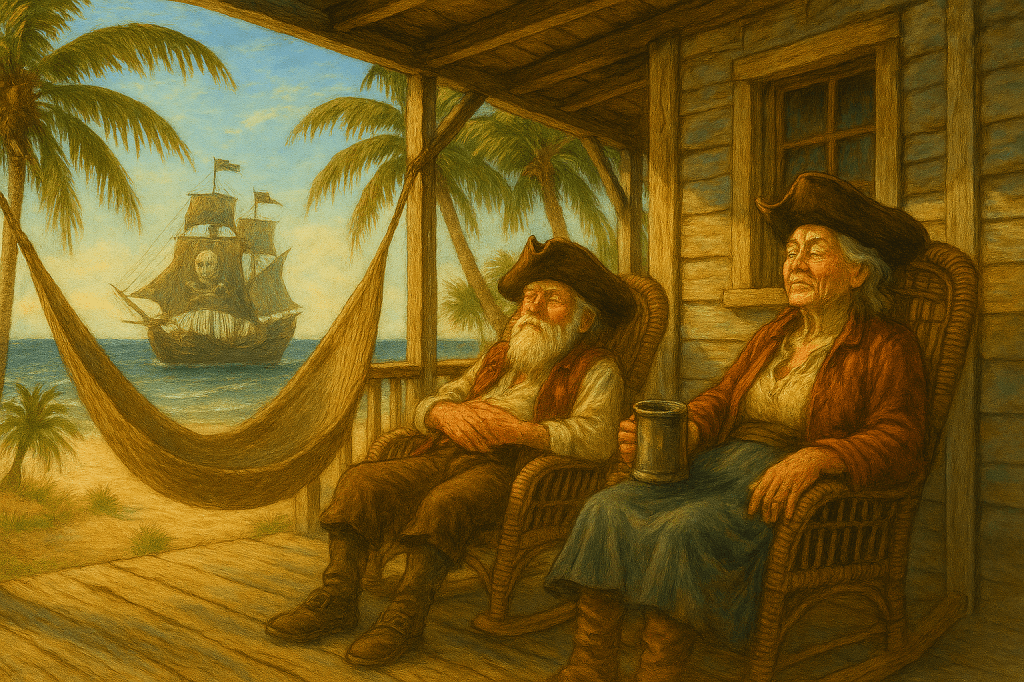
These are the waters of the buccaneer– they live large lives and lounge around with liquor, floating on waters calm, gin-clear, their risks outrageous and their thinking thin, alert to bargain and to dicker and not averse to sin– a life erratic.
The time of storms starts… ends… another year has gone by, always it seems quicker– thoughts of a distant home fade, disappear– beard covers sunken cheeks and chin and there’s no comment, jibe or snicker, only a rueful grin, wry, enigmatic.
There’s no reflection or confession here, for there’s no use for church or vicar. Security is in the bandolier; here, courts and coppers don’t look in, the flame of justice can no more than flicker. More feared is the shark’s fin: steady, emphatic.
But years creep up–ears deafen and eyes blear– dry stone gets harder and wet walkways slicker, and friends go out upon a bier. It’s hardly worthwhile trying to begin new quests once you’ve absorbed this kicker: ‘Really, what’s there to win?’ Change becomes static.
O pirate with your dwindling sense of cheer, while lounging on rattan and wicker! Though others lack your lazy lack of fear, their fine awards, like yours, are only tin. Enjoy your days and friends; don’t bicker: soak in life’s warmth and din. Be undramatic.
*****
I wrote this poem two years ago, and thought it was strong enough to get me into a good new magazine for the first time. And so it turned out… after 20 rejections, the 21st accepted it. So now I’m proud to be featured on the promo page for the latest Magma.
And about time too – after being brought up in a house called ‘Buccaneer Hill‘, by parents who started the ‘Buccaneer Club‘ guest house and restaurant, this poem was long overdue.
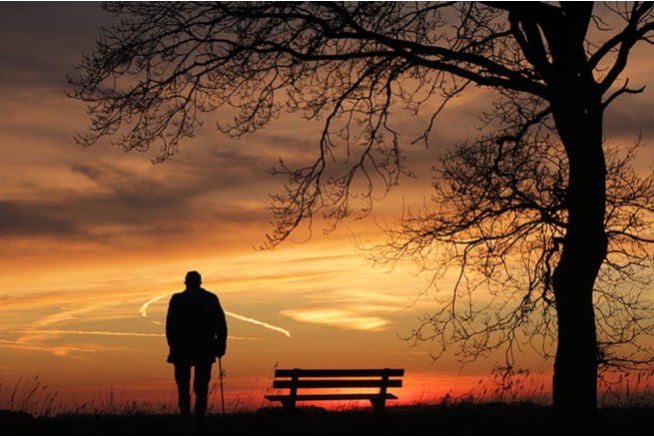
At sunset he ascends the crooked hill to ruminate on times past and to weep for friends long dead and lost friends living still. Each time he climbs this hill it grows more steep.
A day’s end is somehow akin to death as time bleeds out and cannot be revived. He stands on the hill’s summit, out of breath and wonders how on earth he has contrived
to be the last survivor of his peers, avoided heart attack or foul disease. The red sky is a bonfire of his years. Pure luck, the answer whispers in the breeze.
*****
Richard Fleming is an Irish-born poet (and humorist) currently living in Guernsey, a small island midway between Britain and France. His work has appeared in various magazines, most recently Snakeskin, Bewildering Stories, Lighten Up Online, the Taj Mahal Review and the Potcake Chapbook ‘Lost Love’, and has been broadcast on BBC radio. He has performed at several literary festivals and his latest collection of verse, Stone Witness, features the titular poem commissioned by the BBC for National Poetry Day. He writes in various genres and can be found at www.redhandwriter.blogspot.com or Facebook https://www.facebook.com/richard.fleming.92102564/
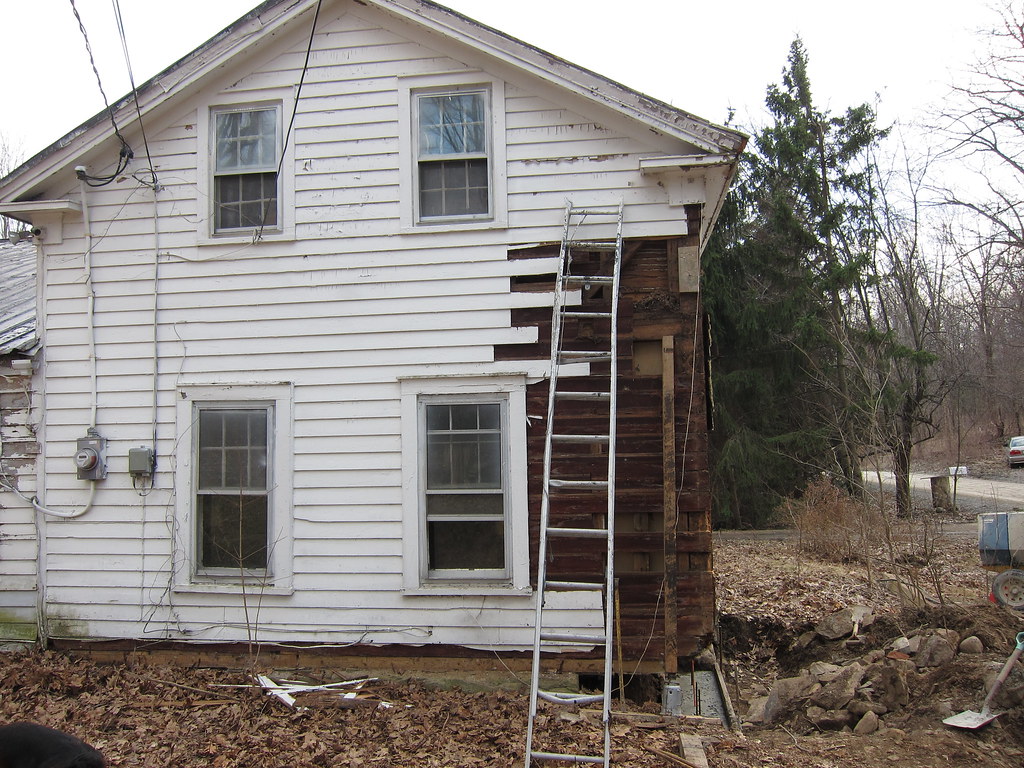
Time was, we spent our muscle and our nous propping an aging house against the pummeling of its hundred years. Clean paint, neat gardens, upkeep rarely in arrears, sober as Donne. Yet now each year afresh burdens us with new failings of the flesh:
Legs that once mounted ladders without qualm tremble. Nor are we calm confronting pipework; torsos will not shrink, backs bend, or shoulders fold to grope below a sink. Hands shake; eyeballs glaze over. What appalls is that our bodies buckle like our walls:
plaque in arteries, soot in chimney stacks, stubborn and troublous cracks in teeth, in plaster. House! Ought we to call ourselves—and you—new poster children for the Fall, for that hard doctrine grumbling down the ages that Sin’s to blame, with Death and Rot its wages?
Entropy as theology—would Donne jape at it? Wink and pun as in his randy youth? Or solemnly robed in his winding sheet, sing Mutability, spinning into the praise of God in Art the fact that all things earthly fall apart?
Or pull from air some bit of modern science, yoking (even by violence) thermodynamics, shortened telomeres, transplants, genetics, sex, the music of the spheres? Strange physics and wild metaphors—all grand, but Rot and Death, plain woes we understand,
are better fought with checkbooks than with verse. We’ll sit, these days. We’ll nurse our beers, while able bodies stir their dust. A distant siren whines—we sigh; it whines for us. Let plumbers, painters, carpenters begin this season’s round of battling Death and Sin.
*****
Maryann Corbett writes: “Last summer, Clarence Caddell was just beginning work on a new magazine, The Borough, and was planning a second issue while the first came together. He had in mind an issue centered on Donne, and he commissioned me to contribute a poem. I’d read the wonderful biography Super-Infinite: The Transformations of John Donne by Katherine Rundell not many months before, so a lot of the life was fresh in my mind–but it was also the season of endless repair that is the eternal truth of owning a house that’s 113 years old. It wasn’t hard to pull together a poem about the woes of home ownership with tidbits that “everyone knows” about Donne–his worldly-to-holy conversion, the familiar line about his yoked-by-violence metaphors–under an allusive title, and in a stanza form a bit like one of his. (Alas, this blog can’t show you the indents that would best imitate Donne’s way of laying out a poem. You’ll have to imagine all the trimeter second lines indented and the hexameter fourth lines hanging out farther left.) In the end, Clarence had to use the poem to fill out his first issue, so it sat alone, unassisted by an issue theme.”
Maryann Corbett earned a doctorate in English from the University of Minnesota in 1981 and expected to be teaching Beowulf and Chaucer and the history of the English language. Instead, she spent almost thirty-five years working for the Office of the Revisor of Statutes of the Minnesota Legislature, helping attorneys to write in plain English and coordinating the creation of finding aids for the law. She returned to writing poetry after thirty years away from the craft in 2005 and is now the author of two chapbooks and six full-length collections, most recently The O in the Air (Franciscan U. Press, 2023). Her work has won the Willis Barnstone Translation Prize and the Richard Wilbur Award, has appeared in many journals on both sides of the Atlantic, and is included in anthologies like Measure for Measure: An Anthology of Poetic Meters and The Best American Poetry.
Book discarded, like excess baggage shed by someone who has rapidly pushed on into uncharted regions far ahead, he sleeps in an old deck chair on the lawn. Gulls circle, skaters on an ice-blue lake, while he dreams on, oblivious, his face unshaded by a hat which, when awake, he wears with equanimity and grace. What does he dream? Is the unreal more real than those pale gulls that spiral high above? In sleep, has youth returned? No longer frail, does he relive time when impatient love was everything and all his heart desired, before life tricked him, left him old and tired?
*****
Richard Fleming writes: “I suppose Sunny Afternoon reflects my own station in life, that is, drifting steadily towards the end, with the usual collection of regrets that most of us have.”
Richard Fleming is an Irish-born poet (and humorist) currently living in Guernsey, a small island midway between Britain and France. His work has appeared in various magazines, most recently Snakeskin, Bewildering Stories, Lighten Up Online, the Taj Mahal Review and the Potcake Chapbook ‘Lost Love’, and has been broadcast on BBC radio. He has performed at several literary festivals and his latest collection of verse, Stone Witness, features the titular poem commissioned by the BBC for National Poetry Day. He writes in various genres and can be found at www.redhandwriter.blogspot.com or Facebook https://www.facebook.com/richard.fleming.92102564/
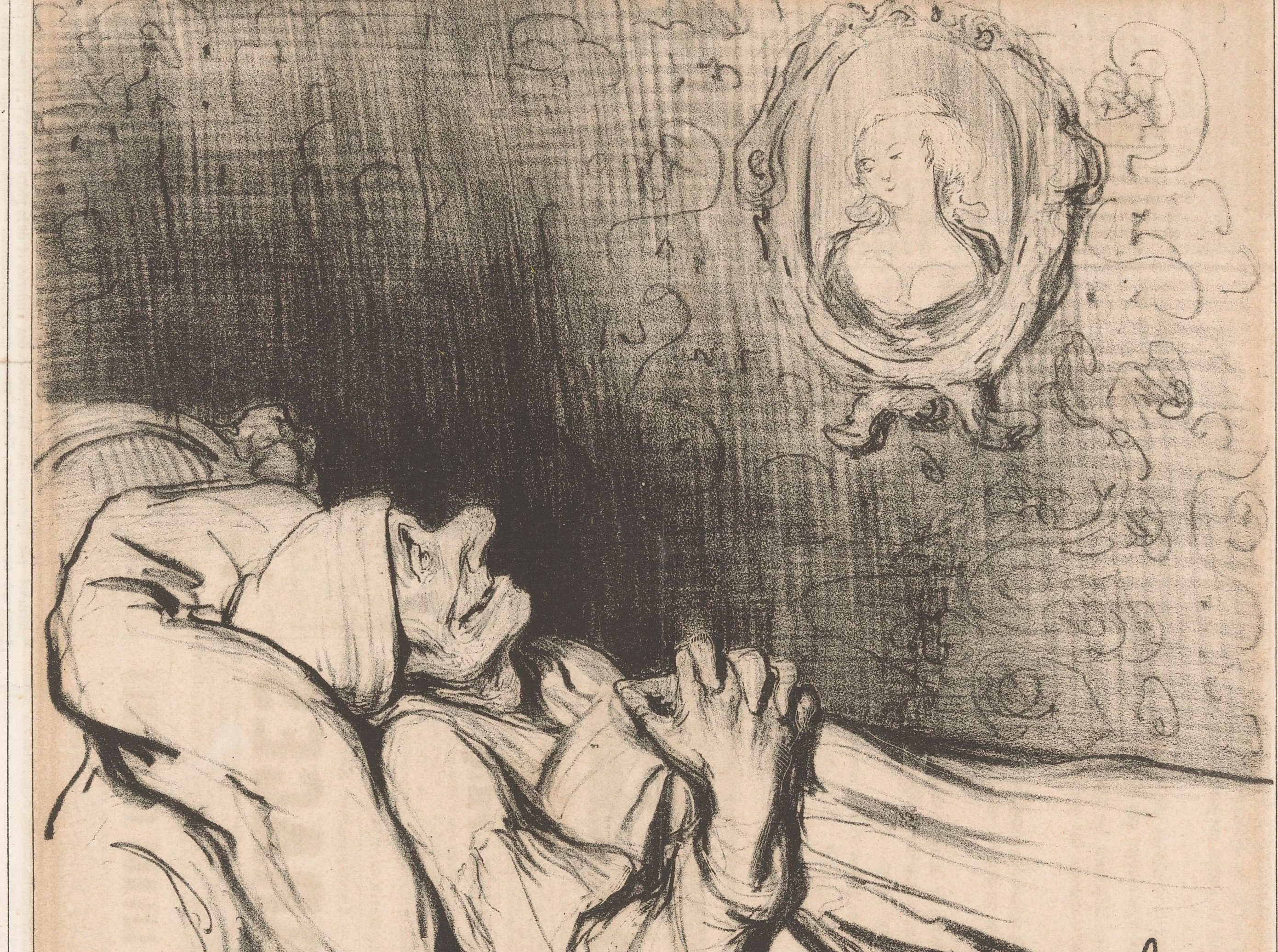
I found myself in bed with an old man. His beard was silvery, his scrawny chest a rack of ribs, his loose-lipped mouth open and toothless as a baby. There he was, there in our bed, as if he owned the place. He snored and grunted like some ancient king asleep after a banquet. But what feast had led, dear heart, to this? What partying? He turned his head to me. I saw his face— a travesty. Some metamorphosis had happened in our sleep, my love replaced by a bag of windy bones. I need a piss, he muttered, and got up. O then I knew what age had done to us, and who was who.
*****
Helena Nelson writes: “Everyone experiences it eventually. You glance at your own reflection in the mirror and get a shock at how old you look. So that’s one of inspirations for this poem. The other spur to write this was a dream I had one night, though in the poem it’s intentionally unclear whether the experience is or isn’t real. I started with near rhymes in the octet and moved towards perfect rhyme at the end to convey the shock. I do hope the reader feels that shock at the end.”
Helena Nelson runs HappenStance Press (now winding down) and also writes poems, one of which appears in the Potcake Chapbook, ‘Lost Love’. Her most recent collection is Pearls (The Complete Mr and Mrs Philpott Poems). She reviews widely and is Consulting Editor for The Friday Poem.
They lift and fix their heavy insect eyes upon the East, from where the sun will send the bees to stroke and lick and fertilize.
They wait, where once they craned their necks to see his passing arc. They wait, amazed. Surprise has painted yellow lashes, perfectly
coronal round a crowded, dark eclipse. Its buzzing beauty pixelates and stares. An alien array of cells unzips.
A thousand thousand sisters nurse the same regret. His warmth is gone. And left behind to hang their heads, disconsolate, they blame themselves. Their tears drop hard and black and blind
*****
Joe Crocker writes: “The French call them Tournesols because, when they are growing, the follow the sun. But when the flowerhead is fully formed, they all face East so they warm up quickly and are more attractive to the bees. The poem came about because I’ve been seeing them more frequently in our local supermarkets and my wife grew some this year. Seeing them close up, I was reminded of the reaction a friend from many years ago used to have. She liked them but kept her distance because she was spooked by their dense busy centres. So the insect eye was the starting metaphor and then the poem led me on. Big, beautiful, disturbing, and in the end, sad.”
Joe Crocker is no relation of the Sheffield-born rock singer. But he does live in Yorkshire and gets by (with a little help from his friends). He is a bit old now to be starting out in poetry but was infected by the muse during Covid lockdown a couple of years ago and has had a few things published, mainly in Snakeskin magazine (where this poem first appeared) and other online venues. He doesn’t have a website but if you Google him, you’ll learn a lot more about a certain Sheffield-born rock singer.
“The trouble with this growing old,” he said, “You lose so much . . . and you get what instead? If you can hang a bath towel on your tool it’s wasted when you’re in an all-boys school. Time was, I’d come — as you’d expect — with just a look, a touch. Now, not so much. The only thing that gets me full erect is feeling flesh firming from kiss and grasp; so all my work is trying to make her gasp! I need her climax if I’m to get sated.” He looked at her. She looked at him. He waited.
*****
This semi-formal poem was published in the Lighthearted Verse subsection of Formal Poetry in that wonderfully rich and varied magazine, Better Than Starbucks. Where else could you find such a variety of areas of expression as BTS’ Regular Feature Pages? Free Verse Haiku Formal Poetry Poetry Translations Poetry for Children International Poetry African Poetry Experimental, Form, & Prose Poetry Poetry Unplugged Fiction Flash Fiction & Micro Fiction Better Than Fiction (creative nonfiction) The Interview Interviewee Poems … and From The Mind of Alfred Corn
And tolerant enough to put up with my verse on occasion! Unfortunately they have announced they are going on hiatus… hopefully they will be back in 2023, as they have been a truly excellent outlet for all manner of poetry and prose.


 Form in Formless Times