Tag Archives: birds

Stephen Edgar, ‘Dawn Solo’

First light beside the Murray in Mildura,
Which like a drift of mist pervades
The eucalypt arcades,
A pale caesura

Dividing night and day. Two, three clear notes
To usher in the dawn are heard
From a pied butcherbird,
A phrase that floats

So slowly through the silence-thickened air,
Those notes, like globules labouring
Through honey, almost cling
And linger there.

Or is it that the notes themselves prolong
The time time takes, to make it stand,
Morning both summoned and
Called back by song.

*****

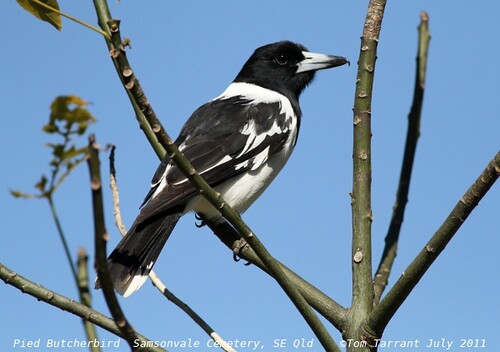
Stephen Edgar writes: “This poem needs little comment, I think. The bird in question is the pied butcherbird, as the poem says, considered by some to have the most beautiful song of any Australian bird. Let me quote some field guides to Australian birds: “superb, slow, flute-like mellow notes”; “song is one of our finest: a varied sequence of pure fluty whistles, sometimes interspersed by throaty warbles”; “fluted, far-carrying notes that seem to reflect the loneliness of its outback haunts”. Perhaps that third quotation best suggests the quality I was trying to capture. The notes seemed to be in slow motion, slowing time. I was attending the Mildura Writers’ Festival. Mildura is on the southern bank of the Murray River in northwestern Victoria. This was the first occasion on which I had heard the pied butcherbird.

“The form is a quatrain rhyming ABBA, with lines progressively shortening from pentameter, though tetrameter, trimeter to dimeter. It was first published in Australian Book Review and then in my twelfth book The Strangest Place: New and Selected Poems (Melbourne, Black Pepper, 2020), which is available on the Black Pepper website.”

Stephen Edgar was born in 1951 in Sydney, where he grew up. From 1971 to 1974 he lived in London and travelled in Europe. On returning to Australia he moved with his then partner to Hobart, Tasmania, where he attended university, reading Classics, and later working in libraries. Although he had begun writing poetry while still at high school, it was in Hobart that he first began writing publishable poems and found his distinctive voice. He became poetry editor of Island Magazine from 1989 to 2004. He returned to Sydney in 2005. He is married to the poet Judith Beveridge.

He has published thirteen full collections: Queuing for the Mudd Club (1985), Ancient Music (1988), Corrupted Treasures (1995), Where the Trees Were (1999), Lost in the Foreground(2003), Other Summers (2006), History of the Day (2006), The Red Sea: New and Selected Poems (2012), Eldershaw (2013), Exhibits of the Sun (2014), Transparencies (2017), The Strangest Place: New and Selected Poems (2020) and Ghosts of Paradise (2023). A small chapbook, Midnight to Dawn, came out in 2025, and a new collection, Imaginary Archive,will be published in late 2025. His website is www.stephenedgar.com.au, on which publication details of his books, and where they can be purchased, are given.

He was awarded the Australian Prime Minister’s Award for Poetry in 2021 for The Strangest Place.

Photo: “Pied Butcherbird (Cracticus nigrogularis)” by aviceda is licensed under CC BY-NC-SA 2.0.
Marcus Bales, ‘A Rainy Day in Cleveland’

A rainy day in Cleveland. I almost said
“The skies are gray.” Of course the skies are gray,
It’s raining, so — what could they be instead?
I meant to mow the rest of the lawn today,
But it’s a day to watch the garden grow.
The finches, flashing in the too-long grass,
Are pecking dandelion seeds, and glow
Their special yellow through rain-dotted glass.
The internet is off. I sit and watch
The irises and roses in the rain,
And do not read about the ugly botch
The greedy criminals in charge sustain
So they can strut around, so white, so male,
And cheat and lie to keep themselves from jail.

*****

Marcus Bales writes: “The rap against democracy has until now always been that the public, once it realized they could simply vote themselves money and benefits, would bankrupt the state voting themselves benefits and money. For 250 years the US public managed not to do that, though the reactionaries always accused them of it. It turns out the real danger is that if you have enough money you can just buy the government and operate it as a racket to benefit yourself and your cronies, even when there are laws in place that you have to break in order to do so. The problem with democracy, it turns out, is not that people are irresponsible but that the wealthy are liars and thieves.”

Not much is known about Marcus Bales except that he lives and works in Cleveland, Ohio, and that his work has not been published in Poetry or The New Yorker. However his ’51 Poems’ is available from Amazon. He has been published in several of the Potcake Chapbooks – Form in Formless Times.

Photo: Danny redd Photography https://www.facebook.com/watch/?v=1605166609548538

Poem : ‘Some Who Would Teach’

Some who would teach
Preach,
But speech cannot reach
As far as silence.

Even the stars perhaps are noisy, but, far as they are,
We hear their silence, not their sound.

Words are not for teaching, adding or changing.
Words can only express
What is already known
To one who already knows.

Words feathered together
Can lift aloft
Any body of men.
Opinions are pinions
With which men fly.
But they come down again
And with their descent
What was meant
Is often lost, or is known
To have never been known.
For a word is a wing
But a body’s a thing
And the body is always the body
But the wing only is when it flies.

Therefore not by talking but being
Does one teach how to be,
And words are for singing–
A song sung
By those knowing their winging as being but having no meaning.
And the best words
Come from birds.

I wrote this, but do I subscribe to the ideas? Did I ever? Not in any absolute sense, but as a rejection of all noisy preachers of faiths, and a rejection of those who put academic lectures ahead of experiential learning. In that sense this (early) poem prefigured my 25-year career teaching business finance through the Income-Outcome interactive games we developed for global clients like Beam Suntory, Michelin and hundreds of other companies and universities.

In another sense this poem is just about the enjoyment of words and songs, regardless of any meaning that the words may have.

It was published by Anima Magazine in the UK, unfortunately quiescent since 2018.

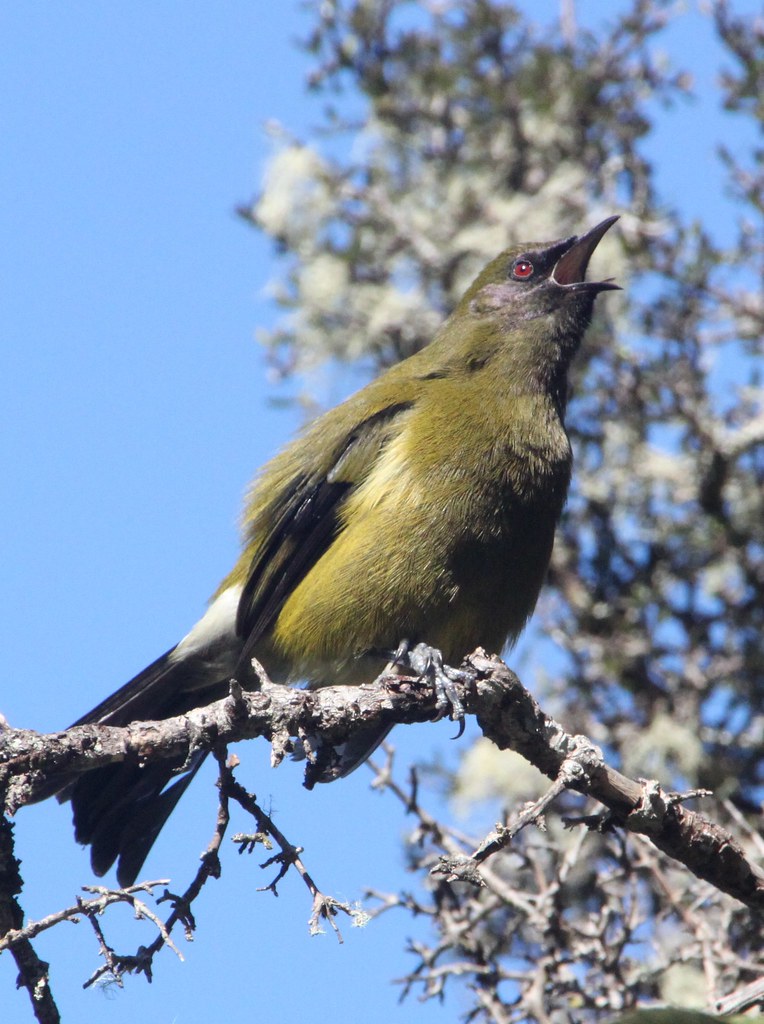
Photo: “Korimako (Bell Bird) singing” by theirishkiwi is licensed under CC BY-NC-ND 2.0

Poem: “I Started Out Alone”

I started out alone
with no numbers and no words.
The people gave me food and clothes.
I loved the sun and birds.

And when I reach the end,
numbers and words all done,
have to be fed and dressed again,
I’ll love the birds and sun.

This little poem was published recently in Bewildering Stories, and I like it for a couple of reasons: its simplicity (echoing the simplicity of the states of beginning and end of life, the simplicity of the basics of being human); and its completeness – it covers an entire life, and I can’t think of more words that could be added; and the formality, not only of the simple rhythm and simple rhymes, but of the structure, the line-by-line echoing of the beginning of life in the end of life.

For all these reasons it is an easy little poem to remember and recite, and that is satisfying in itself.