Tag Archives: Brian Allgar

Using form: Pantoum: Brian Allgar, ‘And then I told you’

We kissed. And then I told you (it was over
dinner at some fancy restaurant)
I loved you, but I couldn’t live like this,
meeting from time to time; I needed more.

Dinner at some fancy restaurant,
and timid sex at your place; that was all, each
meeting. From time to time, I needed more
than you were ready for, so reticent

and timid. Sex at your place – that was all. Each
meeting’s end, I tried not to ask more of you
than you were ready for. So, reticent,
I touched your face in silence, lovingly.

Meetings end. I tried not to ask more of you;
I loved you, but I couldn’t live like this.
I touched your face. In silence, lovingly,
we kissed, and then I told you it was over.

*****

Brian Allgar writes: “In general, I don’t much care for poetic forms, such as the triolet and the villanelle, with repeated lines. But I was attracted by the pantoum’s requirement that the repeated lines, though containing exactly the same words, should somewhat change in meaning each time.”

‘And then I told you’ was first published in Snakeskin.

Brian Allgar was born a mere 22 months before Adolf Hitler committed suicide, although no causal connection between the two events has ever been firmly established. Despite having lived in Paris since 1982, he remains immutably English. He started entering humorous competitions in 1967, but took a 35-year break, finally re-emerging in 2011 as a kind of Rip Van Winkle of the literary competition world. He also drinks malt whisky and writes music, which may explain his fondness for Mendelssohn’s Scottish Symphony. He is the author of The Ayterzedd: A Bestiary of (mostly) Alien Beings and An Answer from the Past, being the story of Rasselas and Figaro. He is also the co-author, with Marcus Bales, of Baleful Biographica, all published by Kelsay Books and available from the publisher or from Amazon.

Photo: “French restaurant with Jean” by obvio171 is licensed under CC BY-SA 2.0.
Using form: Parody: Brian Allgar, ‘Irretrievable Breakdown’

The Owl and the Pussycat went to the Judge,
For they sought to obtain a divorce.
“My dear Sir”, said the Owl, “I’ve no wish to be foul,
Though I fear you’ll consider us coarse.

Our plight’s anatomic; my efforts are comic
To exercise conjugal rights.
With our different bits, there is nothing that fits,
And this failure our happiness blights.”

The Pussycat spoke: “He’s a feathery bloke,
Whereas I’m rather furry and feline.
In vain we have tried to get Owly inside,
So to you we are making a beeline.”

Said her husband: “Your honour, I’ve struggled upon her
And hoped she would prove ‘pussycatable’.
It was useless, of course, and we’re seeking divorce
On the grounds that we’re quite incompatible.” 

So the Judge set a date to determine their fate:
“I’ll decide at the end of next week.”
But the cat came alone, though she carried a bone
And a handful of feathers and beak.

Said the Judge with a scowl: “Where’s your husband, the Owl?
Are you thinking to mock or deride me?”
Then the Pussy confessed:  “I have eaten the rest,
So my husband, at last, is inside me.”

*****

Brian Allgar writes: “What parodist can resist Edward Lear? A gold-mine probably second only to Lewis Carroll.”

Brian Allgar was born a mere 22 months before Adolf Hitler committed suicide, although no causal connection between the two events has ever been firmly established. Despite having lived in Paris since 1982, he remains immutably English. He started entering humorous competitions in 1967, but took a 35-year break, finally re-emerging in 2011 as a kind of Rip Van Winkle of the literary competition world. He also drinks malt whisky and writes music, which may explain his fondness for Mendelssohn’s Scottish Symphony. He is the author of The Ayterzedd: A Bestiary of (mostly) Alien Beings and An Answer from the Past, being the story of Rasselas and Figaro. He is also the co-author, with Marcus Bales, of Baleful Biographica, all published by Kelsay Books and available from the publisher or from Amazon.

Photo: “What She’s Really Thinking” by lumachrome is licensed under CC BY-SA 2.0.

Parody: Brian Allgar, ‘If you can …’

If you can make her laugh, that’s half the battle,
Especially if she’s married to a bore;
If you can make her glad to be your chattel,
Yet treat her like a lady, not a whore;
If you can undo bra-straps single-handed
While murmuring enticements in her ear;
If you can make her think you’re being candid
When telling her just what she wants to hear;
If you, my friend, can easily persuade her
To sample things she’s never tried before,
Or if she sighs with pleasure when you’ve laid her,
And smiles as you sneak out by the back door;
If you can tolerate her endless prattle,
(And never tell her “Darling, get a life”),
Her gossip and her foolish tittle-tattle—
Then you’re the bastard who seduced my wife!

*****

Brian Allgar writes: “Written with a particularly amoral friend of mine in mind, although I am glad to say that the narrator is not me.”

Brian Allgar was born a mere 22 months before Adolf Hitler committed suicide, although no causal connection between the two events has ever been firmly established. Despite having lived in Paris since 1982, he remains immutably English. He started entering humorous competitions in 1967, but took a 35-year break, finally re-emerging in 2011 as a kind of Rip Van Winkle of the literary competition world. He also drinks malt whisky and writes music, which may explain his fondness for Mendelssohn’s Scottish Symphony.
He is the author of “The Ayterzedd: A Bestiary of (mostly) Alien Beings” and “An Answer from the Past, being the story of Rasselas and Figaro”, both available from Kelsay Books and Amazon.

Photo: “Making Her Laugh II” by kahala is licensed under CC BY-NC-ND 2.0.

Brian Allgar, ‘Genesis’

One sunny morning, strolling in my garden,
I stumbled, and my foot crushed something’s head.
“Me dammit!” I exclaimed, “I beg your pardon”,
Looked down, and saw my Serpent lying dead.
 
Now this was most vexatious, for I’d planned
That this poor snake would implement my scheme
To give my little friends a helping hand,
And lead them gently from their childish dream.
 
The Serpent was supposed to tempt the couple
With luscious fruit that Eden’s trees bedecks;
My chosen agent, sinuous and supple,
Would lead the pair to knowledge – and to sex.
 
Omniscience can have its limitations,
And even Godly schemes may gang agley.
I’d once envisaged teeming populations,
But this, perhaps, was better, in its way.
 
No Spanish Inquisition, no Crusades,
No slaves, and no Industrial Revolution,
No mining sites where once were leafy glades,
No factory chimneys belching out pollution.
 
No nation-states, no border wars to settle,
No Holocaust, no tribal genocide,
No Rap, no Hip-Hop, Punk or Heavy Metal,
No hamburgers with coleslaw on the side.
 
No guns, no bullets, no demented shooters,
Since nothing could be made, except of wood;
No mobile phones (thank Me!) and no computers …
I looked on all of this, and found it good.
 
Yet what of those who should have lived hereafter?
No Homer, Shakespeare, Mozart, Botticelli?
No P. G. Wodehouse? (I was fond of laughter,
Though, being God, I didn’t have a belly).
 
Descendants all, but only if they had ’em.
(No Michelangelo, no Sistine Chapel?)
My mind made up, I called to Eve and Adam:
“I wondered if you’d care to try an apple?”

*****

Brian Allgar writes: “As a devout atheist, I felt it my duty to shed some light on the truth behind the Creation myth.”

Brian Allgar was born a mere 22 months before Adolf Hitler committed suicide, although no causal connection between the two events has ever been firmly established. Despite having lived in Paris since 1982, he remains immutably English. He started entering humorous competitions in 1967, but took a 35-year break, finally re-emerging in 2011 as a kind of Rip Van Winkle of the literary competition world. He also drinks malt whisky and writes music, which may explain his fondness for Mendelssohn’s Scottish Symphony.

He is the author of “The Ayterzedd: A Bestiary of (mostly) Alien Beings” and “An Answer from the Past, being the story of Rasselas and Figaro”, both available from Kelsay Books and Amazon.

Photo: “Mary’s Feet” by elycefeliz is licensed under CC BY-NC-ND 2.0.

The Spectator Competition: “Paradise Lost in four lines”

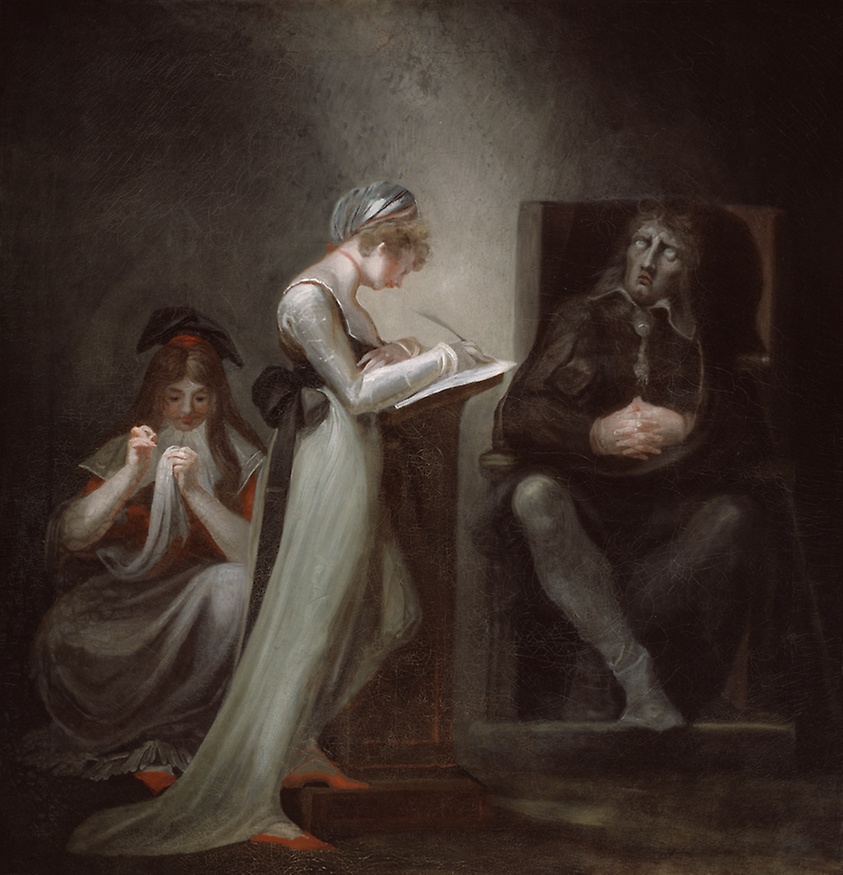
Milton Dictating to his Daughter, 1793, Henry Fuseli

Lucy Vickery runs a competition in the British weekly The Spectator–a truly venerable publication which recently reached its 10,000th weekly issue. Its politics are a bit too conservative for my taste, but the competition is in a class of its own (The New Statesman having dropped its similar competition a few years ago).

The most recent challenge was this: “In Competition No. 3163 you were invited to submit well-known poems encapsulated in four lines.” The gorgeous responses prompted Lucy Vickery to call the results “Paradise Lost in four lines”, after this entry by Jane Blanchard:

Satan found himself in hell —
Eve and Adam also fell —
Good gone bad got even worse —
Milton wrote too much blank verse —

(which exactly reflects my feelings, having had to waste too much of my A Level studies on Paradise Lost at the expense of more interesting poets such as John Donne and Matthew Arnold.)

My personal delight in The Spectator’s competitions is in seeing so many Potcake Poets there (in this case not just Jane Blanchard, but also Chris O’Carroll, Martin Parker, Jerome Betts, George Simmers and Brian Allgar), and in identifying more poets to keep an eye on for possible future chapbooks.

Anyway, if you want to see nice condensations of famous poems, have a look at that specific competition’s results. My favourite is Martin Parker’s take on e.e. cummings’ ‘may i feel said he‘:

foreplay
(more play)
errings, ummings
(and cummings)