Tag Archives: Daniel Galef

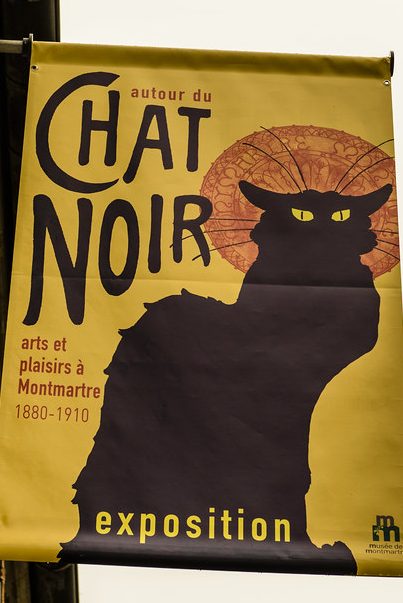
Weekend read: Daniel Galef, ‘Auriol to a Patron at Le Chat Noir’

For it was Auriol who concocted the Chat Noir-Guide toward the end of the nineteenth century. The Guide provides, for every objet d’art and knick-knack purportedly on display in the bar, fantastical tales of provenance.
From Cabaret to Concert Hall, Steven Moore Whiting


Come in, come in! Here, have a glass of beer—
The best in Paris! Whence derives such praise?
The Comte du Saint-Clement, when he drinks here,
And several other lumières Françaises
All say so. (Rimbaud swore “the best in France!”)
Perhaps you have been eyeing some of our
Objets and esoterica? Perchance
You’d like to hear their provenance? Le Soir
Has called the Chat’s decor the greatest work
Of art collection since the Louvre. These darts
Were thrown by Pippi Pavlo of Le Cirque.
This mirror-frame once held a Queen of Hearts
Played by the Duke of Sandwich in the game
At which he famously invented soup.
That specimen was lost before it came
To us—pinched by a croupier with the croup.
The mirror, too, is memorable—this crack
Imparted by a blow from cannon fire.
The cannoneer collapsed. Upon his back
They found the selfsame mark. Since then, each buyer
Has met a grisly fate—until bought by
A suicidal poet named Pierre.
It didn’t work. He gave it to Le Chat
In payment for a shot. We hung it there.
The timepiece on the mantle was a gift
From Pope Immaculate to me. Of course,
At that time, I had left the church. A rift
Arose when I ordained a bishop’s horse.
Ignore the wireless just beside—the news
Is so depressing, no? So . . . uninspired.
The mud, the blood, the bombs, the flu, the coups,
Enough to make Scheherazade tired.
But here! This silhouette is me—back then
I had a beard. I lost it in a duel
With three mad Turkish painters in Ardennes.
The third defaulted. Still I shot. It’s cruel
To leave a loser living. I was called
“The Caesar of Sargasso”—naturally
There wasn’t a resemblance. He was bald
While, under wraps as “Cleopatra Lee”
I worked with Pasteur researching a cure
To hair loss. Though the lab sank in a storm,
I drank the last drop as I swam to shore,
And thus my coiffure’s never lost its form.
This bronze, by Claus of Innsbruck, is a hoot—
So said the critic who is sealed inside
Its twin, the Triton by the stairs. Poor brute!
He knocked for half a week before he died.
It’s best not to insult these artist types.
I have the Gift myself, but can’t unearth it.
To catch the Muse is much like hunting snipes:
They bite, and taste too gamey to be worth it.
Each crystal on that chandelier’s a shard
From Louie Something’s windows at Versailles.
They say there came a witch, old, hunched, and scarred,
One night at midnight. With her one bright eye
She sneered once through the pane, and then departed.
Within a week, the king went mad and smashed
The lot of them, while mumbling “It has started!”
It’s cursed, of course. Too pretty to be trashed.
The candles are of beeswax. And what bees!
They live like princes. Endless fields of flowers
Are tended by the gardeners at Nice
And watered by a set of special showers
Constructed for the grounds by Lord Brunel.
We light them only rarely. For a guest
Such as yourself, I’ll gladly burn one. Well,
Just half. Come back someday, we’ll burn the rest.
These coasters? Quite mundane. They’re bits of planks
I salvaged from the Hesperus. Oh yes,
I once was quite the soldier. Only blanks
I ever loaded in my gun. The rest
Must have a chance, you know. It isn’t fair
To pit them up against whom Nelson dubbed
“The finest shot in Europe.” On a dare,
I handed him my pistol once. He clubbed
Me with his wooden leg. What’s that? His arm?
Oh no, that’s merely what the papers said.
In fact, it was his leg. It does no harm
To stretch the truth a little. Nelson plead
For them (the press) to print it right, but they
Insisted that an arm read better. He,
Of course, cried “What a silly thing to say!
An arm can’t read! Perhaps an eye?” You see,
They listened—Nelson loved Le Chat. You’ll find,
If you direct attention here, I’ll show
You where he signed the bar. Just why he signed
As “Ferdinando Smitty,” I don’t know.
That stool you’re sitting on I carved myself
With a pocketknife from one great slab of teak
When, hounded through a forest by some elf
I climbed a tree and hid there for a week.
That tree was this: The chair. The table, too,
Unless that one’s the Pharaoh’s table—no,
But come along, I’ll show that one to you,
Just past these poker-playing dogs (Van Gogh).
Don’t touch, the paint is fresh! I knew the model,
Lovely gal. Alsatian, I recall.
Her only vice, a weakness for the bottle;
Poor dear! Not drink—the bottle, that was all.
Our barman is a secret Count, a bastard
Practicing the rapier to reclaim
His stolen birthright. So far, he has mastered
Fourteen styles of swordplay. Soon his name
Will grace kings’ lips. For now, he’s just our skinker.
The chambermaid, as well, has quite a story.
A moron, yes? Wrong! Why, that genius thinker
Solved the famous Kjotz Conjecture. Glory
Is nought to her. She labors for mankind,
And for her god (the Devil). The Sorbonne
Has offered her a chair. But she declined.
(They say her mother was Napoleon’s son.)
That busboy? Oh, don’t heed him. He is lame
Not from trench foot, as some (and he) insist,
But—let me see—oh, yes!—a goon whose name
Was “Olaf” chopped his toes off at the wrist,
And now he’s quite—But pray, don’t touch that curtain!
The outside light must never be allowed
To touch these treasures. They’ll tarnish, I am certain.
(Besides, those drapes were Victor Hugo’s shroud.)
Our rum’s supplied by pirates. These fine cups
Looted from the Louvre. These splendid spoons
Are those with which the Mongol chieftain sups.
The silver forks are forged from gold doubloons.
Our beer, which I can see you quite enjoy,
Is brewed by tight-lipped monks who take a vow
Never to speak a lie—I, as a boy
Was in the order. (I have left it now.)

*****

Daniel Galef writes: “A few years ago when I was learning the Gymnopedies and Gnossiennes on piano I also tried reading up on Erik Satie, whose circle was full of interesting eccentrics, especially those frequenting Rodolphe Salis’s famous fin-de-siecle cabaret in Montmartre the Chat Noir: George Auriol, Vital Hocquet, Alphonse Allais, &c. As a fiction writer, I am fascinated by lies and liars and what drives them, and was particularly taken by the fact, mentioned in passing, that Auriol had written and published a fake guidebook for the Chat Noir. I’ve since read more about Auriol, and even tracked down and read (with the help of Google Translate) a scan of the Guide itself (and highly recommend it, if it’s still to be found online), but when it was the only thing I knew about him that line alone in Whiting’s book was enough to serve as springboard for this weird, sort of Browning-y monologue poem, which is one of my favorite things I’ve ever written. The long version was written first even though it was published second; it appeared in 2022 in Bad Lilies, and later I snipped a sonnet out of it, which was published in 2020 in Light (and then in a slightly different form in my first book Imaginary Sonnets).

Daniel Galef’s poetry, half-serious and half-non-, has been published in a variety of venues themselves both serious and non-. His first book, Imaginary Sonnets, collects 70 persona poems from the point of view of various historical figures and literary characters, including Lucrezia Borgia, Christopher Smart’s cat, and a taco. “A Nightingale to a Sad Poet” first appeared in the Spring/Summer 2025 issue of Sein und Werden. Other recent writing can be found in the Indiana Review, the Best Small Fictions anthology, and Scientific American.

Photo: “Le Chat Noir” by Son of Groucho is licensed under CC BY 2.0.

Double sonnet, Daniel Galef, ‘A Nightingale to a Sad Poet’

(Keats’s ‘Ode to a Nightingale’ from the other side)

You slump at my tree’s foot, complex angsts brewing
While our red-clawed, red-beaked animal furies
In these shadowy plots hatch our own undoing.
If thinking is man’s ruin, have no worries.
If you could speak the whistling words of birds
Whose sound to you like music now appears,
As nature’s snow-white cream man sours to curds
To chew, our songs would curdle in your ears:
‘Fly!, fly! The bearded fox is on the prowl!’—
And ‘Keep away! These berries are quick poison!’—
‘I need a mate, or I was born for nought’—
‘Go south, go south!’—‘The horned and hoary owl
Brings swift, crook-taloned death.’ You seek strange joys in
Ignorance, to envy lives so fraught!
Now dull-brained human scientists proclaim
That tool-use is no more unique to apes
Than language, war, or thumbs. They’re all the same
Emergent properties, like wine from grapes.
I am not certain that is Hippocrene;
The Pierian Spring leaves no such scarlet stain.
A jug of wine might well complete the scene:
Your book of verse, &c. A brain
Like smiling Aesop’s, where morals mask the roar
Of lions, the flopping fear of fish in the net,
The worm-wove cloak we dress up in our tomb in—
I think that must be Lethe. Drink, and soar
Above your brain, and me, and quite forget
That you were all too sentient, all too human.

*****

Daniel Galef writes: “I’m a sucker for parodies and response poems! My first book features riffs on Byron, Swift, Ernest Thayer, the ancient epigrammatist Nossis the Epizephyrian, and Doris Day. A few years ago in my master’s program I took a[n excellent] poetry workshop with Barbara Hamby focusing on the history of the Ode, as part of which she had everyone memorize Keats’s “Ode to a Nightingale.” We’d all read the poem before, but engaging with it so closely for a sustained duration was a really lovely experience, and having the whole poem by rote is an excellent party trick if you ever need to clear the room at the end of a party. At the end of the class I sent Professor Hamby a little parody piece, a rebuttal from the nightingale’s point of view to the moping poet sitting underneath its tree. (It was also a gesture of peace because I had gotten on her bad side by insinuating that the speaker calling the nightingale “dryad of the trees” was redundant because all dryads are by definition of the trees.) That poem was three pages or so and more directly parodying Keats’s style, as well as being written with the same stanzaic structure as Keats’s. It was also just for fun and thoroughly unprintable. But something I’ve been doing lately when I can’t bring myself to write an original poem is to sonnet-ize other things I’ve written—short lyric poems, long narrative poems, free verse, even short short stories—as I’m currently putting together a second collection of Imaginary Sonnets, a series of persona poems I’ve been writing for years inspired by the Victorian poet Eugene Lee-Hamilton. I cherrypicked a handful of my favorite lines from the long nightingale poem and spun some sonnet-stuff around them and ended up with this. It was still too much material for fourteen lines but fit into a double-sonnet, which is half as good.”

Daniel Galef’s poetry, half-serious and half-non-, has been published in a variety of venues themselves both serious and non-. His first book, Imaginary Sonnets, collects 70 persona poems from the point of view of various historical figures and literary characters, including Lucrezia Borgia, Christopher Smart’s cat, and a taco. “A Nightingale to a Sad Poet” first appeared in the Spring/Summer 2025 issue of Sein und Werden. Other recent writing can be found in the Indiana Review, the Best Small Fictions anthology, and Scientific American.

Bard of the Mossy Cot” by Giles Watson’s poetry and prose is licensed under CC BY-SA 2.0.


The Two-State Dissolution (2): Landsman, Burch, Lehr, Foster, Galef, Soderling, Kenny, Helweg-Larsen, Smith, Bales, Shore

Peggy Landsman, ‘Go Tell It On The Mountain

Hagar and Sarah should have talked,
Laughed together when alone.
Who did Abraham think he was?
Ha-Yehudi ha-rishon?*

Ishmael and Isaac should have been
Boon companions, closer than brothers,
Passing their days doing their chores,
Tending their father’s sheep together…

Staying up late entertaining themselves
Arguing over the numbers of stars
Each was the first to have named.

*”Ha-Yehudi ha-rishon” means “The first Jew” in Hebrew.

Michael R. Burch, ‘Frail Envelope of Flesh’
for the mothers and children of Gaza

Frail envelope of flesh,
lying cold on the surgeon’s table
with anguished eyes
like your mother’s eyes
and a heartbeat weak, unstable…

Frail crucible of dust,
brief flower come to this—
your tiny hand
in your mother’s hand
for a last bewildered kiss…

Brief mayfly of a child,
to live two artless years!
Now your mother’s lips
seal up your lips
from the Deluge of her tears…

Quincy Lehr, ‘Passive Voice’

History is back in passive voice.
All you can do is watch. The teams were picked;
the commentary doesn’t match the plays.
The game is rigged, and everybody sees.

The game is rigged, and everybody sees,
but referees ignore it, and debate
is limited to the cheap seats far away.
The villains are the only proper nouns.

The villains are the only proper nouns,
the only ones worth mentioning besides
the nebulous abstractions for the rest.
None believe what everyone accepts.

History is back in passive voice.
The game is rigged, and everybody sees
the villains are the only proper nouns.
None believe what everyone accepts.

Gail Foster, ‘The Heap’

How many does it take to make a right?
Go fling another on. The heap grows high
Before too long it will obscure the light
And then where will we be. The end is nigh
And still it reaches up towards the sky
How many more, the village women weep
Of all our sons and brothers have to die
While we pile wrong on wrong upon the heap

Remember sky, how blue it was and bright
And wide, when only birds and clouds did fly
And moons and stars were visible at night
When women laughed and children didn’t cry
What use is wrong for wrong and eye for eye
The world grows blind and bitter and we reap
What we have sown and see our rivers dry
While we pile wrong on wrong upon the heap

What use a pile of pacifists? The sight
May cause a running man to stop and sigh
The wise man said, and think about the fight
And for a fleeting moment wonder why
They chose to sacrifice themselves, deny
The life force and there lie in peaceful sleep
They make a monument, he said, nearby
While we pile wrong on wrong upon the heap

Dear God, when will it end? When will you try?
The heap grows higher and the sides too steep
We love our neighbours with the guns we buy
While we pile wrong on wrong upon the heap

Daniel Galef, ‘Desert Kite’

These endless shifting sands—
They’re always changing hands,
But you can’t make bricks without breaking a little hay.
With oil the streets are pavèd;
Since Solomon and David,
They draft a brand-new atlas every day.
The apostles! The epistles!
And the fossil fuels and missiles—
Like manna in the wilderness they fall!
The land of Abrahamics
Now hosts General Dynamics
With their guardian angels gliding over all.

Janice D. Soderling, ‘Out of Paradise’

A closely woven stillness lines the air,
like linen bedding in a lifted coffin.
Though silence is a hallmark of our time, not often
has the hush been so oppressive. Where
the sand fox sprawls, sprawls too the shattered hare.
Cadavers of gazelle and roe deer stiffen;
the wadded pods of thorn trees burst. If when
you ponder on this devastated garden,
its wretched shame, its bottomless despair,
think not animal, but human, shreds in Eden.
And human was the animal lately passing there.

Janet Kenny, ‘After’

We saw them sweep in like a wolf on the fold.
We hypocrites judge as if time was involved.

Lament, all you lovers whose loved ones are gone.
Condemn, all you judges now grief is your song.

After the fury what’s left to repair?
Oh impotent jury, your conscience is there.

No poem will save us no tears will avail.
No weapons will spare us from history’s gale.

No art can encompass the scale of this rage.
“Tomorrow” is yesterday trapped in a cage.

Robin Helweg-Larsen, ‘Books’

When Science and Experiment
were done through myth and dream, it meant
that Bronze Age herders showed their bent
in naïve tribal Books.

The Israelites searched 40 years
for good land, unprotected, bare,
and slaughtered all those living there –
justified by their Book.

The Muslims conquered far and wide
(and called it peace, and millions died)
to spread new tales we now deride,
new versions of that Book.

The Christians sent wave after wave
crusading, claiming that they’d save
the “Holy Land”… made it a grave,
thanks to their stupid Book.

You advertise benevolence
but justify intolerance
by quoting this or that sentence
from one or other Book.

You bomb a house, a baby dies…
lift up your eyes so we can rise
above the vicious tribal lies:
those stupid, stupid Books.

J.D. Smith, ‘Report from the Field’

I rang the doorbell
of the demolished house
and was met by its generations,
fully armed.

Marcus Bales, ‘Heal or Hate’

You lift or do not lift the weight;
You’re either dealt-to or you deal.
Pick the other, pick the one,
The choice you have is heal or hate,
And you can’t ever hate and heal

Call it nature, nurture, fate
Genetics, fantasy, or real —
Blame whatever – when you’re done
You lift or do not lift the weight.
You’re either dealt-to or you deal.

Short-term crooked looks like straight;
Short-term truth sounds like a spiel.
In both the short and longer run
The choice you have is heal or hate —
And you can’t ever hate and heal

I know, the choices don’t seem great.
They lack in zip or sex appeal.
But no one said this would be fun.
You lift or do not lift the weight.
You’re either dealt-to or you deal.

You must massage your mental state
To organize the way you feel
In spite of all the bullshit spun.
The choice you have is heal or hate,
And you can’t ever hate and heal

You often have to simply wait
And sift to see what’s really real
Since growing needs both rain and sun.
You lift or do not lift the weight;
You’re either dealt-to or you deal.

Late or early, it’s too late.
You’re living through the slow reveal.
The game is rigged: it can’t be won
Or even stopped once it’s begun.
You lift or do not lift the weight;
And though you’re dealt-to or you deal
The choice you have is heal or hate.
You cannot ever hate and heal.

Marion Shore, ‘Peace’

I came upon a garden in the sun,
where children ran and played among the trees,
and entering, I asked two little ones:
“Why are you here? And where are your families?”
One answered, “I was with my dad and mom.
We went into a café for a Coke.
And then I heard somebody scream ‘a bomb!’
and all that I could see was fire and smoke.”
The other said, “I went outside to play,
the street was crowded. Tanks were all around.
Soldiers were shooting. I tried to run away.
I heard a shot and fell down on the ground.
No one heard me crying for my mother.”
The first child said. “I wish I could go home.”
“So do I. But at least we have each other.”
The sun was rising higher in the sky:
my dream was fading, and as I waved goodbye,
‘Salaam,’ said one. The other said ‘Shalom.’


Yuval Noah Harari: We suffer not from the narrowness of the land, but from the narrowness of the mind. https://youtu.be/Uncfi9cgZWo

It’s all about stories: https://youtu.be/L82XOw9sVkY


Acknowledgements:
Peggy Landsman: ‘Go Tell It On The Mountain’, first published in The HyperTexts
Michael R. Burch: ‘Frail Envelope of Flesh’, first published in The Lyric
Daniel Galef: ‘Desert Kite’, first published in Light
Janice D. Soderling: ‘Out of Paradise’, first published in The Rotary Dial and included in her collection ‘War: Make that City Desolate’

Photo: “Scenes from Gaza Crisis 2014” by United Nations Photo is licensed under CC BY-NC-ND 2.0.

Odd poem: Couplet wordplay: Daniel Galef, ‘Letters to an Editor’

When I was in the printing biz,
in magazines (I worked at MS),
under my office door was slipped
a neatly-typed-out MS,
its cover letter curt and snippy,
return address in MS.
And what a scoop! New drug (its doses
prescribed for MS)
a fraud! The source, in bold defiance,
a chemist with a MS.
I showed my boss. “Yeah, right!” she reckoned,
and canned me in a MS.

*****

Daniel Galef provides this key to the various standard meanings of the abbreviation:
“Ms. Magazine; manuscript; Mississippi; multiple sclerosis; Master of Science degree; millisecond.”

Daniel Galef’s first book, Imaginary Sonnets, was published last year. ‘Letters to an Editor’ was published as part of his being the Featured Poet in Light Poetry Magazine. He is currently working on a book of comic poetry and wordplay, as well as on a PhD from the University of Cincinnati.

Photo: “Ms. magazine Cover – Winter 2015” by Liberty Media for Women, LLC is licensed under CC BY-SA 4.0.

Using form: biform poem: Daniel Galef, ‘A Poke of Gold to the Lady That’s Known as Lou’

I saw the sigh in your pretty eye
    When you dreamed that I’d be yours,
But those who steal me fast reveal
    My shine is the start of wars.

First I passed through the purse of a miner who nursed
    A chill. He seemed to be
Just a helping of hurt in a flannelette shirt
    From Plumtree, Tennessee.

It’s the goal of gold to be bought and sold
    And melted and poured in a mould.
From the day they scratched me out of that patch
    Of dirt, I’ve been near as cold.

Now again I change hands, and again the sands
    Run out, and men lie dead.
Good chances, I’d rate, that the heftier weight
    Is a couple of rounds of lead.

I’ve been sought by those men—half a dozen or ten—
    Who flash gold in pokes and pounds,
Who begged you for dances and killed for your glances—
    It’s not as nice as it sounds.


I saw the sigh in your pretty eye when you dreamed
That I’d be yours, but those who steal me fast
Reveal in my shine is the start of wars. First I passed
Through the purse of a miner who nursed a chill. He seemed
To be just a helping of hurt in a flannelette shirt
From Plumtree, Tennessee. It’s the goal of gold
To be bought and sold and melted and poured in a mould.
From the day they scratched me out of that patch of dirt,
I’ve been near as cold. Now again I change hands, and again
The sands run out, and men lie dead. Good chances,
I’d rate, that the heftier weight is a couple of rounds
Of lead. I’ve been sought by those men—half a dozen or ten—
Who flash gold in pokes and pounds, who begged you for dances
And killed for your glances—It’s not as nice as it sounds.

*****

Daniel Galef writes: “Last month Robin posted ‘Casey to His Bat,’ a poem which scans as both a sonnet and as fourteeners in ballad meter. The intro mentioned that I’d written a few more of this type of poem after ‘Casey,’ one of which was titled ‘A Poke of Gold to the Lady That’s Known as Lou.’
As much as I loved the challenge of writing the Casey sonnet, I felt the form had to be justified somehow by the subject, and so, just as ‘Casey’ followed Ernest Thayer* in its alternate scheme of iambic heptameter couplets, each of the subsequent convertible sonnets, part of my Imaginary Sonnets series of persona poems, is also a response to or parody of a specific existing poem in a different meter which the sonnet doubles.
The second convertible sonnet, ‘A Poke of Gold to the Lady That’s Known as Lou’, is a riff on the famous narrative poems of Robert Service ‘The Shooting of Dan McGrew’ and ‘The Cremation of Sam McGee’ in his 1907 collection Songs of a Sourdough. (Like Thayer, Service is sometimes scorned as a jingle-writer partly because of his popularity and his populism, writing in the vernacular voice of Yukon prospectors.) Both of these narrative poems are written in a much looser anapestic ballad meter with more inversions and extra syllables than sonnets normally allow. While ‘McGrew’ has the basic ballad rhyme scheme, scanning as heptameter couplets like ‘Casey,’ ‘McGee’ has a much denser scheme, adding on top of these end-rhymes a pattern of dimeter internal rhyme. I loved the much greater challenge of compounding this rhyme scheme with that of a Petrarchan sonnet, but, due to the anapests, the finished product feels less like a sonnet than ‘Casey ‘did.
This poem appeared in Snakeskin Poetry in 2017, and, although it is not included in my book Imaginary Sonnets published this year, you will find, in the poems there, these same immortal threads: gold (p. 41), murder (p. 71), poetic parody (p. 72), and Canada (p. 19). danielgalef.com/book/
*Thayer’s poem, possibly the last American poem to have massive popular appeal to the extent that it was commonly memorized for fun and performed on the vaudeville stage, was published in 1888, the same year as the florid Victorian sonneteer Eugene Lee-Hamilton published Imaginary Sonnets, which inspired my book.”

*****

Daniel Galef’s first book, Imaginary Sonnets, is a collection of persona poems all from the point of view of different historical figures and objects, including Nossis the Epizephyrian, Christopher Smart’s cat, and a breakfast taco. Besides poetry, he has written plays that won the McGill University Drama Festival, flash fiction selected for the Best Small Fictions anthology, and last year he placed second in the New Yorker cartoon caption contest, which doesn’t really mean anything but he’s been telling everyone anyway.

Using form: biform poem: Daniel Galef, ‘Casey to his Bat’

(as a sonnet after Eugene Lee-Hamilton’s 1888 collection “Imaginary Sonnets”)

You’re swell! No wizard’s-wand or Rod of Aaron
With this ease can whack one past the glove
The way a sparrow weaves through trees. No baron
Wields your power—you’re the scepter of
A king, and blood descendent of the club
That Hercules did swing. That bat was blessed!
It knocked the blocks off lions. (Not a cub—
A full-grown beast.) Herc wore its skin, the rest
Cooked up for grub. My point: We’ll stand immobile.
It’s beneath us—just a dud. To swing
At these poor lulus would insult your noble
Blood. One pitch will come—the air will sing—
We’ll know that this is it. We’ll swing. We’ll hit!
The crowd will cheer! We’ll run! We’ll win!—Oh, shit.

~ ~ ~ ~ ~ ~ ~ ~ ~ ~ ~ ~ ~ ~ ~ ~ ~ ~ ~ ~ ~ ~ ~ ~ ~ ~ ~ ~ ~ ~ ~ ~

(in the meter of Ernest Thayer’s 1888 poem “Casey at the Bat”)

You’re swell! No wizard’s-wand or Rod of Aaron with this ease
Can whack one past the glove the way a sparrow weaves through trees.
No baron wields your power—you’re the scepter of a king,
And blood descendent of the club that Hercules did swing.
That bat was blessed! It knocked the blocks off lions. (Not a cub—
A full-grown beast.) Herc wore its skin, the rest cooked up for grub.
My point: We’ll stand immobile. It’s beneath us—just a dud.
To swing at these poor lulus would insult your noble blood.
One pitch will come—the air will sing—we’ll know that this is it.
We’ll swing. We’ll hit! The crowd will cheer! We’ll run! We’ll win!—Oh, shit.

*****

Daniel Galef writes: “I wrote this poem in 2017 while I was a student at McGill University and looking for anything to work on except my work. I have always loved both math and language, as well as making them kiss like two Barbies you mash together, and “Casey” was inspired by a couple of happy arithmetical coincidences: First, that there are exactly 70 metrical feet (or 25.52 imperial metres) in either one sonnet or 20 lines of ballad meter. Second, that both Ernest Thayer’s famous ballad “Casey at the Bat” and Eugene Lee-Hamilton’s not-so-famous collection Imaginary Sonnets were published in 1888.
The speaker of “Casey” is the mighty mock-hero of Ernest Thayer’s poem, subtitled a “Ballad of the Republic,” which is composed of standard ballad meter: rhyming couplets in iambic heptameter or alternating lines of tetrameter and trimeter. Thayer’s was possibly the last American poem to have massive popular appeal to the extent that it was commonly memorized for fun, performed on the vaudeville stage, and adapted into multiple films and even Disney cartoons. I memorized it in college as a party trick, which I’m quite eager to try out if I ever get invited to any parties.
As far as I know, this is the first sonnet* of its kind. I wrote another after, which was published first. Now that my first book is out,** I’ve written a third and fourth, but am still in the process of trying to find them loving homes in some journal or website where they can frolic and play with the other little sonnets. Of course, nothing’s wholly original. When I was a child I read a short poem by Mary Youngquist in a Willard Espy book which was readable as eight lines of six syllables or six lines of eight syllables. Robin informed me when the second of these was first printed (“A Poke of Gold” in Snakeskin Poetry in 2019; “Casey” was published in Able Muse in 2020) that the French surrealist Louis Aragon was toying with similar four-six/six-four patterns in the 1940s. But I think these are the first sonnets!
If you liked these, by all means check out my book, Imaginary Sonnets, available wherever sonnets are sold—but try here first: danielgalef.com/book/

*Sometimes they’re sonnets! I don’t really know what to call these. “Convertible sonnets” makes it sound like the rain will get in if you leave the top down, and “transforming sonnets” are plastic toys that come with a kid’s meal. The inaugural issue of the Journal of Wordplay called it an “equivocal sonnet,” and linked it to the 19th century genre “equivoque.” If you alternate the letters of sonnet and ballad, you get “sboanlnleatd.”*** Or, if you change the lineation of the poem only on a full moon: “were-sonnets”?
**Imaginary Sonnets (Able Muse Press, 2023), inspired by the Lee-Hamilton book—70 persona poems all from the point of view of different historical figures, literary characters, and inanimate objects, including Lucrezia Borgia, Wernher von Braun, and a new brand of breakfast taco.
***Both “sonnet” and “ballad” come from the Old Occitan troubadours; “sonnet” is a diminutive of “song” whereas “ballad,” a cognate with “ballet,” comes from “dance.”

*****

Daniel Galef’s first book, Imaginary Sonnets, is a collection of persona poems all from the point of view of different historical figures and objects, including Nossis the Epizephyrian, Christopher Smart’s cat, and a breakfast taco. Besides poetry, he has written plays that won the McGill University Drama Festival, flash fiction selected for the Best Small Fictions anthology, and last year he placed second in the New Yorker cartoon caption contest, which doesn’t really mean anything but he’s been telling everyone anyway.

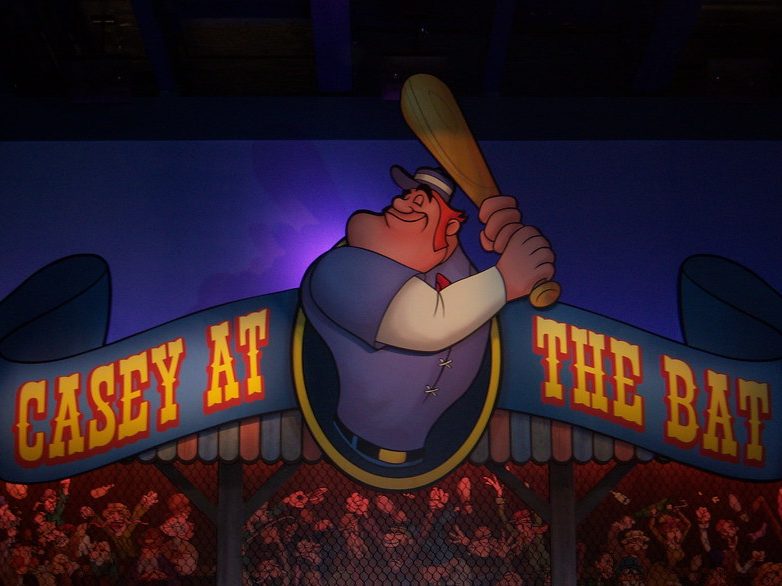
Photo: “Casey At The Bat at Games On The Boardwalk” by Castles, Capes & Clones is licensed under CC BY-ND 2.0.

Potcake Poet’s Choice: Daniel Galef, ‘Proverbs for Engraving onto Imperial Monuments’

War is the price of freedom. Depths bewilder.
The blow aimed at the beast hits him who shields it.
The sword of Justice best serves him who wields it.
The gibbet’s final victim is its builder.
A round coin rolls to him who most deserves it.
A tree outlives its leaves; an age, its fashions.
A carthorse needs its blinders; man, his passions.
The word of Justice best shields him who serves it.
The ardent spirit breaks the firm retort.
Power bears scrutiny like the sun the gaze.
God speaks His queer commands one thousand ways.
The worm awaits. The butterfly is dreaming.
The price of peace is bondage. Chains support.
Persuasion is a proof. Seeing is seeming.

Daniel Galef writes: “I majored in philosophy in college, and it’s very rare that I get a chance to use my degree in any way! (Even everyday critical thinking I engage in not without a little self-conscious embarrassment to be reliving those madcap cogitating days of my youth.) This sonnet began as an un-metrical list of aphorisms, vaguely inspired by Blake’s Marriage of Heaven and Hell, but with an eye less to individual ideas and more to “ideology.” I’m very interested in how philosophy is appropriated by the state, in the form of slogans or anthems or little red books—it’s all fine and dandy to debate competing theories of morality until it’s time to order the transplant waiting list, or convene the board of censors.

“I don’t always do a lot of surgical revision on a poem, but it was after about two years of lying in a drawer [a digital drawer] that I took the loose collection of prose sentences and started pruning, finding and inserting rhymes, and arranging them into pentameter. I’m a poor free verse poet, and verses that start off free end up in metrical shackles much more often than the reverse, even though logically it ought to be tougher to turn prose into verse than vice-verse-a.

“I could write a page on every line in this sonnet, which says much more about my own pretentiousness than about the poem, but will limit myself to saying I chucked in snips and snatches from Plato, Maimonides, Zhuangzi, Lucullus, David Hume, Thomas Jefferson, Aesop, W. H. Auden, Slavoj Žižek, Wernher von Braun, George Orwell, and Groucho Marx. Just about every maxim in the poem has certain levels, interpretations, or applications that I agree with and others which lead to perverse, abhorrent, or outright dangerous positions—which is of course what makes them so useful.

“The poem was published in Philosophy Now, a glossy magazine with a specialized readership but a glossy magazine nonetheless, and one of the highlights of the first summer after I graduated was driving to the Barnes and Noble in Clifton Commons and finding myself there on the shelf along with the movie tie-in reprints and tote bags with snarky quotations on them. It’s probably normal for most poems published, even in larger or well-respected publications, to go essentially unnoticed. I don’t hear back from strangers about the majority of poems I send out into the world and my meager stream of fanfiction is archived in an email folder I dip into when depths start to bewilder. Yet this is the poem that keeps coming back—and the comments I receive on it indicate that different readers draw very different conclusions from it. The year after it was published it was awarded second place in the “Best Poems of 2020” list at the Society of Classical Poets Journal. Someone sent me a Chinese blog where it had been translated into Mandarin, with (Google Translate revealed) a spirited discussion in the comments section as to whether the “blinders” were the same device whether the line was translated as “horse” or as “donkey” (the verdict: they are distinct: the blindfold put on a donkey driving a wheel totally blocks its vision, whereas the blinders put on a horse drawing a vehicle do so only selectively).”

Daniel Galef is a graduate instructor of English at Florida State University and Associate Poetry Editor of Able Muse. His poetry has appeared in Atlanta Review, Able Muse, Measure, The Lyric, Light, First Things, The Christian Century, and Philosophy Now. He is listed in Webster’s dictionary under the entry for “interfaculty (adj.),” which means “brilliant and handsome.” Besides poems he also writes short fiction, humor, and plays, with a story published last year in Juked just awarded a spot in the 2020 Best Small Fictions anthology. He is currently searching for a publisher for a debut poetry collection, Imaginary Sonnets.

More of his work is listed at http://goo.gl/mpRUrs

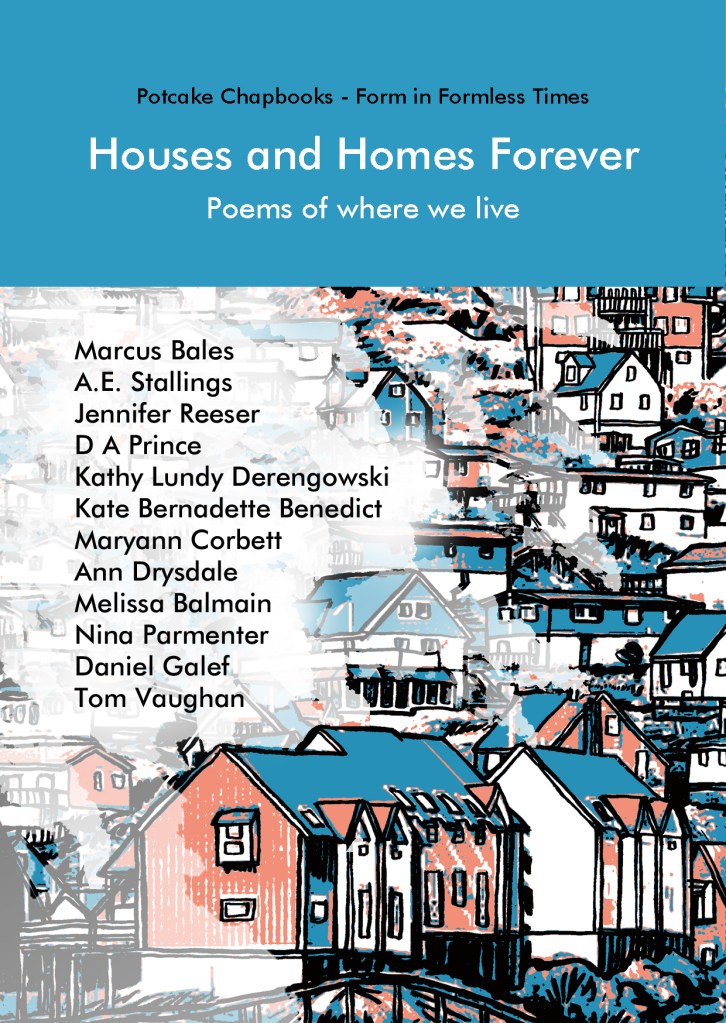
Launch: Potcake Chapbook 8, ‘Houses and Homes Forever’

Home is where you hang your hat, as they say, but it’s more than that. It can be a place of endless work and frustration, or a place of peace and relaxation and deep, strong memories. Houses and homes are part of what makes us who we are.

These poems–all formal, of course!–are as usual in a variety of forms. They were authored by Potcake newcomers Melissa Balmain, Kate Bernadette Benedict, Kathy Lundy Derengowski, Nina Parmenter and Jennifer Reeser, and returning contributors Marcus Bales, Maryann Corbett, Ann Drysdale, Daniel Galef, D A Prince, A.E. Stallings and Tom Vaughan. And well illustrated, as always, by Alban Low.

For the price of a fancy greeting card you can, through the wonders of PayPal, get this 16-page chapbook online for £2.60 + £1.20 P&P to a UK or European address, or £2.60 + £2.20 P&P to a Worldwide address; the seven earlier chapbooks in the series are available as well.

An overview with photos and bios of all the Potcake Chapbook poets is here, all having a home in this big, rambling house.

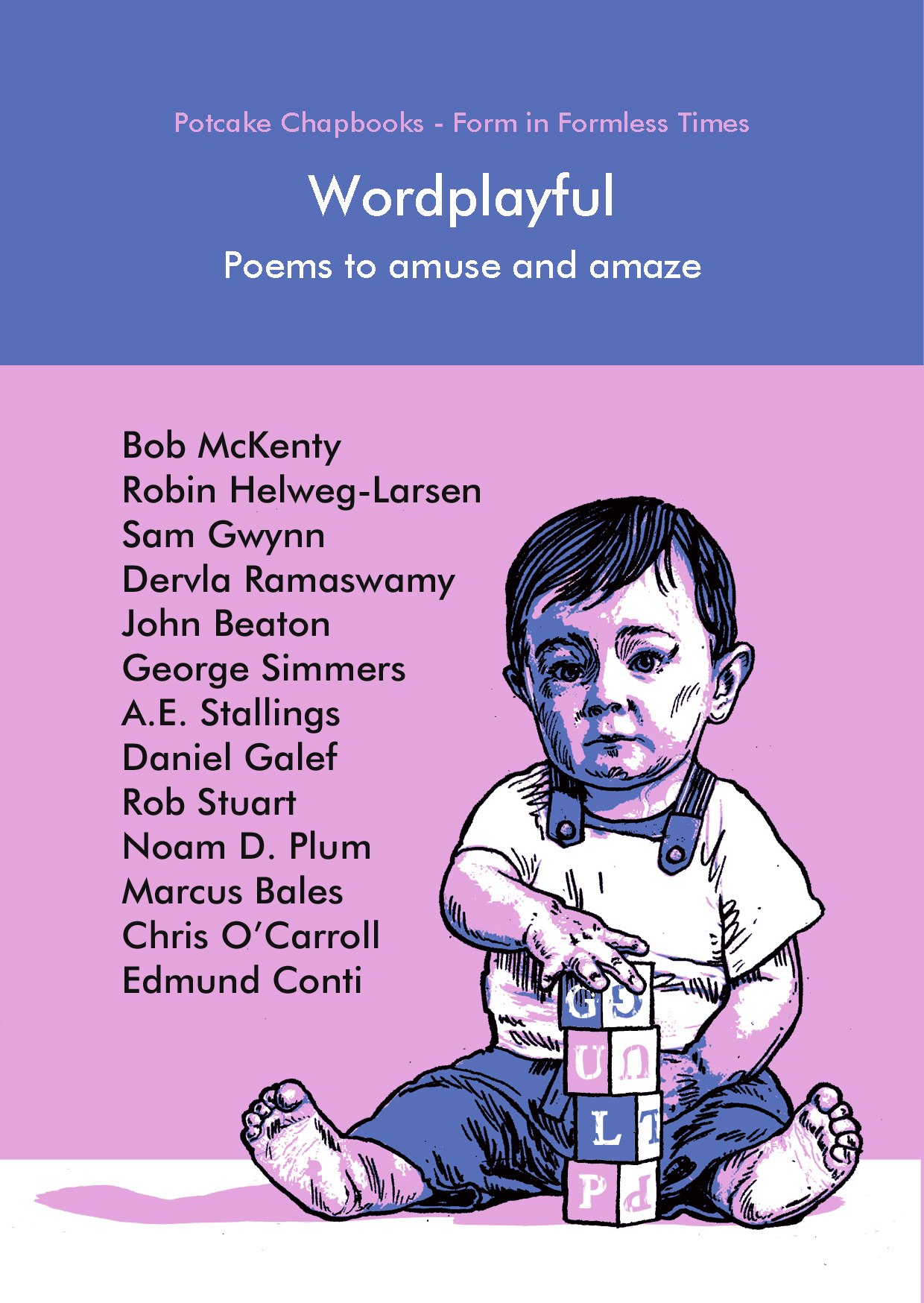
Launch: Potcake Chapbook 6, “Wordplayful”

06 Wordplayful

The sixth in the series of Potcake Chapbooks, ‘Wordplayful – poems to amuse and amaze’, is now beginning to wander around on both sides of the Atlantic (and hopefully further afield). This one is a little different from the earlier ones in the series: puns and puzzles, poems that can be read vertically or in reverse, wordplay in a variety of forms… but, yes, all formal poems, stuffed full of rhyme, rhythm and rich language.

Returning Potcake poets are Marcus Bales, John Beaton, Ed Conti, Daniel Galef, Chris O’Carroll, George Simmers, Alicia Stallings, Rob Stuart and myself; newcomers are Sam Gwynn, Bob McKenty, the unlikely Noam D. Plum and the elusive Dervla Ramaswamy. Mini-bios and photos for most of them are on the Potcake Poets page.

Alban Low has again provided all the art work, but he will now be taking a five or six month break to work on other things, especially the annual Art of Caring exhibition which opens in St George’s Hospital in Tooting in London in May, and moves to St Pancras Hospital in July – or at least it did in 2019. But Alban promises to re-engage with us in the early summer, by which time we may have more idea of what further Potcake Chapbook themes to pursue.

Poems: “Beach and Mountain”, “Now I Know Death”

This month’s edition of Snakeskin has two of my poems in it – and neither is formal. How Linda Ronstadtembarrassing! All the more so as the issue also contains two very nice sonnets by D.A. Prince and Diane Elayne Dees, and a truly excellent transforming poem by Daniel Galef which can be read as either a loose-rhythm 14-line sonnet or, with identical words broken into shorter lines and different rhymes, as five quatrains in the style of Robert Service.

But having given you the links to those, I return to my own poor contributions:

Beach and Mountain

Oh! I said, Look at that Beach!
What! said the Mountain, So go live down there.
See if I care.
Oh Mountain, I said, don’t be so silly,
I choose to live here,
complex and craggy, rich in forests and streams,
here where you rise up, taller than the clouds,
up where the air itself is rarefied
with views over all the world below.
But still… look at that pretty little beach
with its soft white sand,
its smooth clear water…

Now I Know Death

I know how I will die – sadly, slowly,
Regretting all I leave behind
In the spirit of taking a train to school,
Of seeing the holidays pass without a girl,
Of moving out of a good house, leaving the keys
On the table, carefully locking myself out.
Watching the first leaves fall, warning that
The summer comes to an end.
Going to bed only because I am so tired.
Hearing the wind in the pines, hinting at loss.
Feeling without my children, grown,
Transcontinental, unreachable.
The sadness that comes from depths of happiness
And knowing I’m too frail to hold it.