Tag Archives: Danish

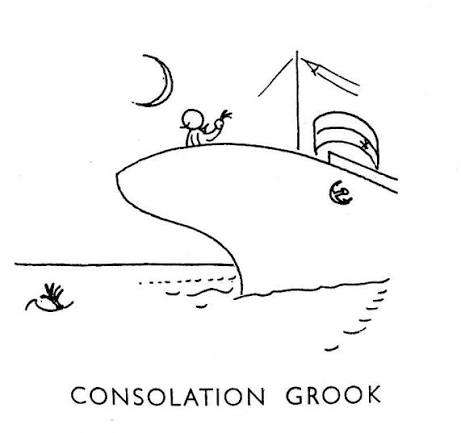
Piet Hein, ‘Consolation Grook’, tr. Piet Hein

Losing one glove
is certainly painful,
but nothing
   compared to the pain,
of losing one,
throwing away the other,
and finding
   the first one again.

*****

Piet Hein’s original Danish version, ‘Trøstegruk’ reads:
Den, som taber sin ene handske,
er heldig i forhold til dén,
der taber den ene,
kasserer den anden
. . . og finder den første igen.


Hein did his own translation into English (as he did with hundreds of his Grooks), and sacrificed word-for-word translation for the sake of keeping the rolling rhythm and the rhyme: the original’s word “lucky” has gone, the word “pain” is introduced to rhyme with “again”. I am glad to see a poet translating his own work, and keeping the versifying more important than the literal words. This is what poetry translation is all about, surely.

The poem has an interesting origin story: it was written right after Germany occupied Denmark in April 1940, and was published in the newspaper Politiken’s daily short poem spot. While it passed German censorship as a light comment on the vicissitude of things, the Danish resistance movement (which Hein was active in) spread it as graffiti across the country, a coded message with losing one glove representing losing freedom, and throwing away the second glove representing giving up your patriotism, collaborating, which you will eventually come to regret.

‘Consolation Grook’ was the first Grook published by Piet Hein. He had a rich and varied life, with an academic background in science, art and philosophy; he was a script writer, an inventor, a furniture designer, a game creator; someone Niels Bohr would bounce ideas off, a friend of Einstein, Charlie Chaplin, and the puzzle creator Martin Gardner. Piet Hein was married four times, and before you think that his personal life would have been like his very civilised grooks, I suggest reading about his tendency to violence and the questions it raises about the death of his fourth wife, the Swedish actress Gerd Ericsson: https://pershmail.substack.com/p/piet-heins-problems

Illustration: by Piet Hein
Nonce Poem: “Roughing It In Europe”

One two three four
Is OK, but you need more:

Un deux trois quat’
If you want a welcome mat

En to tre fire
With the krone getting dearer,

Bir iki uç dirt
Selling off your jeans or shirt

Wahid zoozh teleta arba
In a cafe by the harbour

Üks kaks kolm neli
For some food to fill your belly;

Jeden dwa trzy cztery
Language may be shaky, very,

Uno dos tres cuatro
But they’ll love you if you’re up to

Eins zwei drei vier
Trying freely, laughing freer.

This poem, more fully titled “(On the value of learning languages, when) Roughing It In Europe”, was originally published in Unsplendid, actually a splendid magazine that unfortunately has been quiet for the past couple of years. Now the poem is just being reprinted in The Orchards Poetry Journal whose Summer edition is due out today. The poem dates back to my early hitchhiking days, when I was based in Copenhagen but wandering around Europe, North Africa and North America. My experience was that you could wander into any country without any plans, prior contacts or knowledge of the language, and survive so long as you quickly learned to say Yes, No, Please, Thank you, Hello, Goodbye and to count from one to ten – and so long as you smiled, and were comfortable being laughed at for all kinds of mistakes. Case in point: the word “zoozh” that I learned for “two” in Morocco won’t get you very far in most Arabic-speaking countries… So it goes.

Technically, this poem was written in a simple form, nine rhymed couplets, four feet to a line. The second line of each couplet has mostly trochaic feet (i.e. with two syllables, a stressed or accented one followed by an unstressed one). But the first line of each couplet is simply counting out 1-2-3-4 in different languages, and therefore the feet vary with the words of the language. But as we are used to counting to four in a steady rhythm, everything sounds rhythmic regardless of the number of syllables.

So this shows another type of “form”: each couplet is structured the same with the first line counting 1-2-3-4, always in a new language, and the second line having four feet and rhyming with its first line’s “four”. And therefore the poem has a “nonce” form – I created this form for this specific poem; it was created “for the nonce”. You’d be unlikely to find another poem structured quite like this.

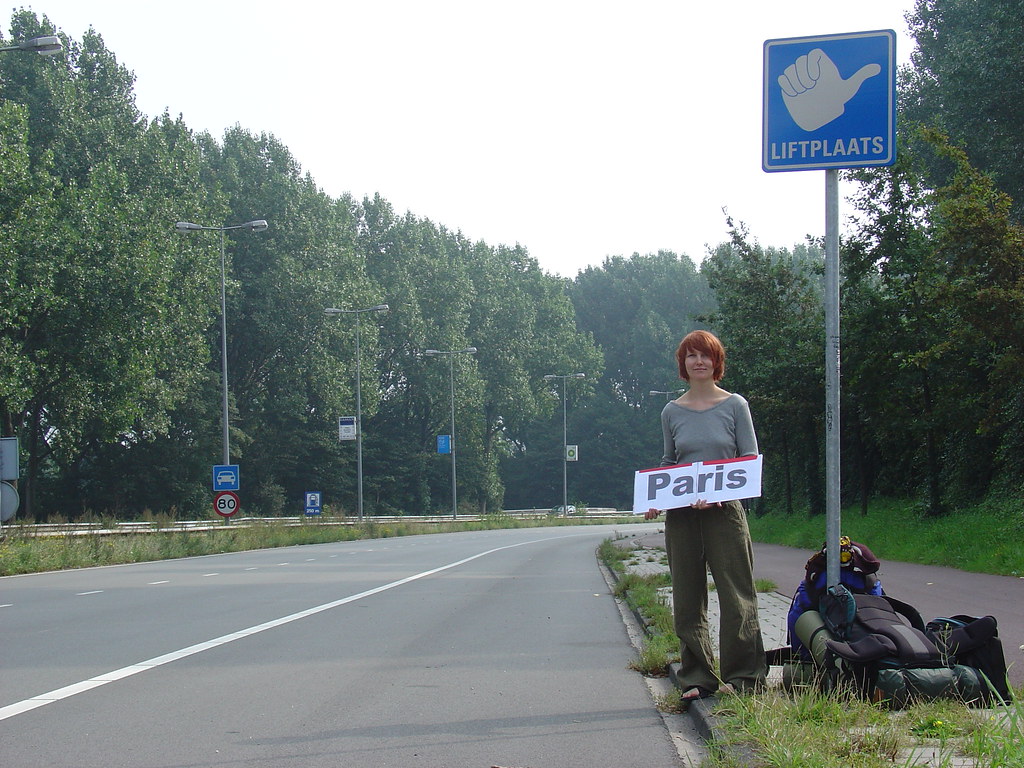
Photo: “Hitchhiking in Amsterdam” by Teppo is licensed under CC BY-NC 2.0

Poem: “Roughing It In Europe”

One two three four
Is OK, but you need more:

Un deux trois quat’
If you want a welcome mat

En to tre fire
With the krone getting dearer,

Bir iki uç dirt
Selling off your jeans or shirt

Wahid zoozh teleta arba
In a cafe by the harbour

Üks kaks kolm neli
For some food to fill your belly;

Jeden dwa trzy cztery
Language may be shaky, very,

Uno dos tres cuatro
But they’ll love you if you’re up to

Eins zwei drei vier
Trying freely, laughing freer.

This poem, more fully titled “(On the value of learning languages, when) Roughing It In Europe”, was originally published in Unsplendid, actually a splendid magazine that unfortunately has been quiet for the past couple of years. The poem dates back to my early hitchhiking days, when I was based in Copenhagen but wandering around Europe, North Africa and North America. My experience was that you could wander into any country without any plans, prior contacts or knowledge of the language, and survive so long as you quickly learned to say Yes, No, Please, Thank you, Hello, Goodbye and to count from zero to ten – and so long as you smiled, and were comfortable being laughed at for all kinds of mistakes. Case in point: the word “zoozh” that I learned for “two” in Morocco won’t get you very far in most Arabic-speaking countries… So it goes.

Technically, this poem written in a simple form, 11 rhymed couplets, four feet to a line. The second line of each couplet has mostly trochaic feet (i.e. with two syllables, a stressed or accented one followed by an unstressed one). But the first line of each couplet is simply counting out 1-2-3-4 in different languages, and therefore the feet vary with the words of the language. But as we are used to counting to four in a steady rhythm, everything sounds rhythmic regardless of the number of syllables.

So this shows another type of “form”: each couplet is structured the same in the sense of the first line counting 1-2-3-4, always in a new language, and the second line having four feet and rhyming with its first line’s “four”. And therefore the poem has a “nonce” form – I created this form for this specific poem; it was created “for the nonce”.