Tag Archives: desire

Sonnet: RHL, ‘Wine Cellar’

Down in the cobwebbed cellars of the mind
fabulous wines you don’t dare drink are stored,
each carrying a price you can’t afford;
so you pass by, deliberately blind.
Upstairs a loved one, dreamier than a vision,
displays each quality your soul desires –
or is a mere projection from the fires
the building’s furnace stokes with soft derision.
Your passions aren’t alive, alight, upstairs:
your love a mere projection of the schemes
the animated house evolves. Your dreams
live in your basement, though you’re unawares.
Though Bacchus urge you to uncork that wine,
the world would find it filthy, not divine.

*****

What I like about Rat’s Ass Review is that the editor will acknowledge and deal with the darker sides of being human… Not horror stories which are mostly pretty simplistic; but poems about the darkness built into all social animals. RAR is a rare journal: full spectrum, light and dark. This sonnet is in the current issue; thanks, Roderick Bates!

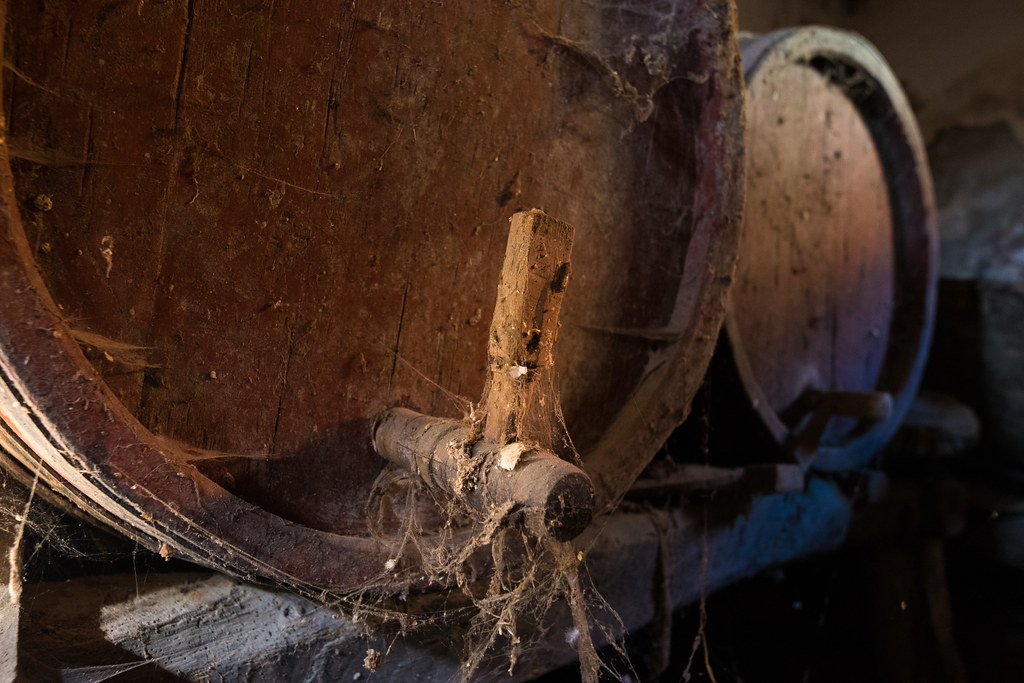
Photo: “Wine barrels in an old cellar” by Ivan Radic is licensed under CC BY 2.0.

RHL, ‘In the Spring’

In the spring, an old man’s fancy
ruefully reviews his youth;
thinks of girls both past and present,
wonders can he hide time’s truth.

His always googly gardening eyes
all ever which ways scan and glower
at the bud-bursting blossoming girls
exploding in their flower of power.

What is this green and noisy growth
that’s flourishing, fresh and unkempt?
Old’s good, so’s young… could one be both?
O Fates! from fate make me exempt!

*****

‘In the Spring’ was published in Bewildering Stories, an online weekly of Speculative Fiction, Poetry, Art, etc. Thanks, Don Webb!

at the museum” by derpunk is licensed under CC BY-NC-SA 2.0.

Casual form: Lisa Marshall, ‘Lust’

Under the moonlight’s magical hold
Lust prowls like a wolf, hungry and bold

Slinking by with a wink of the eye
Slowly drawing me in on the sly

Into temptation’s cunning allure
Tainting even the purest of pure

Whispered confessions into the wind
Forgive me, Father, for I have sinned

*****

Editor’s comments: I’m classifying these lines as ‘casual form’: the meter is undisciplined by classical standards, but the beat is clear and the rhymes are straightforward. The verse is as natural to English as nursery rhymes, noted for their ease of memorisation without being classically regular. Look at the varying numbers of syllable per foot in the four lines of ‘Baa Baa Black Sheep’, for example. English speech is very forgiving regarding unstressed syllables, while still maintaining a rhythmic flow – as we know from rap. By that standard, adherence to beat and structured rhyme is adherence to form.

Lisa Marshall is a poet and author who resides in beautiful Dartmouth, Nova Scotia – also known as the City of Lakes.  She is the author of Black Olive: A Novel and Poetry for the Feminist’s Soul, both of which are available on Amazon Kindle. 
Read more at Not Another Nice Girl Blog.

Photo: from Lisa Marshall’s blog.

Ed Shacklee, ‘Burn’

I took the way of stone,
not water, air or fire:
one element alone
could complement desire.

Not to quickly flare,
nor to slyly flow –
no fickleness of air
could whisper where to go;

for I was each, in turn,
as years unearthed the soul,
yet found no way to burn
but dark and pressed as coal.

*****

Ed Shacklee writes: “I very seldom know what to say about a poem; the cage opens, and the bird flies away – often not quite finished.”

Ed Shacklee lives on a boat in the Potomac River. His first collection, “The Blind Loon: A Bestiary,” was published by Able Muse Press.

And for those who like odd information and representations of animals, The Blind Loon: A Bestiary Facebook group is worth joining.

Photo: “Glowing Coals” by chrisgintn is licensed under CC BY-NC-SA 2.0.

Kyrielle: ‘Desire is the Last Domino to Fall’

Religion starts as trying to explain,
Progresses to high priests’ financial gain.
I’ve tried religions, and seen through them all;
Desire is the last domino to fall.

Explore the world – well, fifty lands’ enough;
Novelty fades; folks are just folks; stuff’s stuff.
I’ve seen both rich and poor round this blue ball;
Desire is the last domino to fall.

And I’ve gone barefoot, and I’ve gone first class:
The trinkets pall beside bare feet on grass.
Markets go up and down and they too pall;
Desire is the last domino to fall.

The fearful right, the overtrusting left:
Politics, history, both of sense bereft.
Reagan’s road leads to Trump and hits a wall;
Desire is the last domino to fall.

My arts expression’s been in writing verse–
The arse end, clearly, of the universe.
There’s rarely silver in the nets I haul;
Desire is the last domino to fall.

I’ve had my fill of sex – but when I see
A vibrant youth, my thoughts are freshly free.
I want, though why I want I mayn’t recall…
Desire is the last domino to fall.

This poem, published by George Simmers in April’s Snakeskin, flowed straight out of a comment by Jackson Browne in a Guardian article on his latest album, ‘Downhill From Everywhere’. My thanks go to Mindy Watson, creator of poems in every form she hears of, for identifying this one as a kyrielle. I hadn’t set out to write within a specific form, I merely wrote a poem that used a repeating last line of the stanza. And this highlights one of the things about form: form follows function, in poetry as in architecture. Metre, rhyme scheme, line length, all these are chosen for their appropriateness for the mood and content of the poem. Ballads, sonnets, couplets, villanelles, each type finds its best use in a different situation, each evolved to provide a good expression of a different mood, each became popular as its expressive strength was demonstrated.

A kyrielle seems to me a natural poetic construct for an expression of prayer or despair or wherever all avenues of thought lead back obsessively to the same essential fact or wish. It was formalised in the time of the troubadours, and its name derives from the Late Latin phrase “kyrie eleison“, “Lord, have mercy”. Very appropriate.

Photo: “Where It All Began” by mckinney75402 is marked with CC BY 2.0.

Sonnet: ‘Fat-shaming’

Gorging on food, an atavistic trait
useful, essential, in the paleolithic–
like a man’s lust for teenage girl as mate–
is one not needed now, shamed as horrific.
It’s healthy, though, to recognise such drives,
note where they came from, why they once were good:
these traits in which the primitive survives,
inbuilt components of our personhood.

It’s acting on them, though, that we deplore:
those who fuck teens and those who overfeed,
like those who steal, or lie, or start a war,
aren’t shamed for primitive desire, but deed–
like those who pray to gods, follow religions,
or skry the future from entrails of pigeons.

It’s not PC these days to even mention various issues, and I seem to have covered a lot of them in this sonnet. But it’s a decent enough Shakespearean sonnet (iambic pentameter, ABAB CDCD EFEF GG, volta between the octave and sestet) and also a good enough expression of an opinion, so what is there to complain about? Originally published in that not-always-comfortable but always formal ‘The Road Not Taken – A Journal of Formal Poetry’. Thanks, Dr. Kathryn Jacobs!

“Young and Fat” by Tobyotter is licensed under CC BY 2.0