Tag Archives: Donald Trump

Rondeau: Political Poem: J.D. Smith, ‘Citizen Vain’

Who burned his sled? That would explain
The wisps of hair coiffed like a mane,
The name writ large on thrusting towers,
His rating of his works and powers.
Who wouldn’t take up his refrain?

A loser, say, without a brain
And envious he can’t obtain
Fresh wives imported like cut flowers.
(Who burned his sled?)

A nation may endure a reign
Of fire once tended with some pain
Outlasting its appointed hours
Yet starved, for all that it devours.
The question holds fast like a stain–
Who burned his sled?

*****

J.D. Smith writes: “I try not to say or write the name of the moral homunculus who is currently the 47th President of my country, lest my words get entangled in his omnipresent branding. That said, in verse I have occasionally renounced him and all his works. This poem was first published during the 2016 primary season, when speculating on how that troubled and troubling man became that way was still an interesting parlor game with low stakes. While others with credentials in psychology have discussed his origin story, perhaps most notably in this book, as a poet I gravitated toward metaphor. As some will ask a badly behaved person “Who broke you?” or “Who hurt you?”, I began to wonder ” Who burned his sled?” in the sense of some analog to the loss of Charles Foster Kane’s sled Rosebud in Citizen Kane. What early personal trauma made the current collective trauma possible?”

J.D. Smith’s seventh collection of poetry, The Place That Is Coming to Us, was published in September by Broadstone Books. His first fiction collection, Transit, is available from Unsolicited Press. Further information and occasional updates are available at www.jdsmithwriter.com.

Photo: screenshot from that unbelievably offensive AI-generated video that Trump posted of himself as King Trump in a King Trump fighter-jet, bombing American protesters with his diarrhoea.
Political poem: Matthew King, ‘Incendiary Song’

Baby you’re the Reichstag
I’m setting you on fire
You no longer represent me
I’m immediate desire
Our constitution is suspended
on a fence of barbed wire
Baby you’re the Reichstag
I’m setting you on fire

I’ve cancelled your election
I’ve exposed your fatal flaw
Trapped in your reflection
we argued to a draw
The people want perfection
they love to be in awe
Baby you’re the Reichstag
my will is the law

Our union needs annulment
our wedding was a sham
The preacher stole the word of God
now he’s on the lam
He said he’d bless the devil
he didn’t give a damn
Baby you’re the Reichstag
who do you think I am

Like lightning this befell me
not you but I self-crowned
No court can now compel me
my power is unbound
I dare you try to tell me
my methods are unsound
Baby you’re the Reichstag
I’ll burn you to the ground

I’m rounding up your lovers
each one of them a liar
They tell me they don’t know you
say it’s me they most admire
Now I alone can save them
or throw them on the pyre
Baby you’re the Reichstag
I’m setting you on fire

*****

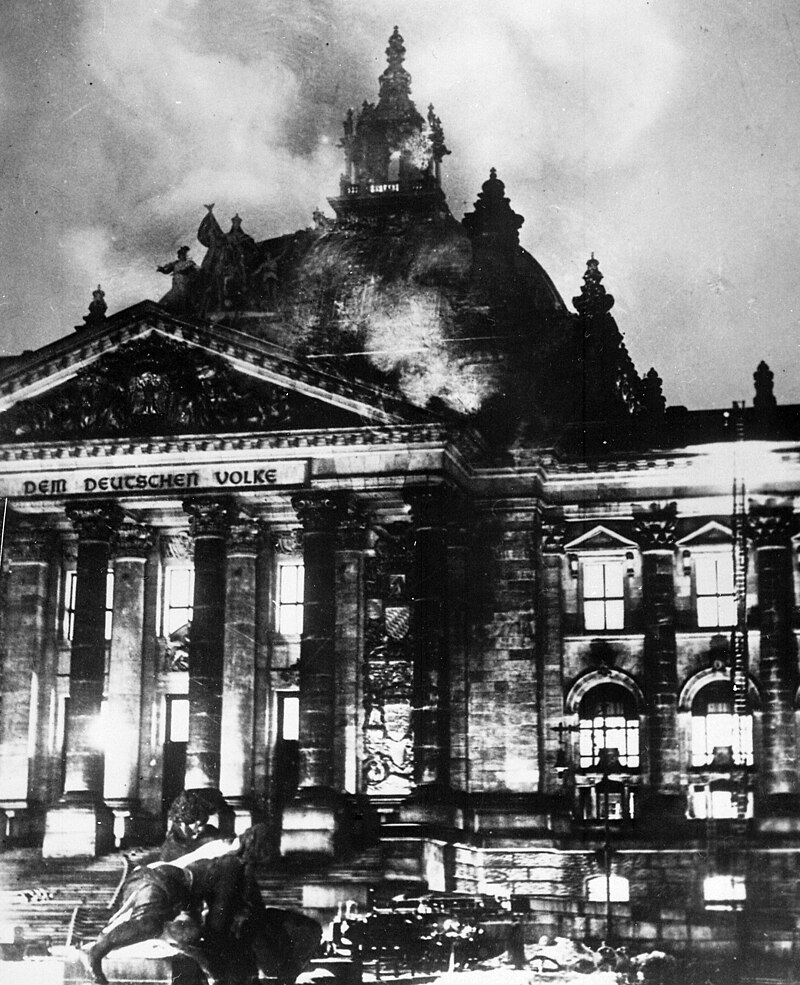
Matthew King writes: “Many, not on only one side of the political divide, have been watching for a “Reichstag Fire moment.” The thing about historical echoes is you’re never sure what you’re hearing is exactly what it sounds like, but with some things sounding like them at all is bad enough. A hat tip to Leonard Cohen, whose shade I seem to be channelling in this poem, and who would have turned 91 on Sept. 21. Leonard! thou shouldst be living at this hour; lucky for you you’re not, I guess.”

‘Incendiary Song’ was first published in New Verse News.

Matthew King used to teach philosophy at York University in Toronto; he now lives in what Al Purdy called “the country north of Belleville,” where he tries to grow things, counts birds, takes pictures of flowers with bugs on them, and walks a rope bridge between the neighboring mountaintops of philosophy and poetry. His photos and links to his poems can be found at birdsandbeesandblooms.com.

Photo: Reichstag Fire, 27 February 1933, public domain.

Marcus Bales, ‘A Rainy Day in Cleveland’

A rainy day in Cleveland. I almost said
“The skies are gray.” Of course the skies are gray,
It’s raining, so — what could they be instead?
I meant to mow the rest of the lawn today,
But it’s a day to watch the garden grow.
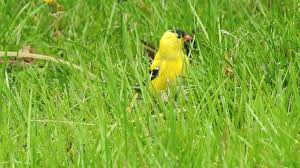
The finches, flashing in the too-long grass,
Are pecking dandelion seeds, and glow
Their special yellow through rain-dotted glass.
The internet is off. I sit and watch
The irises and roses in the rain,
And do not read about the ugly botch
The greedy criminals in charge sustain
So they can strut around, so white, so male,
And cheat and lie to keep themselves from jail.

*****

Marcus Bales writes: “The rap against democracy has until now always been that the public, once it realized they could simply vote themselves money and benefits, would bankrupt the state voting themselves benefits and money. For 250 years the US public managed not to do that, though the reactionaries always accused them of it. It turns out the real danger is that if you have enough money you can just buy the government and operate it as a racket to benefit yourself and your cronies, even when there are laws in place that you have to break in order to do so. The problem with democracy, it turns out, is not that people are irresponsible but that the wealthy are liars and thieves.”

Not much is known about Marcus Bales except that he lives and works in Cleveland, Ohio, and that his work has not been published in Poetry or The New Yorker. However his ’51 Poems’ is available from Amazon. He has been published in several of the Potcake Chapbooks – Form in Formless Times.

Photo: Danny redd Photography https://www.facebook.com/watch/?v=1605166609548538

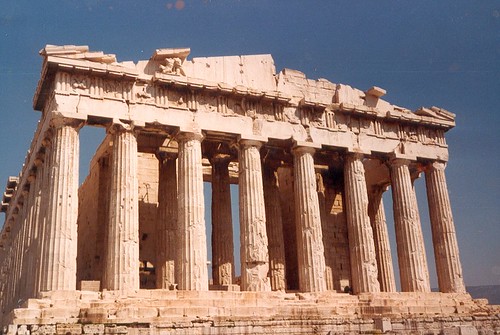
Political poem: A.E. Stallings, ‘An American Wakes Up in Athens, Greece After the 2024 Elections’

I wake up in the dark.
In dark I went to sleep.
There is a kind of stark
Accounting of lost sheep.

The day breaks with a dawn
So much like yesterday’s.
I turn the kettle on
And brew a dark malaise.

Things go from bad to worse,
Let’s call it entropy.
The blessing is a curse,
And treachery goes free

Or something. Never mind,
Here in the cradle of
Democracy I find
There’s history enough —

There on the shining rock
The entasis of state,
The subtle curves that lock
The crooked to the straight.

The centuries were slow
Where stood its solid scenes,
It took one night to blow
The roof to smithereens.

It boasts of Marathon,
It boasts of Salamis
Five generations on,
Of hemlock’s bitterness,

Between, the city nations
Of Greeks warred tribe with tribe
Why trouble with invasions?
It’s easier to bribe.

We still read Athens’ versions,
As though the Spartans lost,
As though the prudent Persians
Did not know what they cost.

Pericles died of plague,
And Phidias in prison.
Division’s sown, and vague
Suspicions have arisen.

It took nine years to build
Those columns in the air,
But half its marbles spilled,
Over fifty to repair.

It’s like a foundered ship,
That ruin on the hill.
It makes my heartbeat skip.
I’m afraid it always will.

*****

A.E. Stallings writes: “I [wrote this] poem the day after the elections. It was written on the fly, and has not been revised.”

‘An American Wakes Up in Athens, Greece After the 2024 Elections’ was originally published in Liberties Journal.

A.E. Stallings is the current Oxford Professor of Poetry. This Afterlife: Selected Poems was published in 2022. Her forthcoming book is Frieze Frame: How Poets, Painters, and their Friends Framed the Debate Around Elgin and the Marbles of the Parthenon

Photo: “Parthenon” by R~P~M is licensed under CC BY-NC-ND 2.0.

Political poem: Michael R. Burch, ‘Not Elves, Exactly’

after Robert Frost’s “Mending Wall”

Something there is that likes a wall,
that likes it spiked and likes it tall,

that likes its pikes’ sharp rows of teeth
and doesn’t mind its victims’ grief

(wherever they come from, far or wide)
as long as they fall on the other side.

*****

Michael R. Burch writes: “Many people misunderstand the most famous phrase in Robert Frost’s poem ‘Mending Wall.’ In the poem Frost’s neighbor quotes his father’s adage that “Good fences make good neighbors” as they work together to repair an unnecessary wall on the border of their properties. Talk about a misunderstanding: this phrase has even been used by politicians to justify apartheid walls and similar barriers! But Frost did not share his neighbor’s belief and compared him to a stone-armed savage who moved in primitive darkness and could not go beyond his father’s saying. Frost’s own belief about such walls was expressed in the poem: “Before I built a wall I’d ask to know / What I was walling in or walling out / And to whom I was like to give offense.” At the end of the poem, Frost considers teasing his neighbor with the idea that mischievous elves are responsible for the wall falling down, but decides to hold his peace. My title questions who builds such walls: ‘Not Elves, Exactly’ but something much darker and more ominous.”

Michael R. Burch’s poems have been published by hundreds of literary journals, taught in high schools and colleges, translated into 22 languages, incorporated into three plays and four operas, and set to music, from swamp blues to classical, 61 times by 32 composers. He is also the founder and editor-in-chief of The HyperTexts.

The Wall Has Spikes” by Kevan is licensed under CC BY 2.0.

Donald Trump’s favourite poem: ‘The Snake’ by Oscar Brown Jr.

On her way to work one morning
Down the path ‘longside the lake
A tender-hearted woman saw a poor half-frozen snake
His pretty colored skin had been all frosted with the dew
“Oh well,” she cried, “I’ll take you in and I’ll take care of you”
“Take me in, tender woman
Take me in, for heaven’s sake
Take me in, tender woman,” sighed the snake

She wrapped him up all cozy in a comforter of silk
And laid him by thе fireside with some honеy and some milk
She hurried home from work that night, and soon as she arrived
She found that pretty snake she’d taken in had been revived
“Take me in, tender woman
Take me in, for heaven’s sake
Take me in, tender woman,” sighed the snake

She clutched him to her bosom, “You’re so beautiful,” she cried
“But if I hadn’t brought you in, by now you might have died”
She stroked his pretty skin again and kissed and held him tight
Instead of saying thanks, that snake gave her a vicious bite
“Take me in, tender woman
Take me in, for heaven’s sake
Take me in, tender woman,” sighed the snake

“I saved you,” cried the woman
“And you’ve bitten me, but why?
And you know your bite is poisonous and now I’m gonna die”
“Oh shut up, silly woman,” said the reptile with a grin
“You knew damn well I was a snake before you took me in”
“Take me in, tender woman
Take me in, for heaven’s sake
Take me in, tender woman,” sighed the snake
“Take me in, tender woman,” sighed the snake

*****

Donald Trump has repeatedly read this poem in his political rallies as a way of attacking immigrants and the US Government’s immigration policies. The ironies are endless:
– that two of Trump’s wives are themselves immigrants (the current one having a very sketchy background as a “model”);
– that Trump always fails to credit Oscar Brown Jr as the song’s author, consistently naming Al Wilson instead;
– that Oscar Brown was a civil rights activist and for ten years a member of the Communist Party (he left when he decided he was “too black to be red”);
– that the song’s message, a variant on one of Aesop’s Fables, is that kindness can be betrayed;
– that Oscar Brown’s daughters have sent Trump cease-and-desist letters because Trump’s message is antithetical to all their father stood for;
– and as one of the daughters said on CNN, “the elephant in the room is that Trump is the living embodiment of the snake that my father wrote about in that song.

Photo: “JAZZ: Portrait of Oscar Brown, Jr.” by Professor Bop is licensed under CC BY-NC-ND 2.0. (Note: the portrait is by Edwin German.)

Sonnet: ‘Sad, Actually’

Unreconstructed, with unhealthy heft—
the image of uncivilised great ape—
a fraud who tries to win by lies and theft,
a man who’d propagate by power and rape,
racist extoller of his genes alone,
a would-be genocidal patriarch,
successful in some twilight Darwin zone,
uncultured as a mugger in the park…
But note, behind the thin success veneer,
the shallow love of gold and gilt and glitz,
gloating dismissals and the bloated sneer,
the self-aggrandisement that never quits:
an unloved child’s in some deep down recess,
the secret of the man’s unhappiness.

*****

I can’t help feeling sorry for people who were raised so badly that they have never learnt to find security, inner peace, personal meaning. On the other hand I can’t help rejoicing when some destructive, selfish racist is exposed as a cheat and a fraud under the control of a foreign power, and is removed from positions of authority. I think of that sympathy/schadenfreud dichotomy as a healthily balanced contradiction; but then, I’m a Libra…

This sonnet (Shakespearean, being in iambic pentameter and rhyming ABAB CDCD EFEF GG) has just been published in Shot Glass Journal, an online journal of short poetry. Most of what they publish is not formal verse, but most of mine is.

Photo: “File:Vladimir Putin and Donald Trump (2019-06-28) 06.jpg” by Presidential Press and Information Office is licensed under CC BY 4.0.

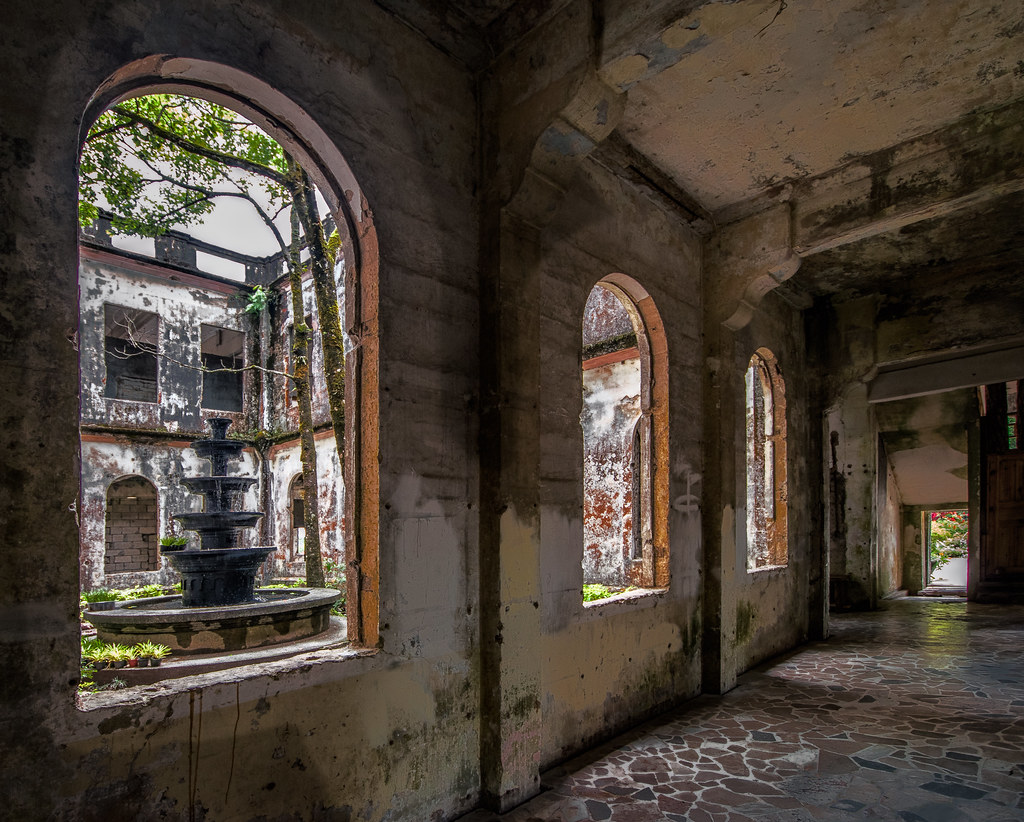
‘Sonnet Found in a Deserted Madhouse (fantasy of an alternative future)’

The winds of winter wind through empty halls,
scraps of abandoned paper blow like leaves
to settle in odd corners of old walls.
Once a community lived here, but no one grieves:
the place was nothing but a wasteful home
for the sick, sad, psychotic and insane
who, locked in rooms or left alone to roam,
babbled their lives away, inept, inane.
All funding for the loonies has dried up;
guards, nurses, admin, tea ladies: dismissed.
And all because Brussels came out on top
and closed this home of British mental mist.
Now Big Ben chimes, tolling a final knell.
Farewell, old Houses; Westminster, farewell.

*****

As an Anglo-Dane raised in a third country, I’m naturally in favour of a borderless world. I loathe Brexit and the lies, greed and social inequities that allowed it to happen. Brexit and Trump were the two big foreign policy successes of Putin, stoking lies and fear and division. Sorry, rant over.

This Shakespearean sonnet was just published in the biannual poetry magazine Allegro, edited by Sally Long.

Abandoned Dominican Building #2” by FotoGrazio is licensed under CC BY-NC-ND 2.0.

Poem: ‘Leadership Transition’

Julius Caesar, Antony, King Lear,
Hamlet, Macbeth – corrupted, vain, impure,
Irrational, bombastic, insecure –
He’s no more clarity or veritas
Than the deceptions of a covert war,
All morals blurred.

That tyrant rant, Tyrannosaurus roar,
Forecasts he’ll suffer a dictator’s fate:
His proud obsessed confusion first seems great,
Then grates, unravels at the seams, slips gear,
Loses its moral metaphors, grows crass;
He dies absurd.

Octavius, Malcolm, Edgar, Fortinbras,
Comes from the wings and strides to centre stage –
Competent, measured, reasonable, sane –
To rule the wreckage of the tragic reign;
Restores some structure, closes out the age,
Speaks the last word.

This archetypal character’s strong thump
Will get his nation out of the morass;
The raucous self-styled hero being dead,
A truer leader takes the throne instead.
(How Shakespeare’d end the Tragedy of Trump
Can be inferred.)

The common fate of Shakespeare’s flawed protagonists–death, and replacement by a more worthy ruler–is a story that humans enjoy and wish applied in their own times and countries… although they may naturally disagree on which ruler is disgraceful and which would be more worthy. Speaking for myself, I don’t need to see a death–I’d be happy for Putin and Trump to avoid assassination or jail by going into comfortable exile at a golf hotel in southern Russia. (You read it first here.) But Shakespeare would deal with them more definitively.

This poem is the third of the five poems published this month in The Brazen Head. Its four stanzas are in iambic pentameter with a short 6th line. The rhymes largely carry over between stanzas–the 6th lines only rhyme with each other. The rhymes and the stanza structure are designed to create a sense of satisfactory achievement–exactly what I feel with Biden taking over from Trump. (Similarly I would love to see Navalny take over from Putin, and almost anyone replace Boris Johnson.)

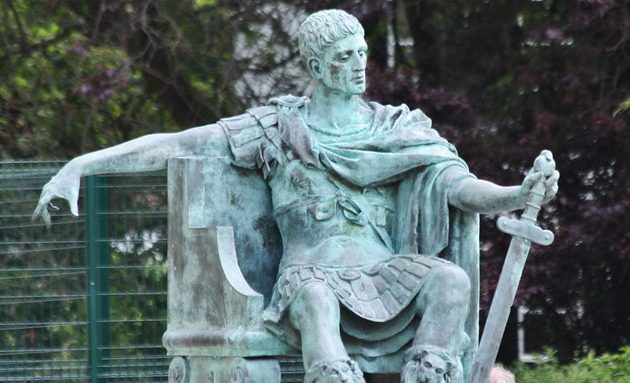
York Minster – June 2013 – Emperor Constantine – One Cool Dude” by Gareth1953 All Right Now is marked with CC BY 2.0.

Short poem: ‘The Inevitable Future’

Now that I’ve got Windows 10,
11 comes; and then, and then…
Next: self-driving flying cars,
Trump in jail and Musk on Mars.

Certain things appear inevitable in the businessman’s crystal ball… Well, we’ll see. This short poem was published in the ever-succinct Asses of Parnassus – thanks, Brooke Clark!