Tag Archives: formal verse

Weekend read: Michael Murry, ‘Inconspicuous Conclusions’

A play’s last scene has often served as trope,
where theater, as metaphoric scheme,
enables authors to compose a dream
of Life as it exhausts its mortal scope.
The actors in our own Life’s play, we “hope”
and “love;” some “challenge fate;” some “sob” and “scream,”
but all personify Forever’s theme:
that with its ending, Life must simply cope.
I cannot speak for others in the cast,
but my bit-part as extra in The Show —
as son and father, husband to the last —
gave me such joy as any man could know.
I’ve lived a lucky life. Of this I’m certain.
So when my last scene ends, ring down the curtain.

*****

Michael Murry writes: “The background concerns the passing away of my 48-year-old son, Stuart Langston Murry, in a freak accident while visiting his mother in northern Taiwan. As part of the grieving process, I turned to reading some of my favorite poets – especially Edna St. Vincent Millay’s ‘Dirge Without Music’ – before composing an elegy for my son’s funeral: ‘A Song for Stuart’ published as a Memoir in Bewildering Stories Issue 1032, followed by a companion sonnet ‘Anticipating Anonymity’ published in Bewildering Stories Issue 1042. So much for the composition’s background. ‘Inconspicuous Conclusions’ was published in Bewildering Stories Issue 1043.

As for the formal sonnet structure of the composition, I chose to use as a model John Donne’s Holy Sonnet (VI) with its opening “This is my play’s last scene” for metaphorical theme. The sonnet’s 14 lines consist of iambic pentameter (5 stress accents and 10 syllables) lines: 12 with masculine endings and 2 lines for the closing couplet’s feminine endings (5 stress accents and 11 syllables): ABBAABBACDCDee.

For relevant biographical information, see my website:  http://themisfortuneteller.com/  with my verse compositions under the “Poetic License” menu tab. Consider me a 76-year-old Vietnam Veteran Against The War – the one that never seems to end – retired and living in Taiwan for the last two decades. I started writing formal verse compositions in 2004 as a sort of DIY bibliotherapy for Delayed Vietnam Reaction. I haven’t stopped yet and see no reason why I should. You and your audience may find my work too polemical for most refined poetic tastes, so if you choose not to quote any of my verses, I will certainly understand. As you please . . .”

Photo: Michael Murry at Advance Tactical Support Base ‘Solid Anchor’, Vietnam, early 1970s.
Light verse: Melissa Balmain, ‘Lament’

Mama never horsewhipped me
or shoved things up my fanny.
She wasn’t hooked on PCP
and didn’t bump off Granny.
Daddy never climbed in bed
to open my pyjamas.
He read me Charlotte’s Web instead;
the bed he shared was Mama’s.
In college, I did not turn tricks
or date warped literati.
I haven’t starved myself to sticks,
joined cults, or loved John Gotti.
The guy I married doesn’t drink,
or French-kiss other fellers.
It really makes me sad to think
I’ll never write best sellers.

*****

From Walking in on People © Melissa Balmain, 2014. Used by permission of Able Muse Press.

Melissa Balmain writes: “This is the first poem I ever published outside of a school journal–in Light, then known as Light Quarterly. Thanks in no small part to the encouragement of Founding Editor John Mella, I never looked back.”

Melissa Balmain’s third poetry collection, Satan Talks to His Therapist, is available from Paul Dry Books (and from all the usual retail empires). Balmain is the editor-in-chief of Light, America’s longest-running journal of light verse, and has been a member of the University of Rochester’s English Department since 2010.

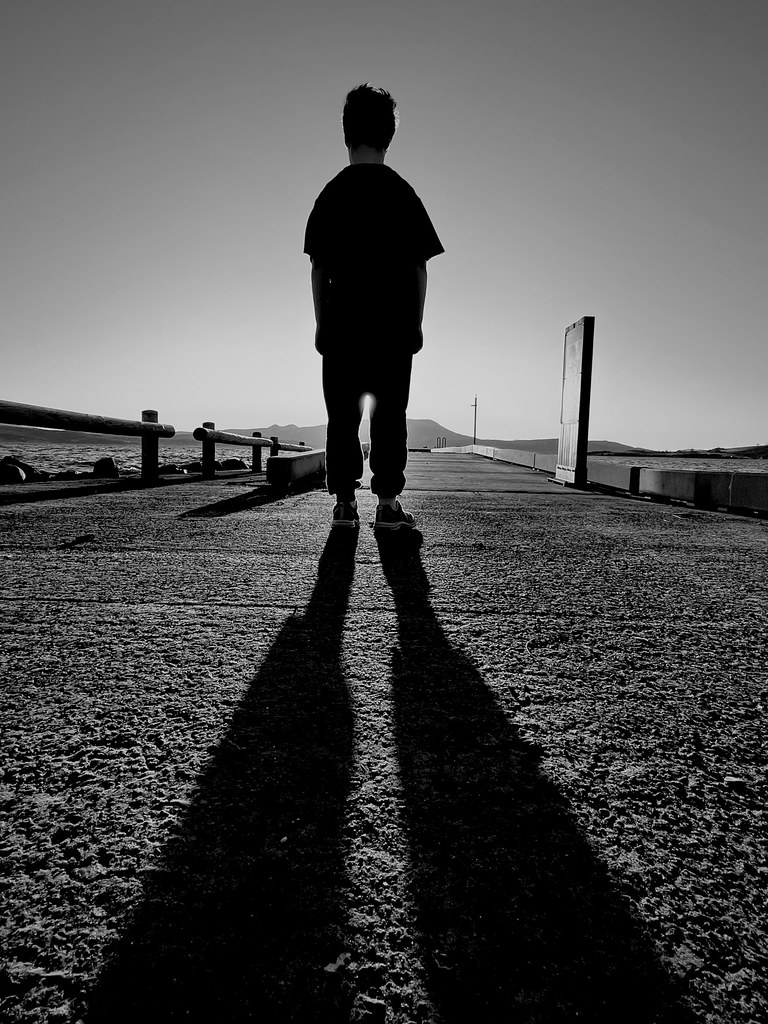
Photo: “Sad child” by Lejon2008 is licensed under CC BY-NC-SA 2.0.

SF Poem: RHL, ‘Out Of Many…’

Two hundred million sperm
in one ejaculation;
and we are standing firm
and spouting with elation,
though but a single germ
survives to incarnation.

And much in nature throws
vast clouds into the ocean,
where myriad embryos
become a magic potion
consumed by all that goes
with food its only notion;

yet one or two survive
to adulthood and, later,
will make the species thrive
and serve up like a waiter
new young crowds that arrive
like cargo crammed on freighter.

This is how nature lives;
we should not think it foolish
eight billion of us gives
but forty fierce and mulish
posthuman narratives,
godlike as much as ghoulish,

in retrospect appearing nature’s plan
for how we cross to Nietzsche’s Superman.

*****

This poem was originally published in the Amsterdam Quarterly, although without the final couplet. I usually allow editors to make changes if they suggest them, and often the changes are an improvement that I retain. But in this case I’m afraid the science fiction speculation may be lost without those last lines: the idea that the present billions of us are on the point of being superseded by the first handful among us who achieve a godlike state of posthumanity… and that this ratio of 200,000,000 seeds being sacrificed to achieve one mature adult in the next generation is not unusual in nature.

Photo: “Stinging nettle stem with +/-15 billion seeds” by esagor is licensed under CC BY-NC 2.0.

RHL, ‘The Sun is Always Setting’

The sun is always setting, always setting on your day;
you sense the dark approaching, wish that it would stay away.
Do you want a life unchanging? Wish to still be a newborn?
Don’t you know life’s not a rosebud, but has root and leaf and thorn?

The sun is always setting and the black drapes are unfurled;
but notice that the sun sets on your world, not on the world:
it’s rolling into brightness in another’s happy land,
and the dark is evanescent and the brightening is grand.

The sun is always setting on the dinosaurs, but birds
are flocking into being, as are Serengeti herds;
and the sun that lights humanity? Of course it’s going to set,
and elsewhere light new tales of which we’ll just be a vignette.

The sun is always setting, but that view is just your choice;
I say the world is turning and evolving; I rejoice.

*****

Sometimes I’m told that my poetry is too bleak. But I think that’s only so if you want everything to stay as it is now. If, on the other hand, you expect change, and that change will ultimately provide more benefit than loss to the universe as a whole, then <shrug>… so it goes.

This poem has 14 lines but is hardly a sonnet. It was recently published in Pulsebeat Poetry Journal. Thanks, David Stephenson!

Photo: “Sunset Sadness” by BaboMike is licensed under CC BY-NC 2.0.

Using form: alliteration: RHL, ‘How Brashly Brave’

How brashly brave, embroiled in this brief life,
we chance our challenge to the unchanging gods!
Strike poses, strut the strident stage of strife,
take optimistic oaths against all odds.

Fearless of foes, false friends, futility,
we wrack our reason to reach, undestroyed—
though usually of no utility—
a burst of brightness bettering the void.

*****

Although I prefer to maintain an unobtrusive persona myself, I subscribe to this philosophy of bravado existentialism. The florid alliteration suits the message.

This poem is published in the current issue of Light – thanks, Melissa Balmain and all.

Photo: “Flamboyant Emperor of the United States” by PeterThoeny is licensed under CC BY-NC-SA 2.0.

Using form: SF sonnet: RHL, ‘On a Dead Spaceship’

On a dead spaceship drifting round a star,
the trapped inhabitants are born and die.
The engineers’ broad privileges lie
in engine room and solar panel power.
The fruit and vegetables and protein co-ops
are run by farmers with genetics skills:
the products of their dirt and careful kills
help service trade between the several groups.
Others — musicians, architects — can skip
along the paths of interlinking webs.
Beyond these gated pods that the rich carve
for their own selves (but still within the ship),
in useless parts, are born the lackluck plebs.
Heard but ignored, they just hunt rats or starve.

*****

This sonnet was republished in Bewildering Stories in April 2024 – original publication had been in Star*Line five years previously. I find something very satisfying about using a formal sonnet structure to express science fiction and speculative fiction ideas – the ideas are by nature open-ended, unconstrained, and it feels good to tie them down as in a neat package with a bow on top. Topiary.

As for what political comments can be read into the poem, read away!

Photo: “Deepstar 2071 at Io” by FlyingSinger is licensed under CC BY 2.0.

Richard Fleming, ‘Invisible’

It’s footwear that I recognise
not faces but that’s no surprise:
I don’t look up, they don’t look down
except occasionally to frown
then look away and hurry on
and moments later they are gone.
There’s city Oxfords, polished, black,
worn by the older, banking pack,
and Converse sneakers for the lads,
whose work is fabricating ads.
The women, they too, dress that way:
I rarely see high heels today.
A constant stream of passing feet
flows by me on this busy street
while I sprawl here, small in my shawl,
and ask, do I exist at all?

*****

Richard Fleming writes: “During my early life I wrote non-rhyming verse, having been conditioned to believe that rhyme and metre were old-fashioned and therefore to be avoided: the last thing a young person wants is to be thought of as old-fashioned.
I was also prejudiced against humorous verse: my enjoyment of it was something of a guilty secret as my contemporaries all wrote dark, navel-gazing, stream-of-consciousness nonsense.
During Covid lockdown I found myself with time to reevaluate these blinkered views and finally embraced my love of nonsense verse. I set myself a goal of writing a light-hearted rhyme a day for the duration of lockdown, to assuage boredom, but once I had established a routine, I just kept on writing a bit of rhyming verse each day.
That was more than a thousand days ago and the rhymes just keep rolling out, one per day on Facebook, often inspired by the quirky images I find online but frequently the verse bubbles up of its own accord and I have to seek a suitable accompanying image.
As you might image, I now have an embarrassment of poems that, like the mayfly, live for, at most, one day and are gone. There’s no obvious long-term home for them.”

Richard Fleming is an Irish-born poet (and humorist) currently living in Guernsey, a small island midway between Britain and France. His work has appeared in various magazines, most recently Snakeskin, Bewildering Stories, Lighten Up Online, the Taj Mahal Review and the Potcake Chapbook ‘Lost Love’, and has been broadcast on BBC radio. He has performed at several literary festivals and his latest collection of verse, Stone Witness, features the titular poem commissioned by the BBC for National Poetry Day. He writes in various genres and can be found at www.redhandwriter.blogspot.com or Facebook https://www.facebook.com/richard.fleming.92102564/

Photo: “2016 – Mexico – Puebla – Street Person” by Ted’s photos – For Me & You is licensed under CC BY-NC-SA 2.0.

Duncan Lawrence, ‘The Poet is the Luckiest of Artists’

There is no struggling with a wayward cello on the train 
Or carting a large canvas through dank cornfields in the rain.

No need to worry chapter sixteen has somehow been deleted 
Or that the woodwind section remains a long way from completed.

No welding burns to speak of, hammered thumbs or calloused palms,
No temperamental band mates whose bad habits raise alarms.

No fearing, that the next plié will surely split these tights 
Or some acerbic, carping critic has got you in their sights.

Just, fingers crossed the last few lines like miracles unfold 
Before the walk is over or the bath become too cold.

Yes, I concede the poet’s lucky, yet still I do despair 
For all the artful artistry the money isn’t there.

*****

Duncan Lawrence writes: “I do not remember any specific incident as a catalysis for this poem. I did see an interview with John Cooper Clarke on the BBC, he said something to the effect that one might splash out on Tap Dance lessons only to discover that you were not that good but a pencil and a bit of paper are always available. That was either the source of the piece or resonated because I had just written it.
As to the form, I understand that it might be “Iambic heptameter with some anapestic
substitutions” but I don’t really know what that means.
I cannot sit down with a blank piece of paper and decide to write about something. The
poem just forms in my head over a few days. I then write it down and clean it up a bit. After I put it aside and continue to mull it over on a walk or in the bath before looking it
over again and, with luck, if it sounds all right, finishing it off.”

Duncan Lawrence is a retired English Teacher. Originally from the United Kingdom, he is a long-term resident in rural Japan. Here he spends an inordinate amount of time walking dogs for the local Guide Dog Association.
He has had three poems (including this one) published by Jerome Betts on his magazine Lighten Up Online.

Photo: “Who says I can’t relax?” by Ed Yourdon is licensed under CC BY-NC-SA 2.0.

Louise Walker, ‘Octave/Sestet’

With each deep breath, the flute will utter prayer,
its voice vibrating with the purest note
of G in the first octave. Then you can float
up to the next because you know it’s there.
The painter knows how to balance sea and air,
concealing rules that have been learned by rote;
the same that give the poet secret hope
that all will be in order, nothing spare.

But look – the sunflower makes a perfect turn
with each new seed; at heart it knows the code
which gives each one sufficient space to grow,
facing the light. It never had to learn
to ask the question Fibonacci posed
of eight and six, the golden ratio.

*****

Louise Walker writes: “After 35 years of teaching English to 11–18-year-olds, I retired to have more time for writing,but I also started flute lessons. Learning my first instrument is fascinating, exhilarating and frustrating by turns; the experience has found its way into my poetry in unexpected ways.
In ‘Octave/Sestet’ I’m exploring the idea that there is a beauty in the proportions of the natural world, which finds its way into painting, architecture, the musical scale and the sonnet. I love the idea that we respond to this beauty instinctively, without conscious recognition of the maths – not my strongest subject, by any means!
Don Paterson’s introduction to his anthology ‘101 Sonnets’ was the final push to get me started on this poem. I often write sonnets, sometimes unrhymed, sometimes with slant rhyme, because I find the division into eight and six really helpful in developing my ideas. But here, I was faithful to the rhyme scheme and iambic pentameters of the Petrarchan sonnet. Recently, I’ve been trying forms such as triolets and terza rima, inspired perhaps by A.E. Stallings who I saw read in London last Spring.”

Louise Walker’s poems have appeared in anthologies by the Sycamore Press and Emma Press, as well as journals such as South, Oxford Magazine, Acumen, and Prole. She was Highly Commended in the Frosted Fire Firsts Award in 2022; in 2023 she was long-listed by The Alchemy Spoon Pamphlet Competition and won 3rd prize in the Ironbridge Poetry Competition. Commissions include Bampton Classical Opera and Gill Wing Jewellery for their showcase ‘Poetry in Ocean’. She is working on her first collection; at its core is her journey onwards from the sudden death of her brother in his/her twenties.
Instagram @louise_walker_poetry; direct message if you would like one of the last few
copies of her pamphlet ‘An Ordinary Miracle’.
‘Octave/Sestet’ was first published in Acumen; you can read a couple more sonnets here:
https://foxglovejournal.wordpress.com/2023/02/14/longwood-louise-walker/
https://acumen-poetry.co.uk/louise-walker/
and a prize-winning psalm:
https://pandemonialists.co.uk/ironbridge-poetry-competition-2023/

Photo: “Sunflower” by auntiepauline is licensed under CC BY-NC 2.0.

D.A. Prince, ‘The Coat’

It should have gone to Oxfam years ago
yet it clings on—through house moves, clearings-out,
declutterings—while fashion’s dictats show
just how unwearable it is. No doubt
of that. It’s heavy: woollen cloth
you’d never find these days, its tailoring
too buttoned-up, too stiff. Even the moth
finds food in something with more flavouring.

I haven’t worn it since the funeral,
that time when death demanded decency
of sober colours, darkness integral
to paying one’s respects. The legacy
hangs here, as though in waiting for some end
I can’t foresee. Then someone else will face
the final clearing, wondering where to send
this coat, and why it takes up so much space.

*****

D.A. Prince writes: “This was my coat and very much as described in the poem. It had followed me around from house to house for over fifty years. It was bought for my father’s funeral, had been worn for a couple of winters afterwards and then consigned to the wardrobe. I imagine most people have some sort of item — not necessarily clothing, just something freighted with the past — that they hesitate to part with.” The poem was published in the February 2024 Snakeskin (issue 314).

D.A. Prince lives in Leicestershire and London. Her first appearances in print were in the weekly competitions in The Spectator and New Statesman (which ceased its competitions in 2016) along with other outlets that hosted light verse. Something closer to ‘proper’ poetry followed (but running in parallel), with three pamphlets, followed by a full-length collection, Nearly the Happy Hour, from HappenStance Press in 2008. A second collection, Common Ground, (from the same publisher) followed in 2014 and this won the East Midlands Book Award in 2015. HappenStance subsequently published her pamphlet Bookmarks in 2018, with a further full-length collection, The Bigger Picture, published in 2022.

Photo: “Rock” is licensed under CC BY 4.0.