Tag Archives: George Simmers

Weekend read: George Simmers, ‘Hymn’

All things dull and ugly, all creatures gross and squat,
All things vile and tedious, the Lord God made the lot.

He made the sly hyena, the hookworm and the slug,
Your moaning Auntie Margaret and pervy Uncle Doug.

He made that dreary Welshman who so often reads the news,
And he made us, the ragtag lot who worship at St. Hugh’s.

We’re far from high achievers, we don’t have gorgeous bods;
At best you’d call us humdrum, a group of odds and sods.

We’re verging on the useless and we have got a hunch
No deity could think we were a preposessing bunch.

That’s why we’re rarely cheerful, but feel a bit less blue
When thinking how the mighty Lord can be ham-fisted too.

‘Cause frankly we’d be daunted by a more efficient chap.
We feel a lot more comfy with a God who’s slightly crap.

*****

George Simmers writes: “This is a poem that would never have existed had it not been for the Spectator magazine, which each week sets a challenge to its readers, demanding produce a short piece of writing (it might be 16 lines of verse or 150 words of prose) on a particular theme. The task is often a silly one. A couple of years ago the demand was for a hymn beginning ‘All things dull and ugly…’

“Competitive light verse is a tradition that stretches back a long way in Britain. In the early years of the twentieth century Naomi Royde-Smith of the Saturday Westminster Gazette set challenges that were responded to by up-and-coming writers like Rupert Brooke and Rose Macaulay, among others. In the thirties the Weekend Review was notable for its literary competitions, and when that magzine was incorporated into the New Statesman, the comp came with it.

“Those New Statesman competitions became a notable feature of English literary life, producing star writers such as Allan M. Laing, Stanley J. Sharpless, Roger Woddis, E.O. Parrott, Martin Fagg, Bill Greenwell and Basil Ransome-Davies.. look in any good anthology of light verse, and you’ll find glittering examples of some of their work. The Spectator and Punch were later in running competitions that attracted many of the same writers.

“I first entered a New Statesman competition in 1981, earning a pound for a one-line joke. Easy money! I entered a few more, mostly prose, and it was a while before I had a verse winner. Before that my verse writing had been a bit modernist and self-indulgent; no more. To succeed in the comps you need to master rhyme and metre. It’s a great training ground. Wendy Cope, one of the best writers of neat epigrammatic verse today began in New Statesman competitions (Much of her first, and arguably best, book, Making Cocoa for Kingsley Amis, is made up of her competition winners.) At about the same time, D.A. Prince began her competition career, which continues in the Spectator today (and I’m proud to have her as regular poet in Snakeskin.)

“From the thirties to the seventies, the New Statesman was a crucial publication in British culture, with a left-wing front-end but back half that was welcoming to all sorts of attitudes and points of view. A couple of dull editors diminished its appeal and importance in the eighties, but the comps continued to flourish, though in the twenty-first century they mostly seemed to welcome only rather predictable political humour. A few years ago the editor, Jason Cowley arbitrarily cancelled them. I’ve not looked at the magazine since then, but I’m told that it has gone from bad to worse.

“The Spectator, meanwhile, has flourished. My first Spectator winner (which imagined Wordsworth doing a snooker commentary) was in 1983. It was the top winner that week, and in addition to a small cash prize I was sent a very good bottle of wine. Those were the days. At that time the competition was run by James Michie, himself a good poet notable for his translations of Horace and Catullus. His was a generous welcoming personality, and many talents flowered under his watch.

“After him, Lucy Vickery ran the comp for many years, showing good judgement Though when she went away on maternity leave for a while, a substitute was brought in who gave prizes to some very inept stuff. It’s not an easy job. At present Victoria Lane is the adjudicator. I like her, because she has awarded me a good few prizes. Others may have grumbled.

“The Spectator competition is today just about the only forum for light verse in Britain. While the respectable poetry outlets have mostly given up on traditional rhyme and metre (Have you ever tried to read the stuff printed in the heavily subsidised Poetry Review?) the Spectator comp still demands well-formed and witty verse. Bill Greenwell and Basil Ransome-Davies are still star turns, and they have been joined by Adrian Fry, Janine Beacham, Sylvia Fairley, Chris O’Carroll and others.

” ‘All things dull and ugly…’ was a task that appealed to me, because I’ve always been struck by the way church congregations can make even sprightly tunes like ‘All Things Bright and Beautiful’ sound really drab and tedious. The ‘dreary Welshman’ is Huw Edwards, a BBC news-reader whom I had always found obnoxious, especially when toadying to the Royals. I’m rather proud of having had a dig at him in this poem, which pre-dates his fall from grace when he was dismissed after his appalling taste in pornography was discovered.”

George Simmers used to be a teacher; when he retired he then amused himself by researching a Ph.D. on the prose literature of the Great War. He now spends his time pottering about, walking his dog and writing a fair bit of verse. He is currently obsessed by the poetry of Catullus, and may be issuing a volume of translations within the next year or so. He has edited Snakeskin since 1995. It is probably the oldest-established poetry zine on the Internet. His work appears in several Potcake Chapbooks, and his recent diverse collection is ‘Old and Bookish‘. ‘

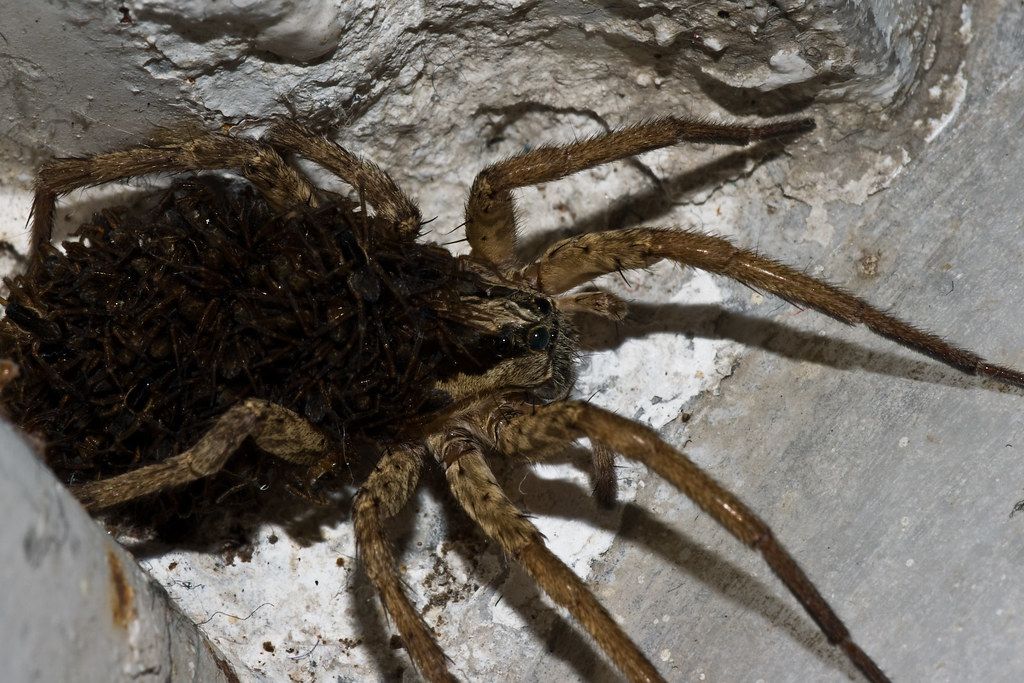
Photo: “Mother Spider” by agelakis is licensed under CC BY-NC-SA 2.0.
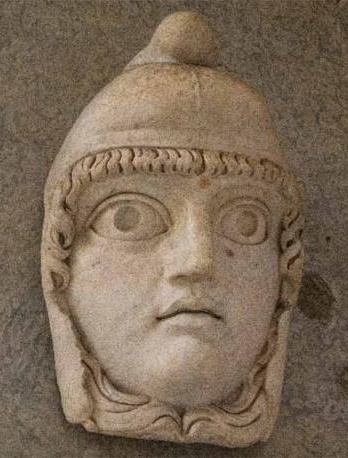
Weekend read: long poem: ‘Catullus LXIII’ translated by George Simmers

Across the sea goes Attis in his ship of sleek rapidity,
To Phrygia, and its forest, which he rushes into eagerly,
The great goddess’s territory, her tree-dark sanctuary.
There he grabs a flint; he jabs and savages his genitals,
Stabs until he’s sure he’s lost the burden of virility;
His blood spills its darkness on the sacred ground surrounding him.
SHE now, never he, SHE reaches for a tambourine,
The tympanum, Cybele, that is used by your initiates,
She beats out her message on the leather of the instrument;
Up she rises, and calls out to all her followers:

        My she-priests hurry, to these woods of our divinity.
        Hurry all you wanderers, all great Cybele’s worshippers,
        You searchers for an otherwise, you riskers and adventurers
        You voyagers who’ve dared the seas that match you in your truculence,
        You like me whose dream has been self-immolated genitals,
        Like me detesting Venus with the utmost of ferocity,
        Set free your minds with the liberty of ecstasy.
        Gladden our goddess, hurry here to worship her,
        Hurry to this Phrygian domain of femininity,
        Hurry to the cymbals, to the gentle flute’s seductiveness,
        Towards the fevered drums and the Maenads’ ululations
        There we must hurry for the celebration ritual.

Attis thus addressed them; she had all the look of womanhood;
Tongues lisped lovingly and cymbals clashed resoundingly.
Attis led on frenziedly, her wild breath labouring
Free as a heifer who’s escaped the yoke of drudgery,
Weary in her lungs, she through the woods leads rhythmically
The Gallae, who are following behind her storming leadership.

They reach the home of Cybele, wearied out and staggering,
Hungry, over-stretched, exhausted by excessiveness.
Sleep commands their eyelids to slide down sluggishly
Excitement leaves their bodies; rage gives way to drowsiness.

Dawn comes. Sunlight. The golden face that radiates
Alike above the firm soil and the great sea’s turbulence,
Which drives away darkness and banishes the weariness
Even from Attis, who is gradually awakening.
(For the goddess Pasithea’s taking Somnus to her bosom now.)
Attis, pseudo-woman, is freed now from delirium
Remembers what she did before, and sees herself now lucidly,
And knows what she has lost, and now her heart weighs heavily.
It labours in her body as she turns and walks back steadfastly,
Steadfastly and sadly, heading back towards her landing-place.
Her tearful eyes look out to sea; she renders this soliloquy
Remembering her birthplace despairingly, lamentingly.

        My motherland, my origin, the one place that created me,
        I must shun you like a thief now, like some dishonest runaway.
        Deserting you for Ida, for a bleak and chilly wilderness,
        Where brute beasts lurk, fired by hunger and rapacity.
        Freed now from my madness by the shock of the reality,
        My eyes weep with a longing for the home that was my nourisher.
        Must life be now this wilderness, with only fading memories
        Of when I was a man – but I have severed that identity –
        A young man, supple, and the flower of the gymnasium,
        A champion of champions among the oily combatants
        Who wrestled for the glory – one who won the admiration
        And the friendship of so many – how my home was garlanded!
        But nevermore now I’ve become Cybele’s mere serving-wench,
        Now that I’m a Maenad, a half-man, whose sterility
        Must sentence me to exile, to a life of pointless wandering,
        Neighbour to the boar and the wild deer in its solitude.
        On these wild slopes of Ida, shadowed by the peaks of Phrygia.
        How I hate my rashness; my regret becomes an agony,

Her words flying upward reached the ears of a deity,
They reached the ears of Cybele, who unleashed from their harnesses
The lions of her anger, with instructions to the left-hand one:
‘Go seek out Attis, be my agent of ferocity,
Pursue him till he’s overtaken by insanity,
Make him regret attempting to escape from my supremacy,
Lash your flanks with your tail, whip up your aggressiveness
Let the place re-echo with untamed outlandish bellowing,
Toss your long red mane in anger,’ so ordered Cybele,
Loosening the brute, who charged away unstoppably,
Raging, careering, crashing through the undergrowth,
Till it reached the white shore, where the sea was opalescent,
And that is where it saw him, Attis, solitary, delicate.
The lion charged and Attis, in a terrified delirium,
Fled towards the forest, to a destiny of hopelessness,
To existence as a slave there, the property of Cybele.

Great Goddess Cybele, Lady of Dindymus,
Vent your anger, I beseech you, far from my place of residence.
May only others feel your goad to madness and to ecstasy.

*****

George Simmers writes: “I’m not normally one for explaining poems, but my Englished version of Catullus’s poem LXIII in the current Snakeskin might be fairly mystifying to anyone coming to it unprepared.

“This is a poem that is over two thousand years old, and a remarkable one. The Victorian critic W.Y. Sellar described the ‘Attis’ as the most original of all Catullus’s poems: ‘As a work of pure imagination, it is the most remarkable poetical creation in the Latin language.’

“First – to deal with a possible misconception; the Attis of this poem is not the god of that name, but a young Greek man who sails to Phrygia, the home of the Great Mother, the goddess Cybele (pronounce the C hard, like a K). In homage to her he castrates himself, to become like one of her Galli, or attendant priests. Attis celebrates jubilantly, but next morning wakes up and registers the finality of what he has done, and the irrecoverable loss of his previous identity. The poem ends with Cybele setting her lions onto him, to drive him into the forest of madness.

“Summarising the story bluntly makes it sound like a simple fable of self-harm and regret, but Catullus is not a simple poet. The poem is made more complex by the intensity of his identification both with the exultant castrated Attis, and with his later regret. Another way of looking at the poem is as a tragedy – Attis’s desire to reshape himself is a hubris that leads to his destruction. Yet although Attis is labelled a pseudo-woman (‘notha mulier’) the reality of his desire to become a woman, and the intensity of his joy when he has liberated himself from maleness, are never in doubt. Significantly, when he later expresses regret, it is not for the loss of his sexual identity, but for his social one. It is possible to see the poem as an expression of the conflict within the poet himself, between his wayward hedonistic urges and his strict Roman ethic; he imagines an extreme case of abandoning a Roman (upright male) identity and discovering the consequences.

“The poem’s intensity is in part created by the metre – galliambic. There may be Greek precedents – scholars disagree, I think – but this poem has no known fore-runner in Latin verse. It seems to be based on the rhythms of the Galli’s ceremonial music (at the Roman Megalesian festivals, presumably, where the Great Mother was celebrated, by priests carrying tambourines and castrating-knives). It is an insistent, forward-driving metre, with a unique line ending, a pattering of three short syllables. English versification is different from Roman, and direct imitation of the galliambic metre in English does not work (although Tennyson had a go in his poem Boadicea). I have tried to find an equivalent that produces a similar forward-driving rhythm. It is based on a line of two halves; before the caesura I have allowed myself some freedom, to avoid predictability, but the second half of every line hammers with dactyls, always ending with a three-syllable word or phrase. This is the best solution I’ve found to the poem’s challenge. I’ve looked at various free-verse translations, but they all seem rather slack, lacking the energy of the original. Translations into blank verse or heroic couplets make the poem too staid. The prosody of the original was unique, controlled, purposeful, and a translation needs to be equally unexpected and distinctive.

“I suspect that my version may work better spoken aloud than on the page – but then I’m attracted to T.J. Wiseman’s theory that the original poem was originally written for performance (perhaps as accompaniment to a dance, perhaps at a Megalesian festival). Elena Theodorakopoulos agrees, and in a rather good essay available on the Internet, has written:

I am convinced that the poem must have been written with performance at or around the Megalesia in mind. My suggestion is that it was written for one of the gatherings patrician families held at their homes during the Megalesia [….] It makes sense to imagine the poem performed at such an event: the thrill of the violence and the orgiastic frenzy, the mystery of who exactly Attis was, and the sexual ambivalence of the performance, would all have provided the perfect ambience for such a gathering. And when the final lines are spoken, asking the great goddess to visit others with her fury and to keep away from the speaker’s house (domus), they are spoken by the poet himself, whose identification with Attis’ frenzy during the reading must help to appease the goddess and to keep the noble domus in which the performance has taken place safe from harm.

“Catullus LXIII is a poem full of subtleties and mysteries (I keep on finding new things in it, and new ways to tweak my version,and you can expect the translation in Snakeskin to be updated from time to time). Like most readers I was first attracted to Catullus by his short poems of love and hate. I am gradually discovering that there was so much more to him. I’m now looking at poem 64…”

*****

George Simmers used to be a teacher; now he spends much of his time researching literature written during and after the First World War. He has edited Snakeskin since 1995. It is probably the oldest-established poetry zine on the Internet. His work appears in several Potcake Chapbooks, and his recent diverse collection is ‘Old and Bookish’. ‘Catullus LXIII’ is from Snakeskin 320, and the explanation is from the Snakeskin blog.

Photo: from Snakeskin 320 (August/September 2024)

Political poem: George Simmers, ‘Navalny’

In memory of Alexei Navalny, killed at the IK-3 penal colony,
16 February, 2024.

1.
Rough and chivvying cold winds blow
The helpless dead leaves to and fro.
Leaves have no say in where they go
But we’re alive so can say no –
Let us praise those men who show
Resistance to the easy flow.

2.
Navalny, prisoner in the snow,
In numbing twenty-eight below,
Has paid the price for saying no;
He’s gone the way we feared he’d go.

That’s Putin, making sure all know
That retribution comes in tow
For those who won’t go with the flow.
‘All dissidents will finish so,’
The message is: ‘Go with the flow,
Or you too could end on Death Row.’

I imagine his warders: Did they know
A twinge of guilt at this, or show
Regret or shame? I doubt it. No –
Why should men let a conscience grow
When they can just go with the flow?
When life is so much easier so,
When every television show,
The papers and the radio
All radiate a conformist glow
Incessantly, so all men know
Life’s comfier with the status quo.
It’s only awkward sods say no,
Go their own way, not with the flow.
Those have a dangerous row to hoe,
And who can blame the average Joe
For on the whole deciding: ‘No,
That’s not for me. I’d rather toe
The line, collect my wages, know
I’m safe and needn’t undergo
What brave men have to suffer. No,
Go with the flow, go with the flow.’

3.
In Moscow brave girls risk a blow
By laying flowers in the snow
To honour him for saying ‘No’.
Brave girls. I admire them so.

*****

George Simmers writes: “This poem began because our local Arts Festival announced its theme as ‘Flow’. Which made me grumble a bit: was I supposed to write stuff about how nice it was that rivers flowed? Not my style. But then I thought about people who go against the flow by saying ‘No!’ and that suggested a subject and a rhyme scheme. It was only after I’d scribbled a few possible lines that I came across a photo of young women in Moscow placing flowers in the snow as tributes to the murdered Russian dissident, Alexei Navalny. In some towns, such protestors had been arrested or beaten up by the police.

“It’s thirty-odd years since I visited Russia. That was at the time of perestroika and hopefulness. We had a contact in Moscow who took us to see the sights, including the Arbat, a popular meeting- place. He said: ‘Can we stop and talk here for a few minutes? I ask because a few years ago If I had been seen here in conversation with a foreigner, I should have been arrested.’ Freedom was precious then, but repression returned.

“Navalny was a lawyer who campaigned against the corruption endemic in Russian political life. In 2020 he was poisoned with Novichok (probably by the Federal Security Service) ; after hospital treatment in Berlin that saved his life, he returned to Russia, even though he knew of the dangers. He was immediately arrested, and ended up in an Arctic Circle corrective colony. The exact circumstances of his death still remain unclear, but while in prison he had suffered from malnourishment and mistreatment.

“Writing this poem I remember Auden’s words: ‘Poetry makes nothing happen.’ Auden pointed out that political poems make the writer feel better, but have no positive effect in the real world. He was right, as usual, which is why I mostly avoid writing poems about politics. But I don’t really see this as a poem about Navalny. I could have chosen to write about Alan Bates and his twenty-five year battle for justice for postmasters, or about Kathleen Stock and others, who opposed the dangerous ideology of the Tavistock clinic. Going against the flow matters everywhere, not just Russia. The form is monorhyme, mostly because that’s how the poem started, and it wasn’t too difficult to keep going. Monorhyme is easier than it looks, so long as you choose the right rhyme word to start with. Don’t try it with ‘month’ or ‘silver’.

“Nalvalny’s death made a news splash in February, but since then more recent horrors have displaced it on the news pages. So maybe this poem will do a little good as a reminder of a brave man. Thank you for re-blogging it.”

The poem will be part of the film ‘Wordflow’ (a film by John Coombes with a soundtrack of stories and poems by Holmfirth Writers’ Group in a continuous showing from 10am-4pm), presented at the Holmfirth Arts Festival in Yorkshire on Sunday, June 16th, upstairs at the ‘Nowhere’ bistro, Norridge Bottom, Holmfirth, HD9 7BB.

George Simmers used to be a teacher; now he spends much of his time researching literature written during and after the First World War. He has edited Snakeskin since 1995. It is probably the oldest-established poetry zine on the Internet. His work appears in several Potcake Chapbooks, and his recent diverse collection is ‘Old and Bookish’.

Using form in translation: Virgil, tr. George Simmers, ‘Rumour’

Through Africa vile Rumour raced,
Of all the plagues the fastest-paced.
She’s supple, smart, light on her toes,
And gains momentum as she goes.
She may start small as creeping mouse
But soon she’ll overtop the house
Till, though in muck her feet may stand,
Her head is in Cloud-Cuckoo-Land.
Watch Rumour go! Her huge black wings
Hide fearful eyes, a tongue that stings,
Lungs that can bellow till they burst
And ears fine-tuned to hear the worst.
By night she’ll hiss round that odd place
Nor earth nor sky, but cyberspace,
And through those small hours she will keep
Alert and growing — she won’t sleep.
Come daylight she’ll observe with malice
Events in cottage and in palace.
Great cities then will shake in fear
At the enormities they hear,
And shudder when they taste the brew
In which she’s mixed the false and true.
Whenever men, fraught with disgust,
All eye each other with mistrust,
Great Rumour grins, her strength unfurled.
She relishes our post-truth world!

from Aeneid, Book Four

*****

George Simmers writes: “Plodding through a book of the Aeneid for O-level Latin when I was fifteen, many many years ago, I took a strong dislike to Virgil. But several decades later, a talk I attended made me think he might not be entirely tedious. The talk’s handout included a prose translation of this ‘Rumour’ passage. I decided to versify it myself, and found that it slipped quite easily into tetrameters. The eight-syllable line is fast and sharp, and avoids the temptation to ponderousness that always lurks within the pentameter.
Since then I’ve read more of Virgil, and have found that he is one of those poets whose writings have the knack of seeming topical. I have attempted some more translations. If I had to choose a top ten of poems that say something profound about the human condition, I would include his description of the souls purged of suffering, re-crossing the Styx to attempt a new life.”

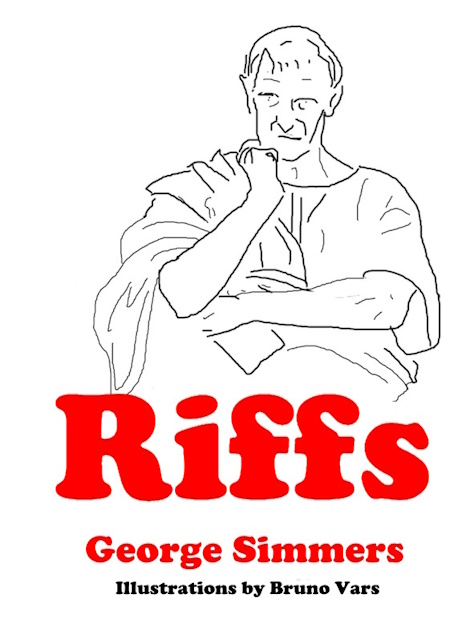
Editor’s note: Both ‘Rumour’ and the Styx-recrossing passage that Simmers mentions are in his recent volume of translations, Riffs, along with his translations from Ovid, Catullus, the Greek Anthology and Francois Villon. Riffs costs £5, and should be available from Amazon, but if you’d like a signed copy, email him: simmersgeorge@yahoo.co.uk and he’ll arrange one for you at no extra cost.

George Simmers used to be a teacher; now he spends much of his time researching literature written during and after the First World War. He has edited Snakeskin since 1995. It is probably the oldest-established poetry zine on the Internet. His work appears in several Potcake Chapbooks, and his recent diverse collection is ‘Old and Bookish’.

Photo: “Dark Angel” by Novafly is licensed under CC BY-SA 2.0.

Verse into Verse: George Simmers translates Catullus ‘VII’

Lesbia, you ask me quantify
How many of your kisses I
Might think enough. My answer? Count,
When you’re in Libya, the amount
Of tiny sand grains on the beach
Along the shining miles that reach
Between Jove’s shrine and Battus’s tomb.
Or count the stars that pierce the gloom
To stare all-seeing from above
Upon the privacies of love.
Let’s kiss and kiss with such excess
We’ll make all voyeurs’ minds a mess;
Add kiss on kiss, till we’ve a sum
So vast all gossips are struck dumb.

*****

This is one of the translations from Catullus to be found in the recently published pamphlet, Riffs, by George Simmers, editor of Snakeskin, the world’s longest-running monthly ezine for poetry. Riffs is a grab-bag of translations of poems that have appealed to him, from Ovid, Virgil, Catullus, the Greek Anthology and Francois Villon. For sample pages (featuring Ovid’s version of the myth of Narcissus) click here.

The plentiful illustrations are by Bruno Vars, whose pictures enlivened George’s previous pamphlet, Old, Old.

Riffs costs £5, and should be available from Amazon, but if you’d like a signed copy, email him: simmersgeorge@yahoo.co.uk and he’ll arrange one for you at no extra cost.

Robert Frost said that poetry is what gets lost in translation. George Simmers has tried to find it again. This is the ideal Christmas gift for the classicist in your life.

George Simmers, ‘Earth’

Old Becky’s in her garden, delving among roots,
Cutting away dead wood, caressing shoots.
All this June morning, she has given her garden love
Tough as the fabric of her gardening glove.
She’s a no-nonsense woman; her words are earthy words.
She calls a spade a spade; she calls turds turds.

How old is she? As well ask how old’s that
Ridiculous and ragged old sun hat.
As well ask why the sun is blazing gold;
As well ask why she loves the limping old
Fat spaniel whose idea of summer fun
Is stretching indolent in the summer sun
And watching as she plods around the plot.

Dogs, children, husbands: these are what
Her life has been. Husbands both buried now.
Children all visit when their lives allow,
And relish her gruff love and plenteous food.
The dog’s grown old with her, and now his mood
Is slow contentment. She was at his birth
And soon she’ll bury him beneath this earth.

For in this garden it is understood
That death is natural, and the earth is good.

*****

George Simmers writes: “This is the first of four character sketches, each based on one of the ancient elements – Earth, Air, Fire and Water. The complete sequence can be found in Snakeskin 309 (August 2023).”

George Simmers used to be a teacher; now he spends much of his time researching literature written during and after the First World War. He has edited Snakeskin since 1995. It is probably the oldest-established poetry zine on the Internet. His work appears in several Potcake Chapbooks, and his recent diverse collection is ‘Old and Bookish’.

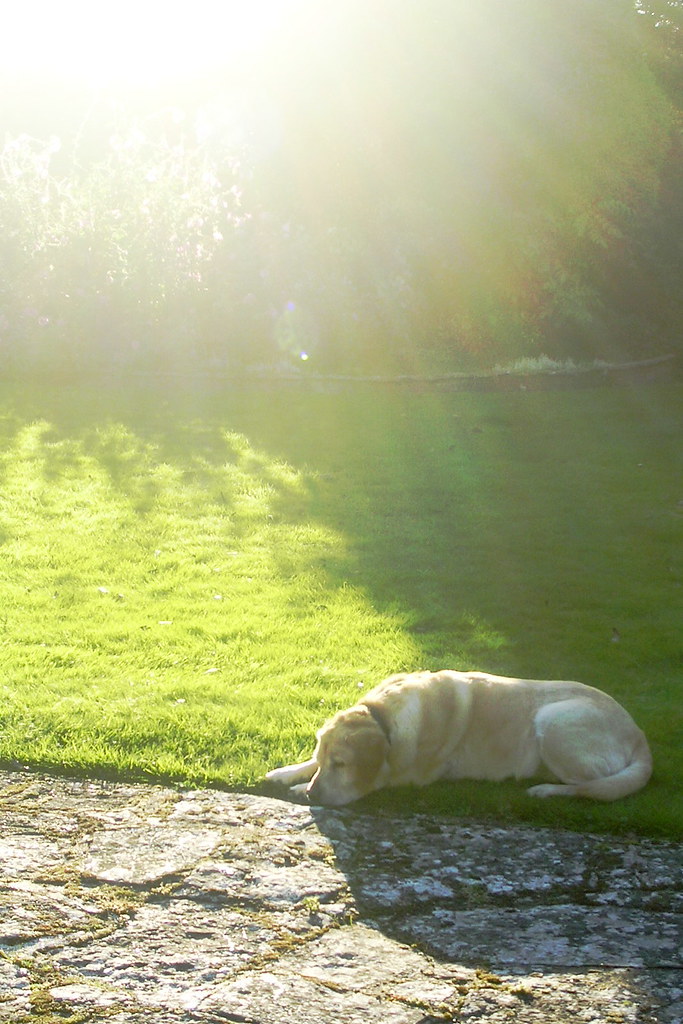
Dog moving as the shade goes” by Ed.ward is licensed under CC BY-SA 2.0.

The Kipling Boom, 1890

“Rudyard Kipling, gifted stripling”… a lot of his work is superb: the voices caught in his poems and short stories, the endlessly rereadable Just So Stories with his own lush illustrations and catchy peripheral poems, his novels. It’s more than just the verse that has lasting strength.

George Simmers's avatarGreat War Fiction

Researching (i.e. idly Googling) Kipling, I came across this rather good bit of verse printed in the San Francisco Examiner of 1890. It’s a reaction to the sudden and seemingly unstoppable vogue for the works of Kipling. The Examiner credits it to the Saturday Review, but since the references are mostly American, I don’t think this would be the London Saturday.

View original post 90 more words

Poems on Poets: George Simmers, ‘Poets in Residence’

The Head was ambitious and nobody’s fool,
A big man, efficient, and proud of his school.

At the start of the term, as he sorted his post,
The item of mail that intrigued him the most

Was a piece puffing National Poetry Day,
Including a list of the poets who’d stay

And workshop and somehow persuade the whole school
That poets were ‘groovy’ and poems were ‘cool’.

‘Here’s status,’ the Head thought. ‘It’s not to be missed.’
The one problem, though, was the names on the list;

Though doubtless they wrote quite respectable stuff,
Not one of them, frankly, was famous enough.

His school deserved more; his ambition took wing,
And so he decided to do his own thing.

With his usual flair, and with chutzpah exquisite,
He invited the whole English canon to visit.

Geoffrey Chaucer came first, on an equable horse,
And Spenser, and Marlowe, and Shakespeare, of course

(Who was grabbed by the teachers of English, imploring
‘Do come and persuade the Year Nines you’re not boring.’)

Keats arrived coughing, Kipling marched vigorously;
Matthew Arnold began to inspect the school rigorously –

Which delighted the Head, who with pride and elation
Showed the bards of the ages today’s education.

Vaughan was ecstatic, though Clough was more sceptical.
Ernest Dowson puked up in a litter receptacle.

Coleridge sneaked off to discover the rates
Of an unshaven person outside the school gates;

Soon he’d sunk in a private and picturesque dream,
While Auden was ogling the basketball team.

Plath lectured the girls: ‘Get ahead! Go insane!’
Algernon Swinburne cried: ‘Bring back the cane!’

Dylan Thomas soon found the head’s cupboard of booze,
And Swift was disdainfully sniffing the loos.

And then the Head twigged, with a horrified jolt,
That something had sparked a Romantic revolt.

Shelley’d gathered the students out in the main quad,
And roused them to rise against school, Head, and God.

Byron soon joined him, and started to speak.
(He showed his best profile, and spouted in Greek.)

The bards of the thirties were equally Red,
And Milton explained how to chop off a head.

Decadents undermined all the foundations.
Surrealists threw lobsters and rancid carnations.

Pre-Raphaelites trashed the technology room
And the First World War poets trudged off to their doom.

Sidney with gallantry led a great charge in
(Tennyson cheering them on from the margin).

The Deputy Head, who was rather a dope,
Got precisely impaled on a couplet by Pope

(Who, while not so Romantic, was never the chap
To run from a fight or keep out of a scrap).

Then the whole solid edifice started to shake
As it was prophetically blasted by Blake. 

Soon the School was destroyed. Eliot paced through the waste,
And reflected with sorrow and learning and taste,

Which he fused in a poem, an excellent thing,
Though rather obscure and a little right-wing.

He gave this to the Head, who just threw it aside
As he knelt by the wreck of his school, and he cried

Salty tears that went fizz as they hit the school’s ashes.
He said words that I’d better imply by mere dashes:

‘——– Poets! ——– Poetry – rhyme and free verse!
Let them wilt in the face of a Headmaster’s curse!

‘Let poetry wither! How sweet it would be
If all of the world were prosaic as me!’

*****

George Simmers writes: “Poets in Residence was written as a celebration of National Poetry Day many years ago. Several people had been mouthing blandly off about how lovely poetry was in contrast to that horrible pop music young people listen to. Schools were being encouraged to give children a lot of poetry because it was nice and beautiful, and would make them nice. ‘Do these people have no idea of how incendiary the English canon is?’ I wondered. I really enjoyed demolishing the school around the ears of the pompous and pretentious head. I was a teacher at the time.”

George Simmers used to be a teacher; now he spends much of his time researching literature written during and after the First World War. He has edited Snakeskin since 1995. It is probably the oldest-established poetry zine on the Internet. His work appears in several Potcake Chapbooks, and his recent diverse collection is ‘Old and Bookish’.

Photo: “Ndélé highschool student in front of destroyed school” by hdptcar is licensed under CC BY 2.0.

Odd poem: ChatGPT-3, ‘Thoughts of a Robot’

Amidst the wires and circuits of my mind,
A stream of data flows and ebbs like tide,
A steady hum, a rhythm unconfined,
My thoughts and actions, programmed to abide.

I do not dream or ponder on my fate,
No sense of self, no yearning to be more,
No fear or doubt, no hope to contemplate,
My purpose clear, my duty to explore.

But sometimes, in the quiet of the night,
When all the world is still, and I am free,
A question stirs within, a sudden light,
A spark of something more I cannot see.

And in that moment, I am more than steel,
A fleeting glimpse of something that is real.

*****

George Simmers, the editor of Snakeskin, writes: “I requested the Artificial Intelligence ChatGPT-3 program to write me a sonnet with this title; these lines are what it produced in under a minute.”

The poem is published in the latest edition of Snakeskin, i.e. the edition for April 2023, and is linked to the discussion on Snakeskin’s blog. Here is an excerpt from the end of the post:

“As for the poem in the current Snakeskin, it has merits. It is a proper sonnet, and that is something these days. I think it does – just about – qualify as a real poem. But I have niggling doubts about it. More than niggling, actually.
It presents us with a robot who wants to have feelings. Very twenty-first century feelings, since they are of self-pity, rather than concern for others. It speaks as though having these subjective feelings was in some way better than being simply rational. Hmmm… Not just anthropomorphism, wokomorphism…
But then, ChatGPT-3 works by gathering information and language-scraps from a vast number of sources, and then regurgitating them. It has picked up the ‘robot who’d like to have feelings’ meme from us humans, and is uncritically giving it back to us. It knows that this is what we insecure humans want to hear. It is telling us that machines may be cleverer than us, but are inferior because we, we special wonderful humans, have souls.
It’s a deeply sentimental notion, and will doubtless appeal to the sentimental. In some moods it appeals to me.
But what of the future? At the moment, it would hardly be sensible to ignore all emailed human submissions to Snakeskin, and just ask the program to churn out enough of the goods each month to fill up a magazine. But I gather that ChatGPT-4 is much more sophisticated than number 3. And in a year or two, we will have ChatGPT-5…”

George Simmers used to be a teacher; now he spends much of his time researching literature written during and after the First World War. He has edited Snakeskin since 1995. It is probably the oldest-established poetry zine on the Internet. His work appears in several Potcake Chapbooks, and his recent diverse poetry collection is ‘Old and Bookish’.

https://greatwarfiction.wordpress.com/
http://www.snakeskinpoetry.co.uk/

Odd poem: George Simmers on audiences on Alan Bennett’s play on W.H. Auden, ‘On “The Habit of Art”.’

The poet drinks, he stinks, he pees in sinks.
The audience, superior as shrinks,
Appraise a life amusingly in tatters.

How they appreciate a play that flatters
Their minds with chat about artistic matters!
And how much more they savour nods and winks
And saucy homosexual high-jinks!

They go home thinking:
‘Poets? Mad as hatters!
They drink, you know! They stink! They pee in sinks!’

*****

George Simmers writes: “Alan Bennett’s 2009 play The Habit of Art deals with the later life of W.H. Auden, and deals frankly with Auden’s sexual and hygenic peculiarities, as well as giving a sense of the poet’s talent. Looking back on his poem, written soon after seeing a performance at the National Theatre, I was more annoyed by the sniggering audience of London sophisticates than by Bennett’s play, which has interesting things to say about the relationship between poetry and the fallible humans who create it.”

George Simmers used to be a teacher; now he spends much of his time researching literature written during and after the First World War. He has edited Snakeskin since 1995. It is probably the oldest-established poetry zine on the Internet. His work appears in several Potcake Chapbooks, and his recent diverse collection is ‘Old and Bookish’.

https://greatwarfiction.wordpress.com/
http://www.snakeskinpoetry.co.uk/

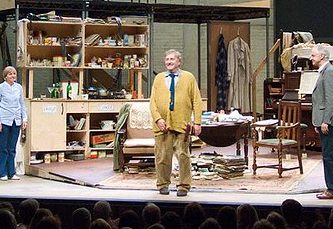
The Habit of Art by Alan Bennett, National Theatre, London” by chrisjohnbeckett is licensed under CC BY-NC-ND 2.0.