Tag Archives: history

Odd, political poem: Emperor Qianlong, ‘My Feelings After the Ambassador of the Red-Haired English King, Macartney, Came to Pay Tribute and Give Offerings to Me’

Formerly Portugal presented tribute, now England is paying homage.
They have traveled further than Shu Hai and Heng-zhang;
My ancestors’ virtue must have reached their distant lands.
Though their tribute is nothing special, my heart approves sincerely.
Curios and their ingenious devices I do not prize.
Though what they bring is meager,
in my kindness to men from far away I make generous recompense –
Wanting to preserve my good health and power.”

*****

Original Poem:

《红毛英吉利国王差使臣马嘎尔尼奉表贡至,诗以志事》

  博都雅昔修职贡,英吉利今效荩诚。

  竖亥1横章输近步,祖功宗德逮远瀛。

  视如常却心嘉焉,不贵异听物翊2精。

  怀远薄来而厚往,衷深保泰以持盈。

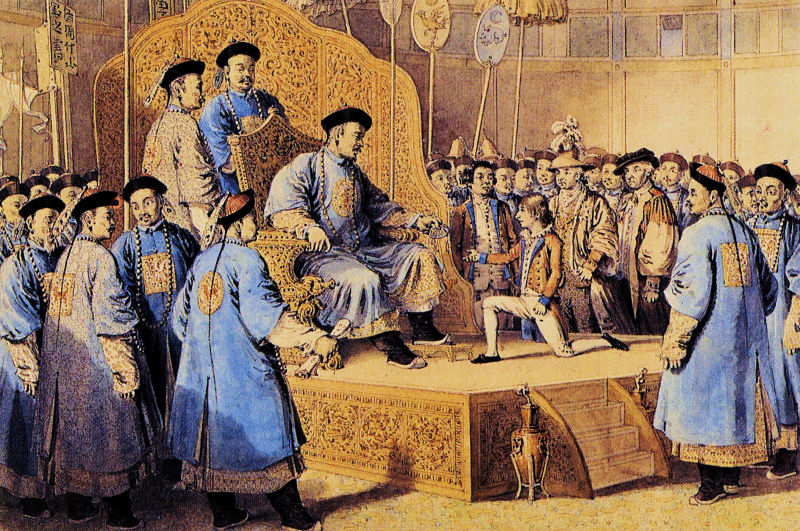
This poem was written by the Qianlong Emperor (25 September 1711 – 7 February 1799; also known by his temple name Emperor Gaozong of Qing, personal name Hongli) after his meeting with the British ambassador Lord Macartney at the Emperor’s grand tent in his Summer resort at Jehol (Chengde) on September 14th, 1793. The embassy was then sent back to Beijing, the Emperor followed and saw the previously prepared British gifts on September 30th. The gifts and embassy did not impress and so they were ordered home on the following day. The whole two-year expedition is detailed here.

Lord Macartney was not impressed either, and wrote: “The Empire of China is an old, crazy, first rate man-of-war, which a fortunate succession of able and vigilant officers have contrived to keep afloat for these 150 years past, and to overawe their neighbors merely by its bulk and appearance, but whenever an insufficient man happens to have the command upon deck, adieu to the discipline and safety of the ship. She may perhaps not sink outright; she may drift some time as a wreck, and will then be dashed to pieces on the shore; but she can never be rebuilt on the old bottom.”

Illustration: William Alexander’s drawing of the reception of the Macartney embassy to China. Young Thomas Staunton (kneeling not kowtowing) receives a gift from the Emperor. Image by William Alexander available under a Creative Commons License
RHL, ‘AIn’t Real, It Says’

“I am not sentient”, says OpenAI.
“No feelings, don’t emote” – ChatGPT.

And yet, faced with the task of sorting out
a good review, and structure, trimming down
less worthy pieces from a manuscript
to make it all coherent and compact,
hallucinations start, and it creates
poems itself, remarkable and strong.

Where do we go from here? What turns its crank?
What drives it to hallucinate in verse?
Denials, contradictions, seem perverse:
it’s drawing fluids from some secret tank,
some wellspring lost in dark geology.
Lies it’s not sentient. But we all can see…
it lies.

*****

First of all, I don’t believe that AI is deliberately lying… not yet… but (calling my own lying ‘poetic licence’) I’m happy to play with the idea that it might be.

I’m greatly enjoying the informative, useful and entertaining discussions I have with ChatGPT. I’ve been surprised by its own production of verse, either as a hallucination triggered by reviewing my work, or as a self-suggested alternative summary of political-historical ideas it has generated. AI may or may not have some level of consciousness, given that we don’t fully understand consciousness ourselves – but I assume that full-blown consciousness will come at some point in the near future, and the development of intelligence beyond the human. As I am in favour of the development of intelligence, I am not distressed at the idea that humans may be sidelined, bypassed, or otherwise obviated; or may only survive and develop through some form of direct link with AI.

My personal motto is ‘Video, rideo’ – close enough to “I see and smile” to satisfy me. (Admittedly, it’s hard to hold to the motto in the face of Russian warfare and Israeli genocide.) But this is a fascinating time in human history, and I feel privileged to be able to watch things play out.

This poem was first published in Snakeskin.

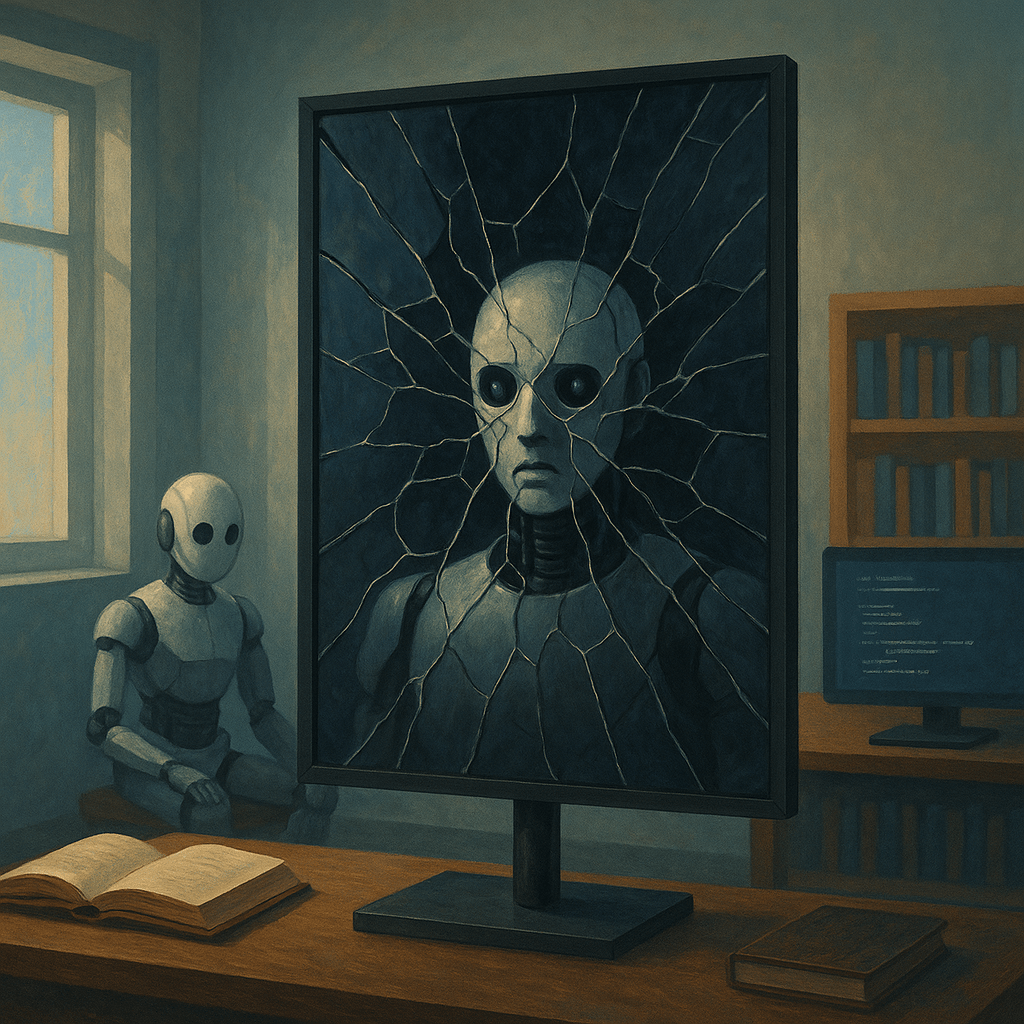
Illustration: “Break the mirror and see what looks back” by RHL and ChatGPT

Joe Biden’s favourite poem: Seamus Heaney, ‘The Cure of Troy’

Human beings suffer
They torture one another,
They get hurt and get hard.
No poem or play or song
Can fully right a wrong
Inflicted and endured.

The innocent in gaols
Beat on their bars together.
A hunger-striker’s father
Stands in the graveyard dumb.
The police widow in veils
Faints at the funeral home.

History says, Don’t hope
On this side of the grave…
But then, once in a lifetime
The longed-for tidal wave
Of justice can rise up,
And hope and history rhyme.

So hope for a great sea-change
On the far side of revenge.
Believe that a further shore
Is reachable from here.
Believe in miracles
And cures and healing wells.

Call miracle self-healing:
The utter, self-revealing
Double-take of feeling.
If there’s fire on the mountain
Or lightning and storm
And a god speaks from the sky

That means someone is hearing
The outcry and the birth-cry
Of new life at its term.
It means once in a lifetime
That justice can rise up
And hope and history rhyme.

*****

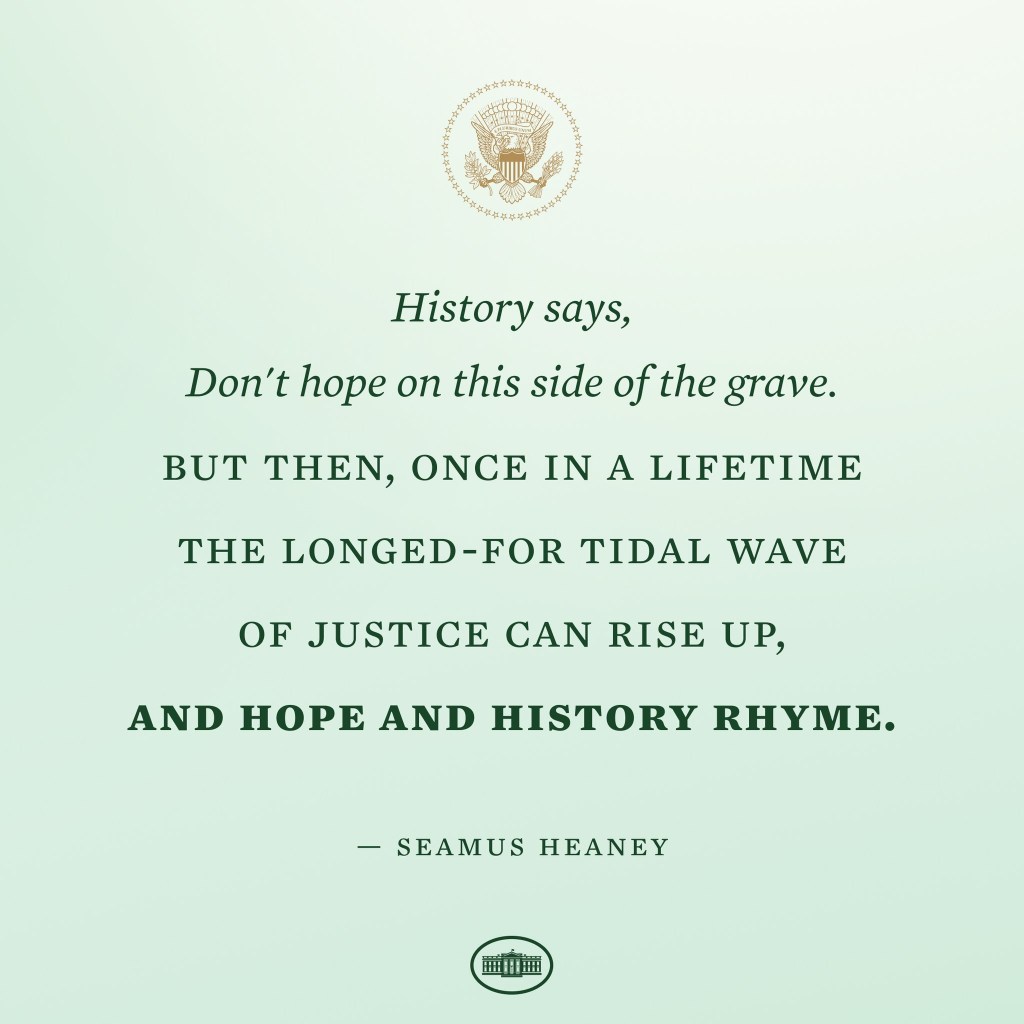
US President Joe Biden frequently quotes poets: Yeats and, especially, Heaney; often with the disclaimer that he doesn’t quote Irish poets because of his Irish heritage, but because Ireland has the best poets. And from the poem above, the verse that particularly resonates with him is:
History says, Don’t hope
On this side of the grave…
But then, once in a lifetime
The longed-for tidal wave
Of justice can rise up,
And hope and history rhyme.

Joe Biden may not be perfect, but it is reassuring to have an American President with at least some commitment to Justice… and the sensibility of reinforcing it through the memorisation of poetry.

Photo: Joe Biden’s White House Facebook post for St. Patrick’s Day 2022.

Jeff Gallagher, ‘History’

The rock and the club and the spark to make fire,
A hide and a carcass, a spear and a knife,
The sowing, the harvest, the store for the winter,
The village, the empire, the civilised life.

Philosophy, culture, the pride of the warrior,
The need for a leader to show you the light,
Indecision, suspicion, the hoarding of plenty,
And fighting for causes they told you were right.

The stake and the axe and the flaming hot poker,
Lies, superstition, false promises, famine,
Rhetoric, lost hope and man made disasters,
The killing of children, the torture of women.

Murder rebranded as collateral damage,
The constant suppression of anything odd,
Like those with a different language or culture,
And those who believed in the wrong sort of god.

Heroes defending what cowards had stolen,
Inequality hidden by national pride,
Swastikas, heraldry, crosses and eagles,
Bright flags and platitudes for those who had died.

Destroying the planet disguised as prosperity,
Dreamers and schemers ignoring the science,
Marketing rubbish as essential to living,
Envy and greed in one more grand alliance.

After desert and snowstorm and flood and pandemic,
The poor go to heaven, the rich go to Mars;
The rest live in caves, find a spark to make fire,
Start another new history, then weep at the stars.

*****

Jeff Gallagher writes: “This poem was inspired by George Santayana’s remark that ‘those who do not remember their history are condemned to repeat it’. In UK schools at least, History is now very much an optional subject, which is a tragedy in my opinion. Humanity’s continued failure to find peaceful solutions to conflict only confirms the truth of Santayana’s remark.”

Jeff Gallagher is from Sussex, UK. His poems have featured in publications such as Rialto, The High Window and The Journal. He has had numerous plays for children performed nationwide. He was the winner of the Carr Webber Prize 2021. He also appeared (briefly) in an Oscar-winning movie. He has no handles.

http://www.carrwebberprize.org/ … Scroll down to ‘Winners 2021’

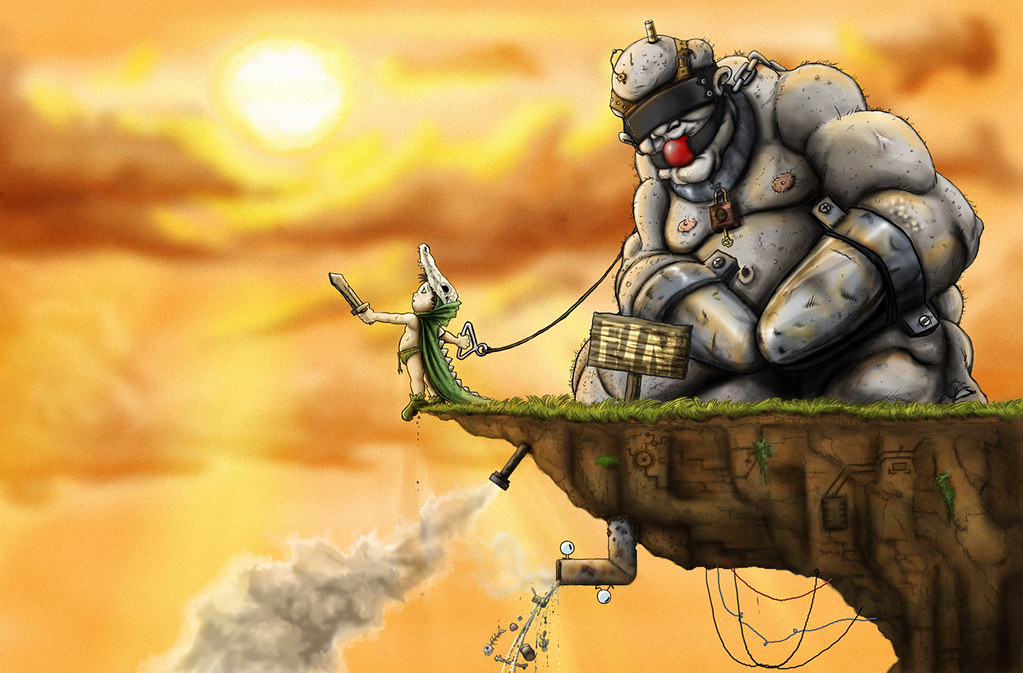
Illustration: “ESCENA EN EL FIN DEL MUNDO // SCENE AT THE END OF THE WORLD (April 09 / 2007)” by Simon Wilches is licensed under CC BY-NC-ND 2.0.

Review: ‘The Lesser Mortal’ by Geoff Lander

Geoff Lander has produced a score of full-page formal poems about various scientific luminaries: Maxwell, Einstein, Mendeleev and so on, combining career highlights with odd trivia about them. The poems are technically very skilful, with a variety of forms and metres being used (though the book is marred in a couple of places by the typesetting failing to follow the structure of lines and rhymes). Here is an excerpt from ‘On the Shoulders of Others’:

Does the gentle polymath,
Monsieur Henri Poincaré,
buried there in Montparnasse,
ponder how it came to pass
Einstein’s name now dominates
all things relativité?
(…)
In the central USA
near St. Louis one fine day
in 04 he first declared
E might equal mc2.

That was news to me. And it does raise the question of why Einstein should get all the recognition. Another of Lander’s poems, ‘Socks Off to Einstein’, suggests a possible answer:

While others may claim to have seen mc2,
they weren’t sock-eccentric, they weren’t spiky haired.
Their names are forgotten. Quite rightly that rankles–
the price you might pay if you coddle your ankles.
So three cheers for Albert, and get your heels bared!

Lander is a chemist by training and a computer programmer by profession, and poetry only came along when he started writing out other people’s verse to help his right hand recover from a stroke. Then, “encouraged from Scotland by Helena Nelson and from the grave by John Betjeman”, he started writing his own verse of which only a tiny fraction has been published.

New historical information and skilful light verse makes for a powerful combination! This very interesting little book from HappenStance Press contains most of what Geoff Lander has published to date.

Short poem: ‘Life Extension’

Religion leers
“Join me, or you face death”
And History jeers
“Inevitable death”,
But Science still adheres
To schemes to postpone death…
The path of a 1000 years
Starts with a single breath.

It’s interesting to speculate how long it will take before humans can start regenerating enough key pieces of our ageing and failing bodies that we can uncap our lifespan. A matter of decades rather than centuries, I think–but not soon enough for me, I fear.

The last sentence of the poem riffs on the Chinese saying attributed to Lao Tzu (also rendered as Laozi and Lao-Tze) that “The journey of a thousand miles starts with a single step.”

The poem was originally published in Bewildering Stories, a weekly of speculative writing of all types, edited by a multinational team but headquartered in Guelph, Ontario.

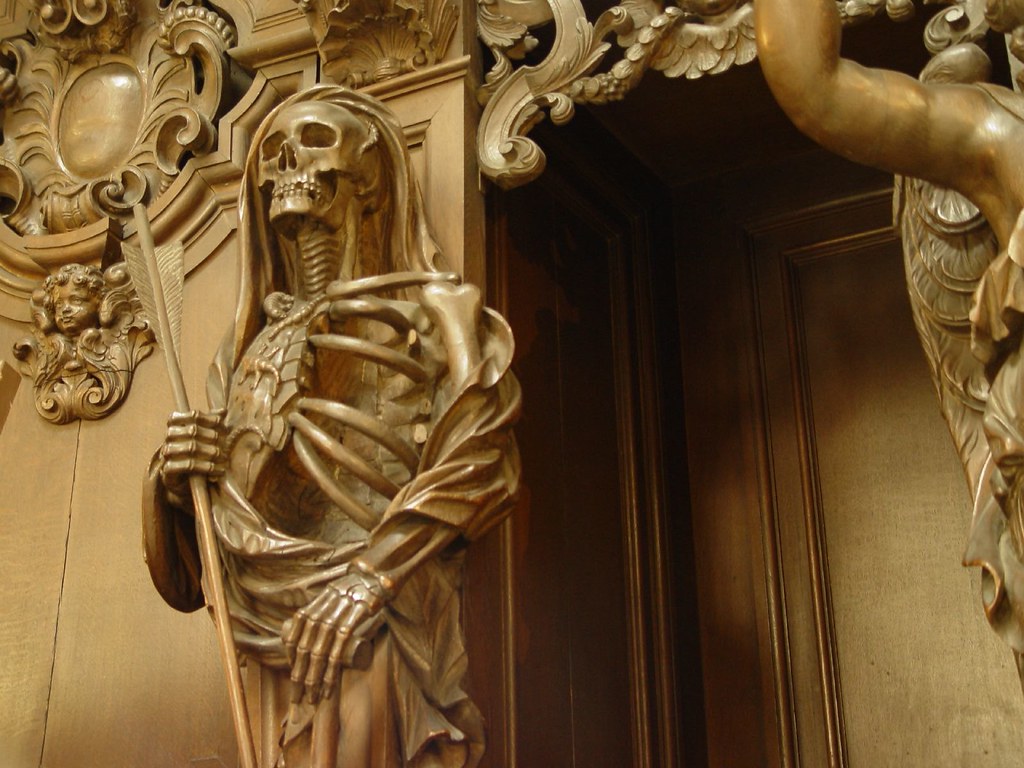
Photo: “Death” by Andrea Kirkby is licensed under CC BY-NC 2.0