Tag Archives: Horatius at the Bridge

Weekend read: Odd poem: Winston Churchill, ‘Our Modern Watchwords’

I
The shadow falls along the shore
The search lights twinkle on the sea
The silence of a mighty fleet
Portends the tumult yet to be.
The tables of the evening meal
Are spread amid the great machines
And thus with pride the question runs
Among the sailors and marines
Breathes there the man who fears to die
For England, Home, & Wai-hai-wai.

II
The Admiral slowly paced the bridge
His mind intent on famous deed
Yet ere the battle joined he thought
Of words that help mankind in need
Words that might make sailors think
Of Hopes beyond all earthly laws
And add to hard and heavy toil
The glamour of a victorious cause.

*****

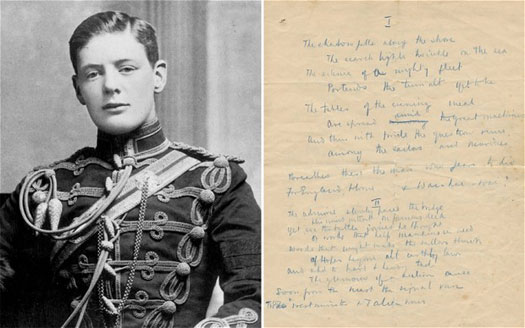
Around 115 years after it was written, the only known poem written by Winston Churchill as an adult was discovered by Roy Davids, a retired manuscript dealer from Great Haseley in Oxfordshire: ‘Our Modern Watchwords’, which was apparently inspired by Tennyson and Kipling.
Written between 1898 and 1900 when Churchill was a cornet (equivalent to today’s second lieutenant) in the 4th Hussars, the 10-verse poem is a tribute to the Empire. The author peppers the poem with the names of remote outposts defending Britain’s interests around the world, many of which he would have visited as a young officer and even fought at, including Weihaiwei in China, Karochaw in Japan and Sokoto in north-west Nigeria. Written in regular iambic tetrameter but with irregular rhymes, the poem exists in a tradition that stretches back to Homer’s Iliad: the soldier waiting impatiently for the battle to begin. As Churchill writes: ‘The silence of a mighty fleet / Portends the tumult yet to be.’
Davids, who says the poem “is by far the most exciting Churchill discovery I have seen”, admits it is merely “passable”.
Andrew Motion, the former Poet Laureate, goes further, calling it “heavy-footed”. “I didn’t know he wrote poems, though somehow I’m not surprised: oils, walls, why not poems as well?” said Motion. “This is pretty much what one would expect: reliable, heavy-footed rhythm; stirring, old-fashioned sentiments. Except for the lines ‘The tables of the evening meal/Are spread amid the great machines’, where the shadow of Auden passes over the page, and makes everything briefly more surprising.”
Despite its lack of literary virtues, however, the poem written in blue crayon on two sheets of 4th Hussars-headed notepaper was expected to raise between £12,000 to £15,000 when it went on sale in 2013. Its price reflected its rarity: the only other poem known to be penned by Churchill is the 12-verse ‘The Influenza’, which won a House Prize in a competition at Harrow school in 1890 when he was 15. However ‘Our Modern Watchwords’ failed to sell at the auction as bidding never reached the reserve price.
Churchill was well-known for his love of poetry. He won the Headmaster’s Prize at Harrow for reciting from memory Macaulay’s 589-line poem ‘Horatius at the Bridge‘.
Allan Packwood, director of the Churchill Archive Centre at Churchill College, Cambridge, said the wartime prime minister’s interest in poetry spanned the sophisticated to the more earthy: “In his speech accepting freedom of the city of Edinburgh in 1942, he quoted Robert Burns and ended by quoting the music hall entertainer Sir Harry Lauder, who was in the audience. This was no cheap politician’s trick, Churchill was an admirer of Lauder’s.”
By the way, Churchill was well-known for his oratory and repartee, but he wasn’t always the victor. My favourite story involves Richard Haldane in the 1920s. Churchill prodded Haldane’s ample belly and asked “What’s in there?” Haldane answered: “If it is a boy, I shall call him John. If it is a girl, I shall call her Mary. But if it is only wind, I shall call it Winston.”
Photos: https://winstonchurchill.org/publications/churchill-bulletin/bulletin-056-feb-2013/appreciation-the-young-churchill-poem-hints-at-the-rhetorical-greatness-to-come/

Evocative Fragments: from Macaulay’s ‘Horatius at the Bridge’

But the Consul’s brow was sad,
And the Consul’s speech was low,
And darkly looked he at the wall,
And darkly at the foe;
“Their van will be upon us
Before the bridge goes down;
And if they once may win the bridge,
What hope to save the town?”

Then out spake brave Horatius,
The Captain of the Gate:
“To every man upon this earth
Death cometh soon or late.
And how can man die better
Than facing fearful odds,
For the ashes of his fathers,
And the temples of his gods!”

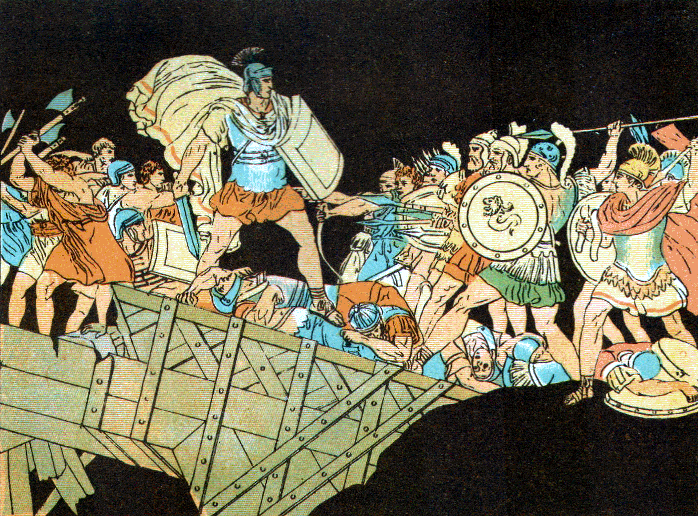
An alliance of neighbouring city-states is attacking the young Roman republic with 10,000 cavalry and 80,000 foot soldiers. The River Tiber provides a natural defence, but the broad wooden bridge is a weak spot. Horatius with two friends will try to hold off the enemy while the bridge is being destroyed underneath them. Enemy champions attack them in single combat and are defeated, until the huge Astur strides up with his “four-fold shield”, shaking the sword “which none but he can wield”. He attacks Horatius and gashes his thigh. Horatius

… reeled, and on Herminius
He leaned one breathing-space,
Then, like a wild-cat mad with wounds,
Sprang right at Astur’s face.
Through teeth and skull and helmet
So fierce a thrust he sped,
The good sword stood a handbreadth out
Behind the Tuscan’s head.

(…)

On Astur’s throat Horatius
Right firmly pressed his heel,
And thrice and four times tugged amain,
Ere he wrenched out the steel.
And “See,” he cried, “the welcome,
Fair guests, that waits you here!
What noble Lucumo comes next
To taste our Roman cheer?”

I was probably 11 when our English classes in my Jamaican boarding school were enlivened by Macaulay’s nearly 600-line poem (though, truthfully, our textbook cut out a lot of the slow introductory verses). As someone who otherwise lived on works like Tarzan of the Apes and Bomba the Jungle Boy (and of course banned comics of Superman and Batman when I was home for the holidays), it was wonderful to discover that verse could deliver just as dramatic, violent and heroic a story as novels and comics. Further, verse can do so in passages of enormous emotional power, heightened by the drama of their rhythm and rhyme, with short passages sticking in the mind forever even if you aren’t trying to learn them by heart.

The other qualities that appealed to me were undoubtedly the feelings of patriotism and religious approval that I suspect are natural in children – the sense of community, of tribe, of duty, of being morally in the right, of overcoming difficulties, of excelling, of supporting and saving people, of being praised for it. And what I value in that today is that it was done without any reference to an actual modern-day country or an actual modern-day religion. In other words the emotions could be stirred up and the child could be (at least temporarily) ennobled, without the poisons of nationalism or religious fundamentalism finding a place. Indeed, by placing the heroic emotions outside the here and now, I think the poem helped inoculate me against such diseases.

I was already very comfortable with poetry when I was introduced to ‘Horatius’ – A.A. Mine, Edward Lear, Robert Service and the Anglican hymn book come to mind – but this poem took poetry into another dimension entirely!

Review: Lord Macaulay, “Lays of Ancient Rome”

horatius

Macaulay’s ‘Lays of Ancient Rome’ are remarkable in several ways. The well-known ‘Horatius’ (aka ‘Horatius at the Bridge’) is glorious, memorable, stirring, heroic, in lovely rolling ballad-type stanzas:

Then up spake brave Horatius,
The Captain of the Gate:
“To every man upon this earth
Death cometh soon or late.
And how can man die better
Than facing fearful odds,
For the ashes of his fathers,
And the temples of his gods?”

Great stuff! It seems in keeping that Winston Churchill (love him or loathe him) would have learnt all 70 stanzas as a schoolboy, inspiring himself to develop courage (and oratory).

But the second remarkable thing is how bad the rest of the material in the volume is. The poetry is uninteresting, and the pure heroism of ‘Horatius’ is replaced either by gods winning the human battle, or by a girl being ‘saved’ from being despoiled by a tyrant by her father killing her when the three are together in the Forum (and not attempting to kill the tyrant), or by the poems deteriorating into blathery fragments.

Macaulay was wordy from an early age. The story is told of him that, uninterested in toys, he was reading avidly by the age of three and he already talked like a book. When hot coffee was accidentally spilled on his legs and a kindly woman asked “Is Diddums all right?” he replied, “Thank you, madam, the agony is abated.”

The third way in which this volume is remarkable is in the main Preface and in the shorter prefaces to each of the poems, especially ‘Horatius’. Here Macaulay lectures in detail on a perceived universal process of ballad creation in preliterate societies (and on the value of verse for memorisation), ballads’ subsequent devaluation when higher standards of literacy come in, and finally their total loss or partial recovery. He recounts the differences between two ballads of the Battle of Otterburn which have quite different outcomes for the protagonists, even though both ballads were probably written by people who were alive at the time of the battle.

And in a throw-away paragraph he inadvertently highlights the changes in education and culture that have taken place in the past 150 years: “The early history of Rome is indeed far more poetical than anything else in Latin literature. The loves of the Vestal and the God of War, the cradle laid among the reeds of Tiber, the fig-tree, the she-wolf, the shepherd’s cabin” (to these five he adds a further 23 examples, ending with) “the combat between Valerius Corvus and the gigantic Gaul, are among the many instances which will at once suggest themselves to every reader.”

As if! Well, that was then, this is now. But ‘Horatius’ itself has a timeless quality to it. Although if you are trying to invoke heroism by reading it to a 10-year-old which I strongly recommend, you should pre-read it and comfortably skip some of the unnecessary early verses.