Tag Archives: John Donne

Helena Nelson, ‘Invitation’

a homage to Donne’s ‘Nocturnal on St Lucies day’
The shortest day is soon. Time for a pact.
I don’t mean with Saint Lucy (Lucy’s day
falls earlier in the month). But hey
let’s meet and talk and counteract
such darkness of the heart
as coincides with winter’s formal start.
We can read Donne’s ‘Nocturnal’, view its art,
its provenance and what on earth it means.
Location doesn’t matter. We have screens.

Nobody writes a poem now like that —
not something so precise and well controlled.
Of course, we hear what we are told:
the world is round, a rhyme is flat,
‘poetics’ have moved on
and these days no-one wants to write like Donne
who was amazing, right? But dead and gone.
Or not that dead. I’d say he’s still alive
in stanza three and certainly in five.

They call Donne ‘metaphysical’, you know,
a word still popular in jacket blurbs
for living, writing bards where verbs
(or verbiage) propel the flow
but hard now to be sure
whether they mean what Johnson meant. The more
‘meta’ you get with blurbs, the more obscure.
When ‘metaphysical’ foretells a treat
it might be true; it might be mere conceit.

But in ‘Nocturnal’, metaphor leans out
and mystifies. It’s not the usual thing
like glass or compasses or string.
It’s nothing. No thing. Less than nowt.
He says what he is not
in several different ways. In fact, the knot
of nothingness becomes his central plot.
The poet in him can’t forget that ‘none’,
his rhyme for ‘run’, echoes both ‘sun’ and ‘Donne’.

So he’s the sum of everything he feels:
annihilated by the loss of one
without whom he is not a man,
just numb. And yet he still appeals
to logic to make clear
how dark existence is. Yes, she was dear.
Each syllable recounts her loss, his fear,
and this is now and then and now, since this
both the year’s and the day’s deep midnight is.

*****

Helena Nelson writes: “In 1617 when, after the death of his wife, John Donne wrote ‘A nocturnall upon S. Lucies day, Being the shortest day’, St Lucy’s Day coincided with the winter solstice in the author’s hemisphere. Then they changed the calendar, and these days, Saint Lucy’s Day is 13 December. But the winter solstice falls over a week later (this year 21 December).

“Every year on the solstice, I think about John Donne’s solstice poem, every year it gets more apposite, since it is essentially about death. Last year, I did a formal online discussion about it, and I wrote an invitation using the form that is Donne’s, though obviously for a less serious purpose. It allowed me to think it through. I’m thinking about the poem again today, so here’s the invitation.”

Helena Nelson runs HappenStance Press (now winding down) and also writes poems. Her most recent collection is Pearls (The Complete Mr and Mrs Philpott Poems). She reviews widely and is Consulting Editor for The Friday Poem.

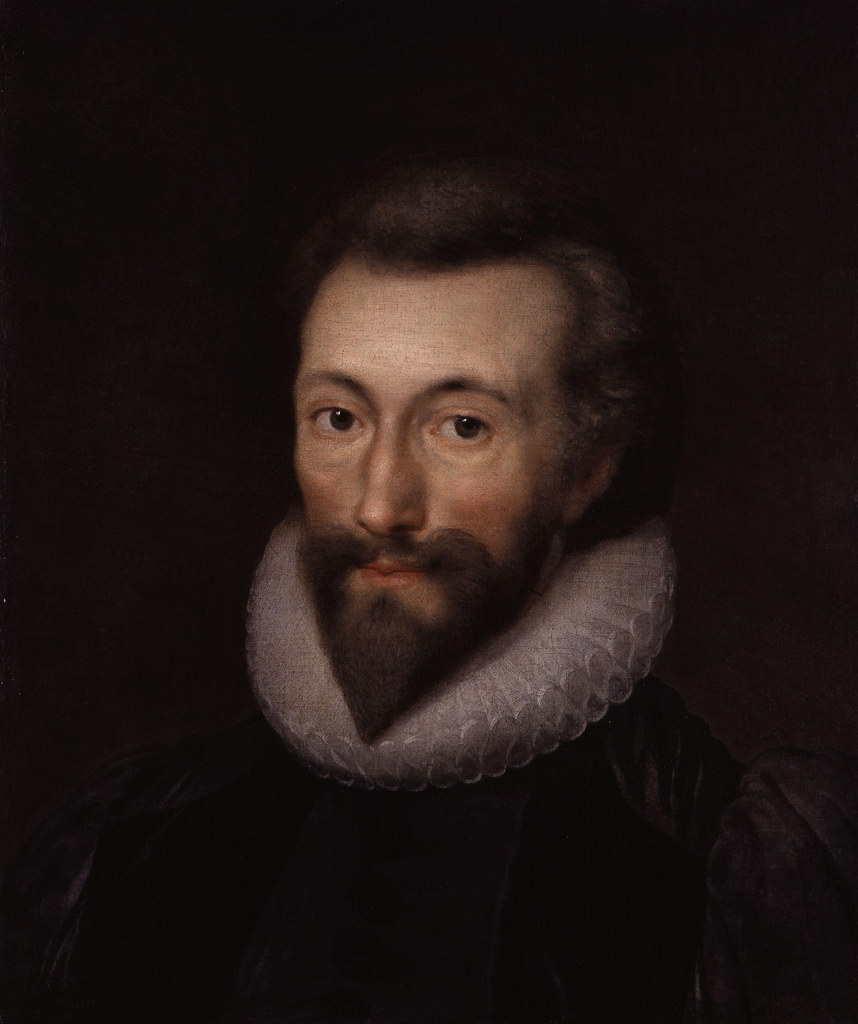
Photo: “John Donne, Poet” by lisby1 is marked with Public Domain Mark 1.0.
Weekend read: Maryann Corbett, ‘A Valediction: of Maintenance Work’

Time was, we spent our muscle and our nous
propping an aging house
against the pummeling of its hundred years.
Clean paint, neat gardens, upkeep rarely in arrears,
sober as Donne. Yet now each year afresh
burdens us with new failings of the flesh:

Legs that once mounted ladders without qualm
tremble. Nor are we calm
confronting pipework; torsos will not shrink,
backs bend, or shoulders fold to grope below a sink.
Hands shake; eyeballs glaze over. What appalls
is that our bodies buckle like our walls:

plaque in arteries, soot in chimney stacks,
stubborn and troublous cracks
in teeth, in plaster. House! Ought we to call
ourselves—and you—new poster children for the Fall,
for that hard doctrine grumbling down the ages
that Sin’s to blame, with Death and Rot its wages?

Entropy as theology—would Donne
jape at it? Wink and pun
as in his randy youth? Or solemnly
robed in his winding sheet, sing Mutability,
spinning into the praise of God in Art
the fact that all things earthly fall apart?

Or pull from air some bit of modern science,
yoking (even by violence)
thermodynamics, shortened telomeres,
transplants, genetics, sex, the music of the spheres?
Strange physics and wild metaphors—all grand,
but Rot and Death, plain woes we understand,

are better fought with checkbooks than with verse.
We’ll sit, these days. We’ll nurse
our beers, while able bodies stir their dust.
A distant siren whines—we sigh; it whines for us.
Let plumbers, painters, carpenters begin
this season’s round of battling Death and Sin.

*****

Maryann Corbett writes: “Last summer, Clarence Caddell was just beginning work on a new magazine, The Boroughand was planning a second issue while the first came together. He had in mind an issue centered on Donne, and he commissioned me to contribute a poem. I’d read the wonderful biography Super-Infinite: The Transformations of John Donne by Katherine Rundell not many months before, so a lot of the life was fresh in my mind–but it was also the season of endless repair that is the eternal truth of owning a house that’s 113 years old.  It wasn’t hard to pull together a poem about the woes of home ownership with tidbits that “everyone knows” about Donne–his worldly-to-holy conversion, the familiar line about his yoked-by-violence metaphors–under an allusive title, and in a stanza form a bit like one of his. (Alas, this blog can’t show you the indents that would best imitate Donne’s way of laying out a poem. You’ll have to imagine all the trimeter second lines indented and the hexameter fourth lines hanging out farther left.) In the end, Clarence had to use the poem to fill out his first issue, so it sat alone, unassisted by an issue theme.”

Maryann Corbett earned a doctorate in English from the University of Minnesota in 1981 and expected to be teaching Beowulf and Chaucer and the history of the English language. Instead, she spent almost thirty-five years working for the Office of the Revisor of Statutes of the Minnesota Legislature, helping attorneys to write in plain English and coordinating the creation of finding aids for the law. She returned to writing poetry after thirty years away from the craft in 2005 and is now the author of two chapbooks and six full-length collections, most recently The O in the Air (Franciscan U. Press, 2023). Her work has won the Willis Barnstone Translation Prize and the Richard Wilbur Award, has appeared in many journals on both sides of the Atlantic, and is included in anthologies like Measure for Measure: An Anthology of Poetic Meters and The Best American Poetry.


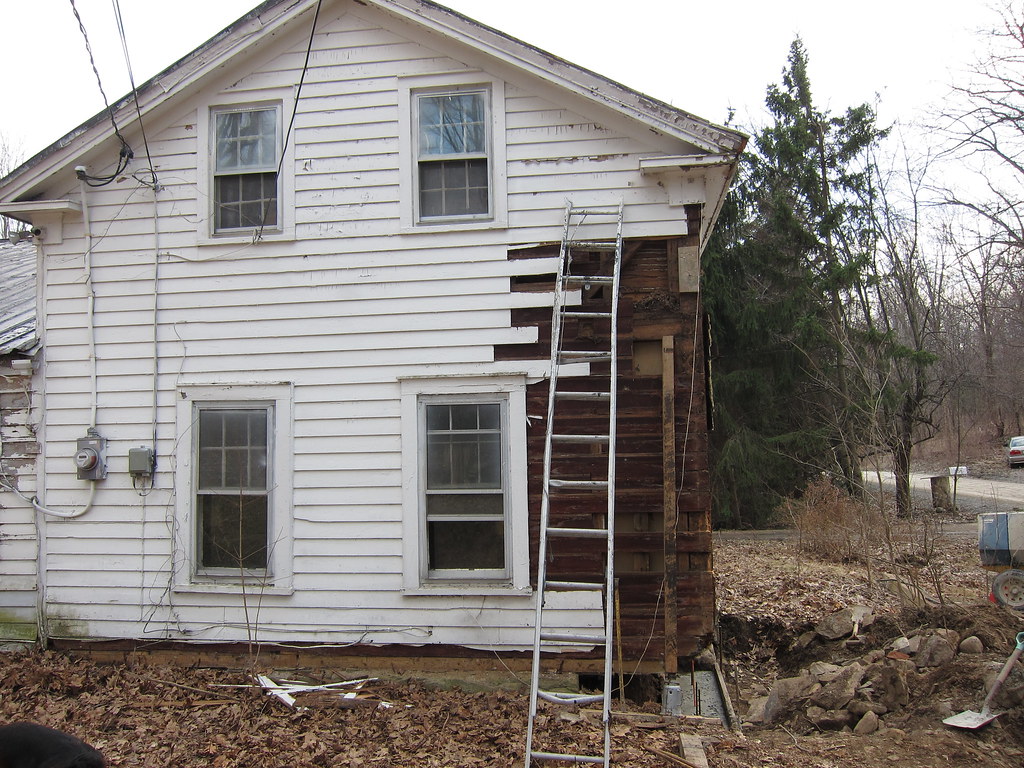
Photo: “House Repairs” by JessNityaJess is licensed under CC BY-NC-SA 2.0.

Weekend read: Michael Murry, ‘Inconspicuous Conclusions’

A play’s last scene has often served as trope,
where theater, as metaphoric scheme,
enables authors to compose a dream
of Life as it exhausts its mortal scope.
The actors in our own Life’s play, we “hope”
and “love;” some “challenge fate;” some “sob” and “scream,”
but all personify Forever’s theme:
that with its ending, Life must simply cope.
I cannot speak for others in the cast,
but my bit-part as extra in The Show —
as son and father, husband to the last —
gave me such joy as any man could know.
I’ve lived a lucky life. Of this I’m certain.
So when my last scene ends, ring down the curtain.

*****

Michael Murry writes: “The background concerns the passing away of my 48-year-old son, Stuart Langston Murry, in a freak accident while visiting his mother in northern Taiwan. As part of the grieving process, I turned to reading some of my favorite poets – especially Edna St. Vincent Millay’s ‘Dirge Without Music’ – before composing an elegy for my son’s funeral: ‘A Song for Stuart’ published as a Memoir in Bewildering Stories Issue 1032, followed by a companion sonnet ‘Anticipating Anonymity’ published in Bewildering Stories Issue 1042. So much for the composition’s background. ‘Inconspicuous Conclusions’ was published in Bewildering Stories Issue 1043.

As for the formal sonnet structure of the composition, I chose to use as a model John Donne’s Holy Sonnet (VI) with its opening “This is my play’s last scene” for metaphorical theme. The sonnet’s 14 lines consist of iambic pentameter (5 stress accents and 10 syllables) lines: 12 with masculine endings and 2 lines for the closing couplet’s feminine endings (5 stress accents and 11 syllables): ABBAABBACDCDee.

For relevant biographical information, see my website:  http://themisfortuneteller.com/  with my verse compositions under the “Poetic License” menu tab. Consider me a 76-year-old Vietnam Veteran Against The War – the one that never seems to end – retired and living in Taiwan for the last two decades. I started writing formal verse compositions in 2004 as a sort of DIY bibliotherapy for Delayed Vietnam Reaction. I haven’t stopped yet and see no reason why I should. You and your audience may find my work too polemical for most refined poetic tastes, so if you choose not to quote any of my verses, I will certainly understand. As you please . . .”

Photo: Michael Murry at Advance Tactical Support Base ‘Solid Anchor’, Vietnam, early 1970s.

The Spectator Competition: “Paradise Lost in four lines”

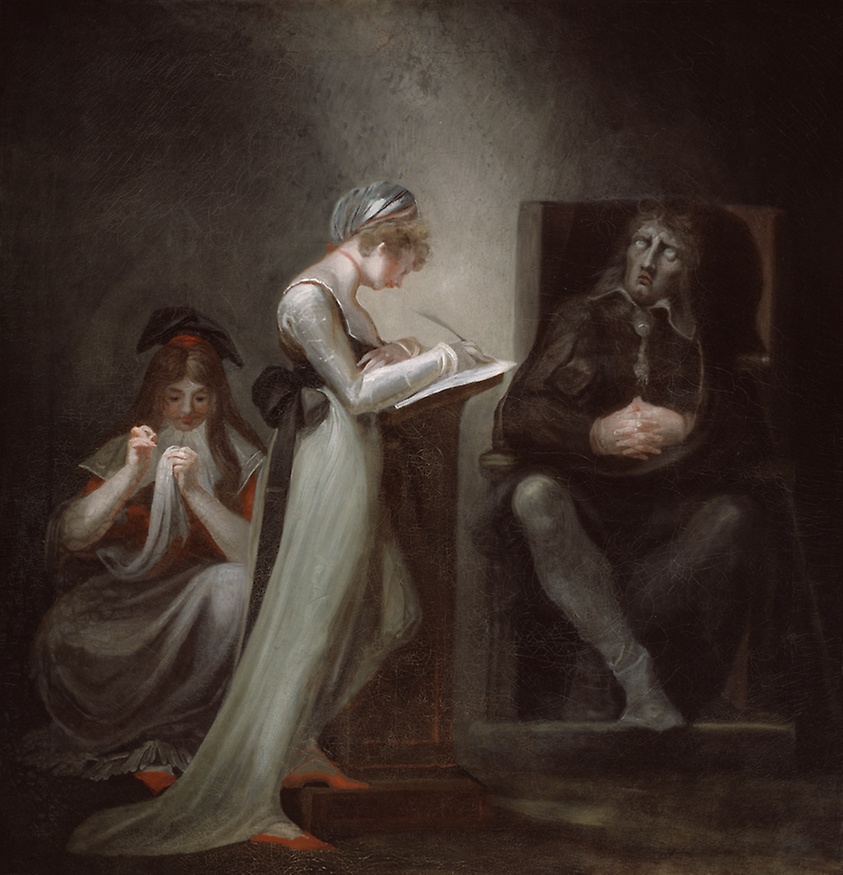
Milton Dictating to his Daughter, 1793, Henry Fuseli

Lucy Vickery runs a competition in the British weekly The Spectator–a truly venerable publication which recently reached its 10,000th weekly issue. Its politics are a bit too conservative for my taste, but the competition is in a class of its own (The New Statesman having dropped its similar competition a few years ago).

The most recent challenge was this: “In Competition No. 3163 you were invited to submit well-known poems encapsulated in four lines.” The gorgeous responses prompted Lucy Vickery to call the results “Paradise Lost in four lines”, after this entry by Jane Blanchard:

Satan found himself in hell —
Eve and Adam also fell —
Good gone bad got even worse —
Milton wrote too much blank verse —

(which exactly reflects my feelings, having had to waste too much of my A Level studies on Paradise Lost at the expense of more interesting poets such as John Donne and Matthew Arnold.)

My personal delight in The Spectator’s competitions is in seeing so many Potcake Poets there (in this case not just Jane Blanchard, but also Chris O’Carroll, Martin Parker, Jerome Betts, George Simmers and Brian Allgar), and in identifying more poets to keep an eye on for possible future chapbooks.

Anyway, if you want to see nice condensations of famous poems, have a look at that specific competition’s results. My favourite is Martin Parker’s take on e.e. cummings’ ‘may i feel said he‘:

foreplay
(more play)
errings, ummings
(and cummings)