Tag Archives: Keats

Double sonnet, Daniel Galef, ‘A Nightingale to a Sad Poet’

(Keats’s ‘Ode to a Nightingale’ from the other side)

You slump at my tree’s foot, complex angsts brewing
While our red-clawed, red-beaked animal furies
In these shadowy plots hatch our own undoing.
If thinking is man’s ruin, have no worries.
If you could speak the whistling words of birds
Whose sound to you like music now appears,
As nature’s snow-white cream man sours to curds
To chew, our songs would curdle in your ears:
‘Fly!, fly! The bearded fox is on the prowl!’—
And ‘Keep away! These berries are quick poison!’—
‘I need a mate, or I was born for nought’—
‘Go south, go south!’—‘The horned and hoary owl
Brings swift, crook-taloned death.’ You seek strange joys in
Ignorance, to envy lives so fraught!
Now dull-brained human scientists proclaim
That tool-use is no more unique to apes
Than language, war, or thumbs. They’re all the same
Emergent properties, like wine from grapes.
I am not certain that is Hippocrene;
The Pierian Spring leaves no such scarlet stain.
A jug of wine might well complete the scene:
Your book of verse, &c. A brain
Like smiling Aesop’s, where morals mask the roar
Of lions, the flopping fear of fish in the net,
The worm-wove cloak we dress up in our tomb in—
I think that must be Lethe. Drink, and soar
Above your brain, and me, and quite forget
That you were all too sentient, all too human.

*****

Daniel Galef writes: “I’m a sucker for parodies and response poems! My first book features riffs on Byron, Swift, Ernest Thayer, the ancient epigrammatist Nossis the Epizephyrian, and Doris Day. A few years ago in my master’s program I took a[n excellent] poetry workshop with Barbara Hamby focusing on the history of the Ode, as part of which she had everyone memorize Keats’s “Ode to a Nightingale.” We’d all read the poem before, but engaging with it so closely for a sustained duration was a really lovely experience, and having the whole poem by rote is an excellent party trick if you ever need to clear the room at the end of a party. At the end of the class I sent Professor Hamby a little parody piece, a rebuttal from the nightingale’s point of view to the moping poet sitting underneath its tree. (It was also a gesture of peace because I had gotten on her bad side by insinuating that the speaker calling the nightingale “dryad of the trees” was redundant because all dryads are by definition of the trees.) That poem was three pages or so and more directly parodying Keats’s style, as well as being written with the same stanzaic structure as Keats’s. It was also just for fun and thoroughly unprintable. But something I’ve been doing lately when I can’t bring myself to write an original poem is to sonnet-ize other things I’ve written—short lyric poems, long narrative poems, free verse, even short short stories—as I’m currently putting together a second collection of Imaginary Sonnets, a series of persona poems I’ve been writing for years inspired by the Victorian poet Eugene Lee-Hamilton. I cherrypicked a handful of my favorite lines from the long nightingale poem and spun some sonnet-stuff around them and ended up with this. It was still too much material for fourteen lines but fit into a double-sonnet, which is half as good.”

Daniel Galef’s poetry, half-serious and half-non-, has been published in a variety of venues themselves both serious and non-. His first book, Imaginary Sonnets, collects 70 persona poems from the point of view of various historical figures and literary characters, including Lucrezia Borgia, Christopher Smart’s cat, and a taco. “A Nightingale to a Sad Poet” first appeared in the Spring/Summer 2025 issue of Sein und Werden. Other recent writing can be found in the Indiana Review, the Best Small Fictions anthology, and Scientific American.

Bard of the Mossy Cot” by Giles Watson’s poetry and prose is licensed under CC BY-SA 2.0.



Using form: Susan Jarvis Bryant, ‘To Autumn’

Your flare of red turns Winter’s hoary head
To gaze upon your blaze and feel the heat
      And fever of your beat.
Your spice and sizzle catch his breath and spread
Through icy sighs to melt the lick of frost
      That dusts the dawn
With hints of chill intent. His plot is lost
In honeyed-apple charm and plummy balm.

You temper smitten Winter’s bitter breeze.
Your foxy bronze and lush rufescent blush;
      Your gold and ruby rush
 Ignite the leaves that shiver on the trees.
You burn through thickest wisps of morning mist.
      Birds laud your glow.
The granite skies grow blue as clouds are kissed
By dreams so hot they thaw all thoughts of snow.

When it’s your time to go you’ll fade with grace
As branches shed their tawny tears of grief –
      Each crisp and crinkled leaf
Will pool and pile. As Winter shows his face
Your fluffy, brush-tailed fans will slump and sleep.
      They’ll hit the sack
Until they spy the coyest crocus peep –
Spring’s message to the world that you’ll be back!

*****

Susan Jarvis Bryant writes: “My poem is a quirky nod to Keats’ timeless and beautiful ode with a much louder and sassier version of the fall with not a mellow trait in sight.  There is no time for mourning loss in this poem. Autumn vows (in true Terminator style) she’ll be back! The form I chose is a nod to the traditional but with two short lines in each stanza – an act of rebellion in keeping with this fiery season.”

‘To Autumn’ was originally published in Snakeskin 321.

Susan Jarvis Bryant is originally from the U.K., but now lives on the coastal plains of Texas. Susan has poetry published on The Society of Classical Poets, Lighten Up Online, Snakeskin, Light, Sparks of Calliope, and Expansive Poetry Online. She also has poetry published in The Lyric, Trinacria, and Beth Houston’s Extreme Formal Poems and Extreme Sonnets II anthologies. Susan is the winner of the 2020 International SCP Poetry Competition and has been nominated for the 2024 Pushcart Prize. She has just published her first two books, Elephants Unleashed and Fern Feathered Edges.

Photo: “Fall Color on the Pond” by fossiled is licensed under CC BY-NC-SA 2.0.

Poems on Poets: George Simmers, ‘Poets in Residence’

The Head was ambitious and nobody’s fool,
A big man, efficient, and proud of his school.

At the start of the term, as he sorted his post,
The item of mail that intrigued him the most

Was a piece puffing National Poetry Day,
Including a list of the poets who’d stay

And workshop and somehow persuade the whole school
That poets were ‘groovy’ and poems were ‘cool’.

‘Here’s status,’ the Head thought. ‘It’s not to be missed.’
The one problem, though, was the names on the list;

Though doubtless they wrote quite respectable stuff,
Not one of them, frankly, was famous enough.

His school deserved more; his ambition took wing,
And so he decided to do his own thing.

With his usual flair, and with chutzpah exquisite,
He invited the whole English canon to visit.

Geoffrey Chaucer came first, on an equable horse,
And Spenser, and Marlowe, and Shakespeare, of course

(Who was grabbed by the teachers of English, imploring
‘Do come and persuade the Year Nines you’re not boring.’)

Keats arrived coughing, Kipling marched vigorously;
Matthew Arnold began to inspect the school rigorously –

Which delighted the Head, who with pride and elation
Showed the bards of the ages today’s education.

Vaughan was ecstatic, though Clough was more sceptical.
Ernest Dowson puked up in a litter receptacle.

Coleridge sneaked off to discover the rates
Of an unshaven person outside the school gates;

Soon he’d sunk in a private and picturesque dream,
While Auden was ogling the basketball team.

Plath lectured the girls: ‘Get ahead! Go insane!’
Algernon Swinburne cried: ‘Bring back the cane!’

Dylan Thomas soon found the head’s cupboard of booze,
And Swift was disdainfully sniffing the loos.

And then the Head twigged, with a horrified jolt,
That something had sparked a Romantic revolt.

Shelley’d gathered the students out in the main quad,
And roused them to rise against school, Head, and God.

Byron soon joined him, and started to speak.
(He showed his best profile, and spouted in Greek.)

The bards of the thirties were equally Red,
And Milton explained how to chop off a head.

Decadents undermined all the foundations.
Surrealists threw lobsters and rancid carnations.

Pre-Raphaelites trashed the technology room
And the First World War poets trudged off to their doom.

Sidney with gallantry led a great charge in
(Tennyson cheering them on from the margin).

The Deputy Head, who was rather a dope,
Got precisely impaled on a couplet by Pope

(Who, while not so Romantic, was never the chap
To run from a fight or keep out of a scrap).

Then the whole solid edifice started to shake
As it was prophetically blasted by Blake. 

Soon the School was destroyed. Eliot paced through the waste,
And reflected with sorrow and learning and taste,

Which he fused in a poem, an excellent thing,
Though rather obscure and a little right-wing.

He gave this to the Head, who just threw it aside
As he knelt by the wreck of his school, and he cried

Salty tears that went fizz as they hit the school’s ashes.
He said words that I’d better imply by mere dashes:

‘——– Poets! ——– Poetry – rhyme and free verse!
Let them wilt in the face of a Headmaster’s curse!

‘Let poetry wither! How sweet it would be
If all of the world were prosaic as me!’

*****

George Simmers writes: “Poets in Residence was written as a celebration of National Poetry Day many years ago. Several people had been mouthing blandly off about how lovely poetry was in contrast to that horrible pop music young people listen to. Schools were being encouraged to give children a lot of poetry because it was nice and beautiful, and would make them nice. ‘Do these people have no idea of how incendiary the English canon is?’ I wondered. I really enjoyed demolishing the school around the ears of the pompous and pretentious head. I was a teacher at the time.”

George Simmers used to be a teacher; now he spends much of his time researching literature written during and after the First World War. He has edited Snakeskin since 1995. It is probably the oldest-established poetry zine on the Internet. His work appears in several Potcake Chapbooks, and his recent diverse collection is ‘Old and Bookish’.

Photo: “Ndélé highschool student in front of destroyed school” by hdptcar is licensed under CC BY 2.0.

Potcake Poet’s Choice: Amit Majmudar, ‘Eyespots’

Caterpillars build their bunkers out
of terror. Transformation hunts them, haunts them
as oak leaf peepholes open underfoot
to bare the air, the emptiness that wants them.
I have a measure of infinity
inside me. A is no and mit is measure
in an ancestral tongue that haunts me, hunts me.
I’m half in love with what I have to be.
The other half is looking for a razor
to make of me the Amit who was once me,

my yogi’s beard a clump of Spanish moss
limp at my feet, a piece of furry roadkill.
I’m no ascetic. Half in love with loss,
I’ll seek out beauty, or at least my ode will,
night-blooming jasmines dooming my samadhi,
scenting, resenting my hermetic dark
because they know a yogi, breathing in
his first girlfriend’s perfume, unarchives her body,
and drives her, after dusk, to the vanished park
where memory of sin cocoons the sin.

Caterpillars ravel bunkers into
bodybags—no way for them to know
the moment that they poke themselves a window,
the rebirth they were hiding from will show:
Two stained-glass windows mounted on my back,
two earshaped eyespot petals I can flex
and fold, a flailing that transforms to flight
while all the darkling jasmines that I lack,
past loves that called me onward to the next,
unpetal in the bodybag of night.

In love, or half in love, with mere aesthetics,
I’ve daydreamed Himalayan caves, a hive
that hums with “Aum” from ninety-nine ascetics,
their senses hibernating, half alive.
No one has ever scaled Kailash, the peak
where Shiva sits in bud, in shut-flytrap samadhi
with ashes smeared across his chest and arms.
But that’s just not the changelessness I seek.
I want my language, shapely as a body,
to weave and rive cocoons, enchantments, forms

with giant wings inside their ashgray berries.
I want my transience to live in speech,
if only as a resonance that carries,
like jasmine scent, beyond my voice’s reach.
I tell myself: Old soul, don’t be afraid
of changing. You are old enough to know,
whenever something changes, something dies,
but the dark you flowered in won’t let you fade.
A crack in this cocoon admits a glow.
The blue moon butterfly will wear your eyes.

Amit Majmudar writes: “This poem, ‘Eyespots’, is what I think of as a Keatsian ode, borrowing its stanzaic form and (I hope) something of its musicality. Yet the poem incorporates Hindu religious imagery throughout and sings of self-transformation in a way that isn’t to be found in Keats. This hybridization of Eastern and Western traditions in the poem feels idiosyncratic. There remain elements still opaque to me about it; so I never really delved into the metaphysical significance of the title’s false eyes, these seeming sense organs that are not actually sensing anything, but, given the focus on ascetic imagery, there seems to be something in that. Maybe in another essay? Or another poem….

I feel as though there are poems I have written that someone else could conceivably have written. But not this one; even ignoring that my name hides caterpillar-like inside the cocoon of the poem, I feel that the range of influences and ideas is simply too idiosyncratically “me” for this to have come from any other poet’s hand. Will everyone like it? Probably not, for precisely that reason. But I know that no one else could have produced this sequence of words, so I confess a certain fondness for it. It’s the one of my literary children who most resembles me. And it’s as good a way as any to get to know me as a writer.”

Amit Majmudar is a diagnostic nuclear radiologist who lives in Westerville, Ohio, with his wife and three children. The former first Poet Laureate of Ohio, he is the author of the poetry collections What He Did in Solitary and Dothead among other novels and poetry collections. Awarded the Donald Justice Prize and the Pushcart Prize, Majmudar’s work has appeared in The New York Times, The New Yorker, Best of the Best American Poetry, and the eleventh edition of The Norton Introduction to Literature. Two novels are forthcoming in India in 2022: an historical novel about the 1947 Partition entitled The Map and the Scissors, and a novel for young readers, Heroes the Color of Dust. Visit www.amitmajmudar.com for more details.

‘Eyespots’ was first published in Measure Review.

Poem: Sonnet: “My Thunder-Galloping Unconscious Mind”

A sonnet from a couple of years ago, published in Snakeskin, November 2016 :

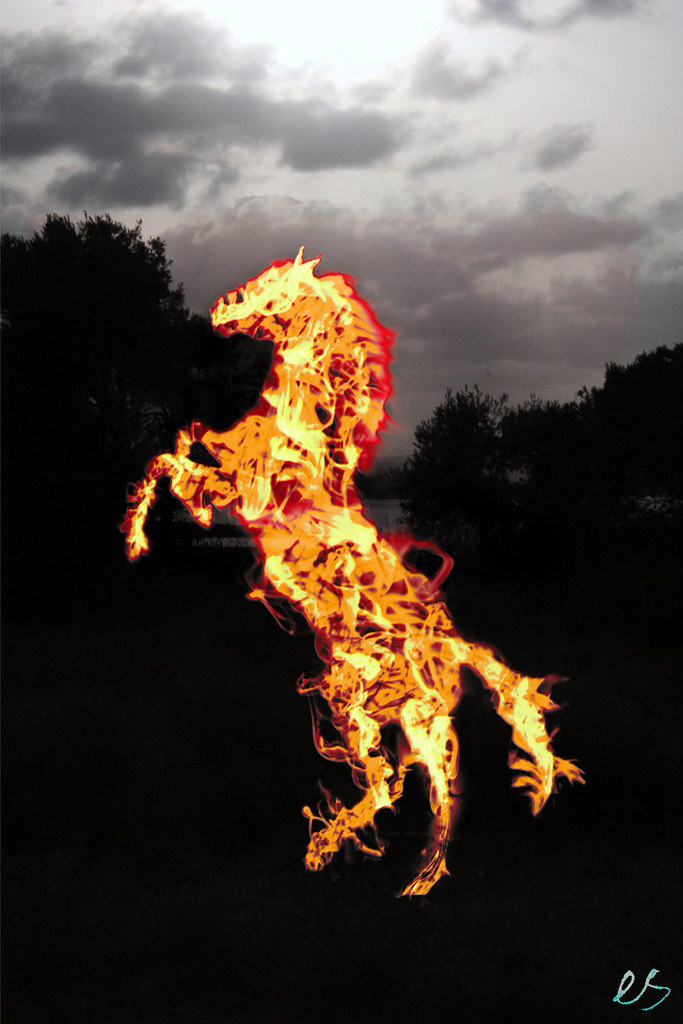
Fire Horse

“fire horse” by sk8rboi90 is licensed under CC BY-NC-SA 2.0


MY THUNDER-GALLOPING UNCONSCIOUS MIND

My thunder-galloping unconscious mind –
On which I, jolly joking jockey, perch
And whose divine intentions I besmirch
With claims its selfishnesses I’ve divined –
This powerhouse, this generator blind,
With pattern-seeking data-crunch research,
Unschooled, ungoverned, then will trip and lurch
Drunk as a soul must be in a mad mind.
But loved and honoured it’s a thundering horse
That powers all the body’s work and health
And flushes poisons in its daily course
And monitors all dangers in its stealth
And feeds uplifting feelings, love and right…
And gifts these images to me at night.

This encapsulates a lot of my thoughts about the way the world works: a lot goes on under the surface of the mind, and we are not as much in charge as we think. In that sense I agree with those who say there is no free will – we think we are consciously deciding to act, but when the brain is monitored we find that we begin to act before the conscious decision – the conscious mind merely rubber-stamps the decision already taken by the unconscious and then, like any figurehead, takes credit for the action.

Also, I am of the opinion that acknowledging the power and healthfulness of the subconscious is key to a happy, balanced and creative life.

The structure of the poem – well, it’s a sonnet, but not pure in form. The first lines rhyming ABBA ABBA are Petrarchan, but after the (weak) volta the CDCD EE is Shakespearean. The effect to a purist is messy, muddy. But honestly, the awareness of four-line chunks is driven by either of those types of fundamental rhyme, just as it is by a rubaiyat’s AABA. When the final couplet comes, the sonnet feels complete – and this couplet is the strength of the Shakespearean sonnet. (The Petrarchan would have ended CDE CDE.)

I am only aware of one sonnet where switching between Petrarchan and Shakespearean was done deliberately and appropriately: a sonnet by Keats in which he was discussing form, and clarifying his new-found preference for the Shakespearean over the Petrarchan.

In anyone else, switching is not ideal, but it’s also not a major obstacle. It is a sign of slight imperfection. But I think this poem still holds. 

Sonnets: John Keats’ 64 Sonnets

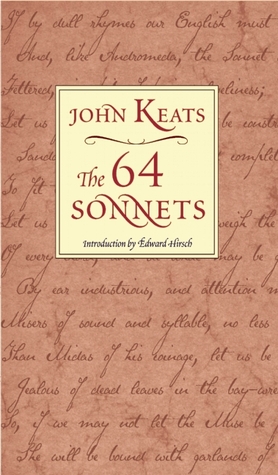
The 64 extant sonnets of John Keats make for a very interesting read for anyone interested in formal verse. Not only do we have the poet developing his skills and The 64 Sonnets by John Keatsexpression in the last five years of his short life (he was 18 when he wrote his first sonnet, and died at 23), but he consciously experimented with the form, outlining in his letters the shortcomings that he saw in the Petrarchan and Shakespearean versions while he looked for a better structure.

This collection has a useful but insufficient introduction by Edward Hirsch and incompetent notes by Gary Hawkins. Hirsch writes of the development of Keats’ themes, but fails to tie the poems into the details of his life. I suggest reading at least the Wikipedia entry on Keats to get a fuller sense of what was going on in his mind, his life, his environment.

The notes by Hawkins appear to have been thrown together without either care or insight. There is a facing page of three or four comments for each poem, and there is a further note on the rhyme scheme in an appendix at the back. The appendix catches four of the lengthened lines (6 or even 7 feet in a line) but misses three of them; and notes one of the shortened lines but misses another. Worse, the analysis of the rhyme scheme for the technically most interesting sonnet (“If by dull rhymes our English must be chain’d”) fails to understand the structure Keats was creating, despite quoting his comments in the letter containing the poem.

Hawkins gives the structure as
abc ad (d) c abc dede (tercets, quatrain)

This is wrong on so many levels… First, the fifth line’s rhyme is b, not d. Second, there is no quatrain at all. Third, Keats has shown how to analyze the sonnet – which is a single sentence – by breaking it into tercets with the use of semicolons to clarify the structure of his thought. Its structure is
abc; abd; cab; cde; de.

That this doesn’t fit into Hawkins’ categories of Petrarchan and Shakespearean sonnets is precisely the point Keats makes in his letter (“I have been endeavouring to discover a better sonnet stanza than we have”) as well as in the sonnet itself (“Let us find out, if we must be constrain’d, / Sandals more interwoven and complete / To fit the naked foot of Poesy;”)

Hawkins also makes errors of fact and interpretation in the notes facing the sonnets themselves. The very first sonnet, written in 1814, references “the triple kingdom” which Hawkins explains as “Great Britain, composed of England, Scotland and Wales.” Wrong. With the Act of Union of 1801 the three kingdoms of England, Scotland and Ireland were united, as represented by the simultaneous creation of the Union Jack with its combination of the crosses of the three flags. Wales was not a kingdom but a principality, and its flag never figured in the larger national flags.

In the sonnet “How many bards gild the lapses of time!”, Keats writes “A few of them have ever been the food / Of my delighted fancy.” Hawkins annotates this as “namely, the epic poets Milton and Spenser.” Oh really? How about Shakespeare, whom Keats addresses directly as “Chief Poet!” in another sonnet. And this is quite apart from sonnets addressed to Byron, Chatterton, Hunt, and Burns.

I have to smile at Hawkins’ interpretation of “artless daughters”:

Happy is England, sweet her artless daughters;
Enough their simple loveliness for me,
Enough their whitest arms in silence clinging:
Yet do I often warmly burn to see
Beauties of deeper glance, and hear their singing,
And float with them about the summer waters.

Hawkins interprets the “artless daughters” as “Scotland and Wales”. Oh come on! Keats could fall in love at a girl’s glance, at a stranger pulling off a glove. I don’t think he meant Scotland and Wales – he meant girls, classic “English rose” girls, and contrasted them with what he might find in the Mediterranean. Where he went, and died.

Few of the sonnets are near as memorable as “On first looking into Chapman’s Homer” or “When I have fears that I may cease to be”, but they are all readable and rereadable, and to have them as this collection is a treat.