Tag Archives: Light Magazine

Max Gutmann, “Ozymandias” Meets “Casey at the Bat”

The outlook wasn’t brilliant for the Sandville One that day.
The boundless, barren, lone, and level sands stretched far away.
The traveler who’d tell the tale now gazed on it alone.
A king’s cracked visage lay beside vast, trunkless legs of stone.

His name was Ozymandias, a name of great renown;
Upon his monumental visage glared a potent frown;
A wrinkle curled his lip; he wore a sneer of cold command,
Asserting the calm certainty that he would always stand.

Oh, somewhere in this antique land the sun is shining fair;
Great Works that tower somewhere cause the Mighty to despair;
And somewhere there is more than pedestals and sand about;
But the King of Kings is joyless—mighty Ozy has struck out.

*****

Max Gutmann writes: “This was part of a series of comic pieces crossing famous poems with each other, not a particularly unique idea, as proven by The Spectator, which ran a contest on a similar premise a few months after I wrote the first of the batch. One of the early ones appeared in that Spectator issue. This one appeared in Light.”

Max Gutmann has worked as, among other things, a stage manager, a journalist, a teacher, an editor, a clerk, a factory worker, a community service officer, the business manager of an improv troupe, and a performer in a Daffy Duck costume. Occasionally, he has even earned money writing plays and poems.

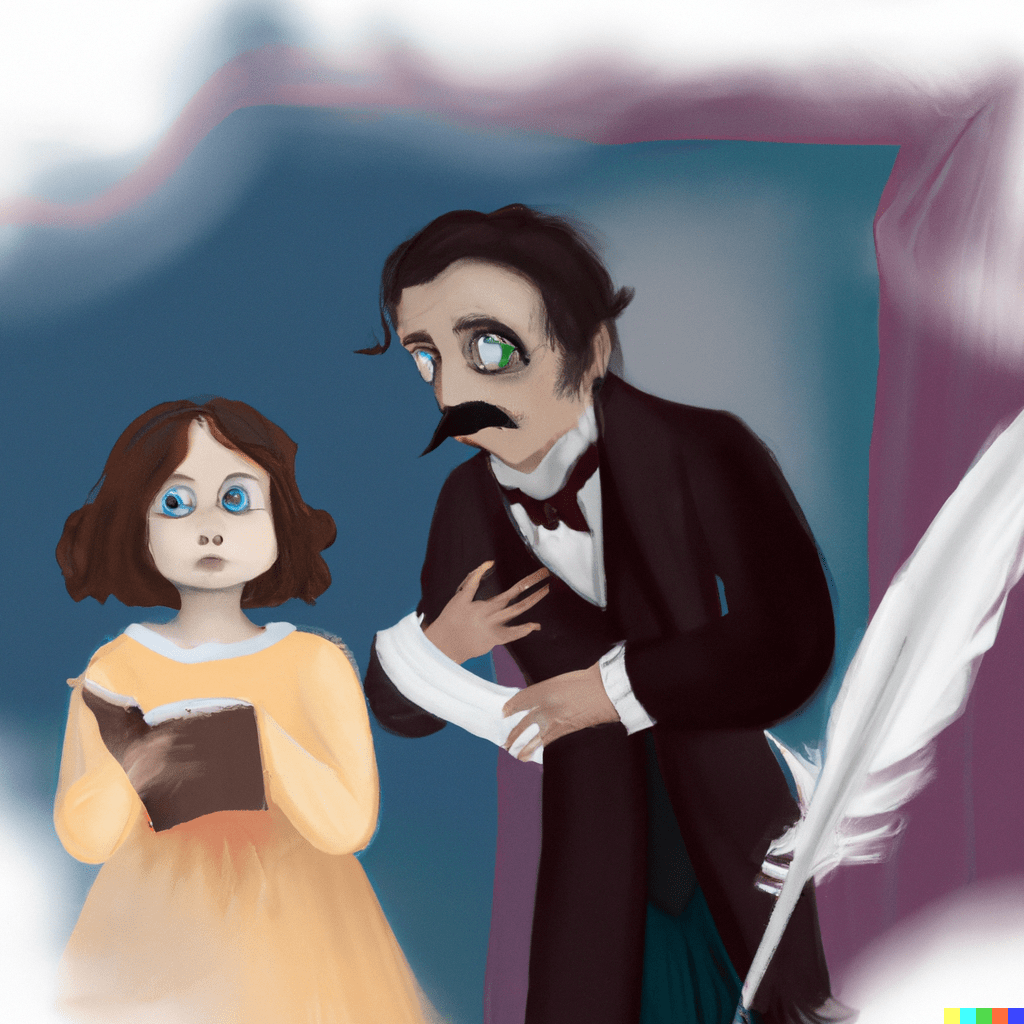
Graphic: “The Pharaoh Ozymandias at bat”, Robin Helweg-Larsen and DALL-E.

Edmund Conti, ‘My Son the Critic’

Read me a bedtime poem, said my son.
So I read him this:

We say hippopotami
But not rhinoceri
A strange dichotomy
In nature’s glossary.

But we do say rhinoceri, he said. Look it up.
So I read him this:

Life is unfair
For most of us, therefore
Let’s have a fanfare
For those that it’s fair for.

I smell a slant rhyme, he said, sniffing.
So I read him this:

While trying to grapple
With gravity, Newton
Was helped by an apple
He didn’t compute on.

My teacher says that’s not poetry, he said.
So I read him this:

René Descartes, he thought
And therefore knew he was.
And since he was, he sought
To make us think. He does.

That made me think, he said. But not feel.
So I read him this:

My hair has a wonderful sheen.
My toenails, clipped, have regality.
It’s just all those things in between
That give me a sense of mortality.

Did the earth move? I asked. Anything?
Nothing moved. He was asleep.

*****

Edmund Conti writes: “This is one of my favorites today. Tomorrow I might have different ones. I like it because it makes me nostalgic for an event that never happened. (My persona has a better life than me.) It came about after I sent the following quatrain to John Mella of Light Magazine (with appropriate punning title, of course).

We say hippopotami
But not rhinoceri
A strange dichotomy
In nature’s glossary.

John liked it and accepted it. I few weeks later he wrote and said he couldn’t use. Talking to a fellow editor, he learned there is such a plural as ‘rhinoceri.’ But now I was in love with my little piece and wanted to salvage it. But how? All I could think of was to take advantage of the poem’s failing. I came up with the idea of showing several possibly flawed quatrains to my son and having him disparage each one. And lo, the poem! I have 2 sons and when either one questions the reality, I just say it was the other one.”

Edmund Conti has many reasons for wanting his poems published—Power! Fame! Money!—but not (as you can see) as a venue for his bio notes.

Edmund Conti has recent poems published in Light, Lighten-Up Online, The Lyric, The Asses of Parnassus, newversenews, Verse-Virtual and Open Arts Forum. His book of poems, Just So You Know, is published by Kelsay Books,
https://www.amazon.com/Just-You-Know-Edmund-Conti/dp/1947465899/
and was followed by That Shakespeherian Rag, also from Kelsay
https://kelsaybooks.com/products/that-shakespeherian-rag

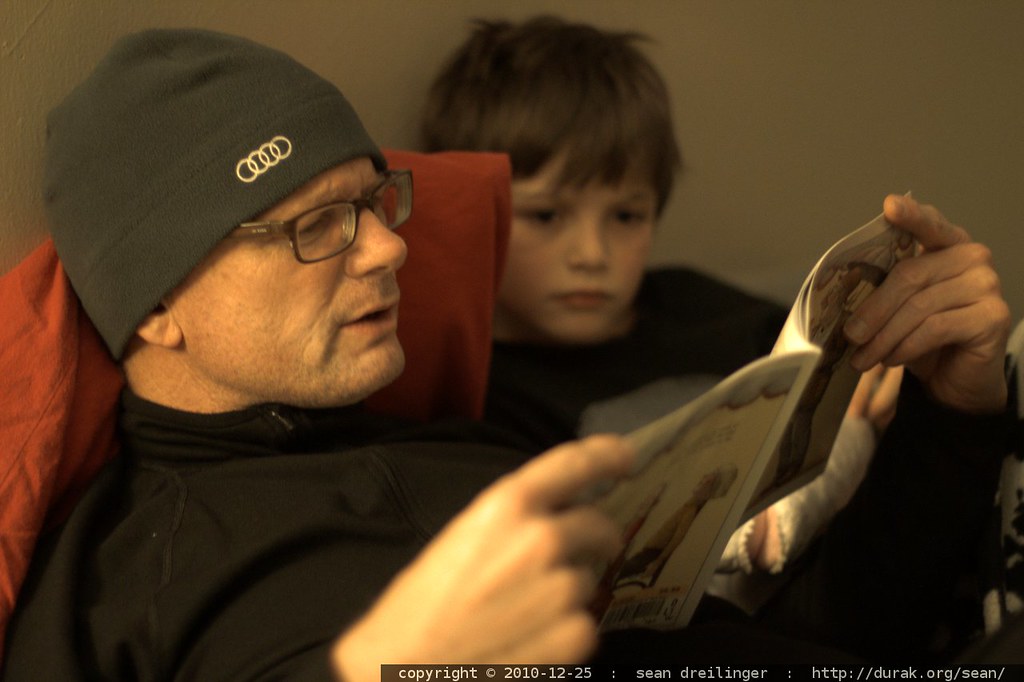
Photo: “grandpa reading nick a bedtime story – MG 6291.JPG” by sean dreilinger is licensed under CC BY-NC-SA 2.0.

Melissa Balmain, ‘Tale of a Relationship, in Four Parts’

Kissing.
Hissing.
Dissing.
Missing.

*****

Melissa Balmain writes: “Often, monorhymes end up feeling a bit forced, so I’m happy when I manage to write one that feels natural (at least to me). Plus, it’s always nice to have a poem in the love-gone-wrong category. Not only is this a prerequisite when you apply for your poetic license, but it can land you in great company. (See Kiss and Part, a 2005 anthology edited by Gail White, where ‘Tale of a Relationship’ rubs elbows with verse by the likes of Dorothy Parker, Wendy Cope, XJ Kennedy, and many poets whose work has appeared in Form in Formless Times.)”

‘Tale of a Relationship, in Four Parts’ is from Walking in on People © Melissa Balmain, 2014. Used by permission of Able Muse Press.

Melissa Balmain’s third poetry collection, Satan Talks to His Therapist, is available from Paul Dry Books (and from all the usual retail empires). Balmain is the editor-in-chief of Light, America’s longest-running journal of light verse, and has been a member of the University of Rochester’s English Department since 2010. She will teach a three-day workshop on comic poetry at the Poetry by the Sea conference in Madison, CT, in May 2024.

Photo: “Broken Kiss; Love Lost” by angelaathomas is licensed under CC BY 2.0.

Light verse: RHL, ‘Question the Universe’

Odin wrote runey verse
Rumi wrote Sunni verse
Edward Lear? Loony verse.
Question the universe
with your buffoony verse.

*****

Sometimes you jot down a little light piece inspired more by wordplay than anything else, and the more you look at it the more it resonates. This is one such. The characters are diverse, coming from pre-literate Scandinavia, Renaissance-inspiring Islam, and Victorian England – they touch the roots of my cultural identity. They are from the past, but their searches are timeless, fully modern, quintessentially human. And I fully subscribe to the idea that we should question everything, and that the Fool‘s tools of succinct and enigmatic wordplay may be as good an approach as any in trying to formulate – let alone answer – all questions, physical and existential.

It further resonates for me in being published (which I find important); in being published just now in Light (which is a wonderfully reassuring place to be); in having been improved in response to Light’s editorial comments (meaning, yes, I am proud that sometimes I am open to criticism and it’s useful); and in being my 400th poem published (by one of my conflicting counts).

Nothing is definite, not the historical reality of historical and semi-historical figures, not the permanence of printed words, not the definition of a poem, not the count of things hard to define, not the nature of physical reality. So though we have to make prosaic choices based on appearances and best guesses, that should be balanced by questioning everything. Preferably in verse.

TL;DR: Even short poems can be unpacked.

Illustration: DALL-E by RHL, ‘Rumi, Odin and Edward Lear are writing poetry to question the universe’

Susan McLean, ‘Morbid Interest’

How unpleasant to meet Mr. Poe.
It gives a young lady a chill
when, just as she’s saying hello,
he asks if she’s lately been ill.

It was mid-afternoon, yet he seemed
to be tipsy or mildly sedated.
How oddly his mournful eyes gleamed
when he heard that we might be related.

He muttered some rhymes for my name,
saying nothing could be more inspiring
to a poet desirous of fame
than the sight of young beauties expiring.

Then he asked if I had a bad cough
or a semi-conversable crow.
I informed him of where to get off.
How unpleasant to meet Mr. Poe.

*****

Susan McLean writes: “In my teens, I was a big fan of Edgar Allan Poe‘s short stories and poetry. I loved his eerie subjects and crooning, incantatory lines. I memorized his poem ‘To Helen,’ and I parodied his iconic ‘The Raven.’ But in grad school, I read his essay ‘The Philosophy of Composition,’ in which he wrote that “the death . . . of a beautiful woman is unquestionably the most poetical topic in the world.” Hmmm. At that moment, it occurred to me that all of those dead women of his stories and poems might be less an outpouring of personal grief and more a product of an agenda. Years later, when responding to a challenge from the British journal The Spectator to write a poem modeled on Edward Lear’s ‘How pleasant to know Mr. Lear‘ but about another author, I imagined how Poe might seem to a young woman being introduced to him.
This poem, which was originally published in Light Quarterly, was later reprinted in Per
Contra
and in my second poetry book, The Whetstone Misses the Knife.”

Susan McLean has two books of poetry, The Best Disguise and The Whetstone Misses the Knife, and one book of translations of Martial, Selected Epigrams. Her poems have appeared in Light, Lighten Up Online, Measure, Able Muse, and elsewhere. She lives in Iowa City, Iowa.
https://www.pw.org/content/susan_mclean

Illustration: DALL-E

Gail White, ‘Money Song’

Money won’t buy you the moon and stars,
but trips abroad and enormous cars
and fancy drinks in exclusive bars,
can all be purchased with money.

Money won’t buy you wisdom and truth
or permanent beauty or lasting youth,
but it makes a very good substituth,
which makes it nice to have money.

The dog and the cat that you adore–
money won’t make them love you more,
but it keeps the wolf away from the door,
which is why I wish I had money.

I’d have a fabulous London flat,
a house in Provence and a Persian cat,
and I’d give up being a Democrat,
if only I had enough money.

When all the sins of excessive wealth
had left me ruined, by speed or stealth,
I’d still have memories of my health,
and the fun I had with my money.

*****

Gail White writes: “I wrote the poem as a sort of updating of Arthur Clough’s ‘Spectator ab Extra‘, which has the refrain line ‘How pleasant it is to have money.’ Some things never change.”

Gail White is the resident poet and cat lady of Breaux Bridge, Louisiana. Her books ASPERITY STREET and CATECHISM are available on Amazon. She is a contributing editor to Light Poetry Magazine. “Tourist in India” won the Howard Nemerov Sonnet Award for 2013. Her poems have appeared in the Potcake Chapbooks ‘Tourists and Cannibals’, ‘Rogues and Roses’, ‘Families and Other Fiascoes’, ‘Strip Down’ and ‘Lost Love’. ‘Money Song’ is collected in ‘Asperity Street‘. Her new light verse chapbook, ‘Paper Cuts‘, is now available on Amazon.

Photo: “Crowne-Gold-Silver-Bullion” by digitalmoneyworld is licensed under CC BY 2.0.

Julia Griffin, ‘Wasp Waste’

The exoplanet Wasp in Pisces
Subsists despite unending crises:
It’s hard to keep an even keel
At near the melting-point of steel,
And even heroes’ hearts might cower
With winds 10,000 miles per hour.
The place can furthermore rely on
Incessant rain of molten iron.
All this might serve as a directive
To keep our problems in perspective.

*****

Editor’s note: Inspired by a story in The Guardian, “Scientists identify rain of molten iron on distant exoplanet. Conditions on Wasp-76b in Pisces include temperatures of 2,400C and 10,000mph winds”, this poem by Julia Griffin ran in Light’s Poems of the Week on 16 March 2020. It was reprinted in the Potcake ChapbookRobots and Rockets‘.

Julia Griffin lives in south-east Georgia/ south-east England. She has published in Light, LUPO, Mezzo Cammin, and some other places, though Poetry and The New Yorker indicate that they would rather publish Marcus Bales than her. Much more of her poetry can be found through this link in Light.

Photo: “Most Earthlike Exoplanet Started out as Gas Giant” by NASA Goddard Photo and Video is licensed under CC BY 2.0.

Melissa Balmain, ‘Not So Snow White’

Things started so well: found a chick in a box,
got her out, and days later, we wed–
such a snap because, speaking of life’s pleasant shocks,
my stepmom-in-law turned up dead.

Home that night, after finally fooling around
(happy ending for both!), I sighed, “Heaven.”
But my wife simply stared at the ceiling and frowned:
“Is that it? I’m accustomed to seven.”

*****

Melissa Balmain writes: “This poem comes from my latest collection, The Witch Demands a Retraction. To anyone who has mistakenly bought a copy of it for little kids: I am sorry. Maybe the book’s subtitle (fairy tale reboots for adults) should have been printed bigger. Or maybe the illustrator, Ron Barrett, should have made his drawings less adorable. Either way, to prevent further disasters in gift-giving, here’s a partial list of topics in the book: Interspecies adultery. Corrupt puppets. Kinky princes. Elderly cannibals. Impotent baked goods. Porcine insurance fraud. And, yes, eightsomes that include Sneezy, Happy and Dopey.”

Melissa Balmain edits Light, America’s longest-running journal of light verse. Her poems and prose have appeared widely in the US and UK. She’s the author of the full-length poetry collection Walking in on People (Able Muse Press), chosen by X.J. Kennedy for the Able Muse Book Award, and the shorter, illustrated The Witch Demands a Retraction: Fairy-Tale Reboots for Adults (Humorist Books). Her next full-length collection, Satan Talks to His Therapist, is due out in fall 2023.

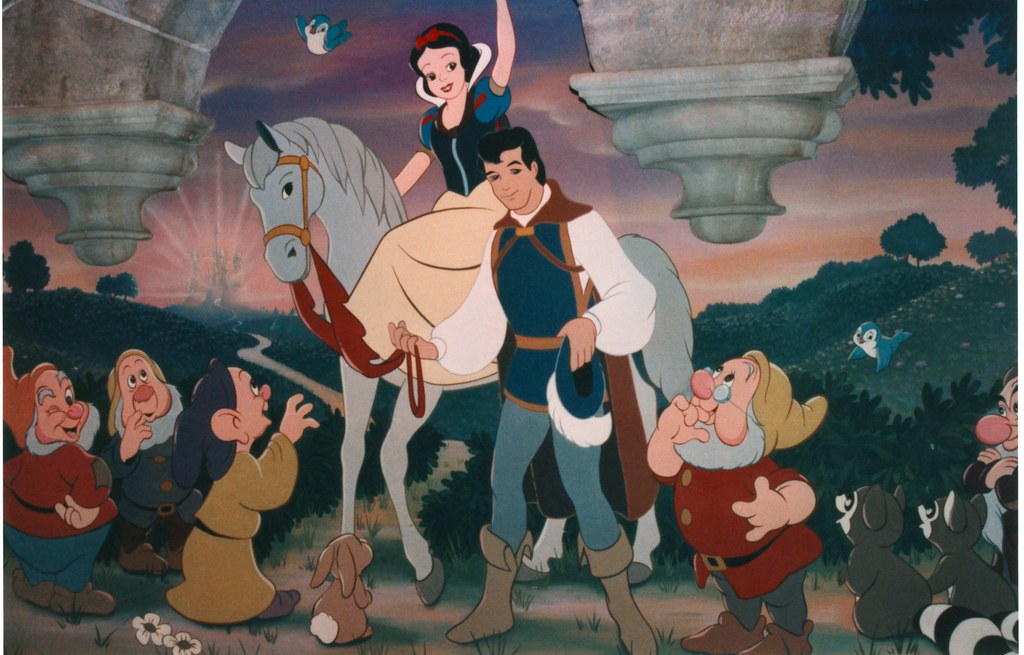
Photo: “Snow White Mural” by ATIS547 is licensed under CC BY-NC-SA 2.0.

Melissa Balmain, ‘Fallen’

As a kid growing up in New York,
I considered our fall second rate:
how I longed for the grand, mythological land
we exotically labeled Upstate.

In that Eden, I’d heard, leaves turned bright,
endless acres of yellows and reds,
while my single tree browned, dropping one tiny mound
that I kicked to the curb with my Keds.

Now I live several hours to the north,
and the maples and oaks truly blaze—
hues so loud they look fake—till the time comes to rake
without stopping, for numberless days.

And I daydream of trips farther south,
of the places I’ll shop, stroll and dine
in that part of the map where the leaves may be crap
but you don’t need a rod in your spine.

*****

Melissa Balmain writes: “Like so many poems I write, this is a case of making lemonade out of lemons—or, more accurately, salad out of way too many leaves. My husband would like it known that in our family, he does most of the raking. But I do most of the talking about raking.”

‘Fallen’ was first published in Lighten Up Online.

Melissa Balmain edits Light, America’s longest-running journal of light verse. Her poems and prose have appeared widely in the US and UK. She’s the author of the full-length poetry collection Walking in on People (Able Muse Press), chosen by X.J. Kennedy for the Able Muse Book Award, and the shorter, illustrated The Witch Demands a Retraction: Fairy-Tale Reboots for Adults (Humorist Books). Her next full-length collection, Satan Talks to His Therapist, is due out in fall 2023.

Photo: “A walk in the woods” by Let Ideas Compete is licensed under CC BY-NC-ND 2.0.

Jerome Betts, ‘Grim Harvester’

Two walkers once, who left the path
With fleeting union in mind,
Were reaped – oh, tragic aftermath! –
And permanently here combined.

*****

Jerome Betts is the Featured Poet in the current issue of Light. I was glad to provide an introduction to the man and his poetry in that magazine’s Spotlight – the short poem I’ve quoted above is a personal favourite: it is a tight, well-structured play on the ‘grim reaper’ and the ‘combine harvester’.

He lives in Devon, England, where he edits the quarterly Lighten Up Online. Pushcart-nominated twice, his verse has appeared in a wide variety of UK publications and in anthologies such as Love Affairs At The Villa NelleLimerick Nation, The Potcake Chapbooks 1, 2 and 12, and Beth Houston’s three Extreme collections. British, European, and North American web venues include Amsterdam QuarterlyBetter Than StarbucksLightThe Asses of ParnassusThe HypertextsThe New Verse News, and  Snakeskin.

Photo: “Combine Harvester (Deutz-Faher TopLiner 4090 HTS) – at work at Moyvalley, Co. Kildare, Ireland. September 1st 2011” by Peter Mooney is licensed under CC BY-SA 2.0.