Tag Archives: loss

Ballade variant: Johnny Longfellow, ‘Like Normal People Do’


Ya’ ever wanna go someplace?
I mean…jus’ disappear.
Leave ev’rythin’. But, leave no trace.
Git your ass out o’ here
To somewhere – could be far or near –
Where you’re no longer you.
Where you can dwell, year after year,
Like normal people do.

Ya’ ever stare at your own face
But still can’t see it clear? –
Ya’ struggle hard jus’ keepin’ pace,
While neighbors, they all steer
‘Tween college, marriage, an’ career,
‘Til – somehow coastin’ through –
They barbeque, an’ drink col’ beer
Like normal people do…

Ya’ ever think they won that race,
But still, fall prey to fear
Them dreams ‘n’ rainbows they all chase,
Once gone, won’t reappear?
Or, do they jus’ choke back each tear
As one beer turns to two,
Findin’ it’s Hell to persevere
Like normal people do?

Ya’ see? You ain’t the first to veer
Off course. That much is true.
Or, last to lose all you hol’ dear
Like normal people do.

*****

First published in The Rotary Dial, Issue 34, December 2015 – best dial poems of 2015

Johnny Longfellow writes: “I’ve discussed the personal circumstances that partially inspired this poem in interviews at the Talk with Me podcast and at the now defunct Sonnetarium, both of which can be linked to in the bio below. So, I’ll just note here, the poem was written roughly six months after a heavy bout of depression. During said bout, I inadvertently stumbled upon The Geographies of Missing People website, hosted by Glasgow University, wherein I took special interest in their Stories of Missing Experience page. Listening to those mashed-up accounts of people who’d elected to go voluntarily missing was profoundly helpful to me during a dark period in my life. With that, I can only recommend to anyone going through a similar period in their own lives that they consider listening to those accounts. For, I can confidently say they helped inspire in me more than just a poem.”

Johnny Longfellow is a poet from Massachusetts. His work has appeared in The Five-Two, The Literary Hatchet, Misery Tourism, Punk Noir, and other fine literary venues, with more work forthcoming in Form in Formless Times. You can learn more about both him and his poetry at Heeeeeeere’s Johnny . . . Longfellow, that is.   

Photo: “Missing Persons” by ChiralJon is licensed under CC BY 2.0.

Barbara Loots, ‘Small Things’

Things have a tendency to lose themselves:
hammer, needle, the necessary spring,
a button, the keys–they disappear like elves,
like roses, wishes, the words for everything.

Dive in. Ransack a drawerful of debris.
Wrestle with irritation, grief, self-doubt.
One earring, that pen, eyesight, dignity:
small things we learn, in time, to do without.

*****
Barbara Loots writes: “The small losses and lapses of memory that happen to everyone seem more vivid and alarming as I grow older. I realize that it isn’t things but myself I must gradually, inevitably let go of. Even so, the vast, abundant universe brings perspective to the human situation, including mine.”

Barbara Loots resides with her husband, Bill Dickinson, and their boss Bob the Cat in the historic Hyde Park neighborhood of Kansas City, Missouri. Her poems have appeared in literary magazines, anthologies, and textbooks since the 1970s. She is a frequent contributor to lightpoetrymagazine.com. Her three collections are Road Trip (2014), Windshift (2018), and The Beekeeper and other love poems (2020), at Kelsay Books or amazon. More bio and blog at barbaraloots.com

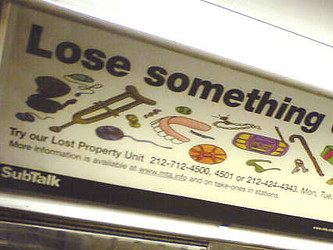
Photo: “Things you might lose on the subway” by Hippolyte is licensed under CC BY 2.0.

J.D. Smith: ‘A Cremation’

Fire steals from slow decay the frame
Of one who wished for us to claim
This small relief:

The words are said, the ashes flown.
What’s left? A weight, a shard of bone
Still sharp as grief.

*****

J.D. Smith writes: “This poem came about in response to the death of a very beloved and quirky dog. Though she was already 10, she was a small dog and could have been expected to live longer. Her ashes, and those of her littermate, were interred with those of my parents.”

J.D. Smith has published six books of poetry, most recently the light verse collection Catalogs for Food Loversand he has received a Fellowship in Poetry from the United States National Endowment for the Arts. This poem is from The Killing Tree (Finishing Line Press, 2016). Smith’s first fiction collection, Transit, was published in December 2022. His other books include the essay collection Dowsing and Science. Smith works in Washington, DC, where he lives with his wife Paula Van Lare and their rescue animals. Twitter: @Smitroverse

Photo: “gone but remembered: dog ashes” by safoocat is licensed under CC BY-NC-ND 2.0.

Short poem: ‘Possessions’

What do you want possessions for?
You’ll die, then you’ll have nothing more.
You lost your house in a fire? The fact is
That was just for practice.

*****

We live (as always) in a time of existential threat to us as individuals and as a species. This short poem was recently published in The Asses of Parnassus – thanks, Brooke Clark! “Light verse”? I like to think so…

Photo, popularly known as ‘Disaster Girl‘. The young Zoë Roth had been taken by her parents to watch the controlled burning of a structure for training purposes when her father took this prize-winning picture of her. To her ongoing delight, the photo became a viral internet meme, and its NFT sold two years ago for close to $500,000.

Short poem: ‘Loss’

Which is the worst –
Is it the loss, or memory of loss,
Or loss of memory? Who gives a toss
When the brain’s banks have burst
And all we valued yesterday
Is washed away?

*****

The above is a short poem, semi-formal (i.e. it’s in iambics, it rhymes, but it lacks formal structure) published in this month’s Snakeskin No. 298. I like semi-formal because it allows natural expression in a way that formal structure often prevents. Contrast these examples from Matthew Arnold of the formal (from The Scholar-Gipsy) and semi-formal (from A Summer Night):

Thee at the ferry Oxford riders blithe,
Returning home on summer-nights, have met
Crossing the stripling Thames at Bab-lock-hithe,
Trailing in the cool stream thy fingers wet…

The inversions of adjectives and phrases were used to fit rhyme and metre to line length. Drop the line length requirements and, even retaining the “thee”s and “thou”s, the expression is more naturally conversational:

And the rest, a few,
Escape their prison and depart
On the wide ocean of life anew.
There the freed prisoner, where’er his heart
Listeth will sail…

Poor Matthew Arnold! With his father a famous Headmaster and himself an Inspector of Schools, there is a sad irony in so much of his poetry being about escaping the tedium of regimented Victorian life.

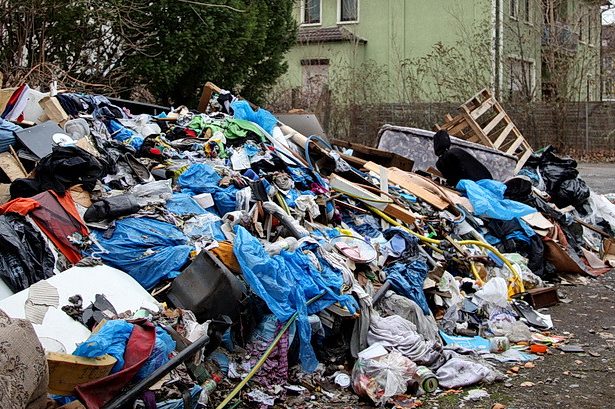
Photo: “Müllhaufen Villa V R s 1000 s” by rosalux-stiftung is licensed under CC BY 2.0.