Tag Archives: metre

Potcake Chapbooks: Updated Call for Submissions

The “Potcake Chapbook” series is named for the dogs of the Bahamas and the Caribbean – strays that live off the burnt scrapings of cooking pots. The poems in the series are a mixed bunch – but the potcake of our logo wears a bow tie to show that he and all the poems are formal. These poems are memorable in part because they rhyme and scan, as all truly memorable (i.e. easily memorisable) poetry does. We subscribe to the use of form, no matter how formless the times in which we live.

Potcakes hunt around the back streets and beaches, looking for something unguarded to eat. Like a potcake, I’m always looking to see if there is some good poem to carry off. The plans for the chapbooks are a bit sketchy, always changing–everything depends on what I run across and what Alban Low would like to illustrate. Perhaps half the poems we have published have come from my poking around back issues of online poetry magazines; and the other half have come from material that has been sent for me to look at.

When there is enough good material on a single theme to fill 13 pages of a chapbook (still leaving room for Alban’s work, of course), then it may become the next project. But until a chapbook actually goes to print everything is subject to change. An even better poem may show up and displace one tentatively placed. A slew (or slough) of poems on a new theme may cause a reprioritisation of planned chapbooks.

This is one of the reasons that I prefer to consider only poems that have already been published–so that I don’t feel guilty about having a bunch of poems that will sit with me for months, years, and may or may not be included in the Potcake series. I have flagged a thousand poems that interest me; but I can only publish a dozen in a chapbook, and only a few chapbooks will get produced in a year.

However I am always keen to read and consider rhymed and metered verse that has already been published. There are several chapbooks that are jostling in the queue for completion and publication:

Travels and Travails (travel)
City! O city! (urban life)
Just a Little Naughty
Portraits Unpleasant
Various Heresies (religion)
Lost Loves
The Horror of Spring! (seasons)

and there are more; but the next one in the series, to come out early in 2021, will be one of science fiction, tentatively ‘Rockets and Robots’. Like all the chapbooks listed above, it is nearly full already. As with all of them, if I run across another poem I really like, I’ll include it.

Poems in the chapbooks run from two or three lines to some 40 lines in length–obviously, with space at a premium, poems over 20 lines and running over one page are less likely to be included… but it does happen. Other criteria: I’m looking for wit, elegance, a variety of traditional and nonce forms, a variety of voices and moods: happy, sad, angry, sardonic, meditative… anything interesting I can scrounge. If you have something you think I might like, on any topic, please send it along to robinhelweglarsen@gmail.com

I can’t promise to use it, but I will read it and reply!
Poem: “Bee”

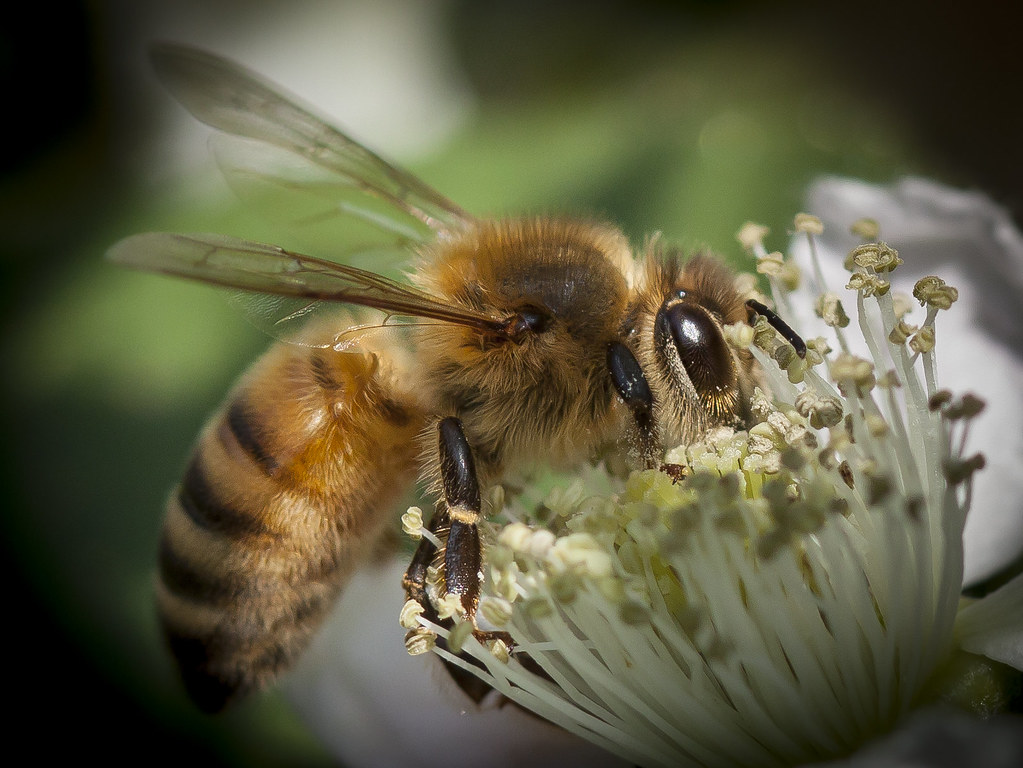
“July Honey Bee” by MattX27 
Through the honeyed halls of Autumn
Hums the angry ageing bee;
As its work faces fruition,
And its life, redundancy.

This little poem was originally published in Candelabrum, a 1970 formalist hold-out that ran for forty years in the UK under Leonard McCarthy. More recently, it was just republished in Jerome Betts’ latest Lighten-Up Online.

Epigrammatic couplets and quatrains, being rhyme- and stress-based, are common throughout Indo-European languages. They hold the same natural place that haiku, senryu and tanka have in syllable-counting Japanese. It is easier to learn by heart a poem whose form uses the natural strengths of the language, rather than something written in a language-inappropriate form.

Similarly, when reading a poem in translation, you get the ideas and the imagery but you normally lose the enhancement of mood caused by the metre, the rhythm of the verse, as well as by the rhyme. So ideas and imagery alone give you prose, not poetry.

Consider the differences in tone of gravity or levity set by rhythm in these opening lines (and you need to read them aloud–in your head if you can do that, otherwise really aloud, in order to hear the rhythm, the beat of the lines):

Let us go then, you and I,
When the evening is spread out against the sky...

I sprang to the stirrup, and Joris, and he;
I galloped, Dirck galloped, we galloped all three...

On the top of the Crumpetty Tree
The Quangle Wangle sat...

The first is meditative, the second full of action, the third is casual, informal… and those moods are set by the rhythm alone.

Metre is an essential component of English poetry. Make the metre-rule your yardstick. Don’t leave home without it.

Using form for argument: Poem: “To Myself in 50 Years Time”

Arguing a point has a structure, which tricks of rhetoric can enhance. Additional tricks of reinforcement are possible in verse, where meter can set a tone, rhyme scheme can create a sense of inevitability, and line length can be used to differentiate between premises and conclusion.

Ageing Man in Mirror

TO MYSELF IN 50 YEARS TIME

Old fool! You really think yourself the same
As I who write to you, aged 22?
Ha! All we’ve got in common is my name:
I’ll wear it out, throw it away,
You’ll pick it up some other day….
But who are you?

My life’s before me; can you say the same?
I choose its how and why and when and who.
I’ll choose the rules by which we play the game;
I may choose wrong, it’s not denied,
But by my choice you must abide….
What choice have you?

If, bored, I think one day to see the world
I pack that day and fly out on the next.
My choice to wander, or to sit home-curled;
Each place has friends, good fun, good food,
But you sit toothless, silent, rude….
And undersexed!

Cares and regrets of loss can go to hell:
You sort them out with Reason’s time-worn tool.
Today’s superb; tomorrow looks as well:
The word “tomorrow” is a thrill,
I’ll make of mine just what I will….
What’s yours, old fool?

(First published in Snakeskin No. 147, September 2008)

Each stanza presents an aspect of the superiority of present youth over future age. (Premise and conclusion aren’t necessarily made as statements, many times rhetorical questions are used instead.) The structure of each stanza is to begin with pentameters for a sense of reasonableness in the first three lines, pick up the pace for the next two lines, and end with a short punchline. I find it aggressive and effective.

I admire the chutzpah, the audacity, of the 22-year-old I was. I still have some years–not many–to think of a suitable answer.

Poetry Resources: Measure for Measure anthology

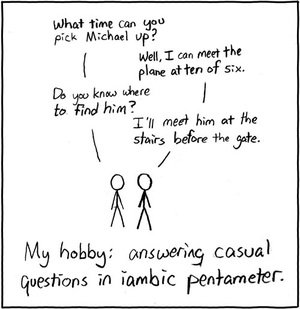
xkcd iambic pentameter

xkcd – another engaging commentator

The ‘Measure for Measure’ anthology clarifies and extols the delights of the variety of metres available to the poet, from the accentual verse of our Anglo-Saxon roots, through the familiar and natural iambs, dactyls and trochees, to the more obscure sapphics and so on based on Greek and Latin forms.

The book is edited by Annie Finch and Alexandra Oliver, two of the most accomplished formal poets of North America writing today. The preface by Annie Finch and the introductions to the various sections include encouraging exercises for developing skills in both reading and writing poetry, and the tone of the anthology is more expository than a mere collection of poems would be.

The selections for each metre are enjoyable in themselves, and by being grouped in that way they drive a fresh awareness and insight into their nature. The only negative for me came towards the very end, where the section on Sapphics and Alcaics confirmed for me that they are not really relevant for English verse.

Overall, an extremely interesting and informative anthology.

Using form for fun: “Old Sailors”

This poem was written purely for fun–and the use of form was essential.

Lantern Slide - Two Sailors Having a Cigarette

Two old tars

OLD SAILORS

Two tars talked of sealing and sailing; one said with a sigh
“Remember gulls wheeling and wailing, we wondering why,
“And noting bells pealing, sun paling — it vanished like pie!
“And then the boat heeling, sky hailing, the wind getting high,
“And that drunken Yank reeling to railing and retching his rye,
“John missing his Darjeeling jailing, and calling for chai?
“While we battened, all kneeling and nailing, the hurricane nigh,
“And me longing for Ealing, and ailing?” His mate said “Aye-aye;
“I could stand the odd stealing, food staling, not fit for a sty,
“And forget any feeling of failing, too vast to defy –
“Home-leaving your peeling-paint paling too far to espy –
“All because of the healing friend-hailing, the hello! and hi!
“And, with the gulls squealing, quick-scaling the mast to the sky.”

The poem started as an exploration of rhymes for both sealing and sailing, which seemed like interestingly paired words. Many of the rhymes (and the third one, “sigh”) fell easily into a nautical mood. The metre flowed on from “sealing and sailing”. Add in alliteration wherever possible, and look for a coherent story and resolution… and there is the poem.

It was originally published in George Simmers’ online poetry journal, Snakeskin–a highly eclectic journal–and it made for what one reader called a “good nautical rhythm”, and another comment was “finely composed wordy-whirlwind of images”. Both those strengths of the poem come from the use of form: the nautical rhythm from the choice of metre, the whirlwind of images from the requirement to compress everything into the rhyme scheme.

It isn’t a deep, meaningful poem; but form can be used purely for enjoyment.