Tag Archives: music

Simon MacCulloch, ‘Mouth Harp’


The doctor raised an eyebrow. He’d pronounced the sentence (death)
And expected her to die now; yet the patient still drew breath.
The woman was a smoker, and the cancer had a hold
That was strong enough to choke her. She was ninety-three years old.
Her lungs must be a sump, awash with nicotine and tar,
And with a clogged-up pump like that she wasn’t going far.

Well, any trouble breathing? Not at all, I just can’t walk!
(I see her, thick smoke wreathing, still unpausing in her talk.)
A cough, perhaps? Not really – nothing wrong that I’m aware.
The doctor starts to feel she must be using different air.
There’s nothing more to say, his grim prognosis is complete;
The science of today must now acknowledge its defeat.

Back home, I watch my mother as she settles in her chair,
Sips coffee, lights another and inhales without a care.
I pass her the harmonica, she takes it, has a blow,
And jaunty and euphonic her recital starts to flow.
The angels have their harps but death’s a word they never knew;
Down here it’s flats and sharps and death’s a song on air turned blue.

*****

Simon MacCulloch writes: “A largely true account of the somewhat surreal day on which my uncomprehending late mother was diagnosed with terminal lung cancer. I’m still quite proud of having rhymed “harmonica” without anyone called Veronica to help out.”

‘Mouth Harp’ was originally published in The Cannon’s Mouth 92.

Simon MacCulloch lives in London and contributes poetry to a variety of print and online publications, including Reach Poetry, View from Atlantis, Pulsebeat Poetry Journal, Spectral Realms, Black Petals and others.

Photo: “Music Maker” by darkday. is licensed under CC BY 2.0.

Using form: Experimenting: Ann Drysdale, ‘When Mister Nifty Plays the Bones’

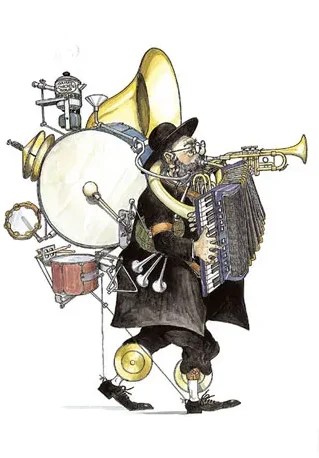
With things like tongs in the palm of his hand
Tongue-depressors or langues-de-chat
He tappets the rhythm of his one-man-band
As he struts in the gutter with a tra-la-la.

He twinkles his fingers and he flicks his wrist
Hey-diddle-diddle and fiddle-de-dee
And his two tame twiddlesticks jump and twist
With a click-click-clackety, one-two-three

For Nifty’s bones are made of wood
And they click like sticks with a restless chatter
His brass as he passes is loud and good
But his rattling bones are a different matter

His drum tum-tums and his trombone groans
And his hi-hat cymbal softly sighs
But all I can hear is the homely bones
That sing out the song in his small sad eyes

He dances a foxtrot, quick-quick-slow
And the hi-hat hisses with a whispered yes
But the bones, bones, bones with their no-no-no
Tick-tock to the tune of uselessness

When Mister Nifty dances by
His fingers flicker and his brass bells shine
But a part of my heart feels cold and dry
As his lonely bones call out to mine.

*****

Ann Drysdale writes “I made this poem because I wanted to see if I could turn words into music, with assonance and dissonance, chiming and clashing like the components of Mr. Nifty’s one man marching band. Laying aside conventional metre and putting boom, boom, boom alongside tum titty tum titty tum. I wanted it to sing and to dance to itself, and for the reader to dance along with it.”

The poem was collected in Miss Jekyll’s Gardening Boots, Shoestring Press, 2015.

Ann Drysdale still lives in South Wales. She has been a hill farmer, water-gypsy, newspaper columnist and single parent – not necessarily in that order. She has written all her life; stories, essays, memoir, and a newspaper column that spanned twenty years of an eventful life. Her eighth volume of poetry – Feeling Unusual – came together during the strange times of Coronavirus and celebrates, among other things, the companionship of a wise cat and an imaginary horse.

Illustration – supplied by Ann Drysdale

Using form: Sonnet: Josh Geffin, ‘A Guide to Renting in London’

So, when it says delightful take it as
a word for small. Make sure to steer away
from cosy – that just means it likely has
no place to put your things or even pray.

A huge and gorgeous room is medium size
while well-maintained denotes a certain lack
of charm and won’t be winning Best Home prize.
A friendly house is code for watch your back.

And please avoid affordable single room
you’ll have to fall or jump from door to bed
(no space to walk around the side). Assume
your rent will cost no less than half your bread.

For something nice you’ll need a partner to live with.
That or move to Hull – or Aberystwyth.

*****

Josh Geffin writes: “A Guide to Renting in London was inspired by my own experience living in London and my frustration at trying to find reasonable rental accommodation. It was also a response to a writing exercise that was part of a video course by Billy Collins on masterclass.com. The writing exercise was to write a strictly rhyming sonnet with a strong metre! I enjoy working with fixed forms, and with humour.”

Josh Geffin is a folk musician and writer from Dorset, based in London. He works as a guitar teacher, composer and performer and his music has appeared on Netflix, BBC, and Sky. Josh’s often playful poems explore themes of mindfulness, memory and belonging. His poems have been published in The Rialto, Acumen (where this poem was first published), Allegro and The Friday Poem‘Shronedarragh, Co. Kerry’ won second prize in the Jack Clemo Poetry Competition 2023. He has also been commissioned to write poetry for Montcalm Hotels.
Follow or buy his music at his Bandcamp page: https://joshgeffin.bandcamp.com/music
Contact: joshgeffin@gmail.com
Instagram: @joshgeffin

Tiny Room” by Peter Kaminski is licensed under CC BY 2.0.

Potcake Poet’s Choice: Michael R. Burch, ‘The People Loved What They Had Loved Before’

We did not worship at the shrine of tears;
we knew not to believe, not to confess.
And so, ahemming victors, to false cheers,
we wrote off love, we gave a stern address
to bards whose methods irked us, greats of yore.
And the people loved what they had loved before.

We did not build stone monuments to stand
six hundred years and grow more strong and arch
like bridges from the people to the Land
beyond their reach. Instead, we played a march,
pale Neros, sparking flames from door to door.
And the people loved what they had loved before.

We could not pipe of cheer, or even woe.
We played a minor air of Ire (in E).
The sheep chose to ignore us, even though,
long destitute, we plied our songs for free.
We wrote, rewrote and warbled one same score.
And the people loved what they had loved before.

At last outlandish wailing, we confess,
ensued, because no listeners were left.
We built a shrine to tears: our goddess less
divine than man, and, like us, long bereft.
We stooped to love too late, too Learned to whore.
And the people loved what they had loved before.

*****

Michael R. Burch writes: “If I remember correctly, the poem was written after I read some disparaging comments by Formalists about Keats and Shelley being ‘too emotional.’ In the poem I make fun of the naysayers by pointing out how they now wail about a lack of attention from readers. I was also told by poets on Eratosphere – I call it ErraticSphere – not to use the word ‘love’ in a love poem and to avoid abstractions and personification. Such wisdom! When I pointed out that Erato was the abstract personification of love poetry, I was banned for life! So I worked that into the poem: ‘We wrote off love.’ One might think the wailing poets are free versers, but the inspiration for the poem was actually Formalists who object to abstract language, personifications and even the word ‘love’ in modern poetry.”

Michael R. Burch is an American poet who lives in Nashville, Tennessee with his wife Beth and two outrageously spoiled puppies. Burch’s poems, translations, essays, articles, reviews, short stories, epigrams, quotes, puns, jokes and letters have appeared more than 7,000 times in publications which include TIME, USA Today, The Hindu, BBC Radio 3, CNN.com, Daily Kos, The Washington Post and hundreds of literary journals, websites and blogs. Burch is also the founder and editor-in-chief of The HyperTexts, a former columnist for the Nashville City Paper, and, according to Google’s rankings, a relevant online publisher of poems about the Holocaust, Hiroshima, the Trail of Tears, Darfur, Gaza and the Palestinian Nakba. Burch’s poetry has been taught in high schools and universities, translated into fifteen languages, incorporated into three plays and two operas, set to music by twenty composers, recited or otherwise employed in more than forty YouTube videos, and used to provide book titles to two other authors. To read the best poems of Mike Burch in his own opinion, with his comments, please click here: Michael R. Burch Best Poems.

Photo: “Folk Band” by garryknight is licensed under CC BY 2.0.

Calling the Poem: 7. ‘The Tiger’

That wild white wind that whips the world away –
The darkness deep and dread in dazzling day –
The light and dark that fuse with furious force –
The leaping tiger that gives no recourse –
Acknowledge, fear, that lurking tiger’s rage,
The terrifying sense of spring-taut powers,
Menacing, tail-tip twitching while it glowers,
Lethal both to ignore or to engage.
Acknowledge it, succumb: you’ve been rewarded.
And now produce – because the debt’s recorded.

*****

This is the 7th of the 15 poems of the Snakeskin e-chapbook ‘Calling the Poem’. ‘The Tiger’ and the next few poems deal with the difficulties of first begging your Muse for inspiration and then finding that the inspiration is uncomfortable – personally, socially, politically, whatever. Perhaps the inspiration isn’t what you were hoping for… but what are your obligations once you have in effect contracted to receive something unknown?

The Muse, the gods, the unconscious or however you like to think of your source of inspiration is not to be trifled with. It is to be respected if you want to stay on good terms with it and benefit from it.

The word ‘music’, by the way, means Muse-ish, ‘of the Muses’. The following is blended from passages in Wikipedia: According to Pausanias in the later 2nd century AD, there were three original Muses, three original Boeotian muses before the Nine Olympian Muses were founded: Aoidē (“song” or “voice”), Meletē (“thought” or “contemplation”), and Mnēmē (“memory”). Together, these three form the complete picture of the preconditions of poetic art in cult practice.

So song, contemplation and memory are the Muses that together drive poetry. Poetry is totally Muse-ish. Therefore poetry is inherently musical. Its music is essential.

(And it was only after writing this blog that I found that the current Oglaf comic features a tiger…)

Photo: ‘Tiger’ by Captain Chickenpants is licensed under WordPress Openverse.

Potcake Poet’s Choice: George Simmers, “The Old Man’s Heaven”

George Simmers

George Simmers

Do those whose taste in music
Is grandly hoity-toity
Think Heaven’s operatic
And ineffably Bayreuth-y?
Do those who go for punky gigs
Think paradise less posh,
Packed hard with spit and violence,
So Heaven’s one long mosh?

Let me describe the paradise
My ageing heart prefers–
A dimly-lit piano bar
And a bottle-blonde chanteuse.
Some broad who’s been around the block,
With a voice of smoky yearning,
A lady who has seen too much,
But she keeps the old torch burning.

She sings that life is made for love,
And time will kill the pain.
She sings that though your love’s gone bad
You still should love again.
She sings that there is always hope
And those who love are wise.
Yes, I could spend eternity
Hearing those lovely lies.

George Simmers writes: “I’ve sent this poem as a favourite because it starts off very definitely as light verse, but then modulates into something else. I like poems like that (and dislike the opposite – the ones that start off sounding deep, but then opt out and end up flippantly).

In the description of the singer and her music, I’m celebrating the kind of music I most enjoy – the torch-songs of the Great American Songbook, mostly from that golden age between 1920 and 1960. As I listen, I enjoy remembering that this is the kind of popular song that in its time was fulminated against by vicars and Leavisites for being popular and shallow (but more deeply perhaps because such folk were made uncomfortable by the Jewish melodies and African rhythms). Great singers like Ella Fitzgerald and Sarah Vaughan made perfect art of it, but I prefer to think of a more imperfect one, a singer in a smallish bar, provincial, earning her rent doing what she loves, and finding in the songs a way of expressing the trials and yearnings of her own imperfect life. The customers drink, and maybe some of them chat. She sings.

Her repertoire is heavy on the music of Harold Arlen, but there is plenty of Rogers and Hart there, too, and Jerome Kern and Irving Berlin, and Gershwin, of course. And yes, Herman Hupfeld and… you name them.

I’m amazed, when looking into anthologies of twentieth-century American poetry, that they do not include ‘The Man I Love’ or ‘I Wish I were in Love Again’ or ‘Blues in the Night’. These are words that will surely outlast those of the poets academically respectable in their day. My poem is a tribute to those songwriters.”

George Simmers used to be a teacher; now he spends much of his time researching literature written during and after the First World War. He has edited Snakeskin since 1995. It is probably the oldest-established poetry zine on the Internet.
https://greatwarfiction.wordpress.com/
http://www.snakeskinpoetry.co.uk/