Tag Archives: Petrarchan

Louise Walker, ‘Octave/Sestet’

With each deep breath, the flute will utter prayer,
its voice vibrating with the purest note
of G in the first octave. Then you can float
up to the next because you know it’s there.
The painter knows how to balance sea and air,
concealing rules that have been learned by rote;
the same that give the poet secret hope
that all will be in order, nothing spare.

But look – the sunflower makes a perfect turn
with each new seed; at heart it knows the code
which gives each one sufficient space to grow,
facing the light. It never had to learn
to ask the question Fibonacci posed
of eight and six, the golden ratio.

*****

Louise Walker writes: “After 35 years of teaching English to 11–18-year-olds, I retired to have more time for writing,but I also started flute lessons. Learning my first instrument is fascinating, exhilarating and frustrating by turns; the experience has found its way into my poetry in unexpected ways.
In ‘Octave/Sestet’ I’m exploring the idea that there is a beauty in the proportions of the natural world, which finds its way into painting, architecture, the musical scale and the sonnet. I love the idea that we respond to this beauty instinctively, without conscious recognition of the maths – not my strongest subject, by any means!
Don Paterson’s introduction to his anthology ‘101 Sonnets’ was the final push to get me started on this poem. I often write sonnets, sometimes unrhymed, sometimes with slant rhyme, because I find the division into eight and six really helpful in developing my ideas. But here, I was faithful to the rhyme scheme and iambic pentameters of the Petrarchan sonnet. Recently, I’ve been trying forms such as triolets and terza rima, inspired perhaps by A.E. Stallings who I saw read in London last Spring.”

Louise Walker’s poems have appeared in anthologies by the Sycamore Press and Emma Press, as well as journals such as South, Oxford Magazine, Acumen, and Prole. She was Highly Commended in the Frosted Fire Firsts Award in 2022; in 2023 she was long-listed by The Alchemy Spoon Pamphlet Competition and won 3rd prize in the Ironbridge Poetry Competition. Commissions include Bampton Classical Opera and Gill Wing Jewellery for their showcase ‘Poetry in Ocean’. She is working on her first collection; at its core is her journey onwards from the sudden death of her brother in his/her twenties.
Instagram @louise_walker_poetry; direct message if you would like one of the last few
copies of her pamphlet ‘An Ordinary Miracle’.
‘Octave/Sestet’ was first published in Acumen; you can read a couple more sonnets here:
https://foxglovejournal.wordpress.com/2023/02/14/longwood-louise-walker/
https://acumen-poetry.co.uk/louise-walker/
and a prize-winning psalm:
https://pandemonialists.co.uk/ironbridge-poetry-competition-2023/

Photo: “Sunflower” by auntiepauline is licensed under CC BY-NC 2.0.
Sonnet: RHL, ‘Halloween’

I sing the changing seasons of the year
And, as leaves fall, I celebrate my death.
Each inhalation may be my last breath;
Each year I lose another near and dear.
So many people live life in Death’s fear,
The very word <cough> Dead’s a shibboleth –
Paint on false youth like old Elizabeth –
Yet half the planet’s Spring, while it’s Fall here.

Eternal life is ever to be felt,
For death, rebirth, are always intertwined
In pious hopes, in science still unseen.
The pagan in me – Viking, Druid, Celt –
All celebrate when Life’s return’s divined.
It’s Halloween, so I will dress in green.

*****

This sonnet with its Petrarchan rhyme scheme (ABBA ABBA CDE CDE) was originally published in The Lyric a couple of years ago. “Founded in 1921, The Lyric is the oldest magazine in North America in continuous publication devoted to traditional poetry.”

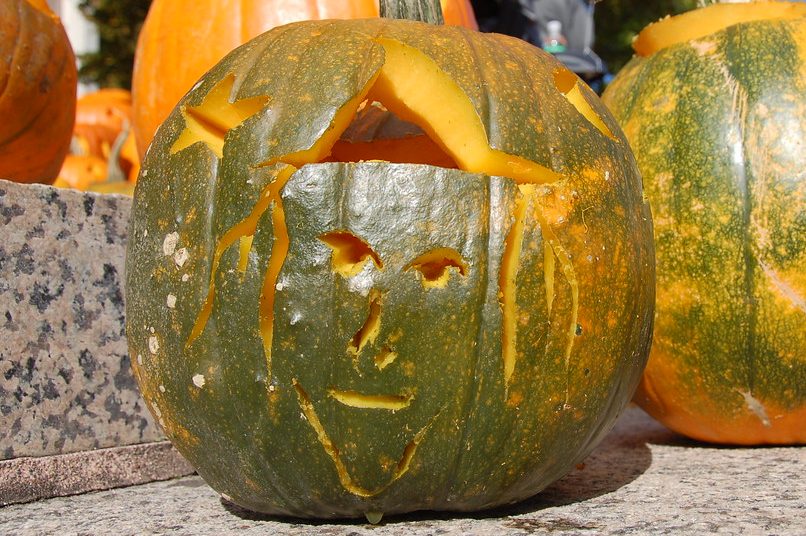
Green pumpkin carved into witch face jack-o-lantern” by Chris Devers is licensed under CC BY-NC-ND 2.0.

NSFW Sonnet: ‘Restaveks’

Illegals, both of us; married last year,
now she cleans houses, I cut grass, sweep decks,
for superrich who see us as mere specks
while their big spaceship exit they prepare.
Earth will be fishless, treeless, plastic, bare.
They’ve offered us both jobs as restaveks,
but I said No, they just want us for sex.
She said Then suck them off, why should you care?
I said, We’ll stay. She said, I said I’d go.
I said, You’d leave me? She said, Stay, be dead.
I said, That makes you nothing but a whore.
She said, I fucked him for your job, you know;
I go to space, I’ll live, have food, have bed,
and, if I’m good, oh maybe so much more…

*****

“Restavek” is normally a term for a child of an impoverished Haitian family, sent to live as a domestic servant for a wealthier (or less poor) family. There are an estimated 300,000 in Haiti, mostly girls; and an unknown number in the Haitian communities in the US.

This sonnet (Petrarchan, rhyming ABBA ABBA CDE CDE) was recently published in the frequently NSFW Rat’s Ass Review – thanks, Roderick Bates!

Illustration: “Tiny Empires 3000” by Daniel Voyager is licensed under CC BY 2.0.

Using form: Sonnet within Sonnet: Daniel Kemper, ‘Her Petrarchan Heart’

a Petrarchan sonnet embedded inside an Elizabethan sonnet

I smile in my Italian heart—but English ways,
against emotions so taboo, require some tact
and so I’m hiding in plain view. My eye still strays.
My nerves are tinder. But the part below this act,
which kindles want, slips through the art I layer on
and now that art is burning too. It’s civil war:
I smother it, but when I do, though flames seem gone,
the smolderings rebel, restart, and billow more.
And yet I’ve learned to love this dance and my disguise
far more than I let on I do. I bait and stare.
I turn demure. It draws you in, intensifies,
and stops. I am not queen by chance. I hold you there:
But if I let you go will you pull through your doubt,
let my Elizabeth stay in…and Petrarch out?

*****

Daniel Kemper writes: “Her Petrarchan Heart is a sonnet within a sonnet, tetrameter within hexameter, to illustrate the real personage inside the speaker.”

Editor’s note: You can indeed read down the poem, line by line, skipping the last four syllables in each line:
I smile in my Italian heart
against emotions so taboo

you will find the rhythm and rhymes easily enough to guide you, and it is a complete poem in itself, the heart sonnet (Petrarchan, rhyming ABBA ABBA CDE CDE) within the speaker sonnet (Shakespearean, rhyming ABAB CDCD EFEF GG).

The poem(s) first appeared in The Society of Classical Poets.

Daniel Kemper is a systems engineer living in California. He writes that his “poetry rebels against the constraints of form, not by destroying it and discarding it, but by turning the tables” in his approach. Only recently emerging into the poetry scene Kemper has already been accepted for publication at thehypertexts.com, The Creativity Webzine, Amethyst Review, Rat’s Ass Review, and Ekphrastic Review. He earned a BA from NC State, and an MBA from University of Phoenix, is currently enrolled in an MA program in Creative Writing at Cal State U, Sacramento, and is working towards being certified to teach community college.

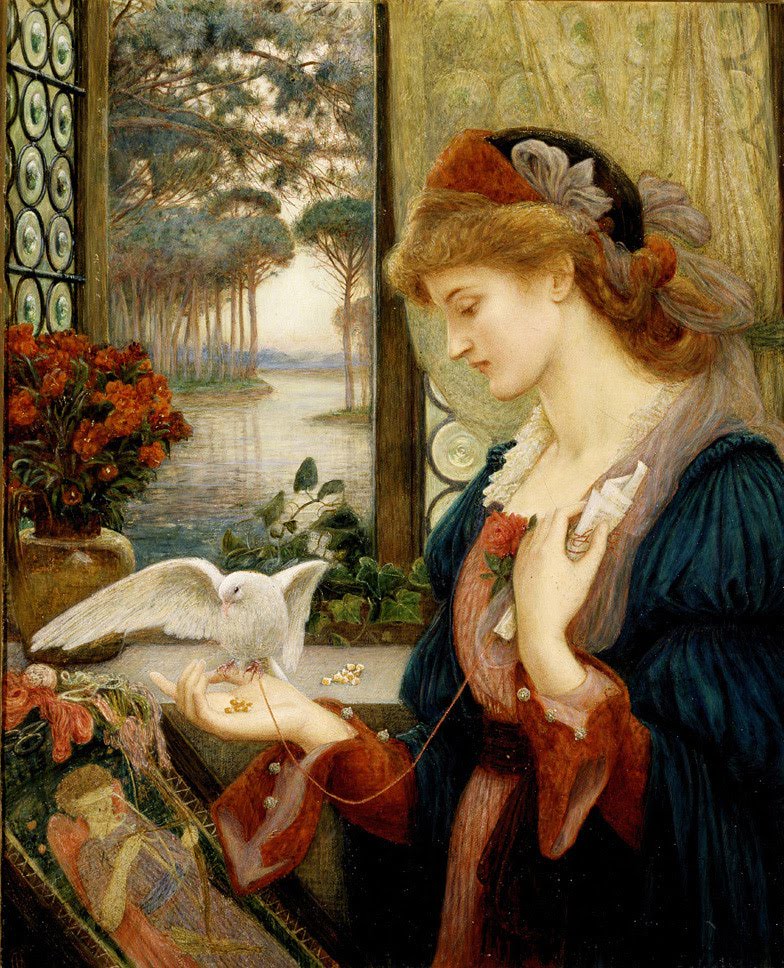
Illustration: “Marie Spartali Stillman – Love’s Messenger [1885]” by Gandalf’s Gallery is licensed under CC BY-NC-SA 2.0.

Sonnet: ‘Simulating the Past’

In the far future, humans gone from Earth,
now disembodied as self-structured flows
of energy and information, woes
of the unknown replacing old Death, Birth
and even Copulation; when a dearth
of physical experience bestows
rich glamor on ideas of Nature’s shows–
sunset, moon rise, trees, seas–the planet’s worth…
they’ll lust after these days we suffer through,
marveling at the rich chaotic times,
enthralled by nearing immortality
while planetary destruction loomed in view.
Wrapping themselves in simulated climes,
they think them us… Are they?… We’re them?… Maybe!

*****

One of my more obscure Petrarchan sonnets, perhaps… but Nick Bostrom of Oxford University hypothesises that, as simulations get increasingly complex, engaging and realistic, there will ultimately be many more simulations than the original reality… and therefore that there is a higher probability that you are living in a simulation than in the “real” world. Whatever the “real” world is. Or whoever you actually are. And seeing as Quantum Mechanics is drawing us all into a sense of the illusory nature of reality (particles being waves when they feel like it, or until closely questioned), then maybe somewhere between Ancient Hinduism and future physics we are all something that we haven’t come close to figuring out yet.

Published in Rat’s Ass Review – thanks, Rick Bates!

Woman having fun with a VR set” by Rawpixel Ltd is licensed under CC BY 2.0.

Sonnet: ‘The Fall of Rome’

Jesus, a preacher with fake miracles,
his “Sea” of Galilee just eight miles wide–
rebelling against Rome and crucified–
his failure clear (though words were lyrical)…
you’d think “Messiah” was satirical!
But epileptic Paul a chance descried
to shut out other gods and thoughts worldwide,
thus sealing up Rome’s vital spiracles.
So, building on apocalyptic fears,
the Jewish Jesus ends where Paul begins.
Scientists, artists, poets, engineers,
are suffocated as the new faith wins.
All progress is set back a thousand years.
The Roman Empire died for Jesus’ sins.

Belief is strange. Take Covid vaccination: two thirds of us believe it’s an effective way to save lives, one third of us believe it’s a dangerous and unscrupulous way to make money and control people. Virtually no one has actually done any research and analysis of the issue, we just listen to our preferred sources of information and the community we’re a part of.

Or take religion: for the most part, children raised in Christian families remain Christian believers all their lives, Muslims remain Muslim, Buddhists remain Buddhist, and so on. Which makes it all the more impressive when someone can radically change the belief structure that surrounds them. Kudos then to the epileptic Paul of Tarsus, who created a Jewish-Mithraist-polytheist mishmash that has lasted almost 2,000 years. Pity about the Roman Empire, though.

This happily Petrarchan sonnet (iambic pentameter, and rhyming ABBAABBA CDCDCD) was originally published in Rat’s Ass Review, where respectfulness and respectability are not required. Thanks, Roderick Bates!

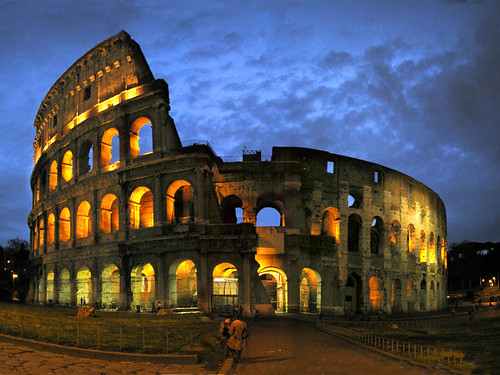
“Darkness Falls in Rome” by Storm Crypt is licensed under CC BY-NC-ND 2.0

Sonnet: ‘The Thief’

More than the actual loss, it’s helplessness
That we most loathe when suffering a theft:
The arbitrary way one daring, deft,
Brass act leaves careful order in a mess;
The knowledge the thief’s wilder and cares less;
The easy way he tears the warp and weft
Of dull security; the insight left
The cosmos can as quickly curse as bless.

Therefore the fears are mostly overblown-–
The thief himself causes no loss or strife
More than insurance or day’s work redeems.
But there’s a greater thief, and more unknown,
Who comes each night and steals one third your life,
Leaving no more than fingerprints, your dreams.

Sleep and dreams are so large a part of our existence that they seem to merit more attention than most people pay them. Sure, we need some rest, but we can get physical rest while awake during the day. So do we really need seven or eight hours every night to defrag our minds and delete unnecessary memories?

I like to think (this is close to “I believe”, but it isn’t belief) that there is something crucial going on that we are missing. The occasional “big dream” that resonates life-changingly. The dream of a distant loved one saying goodbye, before you get the news the next day of their death. The awareness that your unconscious is actually running your show, and that you better pay attention and assist where you can. All these reduce the apparent dominance of the waking mind, and open cans of existential worms. There are no certain answers. We are nowhere near understanding how our bodies, our minds or the universe works.

It’s all wonderful; but I still resent the amount of time I have to sleep. (And to those who say “It’s possible to sleep a lot less” I say “Yes, but at what cost? We have no idea.”)

I’m proud of this sonnet on a technical level. It is a true Petrarchan sonnet (iambic pentameter, and rhyming ABBAABBA CDECDE); the flow of words finds natural tiny pauses at the line breaks; only the volta, the twist to the exposition, is arguably in the wrong place, being strongest after the 11th line rather than after the eighth. But I feel it is all redeemed by a strong last line.

‘The Thief’ was originally published in ‘Candelabrum‘ – a magazine stolen by time.

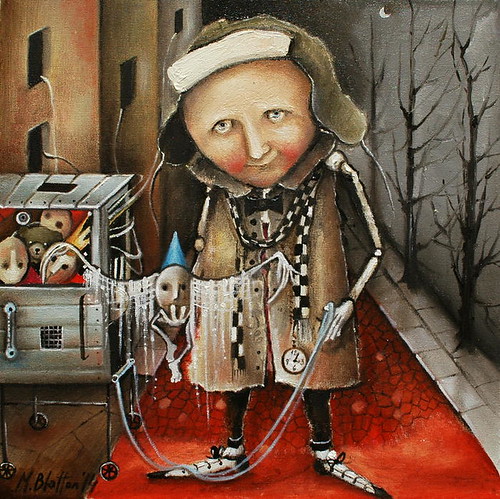
Photo: “Thief Of Dreams” by Monica Blatton is licensed under CC BY-NC-ND 2.0

Sonnet: “Bring on the Violins”

Bring on the violins, the falling leaves,
the wistful ending to a misty day.
The long game’s over and we ride away
to sunset Heaven that no one believes.
Our world is dying, yet here no one grieves:
Earth warms, seas rise, but Wall Street’s still in play…
and we ourselves are aging anyway.
We all face death, and there’ve been no reprieves.
And yet, and yet…robotics and AI,
gene therapy, unlimited life span,
promise an almost-here-and-now sublime,
an unknown life, with our old life gone by.
Trumpet a fanfare for the Superman,
music for dancing to the end of time.

This sonnet has just been published in the Amsterdam Quarterly, this spring’s issue being on the theme of Beginnings and Endings. That may be relevant for our Covid-19 catastrophe, but of course the theme was determined a year ago, and life and death have merely decided to smile on AQ ironically.

But we were all facing death before this latest coronavirus came along. As the saying goes, “Perfect health is simply the slowest rate at which you can die.” And interwoven with death is always new life, never an exact repetition of the old life and often dramatically better. The real issue is, will the new life come at the expense of the old, or can the old reform and regenerate itself, renew itself without needing to die? The avoidance of death has been the quest of religion and medicine since those disciplines (or that discipline) originated. It is great driver of culture, and the pot of gold at the foot of the never-quite-reached rainbow.

Technically this is a correctly structured Petrarchan sonnet, with an initial octave (in this case of existential doom and gloom) rhyming ABBAABBA, followed by a volta (in this case a reversal to hope) for the sestet that rhymes CDECDE.

The sonnet is a marvellous structure for expressing an argument in a compact way.

Using Form: Sonnet: “The Squirrel in the Attic of his Brain”

Sometimes when you get the first idea for a poem with a line or so, such as “The squirrel in the attic of his brain / Shreds photographs and memories”, and the very nature of the idea leads to a long straggly exposition.

Image result for papers in a mess

Papers in the attic

If a squirrel is in his brain destroying his memories… and if he is an old house, of which his brain is the attic… then what other creatures might there be in the house? What other parts of the body might be represented by creatures? Can we get all the way from the hair to the toenails?

Here is how the rest of the squirrel poem worked out–it took a few months, the last image to make it into a sonnet coming while I was in the dentist’s chair having a root canal. You can guess which line that was.

THE SQUIRREL IN THE ATTIC OF HIS BRAIN

The squirrel in the attic of his brain
Shreds photographs, pulls memories apart;
The old dog in the basement of his heart
Howls, lonely, soft, monotonous as rain;
And somewhere further underneath, a snake
In hibernation stirs, irked by its skin.
Up where the world’s news and supplies come in
Through the five senses of his face, to make
The room in which a garrulous parrot squawks
And sometimes songbirds sing – it’s his belief
Mice gnaw behind the wainscots of his teeth.
The cat of consciousness, impassive, walks
Towards the door to go out for the night:
Is everything (oh dog, shut up!) all right?

The sonnet is useful for imposing order. Initial long thoughts get compressed into quatrains or couplets, long lines get compressed into pentameters. And then the search for a rhyme triggers an additional related thought or image, and it has to get squeezed in, which means unnecessary words get squeezed out. And hopefully you end up with something that feels both rich and compact.

The two most traditional forms of the sonnet are the Italian or Petrarchan, and the Shakespearean. The former lays out a position, argument or question in the first eight lines, the octave, rhyming ABBA ABBA; and then makes a turn or volta to provide a resolution in the last six lines, the sestet, rhyming CDE CDE. Shakespeare popularised a sonnet structure of three quatrains (ABAB CDCD EFEF) to lay out a position, with the volta coming for the final couplet, GG.

There is a lot to be said for following those formal sonnet structures, because their rhyme schemes support a clarity of exposition of thought. But people frequently allow themselves unconventional rhyme schemes in order to achieve the meaning they want in the poem. And from more varied rhyme schemes, you can easily move to more varied line lengths, or shifting metre, or a different number of lines–yet still call it a sonnet. Merrill Moore, an American psychiatrist and poet, used loose sonnet-like structures to write down his observations several times during the day. He wrote thousands of poems a year, which, though rarely meeting strict definitions of formal verse, all have a sonnet feel to them.

So you can feel comfortable with sonnets which adhere to the sonnet concept, but use a non-iambic metre, or maintain four feet to the line, or six feet, or use a different rhyme scheme, and so on. I think the metre should still be regular, and there should be solid rhyme, for the poem to be labeled a sonnet. The sonnet above doesn’t adhere strictly to either the Petrarchan or Shakespearean format, but uses a mixture of them. Although I like it, it fails to achieve their true elegance.