Tag Archives: semi-formal verse

RHL, ‘How Sweet It Is’

To be loved by you is like floating on my back,
falling asleep in the sea’s slack.
Sometimes. Sometimes it is more unnerving,
leaping with a wave for bodysurfing,
being swept facedown up the beach,
hair and ears full of sand.
That too is love, and grand.
Sometimes, again, I hope for more that’s out of reach –
(and you do too – don’t glower!)
and sometimes we get gifts hard to believe,
dolphins swimming with us half an hour
till mutually we and they
just turn away,
they to sea and we to shore,
and then they come back suddenly once more
and leap, so close, and leap, and leap again… and leave.

All those are in “loved by” –
the calm; the turbulent rift,
the sparkling fizz,
the sudden unexpected gift.
What can I say? I couldn’t, wouldn’t, choose to deny
how sweet it is.

*****

Thirty-five years with Eliza and still going strong. Who knew.

‘How Sweet It Is’ was published in the current Snakeskin.

Free sea summer scenery background image” by Ajda Gregorčič is licensed under CC BY-SA 2.0.

Semi-formal: RHL, ‘Kinship’

I feel a kinship with those, never met,
who live, uncertain and displaced
in the wrong place on planet earth and sea:
with different languages at home and school,
without a passport from the place they’re raised,
their natural faith despoiled by pointless war,
their sex uncertain, orphaned from themselves,
poets of restlessness, pilots adrift,
obscure, uncertain in their rootlessness,
chameleons of constant camouflage,
and all the little that they know deep down
forever hidden from some foreign frown.

*****

My sense of being displaced is largely one of nationality: in every country I’ve lived in, I feel the closest connection to other expats; and there is no country in which I don’t feel like an expat myself. But that also gives me a sense of commonality with all others in all forms of insecurity and displacement. And maybe it is a natural part of being human… after all, all adults have been displaced from the very different world of childhood.

‘Kinship’ was originally published in the current Shot Glass Journal.

Stand out, don’t blend in!” by partymonstrrrr is licensed under CC BY-NC-ND 2.0.

Long poem: Using forms: John Gallas, ‘Western Man’

1.

Clip clop
clip clop
steady up yon stuntgrass rise, boy,
long as low and stony-brown,
slow like weeks with nothing in them:
saddle-tick,
dirt-crump,
poker-face.

Clip clop
clip clop
privy-top and anchor-wires,
church-cross, store-spike, steady boy,
up yon one-street, just more-trodden dust:
saddle-tick,
dirt-crump,
poker-face.

Clip clop
clip clop
steady, boy, through sad wood civics,
rippled in yon saloon-glass store-side,
road-end, horses maybe leaving:
saddle-tick,
dirt-crump,
poker-face.

Clip clop
clip clop
rise, boy, steady, way ahead,
purple-white mountains, nothing in them
maybe, like weeks maybe:
saddle-tick,
dirt-crump,
poker-face.

2.

My brother’s name was Crazy Sean.
They shot him in the head.
He rattled through the summer corn
and turned the green shucks red.

I laid him in the willowbrake.
I couldn’t stand to pray.
I kissed his cheek for pity’s sake,
and then I rode away.

The plains are full of buffalo.
The woods are red and gold.
The mountaintops are white with snow.
His memory keeps me cold.

I’ve rode through Hope and Whisky Creek.
I’ve rode through Faith and Love.
I’ve laid in Hate and Hide-and-Seek,
and run from God-Above.

The prairie shines, the buckdeer cry.
The hawks hang in the heat.
Clipclop clipclop, the world rolls by.
They say revenge is sweet.

3.

Somewhere still, stark as an afternoon;
Ached in long planks of sunshine;
Like a gambler’s card dropped on an empty land;
Vauntsquare, the nailed-up main street creaks
Against the air. Clipclop – hotel, laundry, saddles,
Telegraph, clap-houses, guns. The horse stops.
Into this hollow spine of fellowship blows a slow
O of wind. Three men clatter at a boardwalk:
Nacarat boots, sharktooth mojos – oh my brother.

4.

I shot one on the shithouse board. His head
smashed like a squash and sprayed the backboards red.
He pissed his boots and died. The stinking hole
spit up a fat, black fly, which was his soul.
I shot one in the barbershop. The chair
caught fire, and ate his o-colonied hair.
He fell out like a slice of spitroast meat.
The duster wrapped him in its winding-sheet.
I shot one in the cornfield. Larks of blood
flew off his skull and twittered in the mud.
He rattled through the stalks. His mashy head
threw up its brain and turned the green shucks red.
I took a bath and threw away my gun.
I rode away wherever. I was done.

5.

drizzle pops on his hatbrim,
cord and wool and steam-sodden,
saddleticks like an empty stomach.

windpump wires and tin-dump,
like horizon-drowning, horse, then man,
hat, gone, clipclop, dusk drips in.

paraffin lamplight pricks the town,
glo-worms, night hunched above,
coyotes carry their eyes like stars.

6.

reckoning
done
how will he ever be warm

purpose
gone
how will he outrun the storm

bearings
none
how will he find another

riding
alone
how will he tell his brother

*****

John Gallas writes: “‘Western Man’ is a weird one: I have a quite spooky love of Westerns, jogging as they do some very deep links with Old En Zed, remnants (many remnants!) of which I grew up with and in. Those old wooden towns, the dim General Stores, the slightly grim and mostly silent (mostly) men, the cheek-by-jowlness of town and bush. It means quite a lot to me. I find the end of most Clint Eastwood films, and especially ‘Once Upon A Time in the West’, as the hero says ‘I gotta go now’, and rides away into lonliness after some bloody vengeance or other, inexpressibly moving.”

(“Old En Zed” = old New Zealand. – RHL)

‘Western Man’ is collected in ‘Star City‘.

John Gallas, Aotearoa/NZ poet, published mostly by Carcanet. Saxonship Poet (see http://www.saxonship.org), Fellow of the English Association, St Magnus Festival Orkney Poet, librettist, translator and biker. Presently living in Markfield, Leicestershire. Website is www.johngallaspoetry.co.uk which has a featured Poem of the Month, complete book list, links and news.

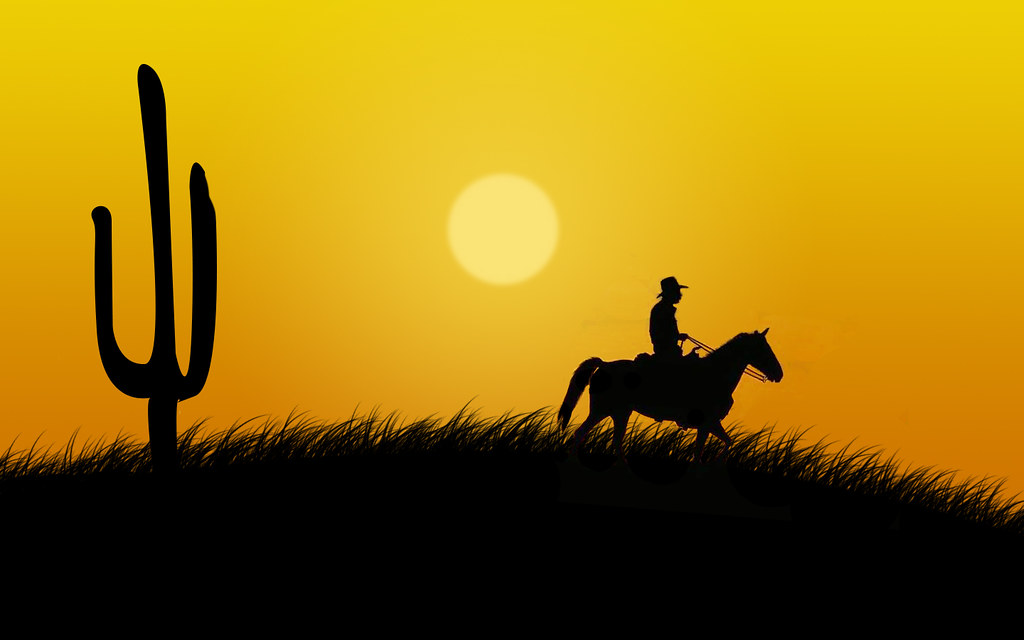
Photo: “lone cowboy” by GarrettRiffal is licensed under CC BY-NC-SA 2.0.

Semi-formal verse: RHL, ‘False Analogies’

The Universe is made of false analogies –
flawed observations, secondhand “I see”s,
discarded dreams.
Nothing is truly as it seems.
We build our intellectual shelter from life’s gales
from scraps of lumber and found nails,
anything within reach,
rope washed up on a beach,
a sliding glass door, still intact,
used as a wall. And all because
the Universe we sense has flaws,
disobeys its own laws,
is just a framework for the Mind That Plays,
a sketch, hypothesis; a tract, not fact;
a work in process, changing with the days.
Dig deeper, and find fresh discrepancies.
Our shelter, in fair weather, keeps us warm,
can stand up to a breeze…
will be no shelter in the coming storm.

*****

I marvel at the impossibilities of the quantum mechanisms of the universe being revealed. I enjoy Nick Bostrom’s speculations on everything being a simulation. I wonder at the powerful who are jockeying for development and control of AI, at our Nietzschean will to power, at our eternal quest for immortality. I am aware that nature constantly sacrifices billions in the process of advancing a few. I wonder if we are in that process now. I am not bothered that I have no answers.

This poem was first published in the current edition of Pulsebeat. Thanks, David Stephenson!

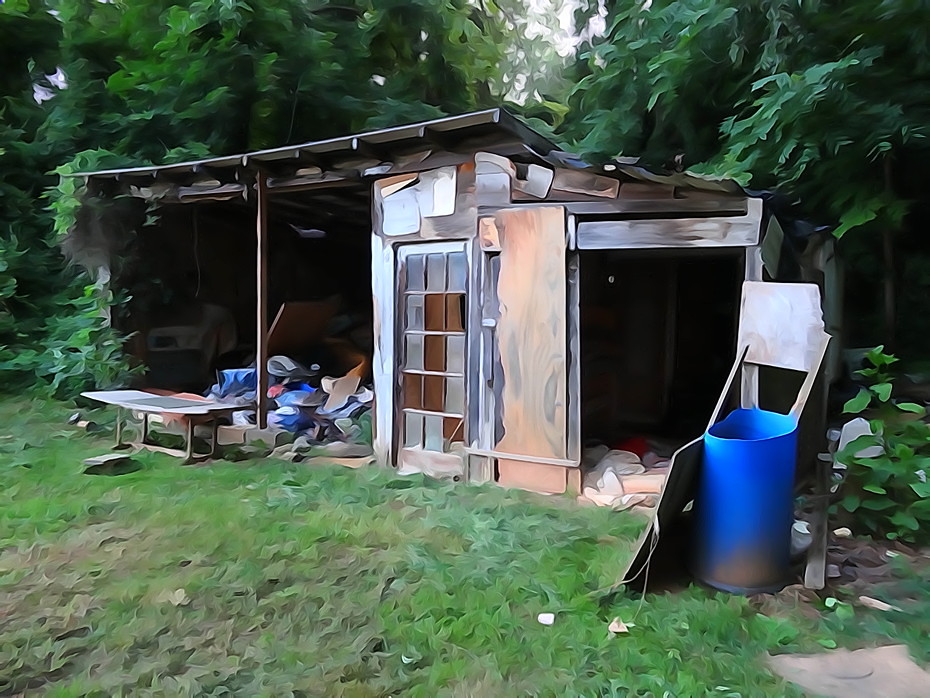
Photo: “wc west avl homeless gathering spot” by zen is licensed under CC BY-NC-SA 2.0.

Helena (“Nell”) Nelson, ‘Separation’

i

Mrs Philpott goes to bed alone.
The clock in the hall ticks on.
Philpott turns to cut glass, then stone.

All the things we do to be loved,
all of them pointless.
The clock ticks on.

Nothing but moonlight dawns.
The distance from downstairs
to upstairs yawns.

Philpott sags and snoozes alone
in the wishing chair,
in the wishing air.

All the things we do to be loved –
in the night they slip far away.
It will never be day.

The clock ticks on
as well it may.

ii

She wakes first. He has not slept
in the chair all night.

At first light
he has crept

into the bed on the other side.
He will not (cannot) say it, but

everything about him is sorry –
only half of him is under the duvet

and his eyes aren’t really shut.
She pulls the covers over them both and he falls

into a sleep as deep and sound
as a lost child who has wandered far out of sight

(while his mother calls and calls and calls)
and is finally found.

*****

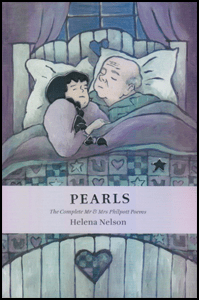
This poem is one of over 80 in Helena Nelson’s ‘Pearls – the Complete Mr & Mrs Philpott Poems’. Starting with poems of the end of their first marriages, it tracks their decades-long second marriage through (as the blurb says) “dreams, anxieties and needs – even sudden spurts of happiness – despite the rainy holidays, arguments and illness. The ordinariness of their love is magical and miraculous. Because ordinary love is a kind of miracle.”

People talk about “novels in verse” but those often don’t capture the poetry of verse. This is definitely a novel in poetry, and the most rereadable novel I’ve come across in a long time.

Helena Nelson writes: “happy that you like Pearls. I made it as well as I could, but it largely came unasked for. I don’t think I have anything to say about it.”

Helena Nelson runs HappenStance Press (now winding down) and also writes poems. Her most recent collection is Pearls (The Complete Mr and Mrs Philpott Poems). She reviews widely and is Consulting Editor for The Friday Poem.

Semi-formal quatrains: Rachel Hadas, ‘Roadblock’

Call me the bee buzzing in the museum.
The younger sister fussing through a house
still stiff with loss.
The meddling goblin in the mausoleum.

My dream: with three in the front seat, we drive
under a bridge and halt. A huge gray bus
blocks the whole road, including us,
the only travelers who are left alive.

It’s drizzling; the windshield wiper blades
busily gesture, yet we’re nearly blind.
You two seem not to mind
blank windows, pulled-down shades.

I mind. I want to get out and explore,
to move around
the deathly obstacle. “Don’t make a sound,”
you say. (Who are you?) “Don’t go near that door.”

Our mountain drive last month—that wasn’t dreamed.
We three again. We ran a dog down. I
alone looked back, alone let out a cry.
I saw it lying in its blood and screamed.

So tell me what these images portend.
Am I a noisy bird of evil omen
or just a person, apprehensive, human,
moving ahead, kid sister into woman,

stonewalled by death each time she rounds a bend?

*****

Rachel Hadas writes: ” ‘Roadblock’ is an older poem, inspired by a visit to my sister and her then husband  years ago.  Our drive, and running over the dog really happened, as did the dream…but which came first?  And another question: would I have remembered either the car accident or the dream had I not written them into a poem?  Dreams still figure often in my poems.  And the fact that I’ll always be a younger sister, while it doesn’t get mentioned all that frequently, is a permanent feature of my consciousness that probably works its way into many of my poems however subliminally. The bee buzzing: my sister once complained that going to a museum with me was like going to a museum with a bee, a comment I’d forgotten until rereading this poem brought it back.  And those “blank windows, pulled-down shades”: doesn’t poetry often strive to pull the shades up?”

‘Roadblock’ is collected in ‘Halfway Down the Hall: New and Selected Poems’ (Wesleyan University Press, 1998)

Rachel Hadas’s recent books include Love and Dread, Pandemic Almanac, and Ghost Guest. Her translations include Euripides’s Iphigenia plays and a portion of Nonnus’s Tales of Dionysus. Professor Emerita at Rutgers-Newark, where she taught for many years, she now teaches at 92Y in New York City and serves as poetry editor of Classical Outlook. Her honors include a Guggenheim fellowship and an award from the American Academy-Institute of Arts and Letters.

Photo: “Bus Crash at Ladprao-Chokchai4” by isriya is licensed under CC BY-NC 2.0.
Semi-formal: RHL, ‘Laffable Religion’

No matter how seemingly affable,
a priest always hopes to be greased;
while others, invoking hellfire,
have us wait for our trip in the hearse
and preach in their suits neatly creased,
these fishers of men that are gaffable,
in this world that they’ve made mud and mire.
That the point of a flock’s to be fleeced
can only be said in light verse;
for religion is simply so laughable
it’s amazing it’s not yet deceased.

*****

Isn’t it amazing that the Pope can claim to have voluntarily taken a vow of lifelong poverty, and millions of his supporters who live in involuntary poverty send money to support him living in a palace? Is it different from a billionaire politician soliciting donations from his impoverished supporters? Is the human need to glorify the tribal god and the tribal leader never going to end?

This poem was first published in The HyperTexts, as part of the August 2024 Spotlight.

Short poem: RHL, ‘Ghosts Twitter’

Ghosts twitter in my head like the memory of predawn birds.
Digging below my present house I find
a structural supportive past with rock veins to be mined.
Upstairs the future isn’t fully built or roofed.
Has someone goofed?
The Architect is vague on final thirds.

*****

I am finding many ways to say I don’t understand existence at all; this is one of them.

This short, semi-formal poem was published recently in The Lyric.

Photo: “unfinished house” by Lodigs is licensed under CC BY-NC-ND 2.0.

Semi-formal poem: RHL, ‘Layered Understanding’

The Universe with which we grapple
searching for structure, meaning, is no apple
with glossy skin outside, substance beneath,
where deep within its core it meets our needs
to find its meaning: seeds.
No, it’s an onion – peel off the outer sheath
of sensory impressions,
and you uncover explanations
coming first from mystic revelations
and then from faith’s and Science’s professions.
Research from Galileo through to Quantum realms
reveals, and contradicts, and overwhelms
until you take away the final layer
and find: there’s nothing there.

*****

I’m a Militant Agnostic: “I don’t know, and neither do you!” We keep searching and probing, the certainties get disproved, new lines of enquiry open up… and off we go again, Quixote-like, because we’re humans.
This poem rhymes irregularly, and is in iambics of different line lengths. Semi-formal.

‘Layered Understanding’ was first published in the Shot Glass Journal #43.

Photo: “half onion peeled” by Hanna Khash is licensed under CC BY 2.0.

Semi-formal? or Spoken Word? RHL, ‘Life is a Bubble’

A life is a bubble:
somewhere the Grand Druid
dips his wand into the universal fluid
and then a new life is formed, floating
on chance breezes until it – pops –
and the thin skin coating
falls back to earth as mere drops,
the shape and rare rainbow glint gone to air,
and the bubble is where?

Earth is a bauble
in the universal flux,
as it foams, boils and freezes,
just dust from God’s various mucks,
sneezes afloat on chance trans-solar breezes.

The humans babble,
rabble rising from the rubble of other lives cut to stubble,
they burble some Bible as they gab, grab and gobble,
cobbling conning towers of Babel and Hubble,
their progress hobbled by their wobbly bobble,
reams of hopes, dreams and schemes
just a bubble.

*****

Sometimes a chance-occurring phrase in some moody mode of thought lets me ramble wildly through tangled words and ideas. It’s not amenable to regular form, but it’s fun. It seems in the spirit of Spoken Verse, though I’ve never performed. The earliest poem I wrote in this style is from over 50 years ago… which is 30 years before I ever had a poem accepted for publication. I was definitely out of step with the non-verse that then controlled the poetry industry to the exclusion of almost all actual verse. Things have eased in recent years, and dozens of poems from those early years have since been published. (Note to struggling young poets: Don’t give up! But have another career that pays money!)

Anyway, ‘Life is a Bubble’ only needed a couple of years to be published in 2024 in The Lyric.

Photo: “Blowing bubbles” by Song_sing is licensed under CC BY 2.0.