Tag Archives: Shakespeare

R.I.P. Edmund Conti, ‘Button, Button’

Just ask the poet, life’s a dumb thing.
Button, button, eating, swilling.
Life isn’t much but, still, it’s something.

Existence is a rule-of-thumb thing.
Buying now with later billing.
Just ask the poet, life’s a dumb thing.

To dream, to sleep, a ho-and-hum thing.
Boring, boring, mulling, milling.
Life isn’t much but, still, it’s something.

Mum’s the word, the word’s a mum thing.
Button lips and no bean spilling.
Just ask the poet, life’s a dumb thing.

Life, of course–the known-outcome thing.
Death and taxes. God is willing.
Life isn’t much but, still, it’s something.

Life is short, a bit-of-crumb thing.
Dormouse summer, daddies grilling.
Just ask the poet, life’s a dumb thing.
Life isn’t much but, still, it’s something.

*****

In his 2021 collection ‘That Shakespeherian Rag‘, Ed Conti threads poetic references throughout (the title is from Eliot); ‘Button, Button’ appropriately begins with:

When one subtracts from life infancy (which is vegetation),–sleep, eating and swilling, buttoning and unbuttoning–how much remains of downright existence?
– The Summer of a Dormouse, Byron’s Journals.

Much of ‘That Shakespeherian Rag’ (including Button, Button) was first published in Light. The collection is divided into 11 sections, organised from youth through adulthood to the prospect of mortality, and each prefaced with a quote from Shakespeare. The preface for the final Section reads:

Make no noise. Make no noise. Draw the curtains–
– King Lear, Act II Scene 6

There is no poem after it.

The charming, delightful, witty and tolerant Edmund Conti died on November 12th, aged 96.

Using form: Sonnet: Max Gutmann, ‘How to Inspire a Sonnet – advice from the pros’

Inspire amore first, but molto forte
If in sonetti dolci you’d be sung.
Then see that you stay bella. You’ll support a
Passione deep and long by dying young.
— Laura

If thou upon his stage the Muse’s part
Wouldst play, each act thou study’st must prolong
Thy Poet’s pain. ‘Tis pain shall prompt great Art.
Then con thy lines with style, and do him wrong.
— The Dark Lady

Stay always by her. Never for a day
Be from her cherished side. ‘Tis paramount
To share the highest love. (And, by the way,
It helps to choose a lover who can count.)
— Robert Browning

‘Tis mystery that fires the crucial spark,
So make him wait–and keep him in the dark.
— Milton’s blindness

*****

Max Gutmann writes: “A reader of Light Quarterly (the marvellous Light back in its days as a print journal) was so offended by a poem of mine ridiculing a lousy president that he cancelled his subscription. Beloved editor John Mella forwarded a copy of the note to me. It was a sonnet! I’d never thought I could inspire a sonnet. I had a ways to go before rivaling Laura or the Dark Lady, but I’d taken the first step. That inspired this poem.

“John declined the poem, so it first appeared in a journal that didn’t specialize in light verse, one highly thought of. (Digging it out now, I see that contributors to the issue the poem appeared in included, among others I admire, Updike, Espaillat, Turner, Gioia, and Hadas.) But the journal goofed. They changed sonnetti dolci to sonnetti dolce (plural noun, singular adjective). This must have been a typo, I imagined, but when I asked, the chief editor not only admitted the change had been intentional, but defended the decision. Dolce being the more familiar form, he argued, it was reasonable to make the change without consulting the writer. I never sent them anything again

“This story calls for a shout-out to Jerome Betts, who reprinted ‘How to Inspire a Sonnet’ in Lighten Up Online (LUPO). (To avoid the impression that Jerome is less than meticulous about acknowledgements–or about anything–I should make clear that I asked him not to acknowledge the earlier journal, and I didn’t name it for him.) Jerome, like most editors I’ve worked with, always asks before making changes–and his proposed changes are usually improvements, often big ones!”

Editor’s note: This poem suggests what might be appropriate ways to inspire sonnets, according to the subjects of sonnets: Petrarch’s Laura, Shakespeare’s Dark Lady, Elizabeth Barrett Browning’s Robert and Milton’s blindness. Self-referentially, the poem is itself a Shakespearean sonnet, written in response to being the subject of a sonnet. Gutmann is therefore both sonneteer and sonnetee, and has the credentials to write a “How to –“

Max Gutmann has worked as, among other things, a stage manager, a journalist, a teacher, an editor, a clerk, a factory worker, a community service officer, the business manager of an improv troupe, and a performer in a Daffy Duck costume. Occasionally, he has even earned money writing plays and poems.

Photo: “IMG_0323C Frans Wouters. 1612-1659. Antwerp. The rural concert. 1654. Dole” by jean louis mazieres is licensed under CC BY-NC-SA 2.0.

Ann Drysdale, ‘Winter Song’

When blizzards blow under the tiles
and the dishcloth crisps on the draining board
and the snowscape stretches for miles and miles
and only the idiot ventures abroad.
When it’s early to bed, and thank heavens for that,
then coldly keens the cast-out cat:
Miaow! Miaow! – a doleful din –
and who will rise and let him in?

When slippery stones by the pond
make filling a bucket an effort of will
and you’re walled-up for weeks in the back of beyond
in a farm at the foot of a hell of a hill
then it’s early to bed, and thank heavens for that,
till coldly keens the cast-out cat:
Miaow! Miaow! – a doleful din –
and who will rise and let him in?

*****

Ann Drysdale writes: “It was published in my very first collection, The Turn of the Cucumber (Peterloo Poets 1995) and dates from a time when I was bringing up three children as a single mum on a hand-to-mouth smallholding on the North York Moors.”

Editor’s note: Ann Drysdale takes the structure, but not the precise metre, of Shakespeare’s ‘Winter Song’ from Love’s Labours Lost. Her rollicking metre allows her “and the snowscape stretches for miles and miles” and the wonderful “in a farm at the foot of a hell of a hill”, for a bigger wintry landscape than Shakespeare shows.

Ann Drysdale now lives in South Wales and has been a hill farmer, water-gypsy, newspaper columnist and single parent – not necessarily in that order. Her eighth volume of poetry, Feeling Unusual, has recently joined a mixed list of published writing, including memoir, essays and a gonzo guidebook to the City of Newport.
http://www.poetrypf.co.uk/anndrysdalepage.html
http://www.shoestring-press.com

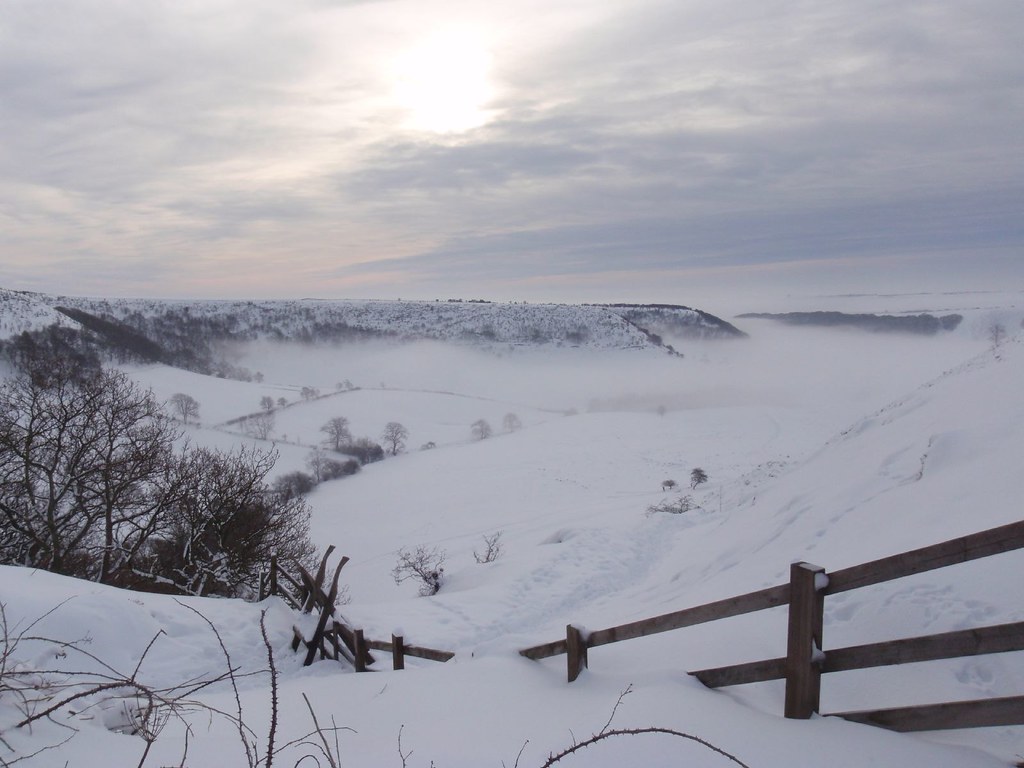
Photo: “Hole of Horkum, North York Moors” by reinholdbehringer is licensed under CC BY-NC-SA 2.0.

John Beaton, ‘A Many-Splendoured Thing?’

Is love a beaming, eye to eye? An oath—you-only-till-I-die?
A U that comes before an I? A hullabaloo-cum-lullaby?
A flirt? A tilting of the neck? An art? A Machu Picchu trek
back in time to that valiant peck on virgin cheek, that what-the-heck?

A brace of lovebirds who embrace instead of pecking cheeks, a plaice
whose eyes achieve a state of grace—as one on one side of its face?
A willing ear we learn to ration between soliloquies? A fashion?
The winning chips we hope to cash in from laying on the wheel of passion?

A bridle? Or a bridal dress? An if-you-love-me-you’ll… duress?
A scandal in the gutter press? A touch-me-there-uh-huh caress?
A smile without the crow’s-feet creases? A summer fling that never ceases?
A joining of two jigsaw pieces? A joke? A yoke with quick-releases?

Love grins with its beret askew, climbs up the sky and paints it blue
then turns the sun to shine on you and says, “You’re puzzled? Hey, me too!”

*****

John Beaton writes: “This started with recollection of a joke by British comedian, Benny Hill: there’s quite a difference between ‘What is this thing called love?’ and ‘What is this thing called, love?’ I decided to come up with humorous answers and they started occurring to me in pairs of rhymed pairs.
I want this to be light and playful. I cobbled the answers together in octameter lines, each with two rhymed tetrameter halves, and configured the lines in three quatrains (aabb) and a rhymed couplet. The result has elements of the sonnet form—fourteen lines and a turn at the end of line twelve. I’ve also played with alliteration and internal rhyme.”

John Beaton’s metrical poetry has been widely published and has won numerous awards. He recites from memory as a spoken word performer and is author of Leaving Camustianavaig published by Word Galaxy Press, which includes this poem. (It is also in the Potcake Chapbook Rogues and Roses.) Raised in the Scottish Highlands, John lives in Qualicum Beach on Vancouver Island.
https://www.john-beaton.com/

What do you see through love?” by TW Chang is licensed under CC BY 2.0.

Poems on Poets: George Simmers, ‘Poets in Residence’

The Head was ambitious and nobody’s fool,
A big man, efficient, and proud of his school.

At the start of the term, as he sorted his post,
The item of mail that intrigued him the most

Was a piece puffing National Poetry Day,
Including a list of the poets who’d stay

And workshop and somehow persuade the whole school
That poets were ‘groovy’ and poems were ‘cool’.

‘Here’s status,’ the Head thought. ‘It’s not to be missed.’
The one problem, though, was the names on the list;

Though doubtless they wrote quite respectable stuff,
Not one of them, frankly, was famous enough.

His school deserved more; his ambition took wing,
And so he decided to do his own thing.

With his usual flair, and with chutzpah exquisite,
He invited the whole English canon to visit.

Geoffrey Chaucer came first, on an equable horse,
And Spenser, and Marlowe, and Shakespeare, of course

(Who was grabbed by the teachers of English, imploring
‘Do come and persuade the Year Nines you’re not boring.’)

Keats arrived coughing, Kipling marched vigorously;
Matthew Arnold began to inspect the school rigorously –

Which delighted the Head, who with pride and elation
Showed the bards of the ages today’s education.

Vaughan was ecstatic, though Clough was more sceptical.
Ernest Dowson puked up in a litter receptacle.

Coleridge sneaked off to discover the rates
Of an unshaven person outside the school gates;

Soon he’d sunk in a private and picturesque dream,
While Auden was ogling the basketball team.

Plath lectured the girls: ‘Get ahead! Go insane!’
Algernon Swinburne cried: ‘Bring back the cane!’

Dylan Thomas soon found the head’s cupboard of booze,
And Swift was disdainfully sniffing the loos.

And then the Head twigged, with a horrified jolt,
That something had sparked a Romantic revolt.

Shelley’d gathered the students out in the main quad,
And roused them to rise against school, Head, and God.

Byron soon joined him, and started to speak.
(He showed his best profile, and spouted in Greek.)

The bards of the thirties were equally Red,
And Milton explained how to chop off a head.

Decadents undermined all the foundations.
Surrealists threw lobsters and rancid carnations.

Pre-Raphaelites trashed the technology room
And the First World War poets trudged off to their doom.

Sidney with gallantry led a great charge in
(Tennyson cheering them on from the margin).

The Deputy Head, who was rather a dope,
Got precisely impaled on a couplet by Pope

(Who, while not so Romantic, was never the chap
To run from a fight or keep out of a scrap).

Then the whole solid edifice started to shake
As it was prophetically blasted by Blake. 

Soon the School was destroyed. Eliot paced through the waste,
And reflected with sorrow and learning and taste,

Which he fused in a poem, an excellent thing,
Though rather obscure and a little right-wing.

He gave this to the Head, who just threw it aside
As he knelt by the wreck of his school, and he cried

Salty tears that went fizz as they hit the school’s ashes.
He said words that I’d better imply by mere dashes:

‘——– Poets! ——– Poetry – rhyme and free verse!
Let them wilt in the face of a Headmaster’s curse!

‘Let poetry wither! How sweet it would be
If all of the world were prosaic as me!’

*****

George Simmers writes: “Poets in Residence was written as a celebration of National Poetry Day many years ago. Several people had been mouthing blandly off about how lovely poetry was in contrast to that horrible pop music young people listen to. Schools were being encouraged to give children a lot of poetry because it was nice and beautiful, and would make them nice. ‘Do these people have no idea of how incendiary the English canon is?’ I wondered. I really enjoyed demolishing the school around the ears of the pompous and pretentious head. I was a teacher at the time.”

George Simmers used to be a teacher; now he spends much of his time researching literature written during and after the First World War. He has edited Snakeskin since 1995. It is probably the oldest-established poetry zine on the Internet. His work appears in several Potcake Chapbooks, and his recent diverse collection is ‘Old and Bookish’.

Photo: “Ndélé highschool student in front of destroyed school” by hdptcar is licensed under CC BY 2.0.

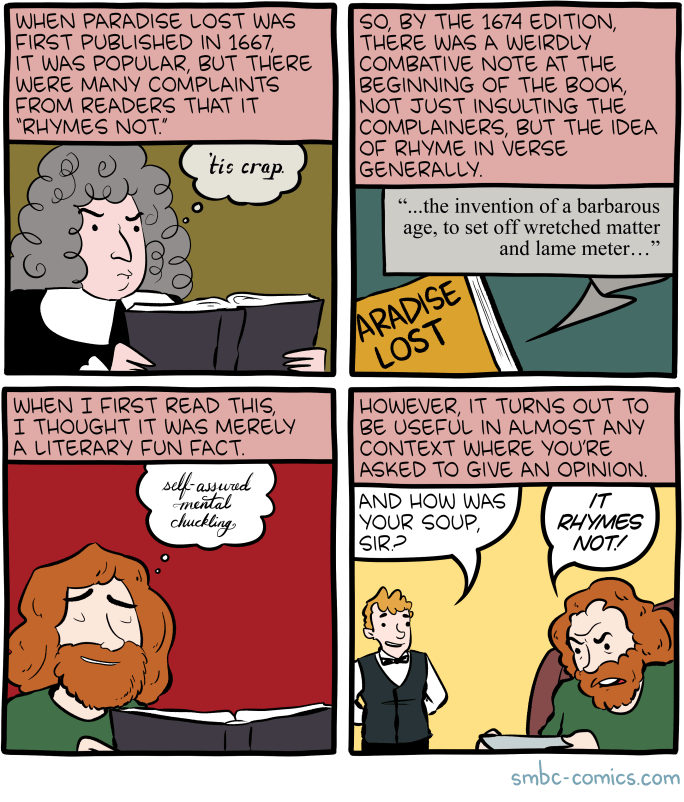
Opinion: ‘Rhymes’ by Zach Weinersmith

John Milton was perfectly capable of expressing himself in rhyme, as in his Petrarchan sonnet on his blindness, When I Consider How My Light Is Spent. Paradise Lost attracted a lot of criticism for its boring lack of rhyme (as well as a lot of unthinking religious approval for its wretched matter). At the front of the second edition of his Paradise Lost in 1674, John Milton defends his books-long use of blank verse:

“The measure is English heroic verse without rime, as that of Homer in Greek, and of Virgil in Latin—rime being no necessary adjunct or true ornament of poem or good verse, in longer works especially, but the invention of a barbarous age, to set off wretched matter and lame metre; graced indeed since by the use of some famous modern poets, carried away by custom, but much to their own vexation, hindrance, and constraint to express many things otherwise, and for the most part worse, than else they would have expressed them. Not without cause therefore some both Italian and Spanish poets of prime note have rejected rime both in longer and shorter works, as have also long since our best English tragedies, as a thing of itself, to all judicious ears, trivial and of no true musical delight; which consists only in apt numbers, fit quantity of syllables, and the sense variously drawn out from one verse into another, not in the jingling sound of like endings—a fault avoided by the learned ancients both in poetry and all good oratory. This neglect then of rime so little is to be taken for a defect, though it may seem so perhaps to vulgar readers, that it rather is to be esteemed an example set, the first in English, of ancient liberty recovered to heroic poem from the troublesome and modern bondage of riming.”

Tell that to Geoffrey Chaucer; his Canterbury Tales is longer, rhymed, more varied and more engaging. As Samuel Johnson wrote, “Milton formed his scheme of versification by the poets of Greece and Rome, whom he proposed to himself for his models so far as the difference of his language from theirs would permit the imitation.” And that’s the problem: Greek and Latin poems are simply not appropriate models for a Germanic language’s poetry.

One of the benefits of rhyme is that it prevents a writer from rambling on fluffily and indefinitely, the way anyone capable of writing blank verse can do. Indeed, when you look at a modern poet’s recent collection you are likely to see short, tight half-page pieces that rhyme, and longer, looser multi-page pieces that don’t. I invariably prefer the former. I find them more enjoyable to read, more succinctly expressed, easier to appreciate, more fun to remember and quote. The others are just lazy, uninspired fillers, or politico-religious pamphlets where zeal has replaced poetry… cf. Paradise Lost.

Illustration: ‘Rhymes‘ by Zach Weinersmith, who publishes a Saturday Morning Breakfast Comics (or SMBC) cartoon daily. He is the author of several brilliant and provocative books, including the previously reviewed ‘Shakespeare’s Sonnets: Abridged Beyond the Point of Usefulness‘.

J.D. Smith, ‘Seven Ages of Man’

I puked and cried–that’s what Mom said.

School sucks. Why can’t I stay in bed?

I want that girl. What is her name?

I’ll kick some ass and stake my claim.

I’m fat. So what? I’ve won the game.

I limp these days, and feel the gout.

Say, now, what was all that about?

*****

J.D. Smith writes: “I hesitate to say very much about this poem, as it plays so blatantly off of Shakespeare, but a short explanation seems in order. The third-person eloquence and loftiness of the original stands in contrast to how we experience the stages of life, and it occurred to me to bring the discussion down to earth with a series of plain first-person statements.”

J.D. Smith has published six books of poetry, most recently the light verse collection Catalogs for Food Loversand he has received a Fellowship in Poetry from the United States National Endowment for the Arts. This poem is from The Killing Tree (Finishing Line Press, 2016).Smith’s first fiction collection, Transit, will be published in December 2022. His other books include the essay collection Dowsing and Science. Smith works in Washington, DC, where he lives with his wife Paula Van Lare and their rescue animals. Twitter: @Smitroverse

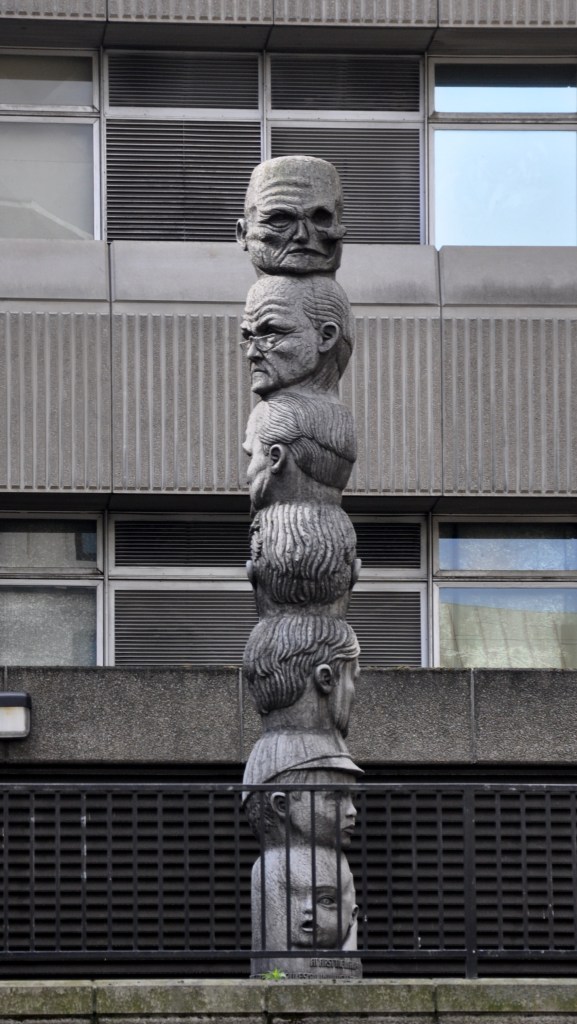
Photo: “File:Baynard House Seven Ages of Man.jpg” by Photo: Andreas Praefcke is licensed under CC BY 3.0.

Potcake Poet’s Choice: D.A. Prince, ‘Horatio’

Always in shadow, on the edge, the light
falling on someone else. I’m used to it—
fidus Achates, and half-acolyte.
Besides, the sidelines are a safer bet
so I survive—at least, upon the page,
though never in imagination.
The curtain falls: I vanish with the stage.
Even Rosencrantz and Guildenstern live on
in other times but I—the dutiful
and sober pal, the philosophic friend—
dissolve. I fade. Meanwhile, the beautiful
capture your soul beyond the play’s neat end
where I’m to set, with due fidelity,
the record straight. You won’t remember me.

From: Common Ground, HappenStance Press, 2014.

D.A. Prince writes: “In the middle of a lively debate about which actor had played the definitive Hamlet, I realised I had no memory at all of any actor playing Horatio. There would have been an equal number, obviously. Horatio is on Elsinore’s battlements in the opening scene, questioning the existence of ghosts, and he’s there in the final scene, surrounded by corpses, giving the penultimate speech. In between he hovers in Hamlet’s shadow, necessary but—if I’m a typical theatre-goer—unmemorable. He doesn’t even get to cross the stage in Tom Stoppard’s Rosencrantz and Guildenstern are Dead. The world is full of people like Horatio so I thought I would give him a brief
acknowledgement: for turning up, for hanging on, for being there.”

D A Prince lives in Leicestershire and London. Her first appearances in print were in the weekly competitions in The Spectator and New Statesman (which ceased its competitions in 2016) along with other outlets that hosted light verse. Something closer to ‘proper’ poetry followed, with three pamphlets, followed by a full-length collection, Nearly the Happy Hour, from HappenStance Press in 2008. A second collection, Common Ground, (from the same publisher) followed in 2014 and this won the East Midlands Book Award in 2015. HappenStance published her pamphlet Bookmarks in 2018 and will bring out a further collection in 2022. There’s just the little matter of a title to resolve first.

Illustration: Hamlet and Horatio in the Graveyard (Eugène Ferdinand Victor Delacroix)

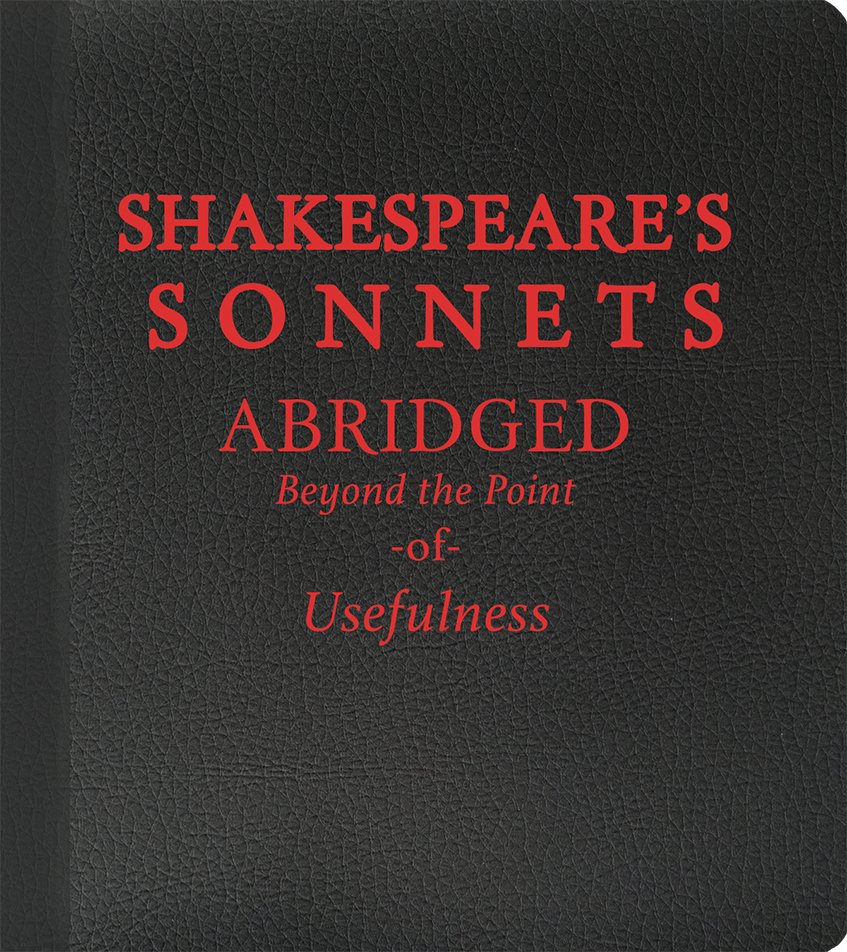
Review: “Shakespeare’s Sonnets: Abridged Beyond the Point of Usefulness” by Zach Weinersmith

Shakespeare's sonnets

Zach Weinersmith is best known as the creator of Saturday Morning Breakfast Comics, a daily comic of random existentialism, religion, robots, sex, etc. As a gift to people self-isolating or otherwise inconvenienced in a time of Covid-19, he is making eight of his books available free as PDFs. I chose one for its intriguing title, and discovered the most amazing piece of literature, more offbeat-creative than anything I’ve read recently: “Shakespeare’s Sonnets, Abridged Beyond the Point of Usefulness“.

What he has done is abridge each of Shakespeare’s 154 sonnets from its rhymed pentameters into a rhymed couplet, abridging the pentameters into tetrameters. (And sonnet 145 being uniquely written in tetrameter, he naturally reduces to trimeter.) For a taste of this, consider Sonnet 18:

Shall I compare thee to a summer’s day?
Thou art more lovely and more temperate.
Rough winds do shake the darling buds of May,
And summer’s lease hath all too short a date.
Sometime too hot the eye of heaven shines,
And often is his gold complexion dimmed;
And every fair from fair sometime declines,
By chance, or nature’s changing course, untrimmed;
But thy eternal summer shall not fade,
Nor lose possession of that fair thou ow’st,
Nor shall death brag thou wand’rest in his shade,
When in eternal lines to Time thou grow’st.
So long as men can breathe, or eyes can see,
So long lives this, and this gives life to thee.

Under Weinersmith’s treatment, it becomes

Summer’s bad, then dies. You won’t.
(OK, you will, but poems don’t.)

But cutting through to the simple essence of the poem without any of that unnecessary flowery stuff is only part of what he has achieved: the greater gift is that in radically abridging the poems, Weinersmith allows the entire series to be seen as a connected series of comments, almost diary entries, in Shakespeare’s relationship first with the so-called “Fair Youth” (the first 126 sonnets) and then the “Dark Lady” (the last 28).

As Weinersmith points out in his brief but enormously enlightening introduction,

‘the term “Fair Youth” is not present in the sonnets, but is something of a euphemism designed to, as poet Don Paterson writes in Reading Shakespeare’s Sonnets , “[keep] everything just on the right side of sodomy”.

After the initial 126 poems, we encounter the 28 “Dark Lady” sonnets. These contend with an unattractive, bad-smelling, yet surprisingly popular married woman whom Shakespeare nags until she sleeps with him. Most of the poems that follow this consummation concern how Shakespeare hates himself for having sex with her. Remember this next time you receive these as a Valentine’s gift.’

Weinersmith lays out the whole flow of Shakespeare’s relationship with the Fair Youth, and the relationship of both of them with the Dark Lady… You will never think of Shakespeare the same again. Read Weinersmith’s introduction, then blast through his couplets. You may, like me, find yourself needing to work your way through the damn sonnets themselves, and see them for the first time as they truly are.


Review: “Holy Tango of Literature”, amazing parodies by Francis Heaney

Holy Tango

T.S. Eliot anagrams to “Toilets”. Francis Heaney therefore uses that theme to parody Eliot’s best-known poem, “The Love Song of J. Alfred Prufrock”, as the opening poem of the book:

Let us go then, to the john,
Where the toilet seat waits to be sat upon
Like a lover’s lap perched upon ceramic;
Let us go, through doors that do not always lock,
Which means you ought to knock
Lest opening one reveal a soul within
Who’ll shout, “Stay out! Did you not see my shin,
Framed within the gap twixt floor and stall?”
No, I did not see that at all.
That is not what I saw, at all.

To the stall the people come to go,
Reading an obscene graffito.

We have lingered in the chamber labeled “MEN”
Till attendants proffer aftershave and mints
As we lather up our hands with soap, and rinse.

And so it goes, throughout the Holy Tango of Literature: anagram the poet’s name, use that as the theme for parodying their best known poem. Here are some of the openings:

e. e. cummings: “nice smug me”

nice smug me lived in a pretty hip town
(with up so noses snobs looking down)
saks moomba vong prada
i wore my mesclun i ate my uggs

William Shakespeare: “Is a sperm like a whale?”

Shall I compare thee to a sperm whale, sperm?
Thou art more tiny and more resolute:

Gerard Manley Hopkins: “Kong ran my dealership”

I hired last summer someone simian, King
Kong of Indies islands, fifty-foot-fierce Gorilla, out of hiding

Chaucer, Dorothy Parker, Frost, Whitman, Gwendolyn Brooks… it is an extensive collection, including parodies of plays by Wilde, Woody Allen, Beckett, Pinter and so on. Samuel Taylor Coleridge, who anagrams to “Multicolored Argyle Sea”, is a particular delight. Beginning

It is an ancient Mariner,
And he taketh lots of drugs,

it surreptitiously develops a second level of parody of a completely different drug-related poem. I’ll let you discover it for yourself.

And one of my favorites is William Blake, “Likable Wilma”:

Wilma, Wilma, in thy blouse,
Red-haired prehistoric spouse,
What immortal animator
Was thy slender waist’s creator?

When the Rubble clan moved in,
Was Betty jealous of thy skin,
Thy noble nose, thy dimpled knee?
Did he who penciled Fred draw thee?

Wilma, Wilma, burning bright, ye
Cartoon goddess Aphrodite,
Was it Hanna or Barbera
Made thee hot as some caldera?

The book is out of print, and its publisher out of business, but even if you can’t find a used copy, it is still available online for free, although without the illustrations… just scroll down the linked page and you’ll find it. It is the most satisfying collection of parodies I have ever read.