Tag Archives: sonnets

Double sonnet, Daniel Galef, ‘A Nightingale to a Sad Poet’

(Keats’s ‘Ode to a Nightingale’ from the other side)

You slump at my tree’s foot, complex angsts brewing
While our red-clawed, red-beaked animal furies
In these shadowy plots hatch our own undoing.
If thinking is man’s ruin, have no worries.
If you could speak the whistling words of birds
Whose sound to you like music now appears,
As nature’s snow-white cream man sours to curds
To chew, our songs would curdle in your ears:
‘Fly!, fly! The bearded fox is on the prowl!’—
And ‘Keep away! These berries are quick poison!’—
‘I need a mate, or I was born for nought’—
‘Go south, go south!’—‘The horned and hoary owl
Brings swift, crook-taloned death.’ You seek strange joys in
Ignorance, to envy lives so fraught!
Now dull-brained human scientists proclaim
That tool-use is no more unique to apes
Than language, war, or thumbs. They’re all the same
Emergent properties, like wine from grapes.
I am not certain that is Hippocrene;
The Pierian Spring leaves no such scarlet stain.
A jug of wine might well complete the scene:
Your book of verse, &c. A brain
Like smiling Aesop’s, where morals mask the roar
Of lions, the flopping fear of fish in the net,
The worm-wove cloak we dress up in our tomb in—
I think that must be Lethe. Drink, and soar
Above your brain, and me, and quite forget
That you were all too sentient, all too human.

*****

Daniel Galef writes: “I’m a sucker for parodies and response poems! My first book features riffs on Byron, Swift, Ernest Thayer, the ancient epigrammatist Nossis the Epizephyrian, and Doris Day. A few years ago in my master’s program I took a[n excellent] poetry workshop with Barbara Hamby focusing on the history of the Ode, as part of which she had everyone memorize Keats’s “Ode to a Nightingale.” We’d all read the poem before, but engaging with it so closely for a sustained duration was a really lovely experience, and having the whole poem by rote is an excellent party trick if you ever need to clear the room at the end of a party. At the end of the class I sent Professor Hamby a little parody piece, a rebuttal from the nightingale’s point of view to the moping poet sitting underneath its tree. (It was also a gesture of peace because I had gotten on her bad side by insinuating that the speaker calling the nightingale “dryad of the trees” was redundant because all dryads are by definition of the trees.) That poem was three pages or so and more directly parodying Keats’s style, as well as being written with the same stanzaic structure as Keats’s. It was also just for fun and thoroughly unprintable. But something I’ve been doing lately when I can’t bring myself to write an original poem is to sonnet-ize other things I’ve written—short lyric poems, long narrative poems, free verse, even short short stories—as I’m currently putting together a second collection of Imaginary Sonnets, a series of persona poems I’ve been writing for years inspired by the Victorian poet Eugene Lee-Hamilton. I cherrypicked a handful of my favorite lines from the long nightingale poem and spun some sonnet-stuff around them and ended up with this. It was still too much material for fourteen lines but fit into a double-sonnet, which is half as good.”

Daniel Galef’s poetry, half-serious and half-non-, has been published in a variety of venues themselves both serious and non-. His first book, Imaginary Sonnets, collects 70 persona poems from the point of view of various historical figures and literary characters, including Lucrezia Borgia, Christopher Smart’s cat, and a taco. “A Nightingale to a Sad Poet” first appeared in the Spring/Summer 2025 issue of Sein und Werden. Other recent writing can be found in the Indiana Review, the Best Small Fictions anthology, and Scientific American.

Bard of the Mossy Cot” by Giles Watson’s poetry and prose is licensed under CC BY-SA 2.0.


Sonnets: John Beaton, ‘Wildfire’

It starts with lightning, tinder, and a gust.
Smoke-jumper teams, at this stage, may contain it—
clad in Nomex, ‘chuting down to dust
they rip along the fireline like a bayonet,
swinging pulaskis, cleaving to clearings and creeks,
drip-torching back-fires, containing each hot spot
with counter-tides of flame. They know physiques
honed to sprint with gear may still be caught
by racing fronts and panic, so they pack 
a thin aluminum drape, a fire-shelter.
A flare-up—now they cannot reach the black
by racing through the flame-wall, helter-skelter,
so they deploy before the terra torch
and bake like foiled potatoes in its scorch. 

The fire expands. Its roaring conflagration
finds ladder fuels and candles standing trees.
The incident commander starts to station
resources round the burn’s peripheries—
machinery and hotshot crews assemble
in camps and helibases. Like mirages,
infernos rise to ridgelines, flare, and tremble.
As faller teams and swampers check barrages
of lowland flame, a bucket-swinging Bell
lathers long control-lines with retardant.
The Super Huey heli-crews rappel;
Sikorsky sky-cranes suck and buzz like ardent
mosquitoes, but combustion’s alchemies
still plate the skies with gold. A rising breeze… 

The crowning flames become a firestorm
as fires’ heads combine. Convection columns
shoot limbs and embers upwards where they form
flak for tanker-crews. Smoke overwhelms
visibility. They drop a Mars
and lift great lumps of lake, on every mission
seven thousand gallons salving scars
from summer’s branding-iron. Sudden fission
caused by sap expanding inside trunks
sends frissons of crackling sparks across the blaze 
as fire-cracker trees explode. The thunks
of falling tops spook ground-crews. Flames find ways 
to lope the overstorey under cover
of smoke while dozers doze and choppers hover. 

Although we fight it, such spontaneous heat
kindles inner duff.  Like Icarus
we’re drawn to flame as if it could complete
combustion of some smoldering in us,
a splendor in the trees. With rolls and dips,
like waxwings, flying wax wings to the sun,
we soar. .. And then, as if a flash eclipse
confronts us with the dark side of the moon,
the aftermath appears: black devastation,
burnt poles which yesterday were foliaged.
Cracked pods already seed reforestation
and years will heal what fire so quickly aged
but now, devoid of even twigs and slash,
this moonscape marks where sunlight fell as ash. 

*****

John Beaton writes: “I wrote this one around 2009 not long after Joyce and I had run the gauntlet on a west-east highway through the coast mountains of Northern California. A major fire complex was burning and the road was opened for only a few hours, but we got through. Burning embers lined the roadside and there was smoke and flame on both sides. Each stanza is in Shakespearean sonnet form.”

John Beaton’s metrical poetry has been widely published and has won numerous awards. He recites from memory as a spoken word performer and is author of Leaving Camustianavaig published by Word Galaxy Press. Raised in the Scottish Highlands, John lives in Qualicum Beach on Vancouver Island.
https://www.john-beaton.com/

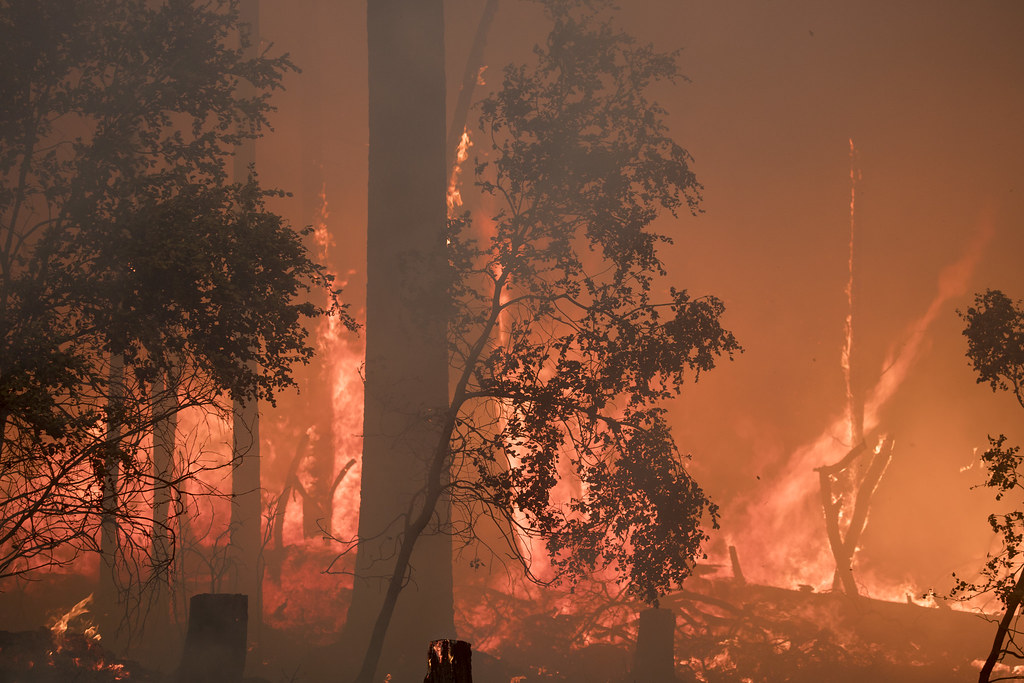
Photo: “20180722_fs_sierra_kg_1081” by Forest Service Photography is marked with Public Domain Mark 1.0.

Sonnet: Eric McHenry, ‘Lives of the Poets’

They rubbed two sticks together and made friction.
They made a fist but couldn’t make a hand.
Their dictionary wasn’t made of diction.
Their diction made them hard to understand.

Trying to make a poem, they made a list.
Trying to make the team, they made the choir.
They made up stories whose protagonist
would rub two sticks together and make fire.

Mistakes were made, and mixtapes to go with them.
They made a couch their bed and made their bed.
They tried to make a joke at the expense
of love and money. “Make me,” money said.
They made up stories but they made no sense.
They rubbed two cents together and made rhythm.

*****

Eric McHenry writes: “Strangely, I remember almost nothing about writing this poem, except that I was thinking about the etymology of ‘poet’ (‘maker’) and about the versatility of the verb ‘make’.”

‘Lives of the Poets’ was first published in Literary Matters.

Eric McHenry is a professor of English at Washburn University and a past poet laureate of Kansas. His books of poetry include Odd Evening, a finalist for the Poets’ Prize; Potscrubber Lullabies, which received the Kate Tufts Discovery Award; and Mommy Daddy Evan Sage, a collection of children’s poems illustrated by Nicholas Garland. He lives in Lawrence, Kansas, with his wife and two children.
Eric McHenry – The Waywiser Press
Eric McHenry, Author at The American Scholar

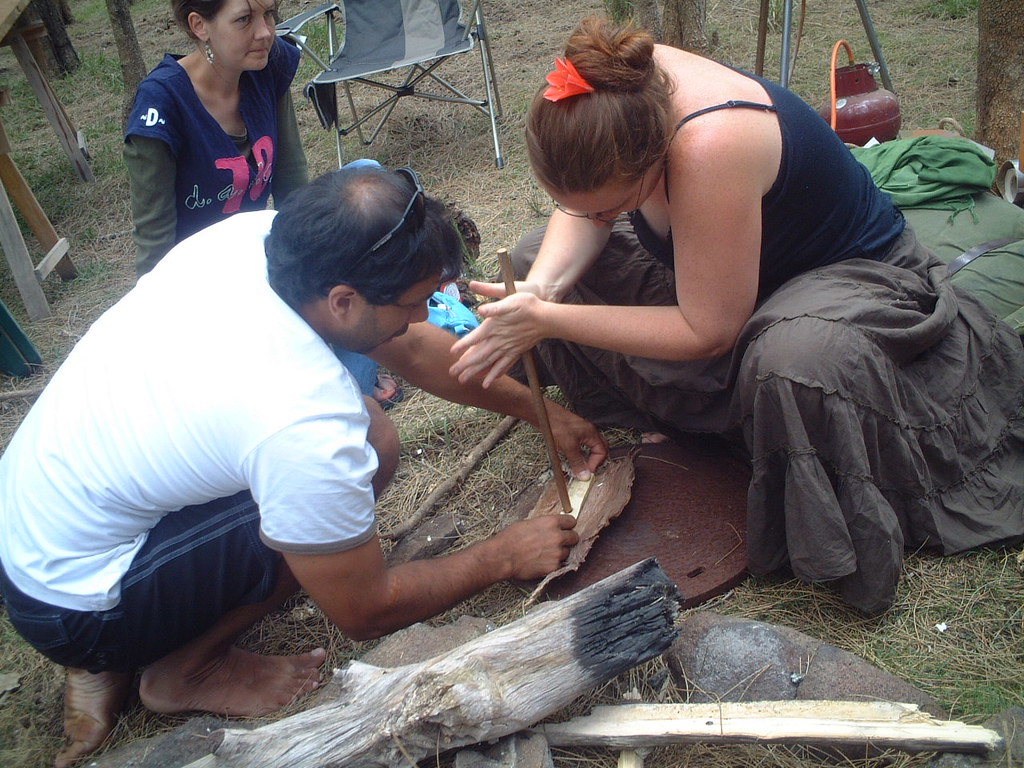
Photo: “Master Sacha twirls the fire stick” by one thousand years is licensed under CC BY 2.0.

Using form: Sonnet: Max Gutmann, ‘How to Inspire a Sonnet – advice from the pros’

Inspire amore first, but molto forte
If in sonetti dolci you’d be sung.
Then see that you stay bella. You’ll support a
Passione deep and long by dying young.
— Laura

If thou upon his stage the Muse’s part
Wouldst play, each act thou study’st must prolong
Thy Poet’s pain. ‘Tis pain shall prompt great Art.
Then con thy lines with style, and do him wrong.
— The Dark Lady

Stay always by her. Never for a day
Be from her cherished side. ‘Tis paramount
To share the highest love. (And, by the way,
It helps to choose a lover who can count.)
— Robert Browning

‘Tis mystery that fires the crucial spark,
So make him wait–and keep him in the dark.
— Milton’s blindness

*****

Max Gutmann writes: “A reader of Light Quarterly (the marvellous Light back in its days as a print journal) was so offended by a poem of mine ridiculing a lousy president that he cancelled his subscription. Beloved editor John Mella forwarded a copy of the note to me. It was a sonnet! I’d never thought I could inspire a sonnet. I had a ways to go before rivaling Laura or the Dark Lady, but I’d taken the first step. That inspired this poem.

“John declined the poem, so it first appeared in a journal that didn’t specialize in light verse, one highly thought of. (Digging it out now, I see that contributors to the issue the poem appeared in included, among others I admire, Updike, Espaillat, Turner, Gioia, and Hadas.) But the journal goofed. They changed sonnetti dolci to sonnetti dolce (plural noun, singular adjective). This must have been a typo, I imagined, but when I asked, the chief editor not only admitted the change had been intentional, but defended the decision. Dolce being the more familiar form, he argued, it was reasonable to make the change without consulting the writer. I never sent them anything again

“This story calls for a shout-out to Jerome Betts, who reprinted ‘How to Inspire a Sonnet’ in Lighten Up Online (LUPO). (To avoid the impression that Jerome is less than meticulous about acknowledgements–or about anything–I should make clear that I asked him not to acknowledge the earlier journal, and I didn’t name it for him.) Jerome, like most editors I’ve worked with, always asks before making changes–and his proposed changes are usually improvements, often big ones!”

Editor’s note: This poem suggests what might be appropriate ways to inspire sonnets, according to the subjects of sonnets: Petrarch’s Laura, Shakespeare’s Dark Lady, Elizabeth Barrett Browning’s Robert and Milton’s blindness. Self-referentially, the poem is itself a Shakespearean sonnet, written in response to being the subject of a sonnet. Gutmann is therefore both sonneteer and sonnetee, and has the credentials to write a “How to –“

Max Gutmann has worked as, among other things, a stage manager, a journalist, a teacher, an editor, a clerk, a factory worker, a community service officer, the business manager of an improv troupe, and a performer in a Daffy Duck costume. Occasionally, he has even earned money writing plays and poems.

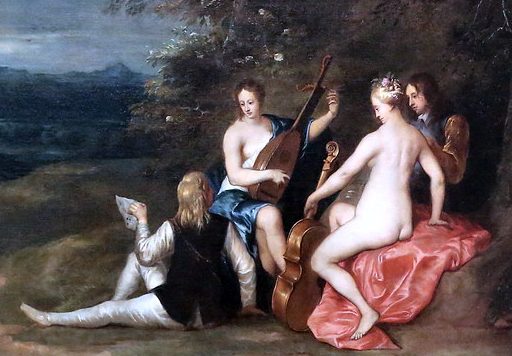
Photo: “IMG_0323C Frans Wouters. 1612-1659. Antwerp. The rural concert. 1654. Dole” by jean louis mazieres is licensed under CC BY-NC-SA 2.0.
Using form: Hybrid sonnet: Susan McLean, ‘Your Other Women’

Your secretaries, eager to assist you;
your colleagues, protégées, even your dean;
the shopgirls who, you joke, cannot resist you;
my own best friends; the maid who comes to clean;
the women whom you’ve charmed in conversation;
the students who adore you from afar—
how can I resent their admiration,
knowing, better than they, how good you are?

So pick your favorite starlets for your spree,
and rent each film they’ve been in from the start—
I won’t complain. How can I say you’re wrong
to ogle blondes you swear all look like me?
For when our jobs require long weeks apart,
we both know what it takes to get along.

*****

Susan McLean writes: “I was surprised to discover the range of interpretations this poem has received. I had meant to subvert the title with the poem’s content, but I have learned in the past that readers are more likely to twist the content to fit the title than to suspect that the title might be ironically meant. A poem can have many different interpretations, depending on what the reader brings to it, so I have accepted that what a reader sees in it may not be what I intended. This poem was originally written in response to Alfred Nicol’s poem ‘Your Other Men’, a much edgier poem. But mine was intended as a humorous love poem to my partner, a man who likes women and whom women tend to like.
The sonnet is a hybrid, with the first eight lines conforming to the Shakespearean model and the last six lines to the Petrarchan model. That dichotomy felt right for decribing an often-long-distance relationship in which our similarities and differences have learned to work together in harmony.”

‘Your Other Women’ was originally published in Hot Sonnets: An Anthology. Eds. Moira
Egan and Clarinda Harriss. Washington, DC: Entasis, 2011. It later appeared in her second poetry book, The Whetstone Misses the Knife.

Susan McLean has two books of poetry, The Best Disguise and The Whetstone Misses the Knife, and one book of translations of Martial, Selected Epigrams. Her poems have appeared in Light, Lighten Up Online, Measure, Able Muse, and elsewhere. She lives in Iowa City, Iowa.
https://www.pw.org/content/susan_mclean

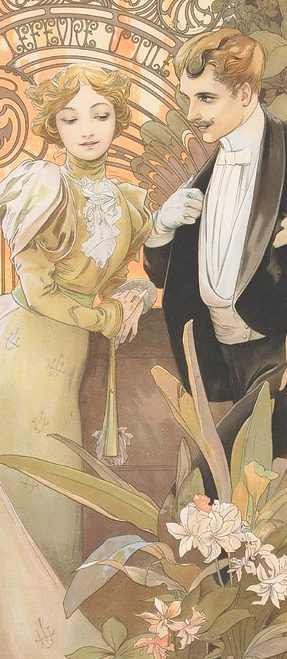
Photo: “Alphonse Mucha – Flirt Biscuits” by sofi01 is licensed under CC BY-NC 2.0.

Using form: Sonnet within Sonnet: Daniel Kemper, ‘Her Petrarchan Heart’

a Petrarchan sonnet embedded inside an Elizabethan sonnet

I smile in my Italian heart—but English ways,
against emotions so taboo, require some tact
and so I’m hiding in plain view. My eye still strays.
My nerves are tinder. But the part below this act,
which kindles want, slips through the art I layer on
and now that art is burning too. It’s civil war:
I smother it, but when I do, though flames seem gone,
the smolderings rebel, restart, and billow more.
And yet I’ve learned to love this dance and my disguise
far more than I let on I do. I bait and stare.
I turn demure. It draws you in, intensifies,
and stops. I am not queen by chance. I hold you there:
But if I let you go will you pull through your doubt,
let my Elizabeth stay in…and Petrarch out?

*****

Daniel Kemper writes: “Her Petrarchan Heart is a sonnet within a sonnet, tetrameter within hexameter, to illustrate the real personage inside the speaker.”

Editor’s note: You can indeed read down the poem, line by line, skipping the last four syllables in each line:
I smile in my Italian heart
against emotions so taboo

you will find the rhythm and rhymes easily enough to guide you, and it is a complete poem in itself, the heart sonnet (Petrarchan, rhyming ABBA ABBA CDE CDE) within the speaker sonnet (Shakespearean, rhyming ABAB CDCD EFEF GG).

The poem(s) first appeared in The Society of Classical Poets.

Daniel Kemper is a systems engineer living in California. He writes that his “poetry rebels against the constraints of form, not by destroying it and discarding it, but by turning the tables” in his approach. Only recently emerging into the poetry scene Kemper has already been accepted for publication at thehypertexts.com, The Creativity Webzine, Amethyst Review, Rat’s Ass Review, and Ekphrastic Review. He earned a BA from NC State, and an MBA from University of Phoenix, is currently enrolled in an MA program in Creative Writing at Cal State U, Sacramento, and is working towards being certified to teach community college.

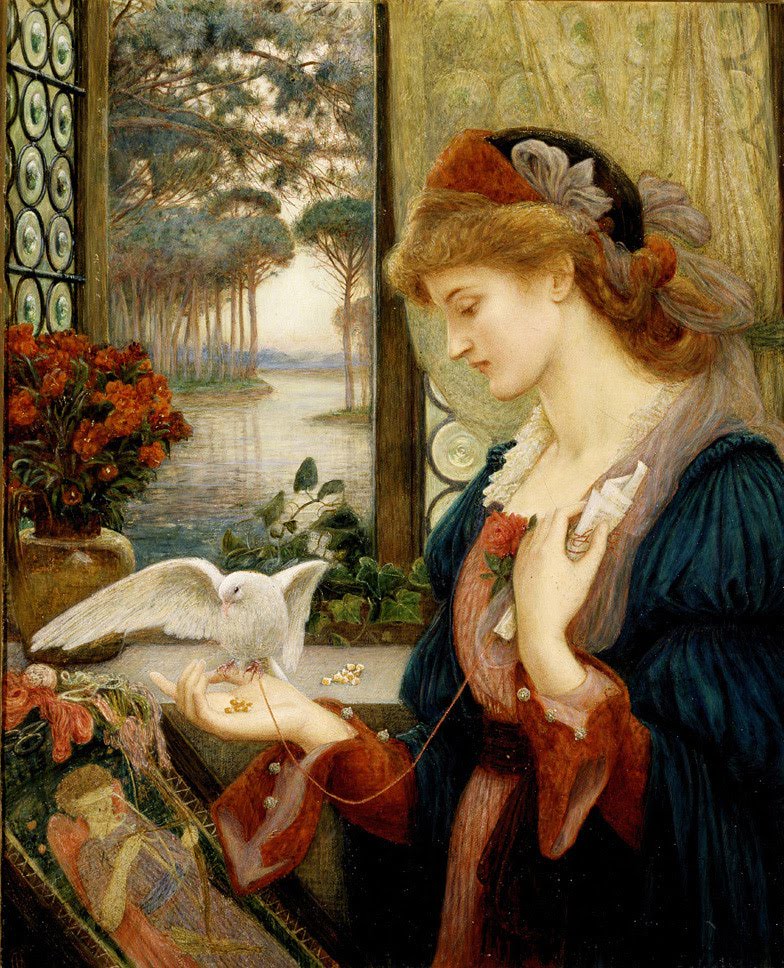
Illustration: “Marie Spartali Stillman – Love’s Messenger [1885]” by Gandalf’s Gallery is licensed under CC BY-NC-SA 2.0.
Sonnet: ‘Simulating the Past’

In the far future, humans gone from Earth,
now disembodied as self-structured flows
of energy and information, woes
of the unknown replacing old Death, Birth
and even Copulation; when a dearth
of physical experience bestows
rich glamor on ideas of Nature’s shows–
sunset, moon rise, trees, seas–the planet’s worth…
they’ll lust after these days we suffer through,
marveling at the rich chaotic times,
enthralled by nearing immortality
while planetary destruction loomed in view.
Wrapping themselves in simulated climes,
they think them us… Are they?… We’re them?… Maybe!

*****

One of my more obscure Petrarchan sonnets, perhaps… but Nick Bostrom of Oxford University hypothesises that, as simulations get increasingly complex, engaging and realistic, there will ultimately be many more simulations than the original reality… and therefore that there is a higher probability that you are living in a simulation than in the “real” world. Whatever the “real” world is. Or whoever you actually are. And seeing as Quantum Mechanics is drawing us all into a sense of the illusory nature of reality (particles being waves when they feel like it, or until closely questioned), then maybe somewhere between Ancient Hinduism and future physics we are all something that we haven’t come close to figuring out yet.

Published in Rat’s Ass Review – thanks, Rick Bates!

Woman having fun with a VR set” by Rawpixel Ltd is licensed under CC BY 2.0.

Odd poem: ‘Sonnets for the Novachord (1.)’ by the non-existent Ern Malley

Rise from the wrist, o kestrel
Mind, to a clear expanse.
Perform your high dance
On the clouds of ancestral
Duty. Hawk at the wraith
Of remembered emotions.
Vindicate our high notions
Of a new and pitiless faith.
It is not without risk!
In a lofty attempt
The fool makes a brisk
Tumble. Rightly contempt
Rewards the cloud-foot unwary
Who falls to the prairie.

*****

This sonnet is by “Ern” Malley, a fictitious poet whose biography and body of work were created in one day in 1943 by conservative writers James McAuley and Harold Stewart in order to hoax the Angry Penguins, a modernist art and literary movement centred around a journal of the same name, co-edited by poet Max Harris and art patron John Reed, of Heide, Melbourne.

In one afternoon, McAuley and Stewart wrote Malley’s entire body of work: 17 poems, none longer than a page, and all intended to be read in sequence under the title The Darkening Ecliptic. Their writing style, as they described it, was to write down the first thing that came into their heads, lifting words and phrases from the Concise Oxford Dictionary, a Collected Shakespeare, and a Dictionary of Quotations: “We opened books at random, choosing a word or phrase haphazardly. We made lists of these and wove them in nonsensical sentences. We misquoted and made false allusions. We deliberately perpetrated bad verse, and selected awkward rhymes from a Ripman’s Rhyming Dictionary.”

They mailed sixteen poems to Harris under the guise of Ethel, Ern Malley’s surviving sister. Harris and other members of the Heide Circle fell for the hoax, and, enraptured by the poetry, devoted the next issue of Angry Penguins to Malley, hailing him as a genius. The hoax was revealed soon after, resulting in a cause célèbre and the humiliation of Harris, who was put on trial, convicted and fined for publishing the poems on the grounds that they contained obscene content. Angry Penguins folded in 1946.

In the decades that followed, the hoax proved to be a significant setback for modernist poetry in Australia. Since the 1970s, however, the Ern Malley poems, though known to be a hoax, became celebrated as a successful example of surrealist poetry in their own right, lauded by poets and critics such as John Ashbery.

The above is copied and tweaked from https://en.wikipedia.org/wiki/Ern_Malley_hoax

and the BBC covers his story here: https://www.bbc.com/reel/video/p0f3h03g/ern-malley-the-influential-australian-poet-who-never-lived

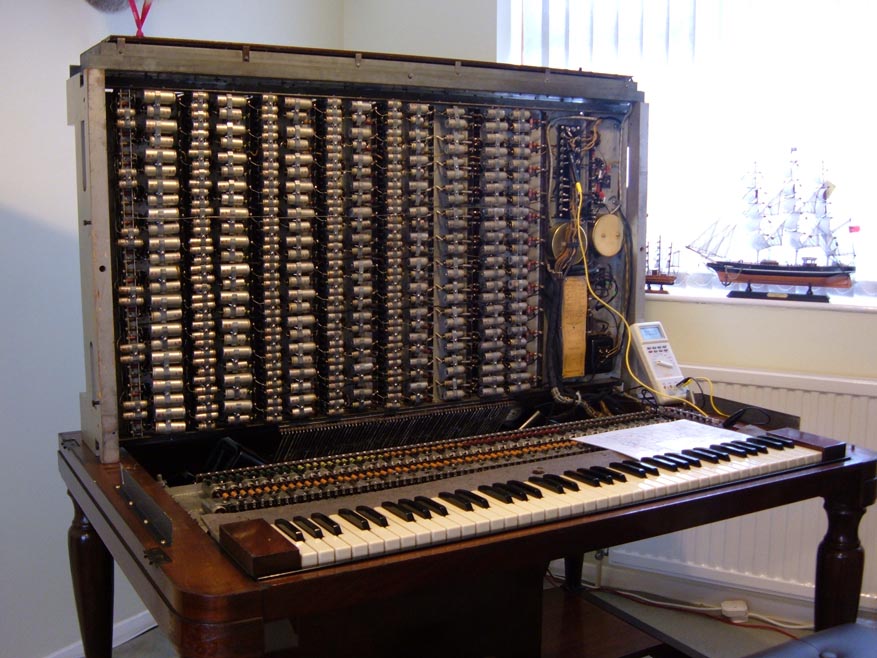
CC BY 3.0, File:Novachord insides3.jpg, Created: 29 December 2009 Attribution: Hollow Sun at English Wikipedia

A.M. Juster: ‘Cancer Prayer’

Dear Lord,
Please flood her nerves with sedatives
and keep her strong enough to crack a smile
so disbelieving friends and relatives
can temporarily sustain denial.

Please smite that intern in oncology
who craves approval from department heads.

Please ease her urge to vomit; let there be
kind but flirtatious men in nearby beds.

Given her hair, consider amnesty
for sins of vanity; make mirrors vanish.

Surround her with forgiving family
and nurses not too numb to cry. Please banish
trite consolations; take her in one swift
and gentle motion as your final gift.

*****

A.M. Juster writes: “One of my favorites.”

A.M. Juster is the Plough Quarterly poetry editor. His work has appeared in Poetry, Paris Review, Hudson Review and other journals. His tenth book is Wonder and Wrath (Paul Dry Books 2020) and his translation of Petrarch’s Canzoniere is due from W.W. Norton in early 2024.
www.amjuster.net

Photo: “A Silent Calling” by Alyssa L. Miller is licensed under CC BY 2.0.

Irregular Sonnet: ‘Where Do They Go?’

Where do they go, those children asleep?
Do they roost, or do angels put them on shelves?
Or do they go home, to some place they keep
locked far away from us and themselves,
Or an alternate universe? In, out, up, down?
Into a not-place, past care and past fear?
Past love and past tired, past smile, yawn and frown
into subtracted space, full of not here?

And where do they go, the dead?
We say we can’t know where they go,
just that they’re gone. But the crow
says, There is more to know that you don’t know –
says, Better ask instead
where do we go, when dead?

*****

This almost-regular sonnet was originally published in Bewildering Stories (thanks Don Webb). I thought it might be nice to emphasise (after some of irreligious poems) that I am not an atheist (except in the eyes of the organisedly religious). I am a Militant Agnostic: “I don’t know, and neither do you.”

Photo: “Good sleeping children in the morning” by michibanban is licensed under CC BY-NC-ND 2.0.