Tag Archives: Susan McLean

Using form: Triolet: Susan McLean, ‘In Arcadia’

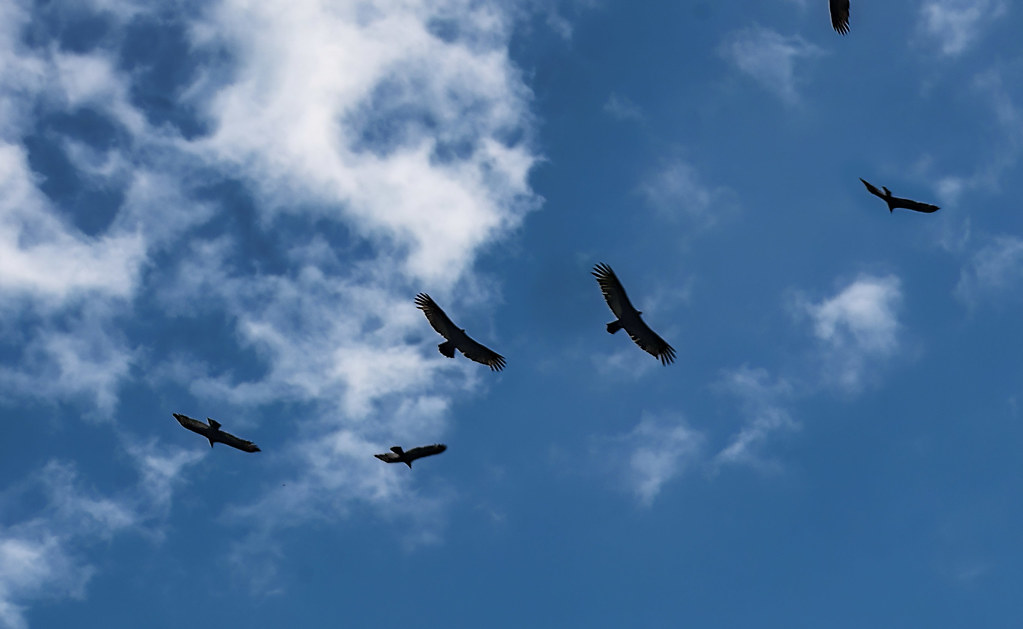
We hadn’t pictured paradise
with vultures circling overhead.
Edenic lushness has a price
we hadn’t pictured. Paradise
seems changeless, but its clock’s precise.
“It’s feeding time,” the watchers said.
We hadn’t pictured paradise
with vultures, circling overhead.

*****

Susan McLean writes: “This triolet was inspired partly by the Latin phrase “Et in Arcadia ego” (which means “I too [am or was] in Arcadia”), partly by the famous Nicolas Poussin painting in which that phrase appears on a tombstone surrounded by gawking Arcadian shepherds, and partly by a family trip to Florida at Christmas, to celebrate my parents’ sixtieth wedding anniversary. Arcadia, a region in Greece, was made famous by Vergil in his Eclogues as an idyllic rural land mainly populated by shepherds. “Arcadia” thus came to be associated with a relaxed bucolic paradise. Yet the Latin phrase reminds us that no earthly location is immune to death.

“In contemporary America, one of the locations associated with tropical warmth and pleasant leisure is Florida, where many Americans from more northerly locales go to vacation or retire. While my family was staying at a rented home near Sarasota Bay, on the highway we often passed signs for Arcadia, Florida, which was not far away. The weather and the natural beauty of Sarasota came up to our expectations, but we did not foresee that every time we went outside we would see vultures circling overhead. Given our parents’ ages, the vultures were a poignant reminder of mortality.

“A triolet is one of the shorter French repeating forms. One of the challenges it presents is how to vary the repeated lines so that they do not become boring, usually done by adding slight changes to the punctuation of those lines. This poem originally appeared in Able Muse and later in my second poetry book, The Whetstone Misses the Knife.”

Susan McLean has two books of poetry, The Best Disguise and The Whetstone Misses the Knife, and one book of translations of Martial, Selected Epigrams. Her poems have appeared in Light, Lighten Up Online, Measure, Able Muse, and elsewhere. She lives in Iowa City, Iowa.
https://www.pw.org/content/susan_mclean

Photo: “Road Trip Santa Clara to Camajuani via Central Road of Cuba (banda Placetas) passing through La Movida, Pelo Malo, Manajanabo, Miller town and Falcon city. Villa Clara province, Cuba, November 2023” by lezumbalaberenjena is licensed under CC BY-NC-ND 2.0.

Using form: Iambic trimeter: Susan McLean, ‘Danse Macabre’

The dancers, taut as bows,
burn in their joyous fire.
They whirl, entwine, and pose
in friezes of desire.

No skeletons appear
to shock the celebration.
The dancers, bowing, hear
a rapturous ovation.

Outside, the wind blows colder.
Although she’d rather linger,
she senses on her shoulder
the tap of a light finger.

And, though she came alone
and doesn’t need a ride,
a shadow, thin as bone,
attends her, stride for stride,

then leaves her, still denied.
But the end is not in doubt.
The skeleton inside
eventually wants out.

*****

Susan McLean writes: “I wrote this poem after attending a performance of Ailey II, the junior corps of dancers in the company founded by Alvin Ailey. It was on a cold night in autumn around Halloween, and even though there was nothing sinister about the dances I witnessed, I was reminded of the medieval Dance of Death, in which skeletons appear to people in the midst of their daily routine to summon them away to death. One of the most memorable images of that theme occurs at the end of Ingmar Bergman’s film The Seventh Seal, and I have seen it portrayed also on the wooden bridge in Lucerne in Switzerland. The poem is written in three-beat lines of iambic trimeter, which reminded me of a stately waltz.”

‘Danse Macabre’ originally appeared in THINK Magazine.

Susan McLean has two books of poetry, The Best Disguise and The Whetstone Misses the Knife, and one book of translations of Martial, Selected Epigrams. Her poems have appeared in Light, Lighten Up Online, Measure, Able Muse, and elsewhere. She lives in Iowa City, Iowa.
https://www.pw.org/content/susan_mclean

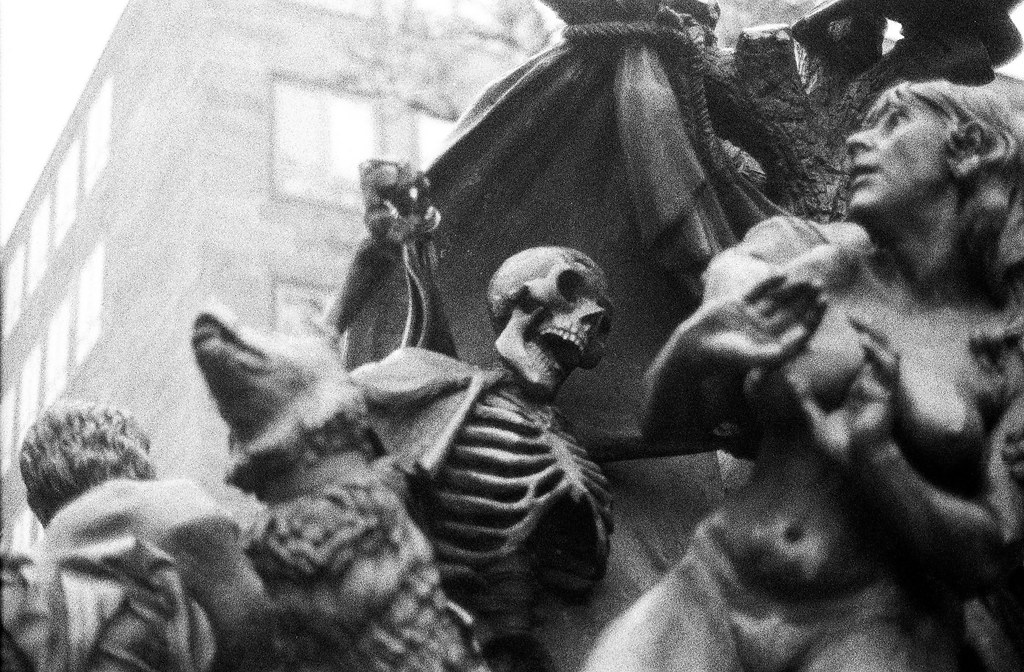
la danse macabre” by a magic monkey! is licensed under CC BY-NC-SA 2.0.

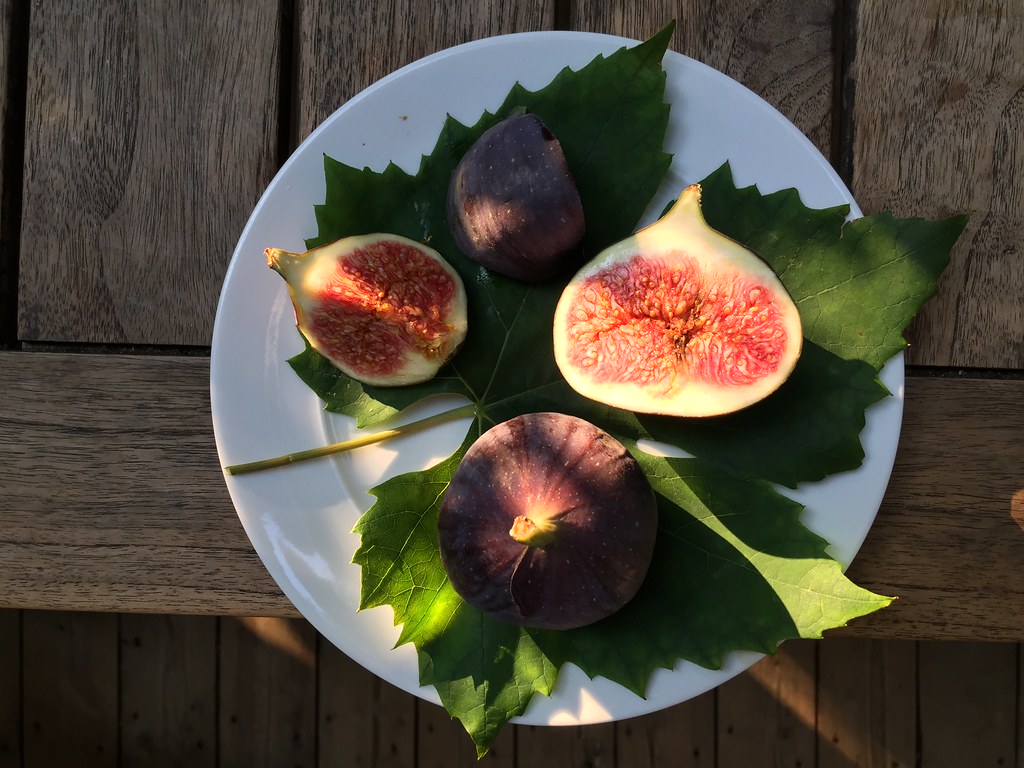
Using form: Quatern: Susan McLean, ‘Cropped’

He doesn’t care for flowers or for fruit,
so don’t implore him not to clip or prune
the fig trees and camellias. His pursuit
of geometric form makes him immune

to luscious tastes and beauties others crave.
He doesn’t care for flowers or for fruit,
so once the buds appear, don’t try to save
them from his trimmer. All your pleas are moot.

He holds a tidy yard in high repute,
a verdant symbol of his mastery.
He doesn’t care for flowers or for fruit,
but takes some pleasure in your misery

as he destroys what you had hoped to see.
His need to have control is absolute,
and you can’t argue with machinery.
He doesn’t care for flowers or for fruit.

*****

Susan McLean writes: “This poem started with my desire to write a quatern, a form that I had encountered in Chad Abushanab’s workshop on rare poetic forms at the Poetry by the Sea conference in 2024. A quatern is four quatrains long, and the first line of stanza one becomes the second line of stanza two, and so on. As for the poem’s content, it grew out of a dispute about gardening practices with someone I know well. I was unable to convince him to change his ways. I should add that his ascribed motives are all conjectural on my part, not based on anything he said. But poets don’t really lose an argument; they just take the opportunity to restate it as a poem. This poem first appeared in the August 2025 issue of Snakeskin.”

Susan McLean has two books of poetry, The Best Disguise and The Whetstone Misses the Knife, and one book of translations of Martial, Selected Epigrams. Her poems have appeared in Light, Lighten Up Online, Measure, Able Muse, and elsewhere. She lives in Iowa City, Iowa.
https://www.pw.org/content/susan_mclean

Photo: Snakeskin

Political poem: Villanelle: Susan McLean, ‘Echo Chambers’

Everyone wants peace, but votes for hawks.
A senator holds forth to an empty chamber.
No one listens. Everybody talks

conspiracies and outrage. Voting blocs
preserve their seamless fronts, and by November,
everyone wants peace, but votes for hawks.

I shoot my mouth off, and you shoot your Glocks.
Statesmen make deals they later can’t remember.
No one listens. Everybody talks

in slogans sold on T-shirts. Hackers doxx
judges whose moral codes are less than limber.
Everyone wants peace, but votes for hawks.

Act your rage, they tell you. Ragnarok’s
coming your way, to light you up like timber.
No one listens. Everybody talks

as midnight’s ticking closer on the clocks.
We’re parties of one, and one’s a lonely number.
Everyone wants peace, but votes for hawks.
No one listens. Everybody talks.

*****

Echo Chamber was originally published in Rattle‘s Poets Respond.

Susan McLean writes: “The original idea for the poem came when I heard about a senator addressing an empty chamber in Congress. I commented “No one listens. Everybody talks.” It occurred to me then that that would make a good repetend in a villanelle. As I worked on writing it, my feelings about other recent events influenced the direction the poem took. As I wrote in Poets Respond, “It wasn’t one story this week that inspired this poem, but a confluence of events: the proposed invasion of Gaza by Israel, the wildfires all over the U.S. and Canada, the lone shooter trying to register his outrage by killing people at the CDC, the Democrats fleeing Texas in an effort to prevent redistricting. It all felt apocalyptic and Wagnerian to me.”

Susan McLean has two books of poetry, The Best Disguise and The Whetstone Misses the Knife, and one book of translations of Martial, Selected Epigrams. Her poems have appeared in Light, Lighten Up Online, Measure, Able Muse, and elsewhere. She lives in Iowa City, Iowa.
https://www.pw.org/content/susan_mclean

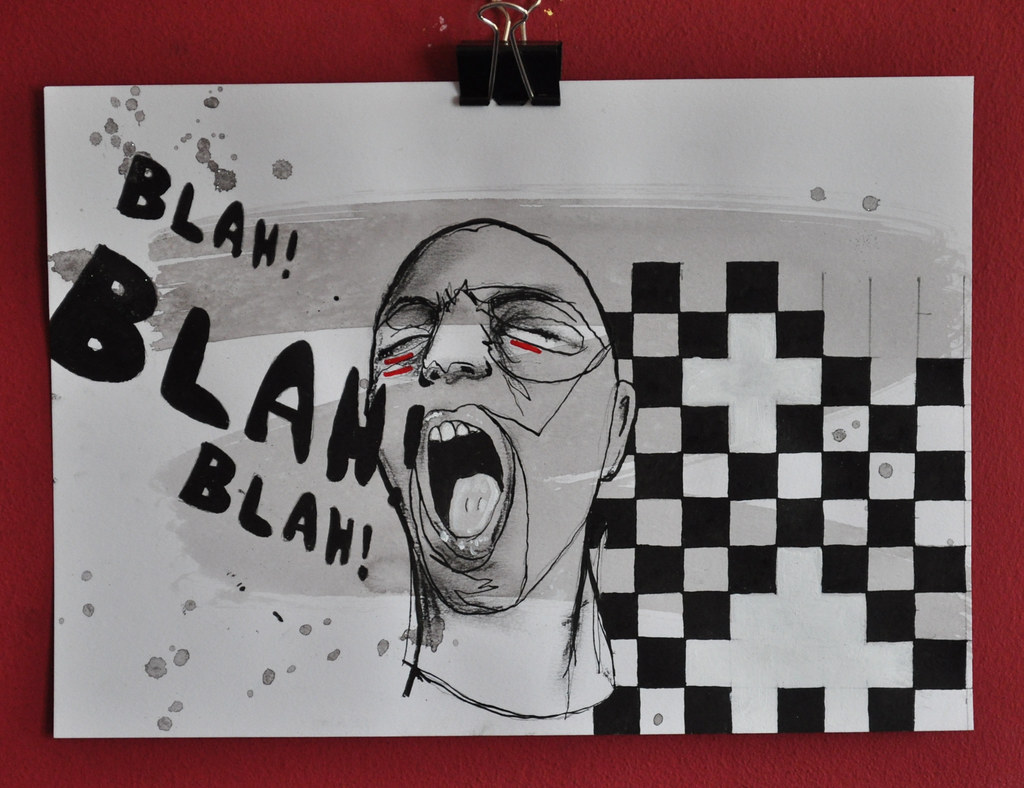
Photo: “Blah Blah Blah” by id-iom is licensed under CC BY-NC 2.0.
Susan McLean, ‘Anagram: A Pallor, An Edge’

Late at night, I saw a glowing,
as if realms beyond our knowing
kindly solace were bestowing.
Could this phantom be my wife?
 
But the gleam, as I drew nearer,
taking form and growing clearer,
was my visage in the mirror,
and the figure held a knife.
 
“Fool,” said I, “your idle dreaming
on some insubstantial seeming
is some demon’s way of scheming
to mislead your soul to hell.

“Melancholy, doom-and-glooming,
pining, horror, guilt, exhuming,
Nevermore and Ulalume-ing –
write your angst out: that could sell.”

*****

Susan McLean writes: “This poem was inspired by a 2019 competition at The Spectator to write a poem in the style of a famous author and to have its title be an anagram of the poet’s name. I was a big fan of the poetry and short stories of Edgar Allan Poe when I was a teen, so I investigated words that I could draw from his name that would have strong associations with his work. Poe married his thirteen-year-old cousin, Virginia Clemm, who died of tuberculosis eleven years later. Many of his poems and stories concern mourning for the death of a beautiful woman, including his most famous poem, “The Raven.” This poem borrows the trochaic meter and some elements of the rhyme scheme of that poem. It also alludes to a number of Poe’s favorite themes, and echoes some of his lines. It was not among the winners at The Spectator, but I later reworked it, and it recently appeared in Lighten Up Online.”

Susan McLean has two books of poetry, The Best Disguise and The Whetstone Misses the Knife, and one book of translations of Martial, Selected Epigrams. Her poems have appeared in Light, Lighten Up Online, Measure, Able Muse, and elsewhere. She lives in Iowa City, Iowa.
https://www.pw.org/content/susan_mclean

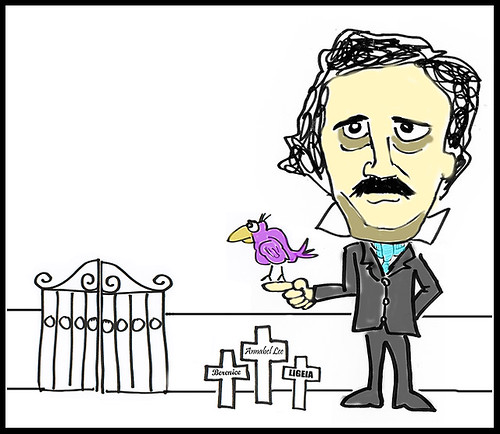
Edgar Allan Poe (ilustración off topic)” by El Humilde Fotero del Pánico is licensed under CC BY-NC 2.0.
Quatrains: Susan McLean, ‘Pain Management’

The management has gauged how much you’ll take
before you buckle or walk out. They care
about your health—at least until you break,
use up your sick leave, or require repair.

The management endorses your retiring
early. They will help you out the door,
so that they can economize by hiring
fresh blood for half of what they paid before.

The management can’t monetize your gain
in knowledge or experience. They doubt
that anything you’d do if you remain
could beat their savings if you’re shunted out.

They needn’t lay you off, just raise your stress
through higher workloads and adverse conditions,
until exhaustion, strain, and hopelessness
force you to leave, fulfilling their ambitions.

*****

Susan McLean writes: “In my lifetime, I’ve worked in private businesses, government agencies, and academia; most of them abused or exploited workers at some level, which is not surprising when power relations are one-sided. However, I was most shocked by what happened when the business model was applied to education. Education suffers when students are treated as products to be turned out as cheaply as possible, and when teachers are treated as easily replaceable cogs in a machine. But the mistreatment of workers to increase profitability is widespread across many forms of employment, so I did not want to limit the poem’s relevance to the academic world.

“Over the thirty years that I taught at a state university, states reduced the amount they paid for public higher education, shifting the economic burden more and more to the students, and creating budget crises for the universities. In response, university administrators reduced their hiring of professors, often increasing class sizes dramatically, shifting teaching of many classes to ridiculously underpaid grad students or adjunct instructors with no job security, and shutting down departments in order to lay off tenured professors. Students were paying more and getting less; professors were overworked and fearful of losing their jobs at ages at which no one else would be likely to hire them; recent PhDs were unable to find teaching jobs with a livable wage or any prospect of long-term employment. Meanwhile, administrative jobs were burgeoning, adding more deans and assistant deans to bolster the status and shoulder the duties of those in charge.

“The stress and overwork that many professors experienced under the business model of higher education took a physical toll on many, with some disciplines suffering more than others. Those who had to spend endless hours at computers or grading papers tended to develop back pain and a host of other ailments common to sedentary jobs. When administrators offered incentives for them to accept early retirement, so that the university could save money by replacing them with lower-paid workers, many retired. I was one of them.

“This poem got its start when I noticed that “pain management” (usually associated with using analgesics or other methods to reduce pain) could also mean “management by means of pain.” It was published in New Verse Review.”

Susan McLean has two books of poetry, The Best Disguise and The Whetstone Misses the Knife, and one book of translations of Martial, Selected Epigrams. Her poems have appeared in Light, Lighten Up Online, Measure, Able Muse, and elsewhere. She lives in Iowa City, Iowa.
https://www.pw.org/content/susan_mclean

Photo: “Stress” by topgold is licensed under CC BY 2.0.

Using form: Shakespearean sonnet: Susan McLean, ‘Foreshadowing’

You’re a holiday.
—”Holiday,” The Bee Gees

One month from when you met me, when you brought
the first of many gifts, a 45
of plaintive praise and longing, who’d have thought
that forty-five years later we’d survive
on weekends, holidays, and summer breaks,
a foretaste of the end in every start,
anticipation ballasted with aches
as we put love on hold and live apart?

You are a holiday. The working week
unspools like toilet paper from a roll.
My attitude goes airborne when we speak,
and when we meet, my heart swoops like a shoal
of fish. Would we have lost this giddy glow,
living together? Better not to know.

*****

Susan McLean writes: “It makes me feel ancient to realize that for younger readers I will have to explain that a 45 was a record with one song on each side, which played on a record player at 45 revolutions per minute. Love poems themselves tend to feel old-fashioned these days, though this one is about a relatively modern problem, the long-term, long-distance relationship in which both people are employed full time at jobs far apart from one another. The form, a Shakespearean sonnet, mirrors the content, in that the rhymes are separated from one another until the end, when they are reunited. The poem was originally published in the online journal of female formalist poets Mezzo Cammin, and it later appeared in my second book of poetry, The Whetstone Misses the Knife.

Photo: “File:45 record.png” by laurianne is marked with CC0 1.0.

Susan McLean, ‘Home Economics’

Like other teenage girls in ‘65,
I learned to knit, embroider, and crochet,
so if I’m teleported back in time
a century or two, I’ll do okay.

I learned the way to wrap a package neatly,
to tie a range of plain and froufrou bows,
to minimize my body flaws discreetly,
using the cut and pattern of my clothes.

I also learned to iron, hem, and baste,
to sew on zippers, trim, and appliqué,
to choose a hairdo that would suit my face—
and nothing that I ever use today.

*****

Susan McLean writes: “In the mid-Sixties, the times were changing, but the education of teenage girls was not. In junior high school home economics classes, which girls were required to take, the girls were trained in sewing and cooking skills as preparation for their future roles as wives and mothers. The ideas that men might need to know any of those skills or that women might have full-time careers were not considered. In addition to teaching girls domestic skills, the classes served to reinforce the gender roles and expectations of the time (which had not changed significantly from those of the previous few centuries).

“I slightly overstate my case when I say that I never use anything now that I learned in the two years of sewing classes I took. I still wrap a package and sew on a button occasionally, but I had learned both of those skills well before I took the classes. And even when I was taking the classes, I was already determined to have a career of my own. I petitioned successfully to be allowed to skip the cooking classes so that I could take art classes in their place (though, ironically or not, I am now an enthusiastic home cook). I didn’t mind learning various sewing skills, which had an artistic side, but I had no interest in spending a lot of time using them afterwards, and the view of my options that the classes conveyed was quite dispiriting. No one foresaw how radically the roles of many women would be changing soon afterwards. But I am very glad that they changed.

“The rhymed quatrains that the poem is written in are a standard poetic form, though the mix of slant rhymes with true rhymes suggests an underlying dissonance that ties in with the poem’s themes. The poem originally appeared in the online journal Umbrella and was later published in my second poetry book, The Whetstone Misses the Knife.”

Susan McLean has two books of poetry, The Best Disguise and The Whetstone Misses the Knife, and one book of translations of Martial, Selected Epigrams. Her poems have appeared in Light, Lighten Up Online, Measure, Able Muse, and elsewhere. She lives in Iowa City, Iowa.
https://www.pw.org/content/susan_mclean

Photo: “Home Economics Class at Elgin Court School, St. Thomas, 1961” by Elgin County Archives is licensed under CC BY-NC-ND 2.0.

Using form: Heterometric verse: Susan McLean, ‘Teaching to the Test’

I know you have no use for them,
poems with their sly quicksilver words
that won’t just speak their minds,
but carom through your head like startled birds.
Is that despair or longing in their cries?
Their dolors make no sense.
They’ll never buy you larger-screened TVs
or seats at sports events.

But someday, as you watch a pair hold hands
and leap from a burning tower,
as you wait for test results or hear
your phone ring at an unaccustomed hour,
what you feel will circle wordlessly—
tense, accusing, gaunt.
You’ll find that you are tested and found wanting,
and these are what you’ll want.

*****

Susan McLean writes: “As a professor myself and a person who once worked on writing standardized tests, I am familiar with the complaint of teachers that they are often forced to “teach to the test,” i.e., teach only the sort of knowledge and skills that students need for passing that sort of test. But as a poet, I know that we are tested in life in all sorts of ways. Most people think that they can get through life just fine without poetry. They tend to find poetry annoying and impenetrable, something that needs to be decoded, that has no practical use. Yet in tragedies, when all hope and comfort are gone, there is some comfort in hearing that others who have been in similar situations were able to put into words the feelings that you can’t. And the most memorable and condensed of those responses are often poems.
This poem is rhymed and metrical, but the lines are of different lengths in unpredictable patterns, a form called “heterometric,” and the rhymes occur only every other line. That unpredictability is meant to mirror life, in which the bad news always seems to come out of nowhere. The poem originally appeared in Able Muse and later in my second poetry collection, The Whetstone Misses the Knife.”

Susan McLean has two books of poetry, The Best Disguise and The Whetstone Misses the Knife, and one book of translations of Martial, Selected Epigrams. Her poems have appeared in Light, Lighten Up Online, Measure, Able Muse, and elsewhere. She lives in Iowa City, Iowa.
https://www.pw.org/content/susan_mclean

Photo: “When Young Children ‘Hate’ School” by wecometolearn is licensed under CC BY 2.0.

Using form: Villanelle with a limp: Susan McLean, ‘Instructions for Climbing and Descending’

Good foot goes to heaven; bad foot goes to hell.
When every step torments and pain is chronic,
you can’t do as you did before you fell

and sprained your ankle. As the tendons swell,
don’t make things even worse. Learn this mnemonic:
good foot goes to heaven; bad foot goes to hell.

Take one step at a time. Do not rebel
or grumble that restrictions are moronic.
You can’t do as you did. Before you fell,

you bounded up the stairs like a gazelle,
but now your gait is nearly catatonic:
good foot goes to heaven; bad foot goes to hell.

You’ve always known it doesn’t help to dwell
on loss. You should let go, but (how ironic!)
you can’t. Do as you did before you fell,

but try to play it safe while getting well.
The best advice is simple, yet Miltonic:
good foot goes to heaven; bad foot goes to hell.
You can’t do as you did before. You fell.

*****

Susan McLean writes: “I love villanelles. I like them partly because they are songlike and partly because they present interesting challenges for rhyming and for varying the repeating lines, known as repetends. I thought at first that I had set myself an impossible task with my “-onic” rhymes, but they kept surprising me and leading me in new directions. I was not planning to refer to Milton when I started, for example, but when I stumbled on “Miltonic,” it fit perfectly with the metaphors in the first line. When I started, I also didn’t realize how many ways the second repetend could be varied while still making literal sense.
“The idea behind the poem came from real-life experiences. I had sprained my right ankle once, and after I wrote this poem, I broke it twice. However, the first line, which is literally the mnemonic device offered by a physical therapist as a reminder of which foot to step on when going up or down stairs, was one I heard secondhand. My partner John was told it by his therapist when he had a painful foot. The rest of the poem is in lines with five beats (iambic pentameter), but that line has six. I decided to use it, nevertheless, because the extra beat in that repetend slows the line down, mimicking the slow gait of the person with the sprain. It also makes the line itself seem to limp.
The poem was originally published in First Things and later appeared in my second poetry book, The Whetstone Misses the Knife.”

Susan McLean has two books of poetry, The Best Disguise and The Whetstone Misses the Knife, and one book of translations of Martial, Selected Epigrams. Her poems have appeared in Light, Lighten Up Online, Measure, Able Muse, and elsewhere. She lives in Iowa City, Iowa.
https://www.pw.org/content/susan_mclean

Photo: “How Many Times Do You Have to Fall Before You End Up Walking” by Thomas Hawk is licensed under CC BY-NC 2.0.