Tag Archives: Susan McLean

Susan McLean, ‘Dead Giveaway’

Who’ll take my dead? I’ve carried them so long
my mind is swaybacked from their aching weight.
I can’t just cast them off. It would be wrong
to leave them in some shed, like unclaimed freight.
How could I walk away as Cathy’s smile
collapsed, as Brian gently said “Take care,”
and Grammy begged “Please take me home now” while
I shut them in the dark and left them there?

I’ve jettisoned so much I took to heart—
the afterlife, belief in justice, prayer.
I’ll have to lay my dead down too, I know.
After a party, when my friends depart,
I wash up, stow away what’s left, yet they’re
still here. The dead are always last to go.

*****

Susan McLean writes: “I love the way a cliché can take on new life if the words are interpreted in a nontraditional way. The title of this poem seemed painfully poignant to me when I imagined it applying to the dead we all carry around with us. It would be nice to be able to walk away from that sadness, but of course who among us could bring ourselves to do it? Though I try to keep the voice of the poem sounding natural, I pay attention to the play of sounds in the words, as in the echoes of consonant and vowel sounds in the first two lines: “take,” “swaybacked,” “aching,” and “weight.” In the sestet of the sonnet, the imagined action of the speaker’s leaving her dead behind in the octave is reversed when she is herself left behind by her departing friends, with only her dead to keep her company.
This poem first appeared in the online journal 14 by 14, and later was published in my
second poetry book, The Whetstone Misses the Knife.”

Susan McLean has two books of poetry, The Best Disguise and The Whetstone Misses the Knife, and one book of translations of Martial, Selected Epigrams. Her poems have appeared in Light, Lighten Up Online, Measure, Able Muse, and elsewhere. She lives in Iowa City, Iowa.
https://www.pw.org/content/susan_mclean

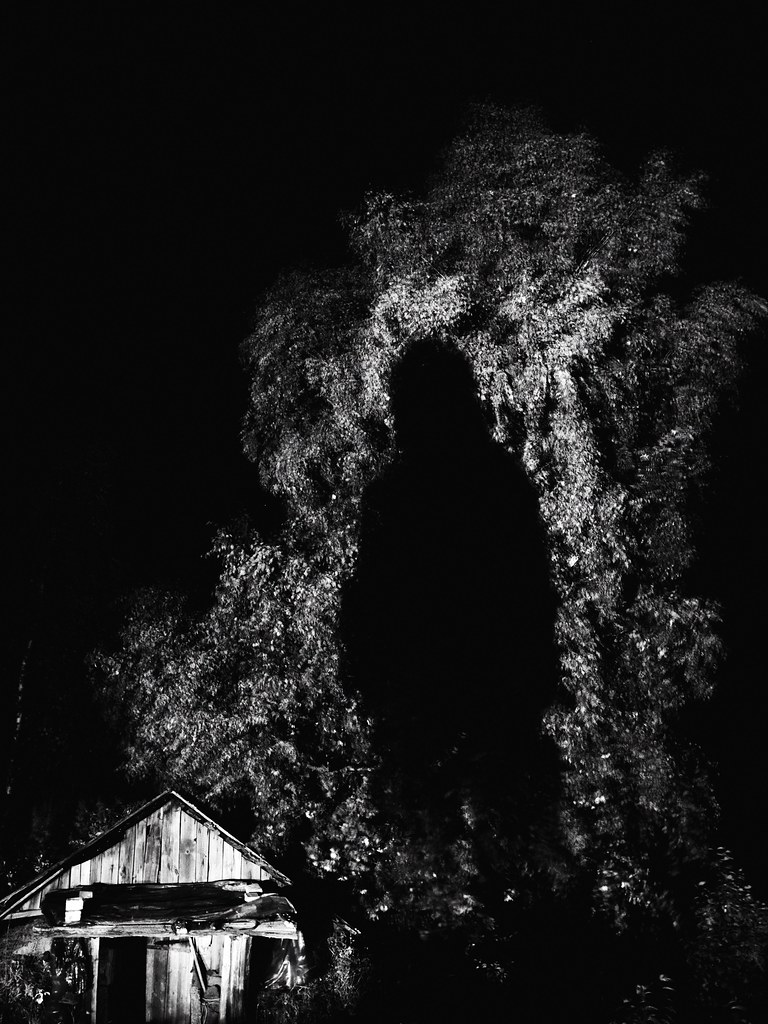
Photo: “Ghosts of the old house” by Tree Leaf Clover is licensed under CC BY 2.0.

Susan McLean, ‘The Mirror’s Desolation’

Once you adored me. I would bask
in looks you saved for me alone,
giving no hint—if any ask—
of secrets only I have known.
But now you find me hard to face.
I care for you too much to lie,
copying lines you would erase.
You hurry past, head down, and I,
sensing your pained indignity,
return your look of mute distress.
Though you no longer cherish me,
I do not love you any less.

*****

Susan McLean writes: “I took the idea of a talking mirror from Sylvia Plath’s poem ‘Mirror,’ but whereas she presents the mirror as being totally dispassionate, my mirror reflects the emotions as well as the faces of those who look into it. Sometimes, if you see someone beautiful, you may think “the mirror loves her (or him).” But it occurred to me that mirrors love everyone. They just as gladly reflect the old and ugly as the young and beautiful. In this poem, I imagine the mirror’s sorrow that its love is not returned. In French, “I’m sorry” is “je suis désolé” (“I’m desolated”), which always seemed charmingly over-the-top to me. It occurred to me that the phrase “the mirror’s desolation” could refer both to the sorrow the mirror feels and to the devastation it causes. This poem first appeared in Valparaiso Poetry Review, and then in my second poetry book, The Whetstone Misses the Knife.

Susan McLean has two books of poetry, The Best Disguise and The Whetstone Misses the Knife, and one book of translations of Martial, Selected Epigrams. Her poems have appeared in Light, Lighten Up Online, Measure, Able Muse, and elsewhere. She lives in Iowa City, Iowa.
https://www.pw.org/content/susan_mclean

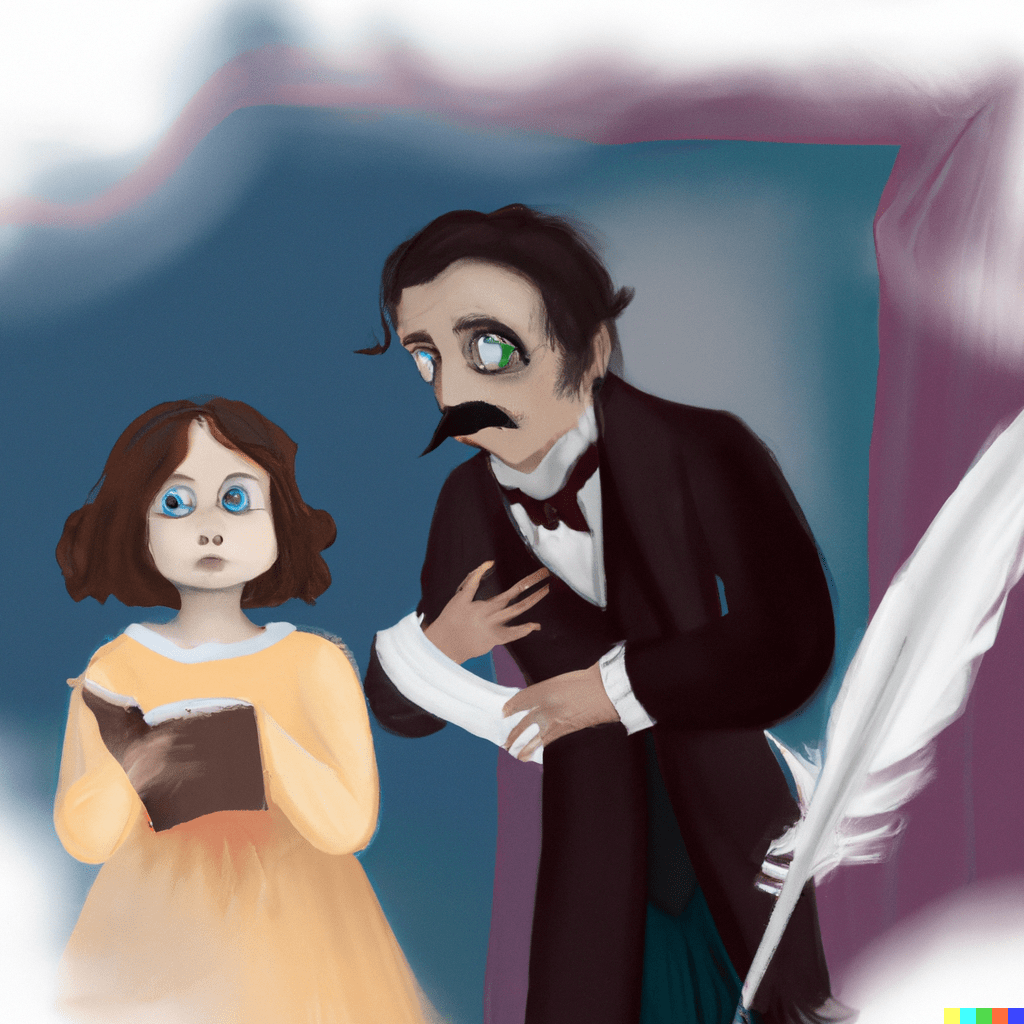
Illustration: DALL-E

Susan McLean, ‘Morbid Interest’

How unpleasant to meet Mr. Poe.
It gives a young lady a chill
when, just as she’s saying hello,
he asks if she’s lately been ill.

It was mid-afternoon, yet he seemed
to be tipsy or mildly sedated.
How oddly his mournful eyes gleamed
when he heard that we might be related.

He muttered some rhymes for my name,
saying nothing could be more inspiring
to a poet desirous of fame
than the sight of young beauties expiring.

Then he asked if I had a bad cough
or a semi-conversable crow.
I informed him of where to get off.
How unpleasant to meet Mr. Poe.

*****

Susan McLean writes: “In my teens, I was a big fan of Edgar Allan Poe‘s short stories and poetry. I loved his eerie subjects and crooning, incantatory lines. I memorized his poem ‘To Helen,’ and I parodied his iconic ‘The Raven.’ But in grad school, I read his essay ‘The Philosophy of Composition,’ in which he wrote that “the death . . . of a beautiful woman is unquestionably the most poetical topic in the world.” Hmmm. At that moment, it occurred to me that all of those dead women of his stories and poems might be less an outpouring of personal grief and more a product of an agenda. Years later, when responding to a challenge from the British journal The Spectator to write a poem modeled on Edward Lear’s ‘How pleasant to know Mr. Lear‘ but about another author, I imagined how Poe might seem to a young woman being introduced to him.
This poem, which was originally published in Light Quarterly, was later reprinted in Per
Contra
and in my second poetry book, The Whetstone Misses the Knife.”

Susan McLean has two books of poetry, The Best Disguise and The Whetstone Misses the Knife, and one book of translations of Martial, Selected Epigrams. Her poems have appeared in Light, Lighten Up Online, Measure, Able Muse, and elsewhere. She lives in Iowa City, Iowa.
https://www.pw.org/content/susan_mclean

Illustration: DALL-E

Susan McLean, ‘Loving Mr. Spock’

At sixteen I was hooked on Mr. Spock,
not knowing why his cool control disarmed me,
while Kirk’s grand passions seemed a laughingstock—
each week another loved and left. What charmed me
was not, I think, Spock’s coldness, but my guess
that hidden urges gnawed at his resistance,
as mine gnawed me, his stoic loneliness
a shield against the claws of loss and distance.
I now know passion only lasts on ice.
Nothing attracts like those who do not want us—
or do, but can’t be had. The paradise
we own we do not see. It cannot haunt us
like that tall figure, silent and apart,
still burning in the black hole of my heart.

*****

Susan McLean writes: “The world of the crush has laws more bizarre than any world of science fiction. The more impossible of fulfillment the crush is, the longer it lasts. If exposed to real contact, most crushes wither and are quickly forgotten, or are remembered only as some weird aberration in the past. But crushes that exist only in the mind can live on there forever. When I first wrote this poem, another poet tried to convince me that Leonard Nimoy was not very likeable in person. He didn’t understand: the crush was on Spock, not the actor who played him. And, even odder than that, the crush was on that character as filtered through my own mind at the time, part reflection, part projection. The alternating masculine and feminine rhymes that run through the first twelve lines of the poem mirror the union between the individual psyche and the animus/anima of its own creation.”

Susan McLean has two books of poetry, The Best Disguise and The Whetstone Misses the Knife, and one book of translations of Martial, Selected Epigrams. Her poems have appeared in Light, Lighten Up Online, Measure, Able Muse, and elsewhere. She lives in Iowa City, Iowa.
https://www.pw.org/content/susan_mclean

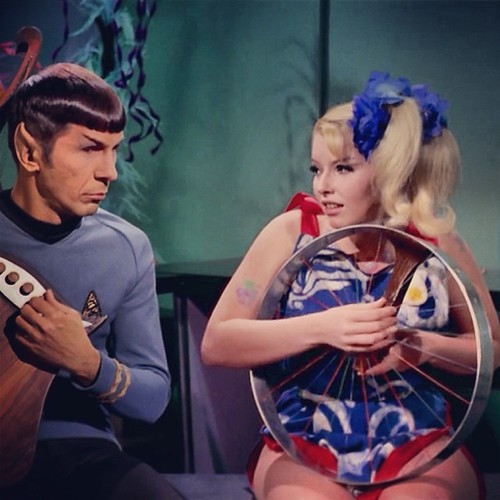
Photo: “A bicycle wheel as a musical instrument?! The future is crazy. Rock out with your Spock out.” by Walnut Studiolo is licensed under CC BY 2.0.

Using form: Susan McLean, ‘Cul-de-Sac’

The man who had a perfect lawn
forced his three kids to toil outside
till every dandelion was gone.

His wife, gentle and put-upon,
dusted the trophies of his pride
(for tennis, not his perfect lawn).

His son, advancing like a pawn
to keep his father satisfied,
chose, when his girl and job were gone,

to hit a bridge (or gun) head-on.
The neighbors whispered “suicide”
while walking past that perfect lawn.

The youngest, timid and withdrawn,
lived with her parents till she died
of cancer, but the oldest, gone

for decades, had skipped town one dawn.
When she died too, her parents lied
that she was fine. Their perfect lawn
remains. But all the kids are gone.

*****

Susan McLean writes: “From the ages of six to sixteen, I lived on a suburban cul-de-sac, a more elegant term for a dead end. The neighbors I knew best, whose three children were around the same ages as the oldest three children in my family, came to symbolize for me the dark side of suburbia, the disturbing realities that lie behind the manicured exteriors and are never spoken of. Not until the father of that family died did we learn, from his obituary, that his oldest daughter, the one who was my age, had died several years earlier, of undisclosed causes. The mother, who played bridge weekly with my mother, had always said when asked about that daughter that she was ‘fine’.

I chose to tell this story in a variant on a villanelle in which only the last words of the repeating lines reappear: ‘perfect lawn’ and ‘gone’. That loosening of the form allowed more narrative to fill the lines, but the tolling repetitions of those words encapsulate, for me, the irony and tragedy of keeping up appearances in suburbia. The villanelle itself can be a straitjacket of a form, and the short tetrameter lines tighten it further, till it feels as though there is no way out.”

Susan McLean has two books of poetry, The Best Disguise and The Whetstone Misses the Knife, and one book of translations of Martial, Selected Epigrams. Her poems have appeared in Light, Lighten Up Online, Measure, Able Muse, and elsewhere. She lives in Iowa City, Iowa.
https://www.pw.org/content/susan_mclean

An 8 Bedroom Vacation Rental” by Discount Vacation Rentals Online is licensed under CC BY 2.0.

Using form: anapest (anapaest): Susan McLean, ‘Illicit’

I needed to take a vacation from cake
so my diet would be more judicious.
But my plan was cut short by a chocolate fudge torte,
and the relapse was truly delicious.

Next it was cheese (such as triple-cream Bries
and Gruyères) that I vowed to avoid.
But I fell in the snare of a ripe Camembert.
It was bliss. My resolve was destroyed.

When the experts all said “To lose weight, give up bread,”
I thought that was a food I could shun.
I succumbed to the spell of the beckoning smell
of a freshly baked cinnamon bun.

I have found self-denial is not such a trial
and has unforeseen good effects.
True relish is hidden in all things forbidden.
Have I mentioned I’m giving up sex?

*****

Susan McLean writes: “Like many women, from my teens on, I had periods of dieting, followed by periods of eating normally and gradually regaining weight I had lost on the diets. That pattern can cause despair for many, but in my case, it made me notice how delightful a food becomes once it is forbidden. Diets are dull, and demonizing any particular kind of food is silly, so these days I don’t deny myself anything, but just cut back on the portions. Since the poem is about pleasure (and I once heard Dr. Joyce Brothers say that all pleasures are related to one another), I decided to write it in rollicking anapests, with lots of fun internal rhymes and polysyllabic rhymes.
This poem first appeared in Mezzo Cammin, an online journal of female formalist poets,
and later was published in my second book, The Whetstone Misses the Knife.”

Susan McLean has two books of poetry, The Best Disguise and The Whetstone Misses the Knife, and one book of translations of Martial, Selected Epigrams. Her poems have appeared in Light, Lighten Up Online, Measure, Able Muse, and elsewhere. She lives in Iowa City, Iowa.
https://www.pw.org/content/susan_mclean

Photo: “Joann’s cake: Now featuring every delicious thing at once” by ginnerobot is licensed under CC BY-SA 2.0.

Using form: Roundel: Susan McLean, ‘No Thanks’

No one wants to be the damsel in
distress, the one in need of chivalry,
chained to a rock in nothing but her skin.
No!  One wants to be

the one who skirts the trap and steals the key,
testing the rope bridge with a shaky grin.
Whoever longs for victims he can free

is not a hero, but the villain’s twin.
So save yourself.  Don’t go expecting me
to play the clingy wimp, the might-have-been
no one wants to be.

*****

Susan McLean writes: “This poem got its start when I heard that Kirsten Dunst said, about playing Mary Jane in Spider-Man (2002), “I just don’t want to be the damsel in distress. I’ll scream on the balcony, but you’ve got to let me do a little action here.” It struck a chord with me. I was so tired of watching action movies in which the male hero does all of the derring-do and the female lead exists only to be saved, over and over again. Men still write, direct, and produce most films, so I guess it is not surprising that most movies reflect male fantasies. But women have fantasies, too, and screaming while I wait to be saved is not one of mine.
“The poem is a roundel, a poetic form invented by Algernon Swinburne. As in a rondeau, the poem has only two rhymes, and the first part of the first line appears twice more. Part of the fun of writing it lies in finding ways to vary the repeating line, and part lies in the challenge of finding five rhyme words for each rhyme. English averages fewer rhymes per word than French, the language in which the rondeau originally appeared. Swinburne chose to make the roundel shorter than the rondeau (which is fifteen lines long) in order to make it easier to write in English.
” ‘No Thanks‘ originally appeared in Mezzo Cammin, an online journal that features female formalist poets. It was also included in my second poetry book, The Whetstone Misses the Knife.”

Susan McLean has two books of poetry, The Best Disguise and The Whetstone Misses the Knife, and one book of translations of Martial, Selected Epigrams. Her poems have appeared in Light, Lighten Up Online, Measure, Able Muse, and elsewhere. She lives in Iowa City, Iowa.
https://www.pw.org/content/susan_mclean

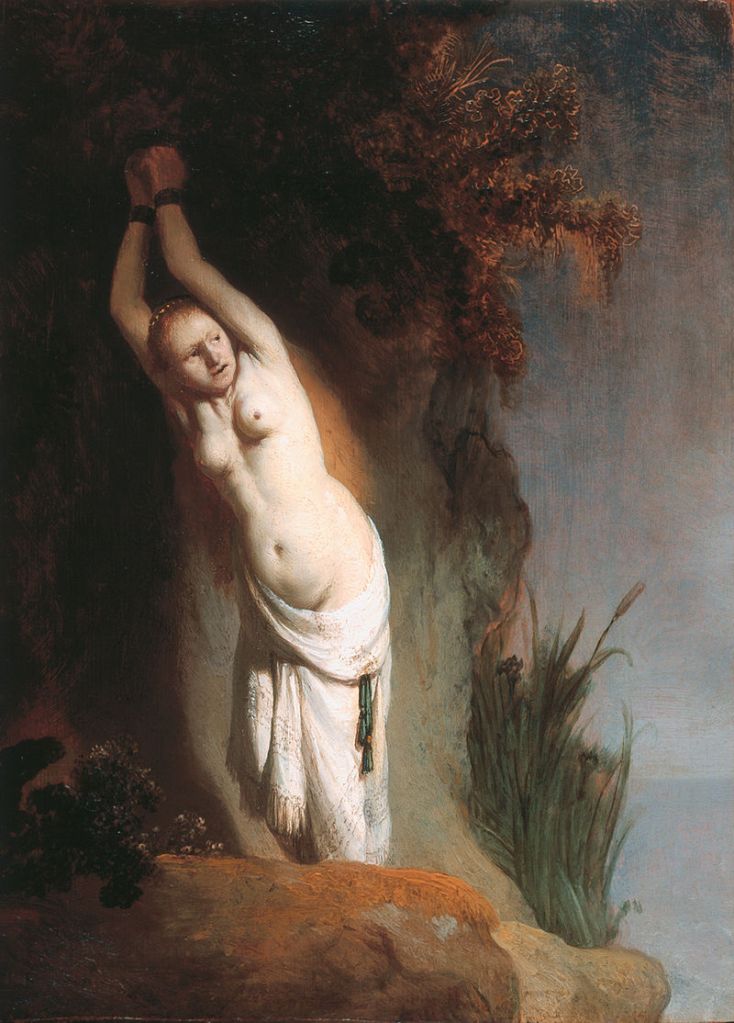
Painting: ‘Andromeda Chained to the Rocks‘ by Rembrandt Harmensz. van Rijn, ca. 1630

Susan McLean, ‘Out-of-Town Conference Texts’

He:      Met with a colleague for cocktails.  Last night is a blur.
            Having a wonderful time.  Wish you were her.

She:     I’ve been tidying up and arranging while you’ve been gone.
            When you want to retrieve your things, they’re out on the lawn.

*****

These two couplets by Susan McLean were recently published in The Asses of Parnassus; she comments: “I got the idea for this poem by misreading a line in a poem by Amit Majmudar.  It is not the first time I have gotten an idea for a line by misreading or mishearing something: aging has its unforeseen benefits.  The line was the standard phrase from postcards, “Wish you were here,” which I misread as “wish you were her.”  I immediately saw the comic potential of that phrase, and at first I thought of the exchange as written on postcards. But then I realized that conferences are often short, making sending a postcard impractical, and that no one tends to send postcards anymore.  So I reconceived the poem as texts–which also have to leave a lot unsaid because of their length.  I left open the question of whether “her” was an accidental typo or a deliberate choice.”

Susan McLean has two books of poetry, The Best Disguise and The Whetstone Misses the Knife, and one book of translations of Martial, Selected Epigrams. Her poems have appeared in Light, Lighten Up Online, Measure, Able Muse, and elsewhere. She lives in Iowa City, Iowa.
https://www.pw.org/content/susan_mclean

Photo: “Business Affairs” by edwicks_toybox is licensed under CC BY-NC 2.0.

Susan McLean, ‘My Evil Twin’

My evil twin is full of feminine
self-deprecation. Don’t be taken in
by her rapt nods and deference, which mask
her sly, satiric humor. While you bask
in her respect, she’ll turn away and grin.

You think you’ve won an argument? Her chin
is cocked. She’s packing nitroglycerin.
Why can’t she let the matter slide? Don’t ask
my evil twin.

One minute she’s as sweet as saccharin,
but then, like any snake, she sheds her skin.
If you suspect that it’s a hopeless task
to coax this genie back into her flask,
you’re right. But don’t be fooled: I’ve always been
my evil twin.

*****

Susan McLean writes: “I have always loved the French repeating forms for their songlike appeal. The villanelle is my favorite among them, and I have also written a fair number of triolets, but the rondeau is a form I have rarely tried. At fifteen lines long, with only two rhymes, it is extremely demanding to write, since in English most words have relatively few rhymes. That difficulty made for a fascinating challenge and some unusual rhymes. It’s hard to imagine another poem in which I would use both ‘nitroglycerin’ and ‘saccharin.’

Twins have a long history of featuring in comedies of mistaken identity, from Plautus to Shakespeare and onward, but the ‘evil twin’ is a relatively recent development, I think, with origins in Stevenson’s Jekyll and Hyde. Soap operas, comic books, and serial dramas are full of them. Yet in real life, most people behave differently at different times and with different people. Actors often prefer playing the villain to playing the hero; viewers love to watch characters who break taboos with impunity, a sort of vicarious release from the inhibitions of civilized life. So, is this poem a self-portrait? More a self-caricature, but caricatures are often more recognizable than photographs.

This poem was originally published in the online journal Umbrella, and it also appears in my second book, The Whetstone Misses the Knife.”

Susan McLean has two books of poetry, The Best Disguise and The Whetstone Misses the Knife, and one book of translations of Martial, Selected Epigrams. Her poems have appeared in Light, Lighten Up Online, Measure, Able Muse, and elsewhere. She lives in Iowa City, Iowa.
https://www.pw.org/content/susan_mclean

Photo: “(Be Gone) Evil Twin Gum” by found_drama is licensed under CC BY-NC-SA 2.0.

Susan McLean, ‘Rules for Love’

Don’t wear make-up, ever. Don’t act girly.
Don’t collect shoes or shop until you drop.
If your hair is straight, don’t make it curly.
Don’t play dumb or play his games. Don’t stop
reading or saying what you think. Don’t flatter.
Don’t claim that you love football if you don’t.
Don’t sidestep. Don’t pretend it doesn’t matter
if he puts down your friends or if he won’t
do his fair share of housework. Do your best
to give your talents scope and free his own.
Grill steaks; eat chocolate. This is not a test.
If he won’t love you, you’ll do fine alone.
Sex is a bonus. Give as good as you get,
but make it clear you don’t intend to marry.
Love what you have, and what you don’t, forget.

These worked for me. (Your own results may vary.)

*****

Susan McLean writes: “This poem got its start in answer to a contest at the magazine The Spectator in the UK for a poem about “rules for love.” The words rules and love don’t normally go together, because love is something that often seems to break all the rules. Yet most people have their own mental set of requirements for love, which they will not easily set aside, as well as an internalized list of dos and don’ts that they think are the way to achieve love. I found it entertaining to try to pin down some of mine, knowing that each person will have a different list. How often women run into articles in women’s magazines that purport to tell them exactly how to find lasting love! This poem tries to be funny by saying the sorts of things that would never appear in those articles. It was not among the winners at The Spectator, but it was a lot of fun to write. Trying to pin down one’s own rules for love produces an indirect self-portrait. The poem first appeared in my second book, The Whetstone Misses the Knife.”

Susan McLean has two books of poetry, The Best Disguise and The Whetstone Misses the Knife, and one book of translations of Martial, Selected Epigrams. Her poems have appeared in Light, Lighten Up Online, Measure, Able Muse, and elsewhere. She lives in Iowa City, Iowa.
https://www.pw.org/content/susan_mclean

Photo: “love rules” by hmmlargeart is licensed under CC BY-NC-ND 2.0.