Tag Archives: Sylvia Plath

Odd poem: Parody of a Self-Parody of a Self-Parody: Melissa Balmain, ‘How Unpleasant to Meet Mrs. Hughes’

From the files of Sylvia Plath

How unpleasant to meet Mrs. Hughes,
Who’s so thoroughly, willfully odd.
It’s a wonder Ted happened to choose
Such a creature. (He’s rather a god.)

Her lipstick is always a mess.
She’ll go on for an hour or three
About Nazis or bees—as you’d guess,
This does not get her asked out to tea.

Her headbands aren’t quite comme il faut.
(They’re a match for her queer Yankee frocks.)
She knows more than a lady should know
Of low-voltage electrical shocks.

Come to think of it, lately she’s been
More appalling than ever before.
She looks sullen and terribly thin;
If you knock, she won’t answer the door.

Her complexion grows whiter and whiter.
She wears the most horrible shoes.
You can certainly tell she’s a writer.
How unpleasant to meet Mrs. Hughes!

*****

Melissa Balmain writes: “I believe this one started when a contest—probably in The Spectator—called for poems riffing on Edward Lear’s self-mocking ‘How Pleasant to Know Mr. Lear’ (and T.S. Eliot’s equally self-mocking parody of it). I found it funny and sad to imagine Sylvia Plath writing about how her English neighbors might see her. The poem was published in Mezzo Cammin.”

Melissa Balmain’s third poetry collection, Satan Talks to His Therapist, is available from Paul Dry Books (and from all the usual retail empires). Balmain is the editor-in-chief of Light, America’s longest-running journal of light verse, and has been a member of the University of Rochester’s English Department since 2010.

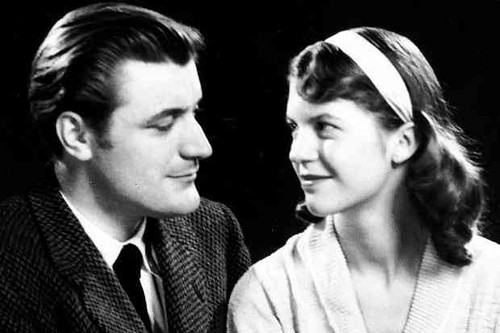
Photo: “TED HUGHES AND SYLVIA PLATH” by summonedbyfells is licensed under CC BY 2.0.

Poems on poets: A.M. Juster, ‘Houseguests’

There’s shouting by the stove (it’s Plath & Hughes)
as Wystan wanders off without his shoes
and Whitman picks the Cheetos off his beard.
The Larkin-Ginsberg chat is getting weird,
for after countless hours they have found
bizarre pornography is common ground.
Old Emily is not
As prim as billed—
When Dylan finds her bra-hooks—
She is thrilled.
Poe strokes his bird; Pound yawps that it’s a pity
Eliot can’t sleep without his kitty.
Rimbaud’s on eBay searching for a zebra
while sneering, “Oui, a cheemp can write vers libre!”
The Doctor’s soggy chickens start to smell
and Stevens has insurance he must sell.
The readings are spectacular, I know,
but is there any way to make them go?

*****

A.M. Juster writes: “This was first published in The Barefoot Muse. It looks like I wrote it in late 2008, it was a fairly prolific period for me and I was a little distracted because I was running the Social Security Administration. (Under his unpoetic name, Michael J. Astrue. – Editor). I don’t remember now the impetus for writing it, but I did enjoy taking these poetry idols off their pedestals and making them more human for a few laughs. This was about the time that I finished my translation of Horace’s Satires in something like 1850 heroic couplets, so I was much more comfortable with the form than I would have been five years before. I think the imitation of Emily Dickinson’s form is an amusing touch for the reader, although it is undetected when I read it because it remains in rhymed iambic pentameter.”

A.M. Juster’s poems and translations have appeared in Poetry, The Paris Review, The Hudson Review and other journals. His tenth book is Wonder and Wrath (Paul Dry Books 2020) and his next book will be a translation of Petrarch’s Canzoniere, which W.W. Norton will release in early 2024. He also overtweets about formal poetry @amjuster.

Photo: “me drunk & chris’_MMVI” by andronicusmax is licensed under CC BY 2.0.

Susan McLean, ‘The Whetstone Misses the Knife’

I answered your desire to meet
resistance and be honed by friction.
Sharp as you were, you couldn’t beat
the zero-sum of contradiction.

Abrasion was your privilege,
the only stroking I have known.
Now you have lost your cutting edge
and I am just another stone.

*****

Susan McLean writes: “This poem was inspired indirectly by the suicide of a talented poet whom I had seen at conferences, but had never had a conversation with. I heard that she had killed herself on Christmas Eve because of an unhappy love affair. Since I knew nothing about her personal life, this poem is not about her, but her fate made me think about unhappy relationships, particularly those in which both partners have strong but conflicting personalities. I had in mind such stormy creative relationships as those of Sylvia Plath and Ted Hughes, Diego Rivera and Frida Kahlo, Camille Claudel and Auguste Rodin, in which the clashes are initially part of the attraction, yet turn destructive eventually. However, the imaginary relationship depicted in this poem is not based on the specifics of any of those relationships.
Balance and antithesis are the key characteristics of the theme of this poem, so I thought two quatrains with a rhyme scheme of ABAB would give equal weight to the “I” and the “you” of the poem.
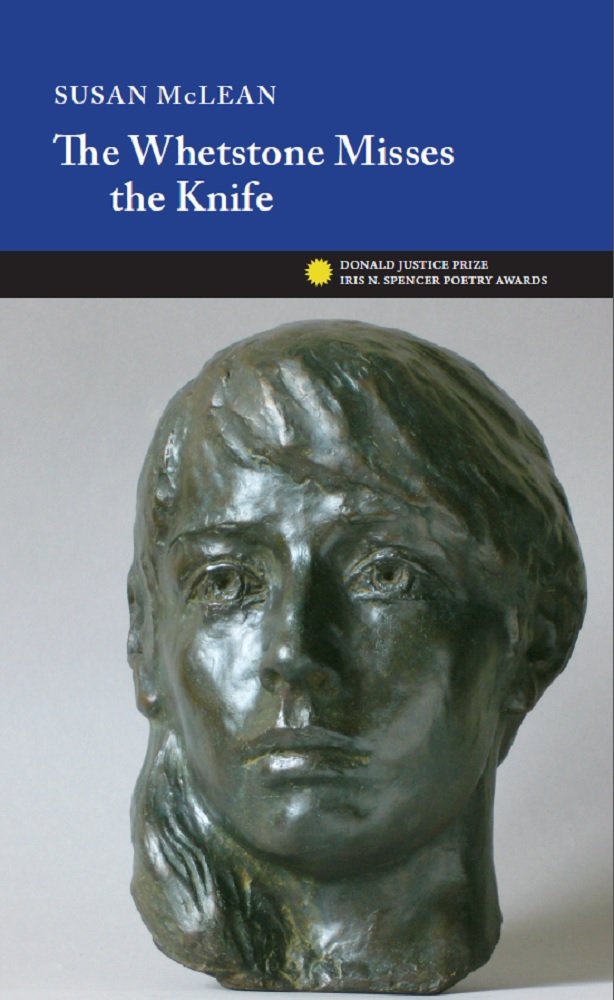
This poem first appeared in Mezzo Cammin, an online journal of female formalist poets, and later was published in my second book, The Whetstone Misses the Knife, which featured a bronze bust of Camille Claudel by Jacques Chauvenet on the cover.”

Susan McLean has two books of poetry, The Best Disguise and The Whetstone Misses the Knife, and one book of translations of Martial, Selected Epigrams. Her poems have appeared in Light, Lighten Up Online, Measure, Able Muse, and elsewhere. She lives in Iowa City, Iowa.
https://www.pw.org/content/susan_mclean