Tag Archives: time

Morri Creech, ‘Mileage’

The car mechanic’s counting out his bills
behind the E-Z Mart at one a.m.;
he’ll toss rocks at beer bottles just for thrills
until his dealer comes, it’s fine with him.

He draws in a deep breath and sees the light
swerve from the highway, puzzling the back wall
he leans against just to keep out of sight.
A quarter bag and some fentanyl, that’s all.

His phone vibrates again though nothing’s wrong.
For two years he’s been living in a trailer
with a girl who works at Publix. They get along
even if sometimes she says he’s a failure—

what can he say to that? Sure. He lives cheap.
They’ll fight until she forces a decision,
then roll around on the couch. Once she’s asleep
he’ll take a dose and watch some television.

At night he dreams of cylinders and sprockets,
the trucks and cars too busted up to fix;
startled awake, eyes aching in their sockets,
he’ll watch the clock hands grope their way to six.

A car pulls up but he can see it’s not
his hookup. Just kids with nothing else to do
but drink a six-pack in the parking lot
before they head out to the lake to screw.

He had his share of mischief, too, Lord knows.
The girls don’t eye him in the check-out aisle
much anymore, the ones with painted toes.
A few years back, at least, they used to smile.

The boys can see the grease that stains his hands;
they all think, damn, who wants to work that hard?
He spends the day beneath their dads’ sedans
while they play tackle football in the yard.

Chasing a football blew out both his knees
and broke his wrist. That was three years ago.
Customers say, “go Stags,” and toss their keys,
then look at him real close as if they know.

A text says no one’s coming. The BP sign
flickers over the pumps, and though it’s half-
past two now, and he’s tired, he’s feeling fine
enough to think it’s all a bust, and laugh.

And, anyway, it’s good to be alone
with the gas fumes and blinking traffic light
and fifteen missed calls lighting up his phone.
Later, he thinks, once he and his girl fight,

and once she falls asleep on his left arm,
he’ll stare at the divots on the ceiling tile
and wait to hear the clock sound its alarm
while the night’s odometer counts one more mile.

*****

Morri Creech comments: “As Mark Strand once said, I write to find out what I have to say. I don’t start a poem with an idea; I start with a line, an image, a rhetorical stance. Then I write in search of context: how can I situate this in a situation, a narrative moment, an argument, a meditation? The language takes me wherever I end up. This poem was constructed like that. I started with a first line and then wrote toward trying to figure out the context of the line. In this case, it led me to a character sketch. It was fine to discover what this character was about; the decisions I made about his character and circumstances were largely directed by rhymes. They steered me in what I hope was the right direction.”

‘Mileage’ was first published in Literary Matters.

Morri Creech is the author of five collections of poetry, including the Sleep of Reason, a finalist for the Pulitzer Prize, Blue Rooms, and The Sentence (published by LSU Press, and which includes this poem). A recipient of NEA and Ruth Lilly Fellowships, as well as North Carolina and Louisiana Artists Grants, he teaches at Queens University of Charlotte.
www.morricreech.com

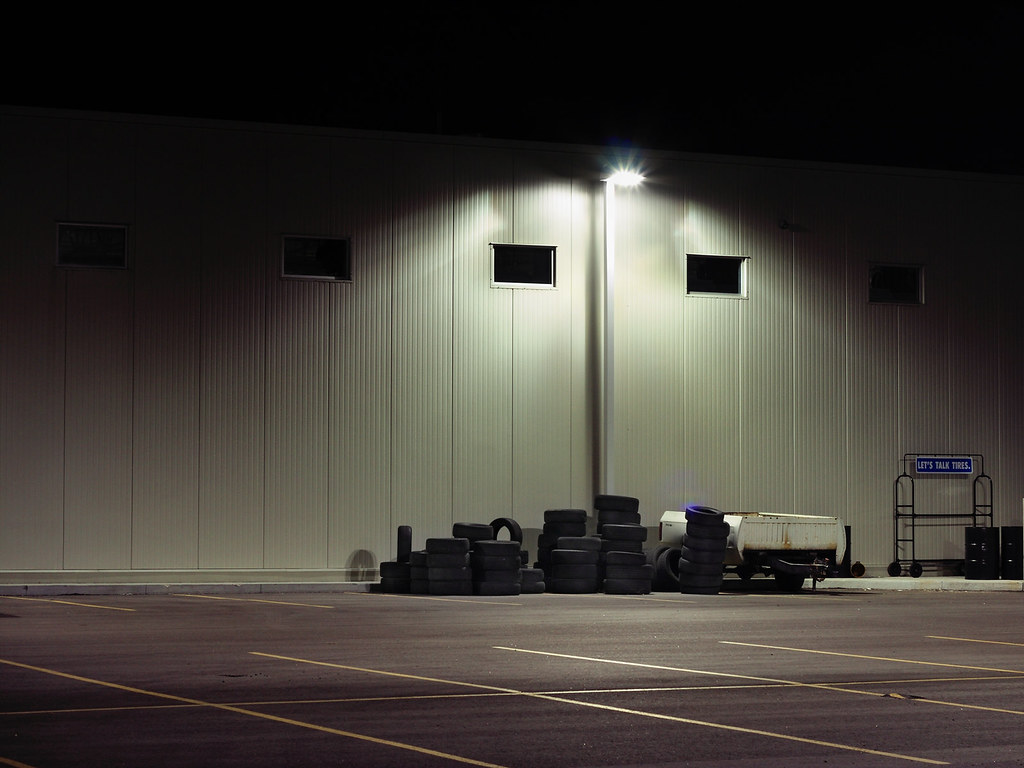
Photo: “Let’s Talk Tires” by gfpeck is licensed under CC BY-ND 2.0.
Weekend read: Tom Vaughan, ‘Rhyme-Crime’

Does rhyme matter –
    however occasional?

It used to be
    considered vocational

a must for verse’s
    inspirational

impact, even
    educational –

but these days, it’s a
    generational

sign your stuff’s just
    recreational.

*****

Tom Vaughan writes: “For me, rhyme is not just a technical trick to help make poetry memorable. I think the world rhymes in odd ways. I also believe time rhymes, across the centuries but also in our short individual lives, sometimes in irony, but more often – if we listen hard enough to hear it – to point the way to a deeper level of challenge and reflection.”

Editor: I had been planning a rant on the essence of poetry being all the tricks that make it memorisable word-for-word: rhyme, rhythm, alliteration, assonance, etc; and on the fact that the bits of poems an adult remembers are invariably rhymed; and on poetry’s links to dance and song and the prenatal heartbeat. But Tom Vaughan introduces a whole new layer of value of rhyme, obliquely in his poem, incompletely in his comment. There are things to meditate on here.

Tom Vaughan is not the real name of a poet whose previous publications include a novel and three poetry pamphlets (A Sampler, 2010, and Envoy, 2013, both published by HappenStance; and Just a Minute, 2024, from Cyberwit). His poems have been published in a range of poetry magazines, including several of the Potcake Chapbooks and frequently in Snakeskin.
He currently lives in Brittany.
https://tomvaughan.website

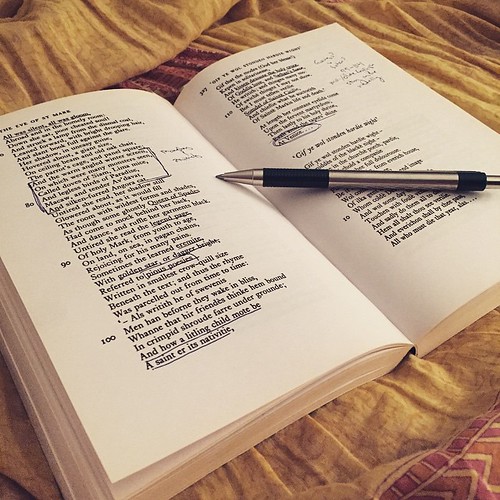
Photo: “Sometimes, I like going back into #poetry and pretending like I am still in college. #johnkeats #bookstagram #annotations #reading #books” by alis.smith is licensed under CC BY-NC 2.0.

Sonnet: RHL, ‘The Days Have Come Unhooked’

The days have come unhooked from passing time,
its little Brio trucks are off their tracks;
the past and future mix to make their rhyme,
with pieces placed at random in fresh stacks.
Clear memories blend their present, future, past.
The days stretch out, and yet the months fly by –
you turn in circles, facing first, not last.
As childhood deepens, old age pools go dry.
Behind its smoke and mirrors, whores and pimps,
its harshly lovely playful attitude,
reality is thinning – you now glimpse
an indescribable infinitude.
The game is won – your enemies are no more,
yet you don’t end it while you max your score.

*****

Published in the Spring 2024 issue of The Road Not Taken.

Photo: “Brio freight train set” by Ben Sutherland is licensed under CC BY 2.0.

Short poem: Richard Fleming, ‘The Clock Collector’

He didn’t hurry, took his time
to gradually collect the clocks:
large clocks, small clocks, clocks with a chime,
he gathered stocks of ticks’n tocks
time-pieces, chronographs, all gold,
he harvested them like a crop.
He hoped to put his life on hold
but time, unmeasured, did not stop.

*****

Richard Fleming writes: “I think I was just playing with rhyme on this one. That it says something serious was an unexpected bonus.”

Richard Fleming is an Irish-born poet (and humorist) currently living in Guernsey, a small island midway between Britain and France. His work has appeared in various magazines, most recently Snakeskin, Bewildering Stories, Lighten Up Online, the Taj Mahal Review and the Potcake Chapbook ‘Lost Love’, and has been broadcast on BBC radio. He has performed at several literary festivals and his latest collection of verse, Stone Witness, features the titular poem commissioned by the BBC for National Poetry Day. He writes in various genres and can be found at www.redhandwriter.blogspot.com or Facebook https://www.facebook.com/richard.fleming.92102564/

Richard Fleming, ‘Time 2’

A hamster racing on a wheel,
a movie spinning on a reel,
the clock-hands march inexorably.
What they record, we cannot see
or touch, or hear, or smell, or taste,
yet it diminishes. Make haste.

*****

Richard Fleming writes: “When young, I thought about time in terms of how quickly I could run 200 metres and, later, whether I could dip under 35 minutes in a 10k road race. Yes, I was shallow then but youth and shallowness often go hand in hand: they did in my case. Grown older (let’s be honest, old) , Time has acquired a capital T and seems to have morphed into a rather unnerving companion who demands more and more of my attention every day.”

Richard Fleming is an Irish-born poet (and humorist) currently living in Guernsey, a small island midway between Britain and France. His work has appeared in various magazines, most recently Snakeskin, Bewildering Stories, Lighten Up Online, the Taj Mahal Review and the Potcake Chapbook ‘Lost Love’, and has been broadcast on BBC radio. He has performed at several literary festivals and his latest collection of verse, Stone Witness, features the titular poem commissioned by the BBC for National Poetry Day. He writes in various genres and can be found at www.redhandwriter.blogspot.com or Facebook https://www.facebook.com/richard.fleming.92102564/

Richard Fleming, ‘Time’

Screenshot 2023-07-30 at 19.15.56.png

He took the time to take the time
and taking it, although a crime,
was what he felt he had to do
so, whilst one might well take the view
that stealing time left others short,
he’d answer with a sharp retort
that time and tide wait for no man
and man must take what time he can.

*****

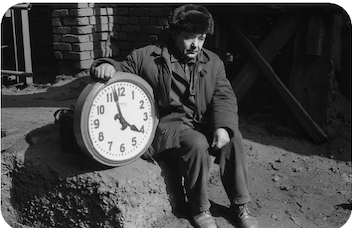
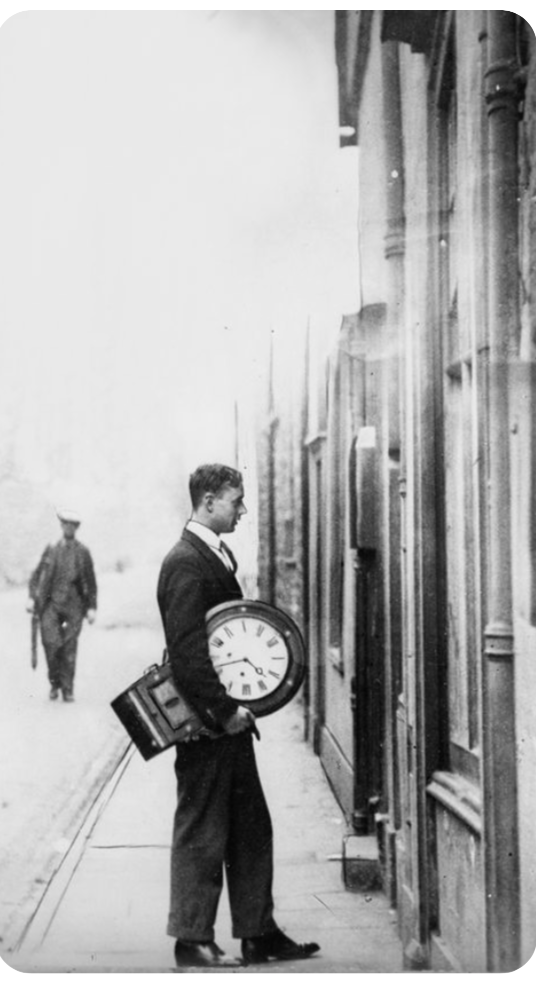
Richard Fleming writes: “This poem, written in response to a prompt in the form of an image of a man carrying a large clock, is primarily a piece of nonsense-verse and an exercise in word-play, two forms of writing that I particularly enjoy. That it rhymes and scans is something of a bonus.”

Richard Fleming is an Irish-born poet (and humorist) currently living in Guernsey, a small island midway between Britain and France. His work has appeared in various magazines, most recently Snakeskin, Bewildering Stories, Lighten Up Online, the Taj Mahal Review and the Potcake Chapbook ‘Lost Love’, and has been broadcast on BBC radio. He has performed at several literary festivals and his latest collection of verse, Stone Witness, features the titular poem commissioned by the BBC for National Poetry Day. He writes in various genres and can be found at www.redhandwriter.blogspot.com or Facebook https://www.facebook.com/richard.fleming.92102564/

Prose, really: RHL, ‘Time is the Measurement’

Time is the measurement of rearranging atoms.
Atoms are rearranged like blocks, and that is time.
Putting the blocks back as they were before is not going back in time.
There is no past,
there is no future,
there is only the eternal present.
There was a past, there will be a future… but you can’t get there from here,
except as the atoms rearrange.

A time machine would have to rearrange the atoms
of the world,
of the galaxy,
of the entire universe,
to put every particle back into some prior arrangement.
The calculations, let alone the actions, would be… difficult.

It is no wonder that we have never seen visitors from the future.
They don’t exist. There is no future, and there is no past.
There is only the eternal present.
Enjoy it.

*****

This “poem” was just published in Consilience, “the world’s first peer-reviewed science and poetry journal”. In addition to a poem, the journal requires a comment focusing on the science behind the poem. So here is
“The Science.
Time may be a dimension and a useful concept, but it is not a dimension in the sense of something that one can move back and forth in. We measure time with atomic clocks, which produce electromagnetic radiation that atoms in the clock absorb. Cesium atoms absorb microwaves with a frequency of 9,192,631,770 cycles per second, which then defines the international scientific unit for time, the second. Accurate time like this has helped to prove Einstein’s theories about time moving at different rates when clocks are moving at different speeds. Without accurate clocks and an understanding of Einstein’s theories about the speed of light and space-time, we wouldn’t have the Global Positioning System (GPS), which uses clocks in space and on the ground to show you where you are.”

There are limits to the amount that can be written in the Science section, so I haven’t gone into rambling speculation about the subjective aspect of time which appears to speed up as we get older. My suggestion is that we experience a ‘Subjective Time Unit’ as a constant amount of thought-processing. Say as a teenager you process 100,000 bits of information in a second (that’s a random number, but you get the point). Then as you age and the brain physically deteriorates, perhaps by age 50 it takes you two seconds to process that amount of information. You would feel the external world cycling twice as fast between day and night, because it would happen with the passing of half as many STUs. You would still think as logically, but time would feel like it was speeding up. The use of pharmaceutical uppers and downers will also change how much time you feel passes (by impacting how rapidly you are processing information), as will being half asleep (time slides by rapidly) or being in an adrenaline-enhanced emergency (time will appear to slow down).

But these are all mere speculations about the subjective nature of time, different from the question of the objective nature of time itself.

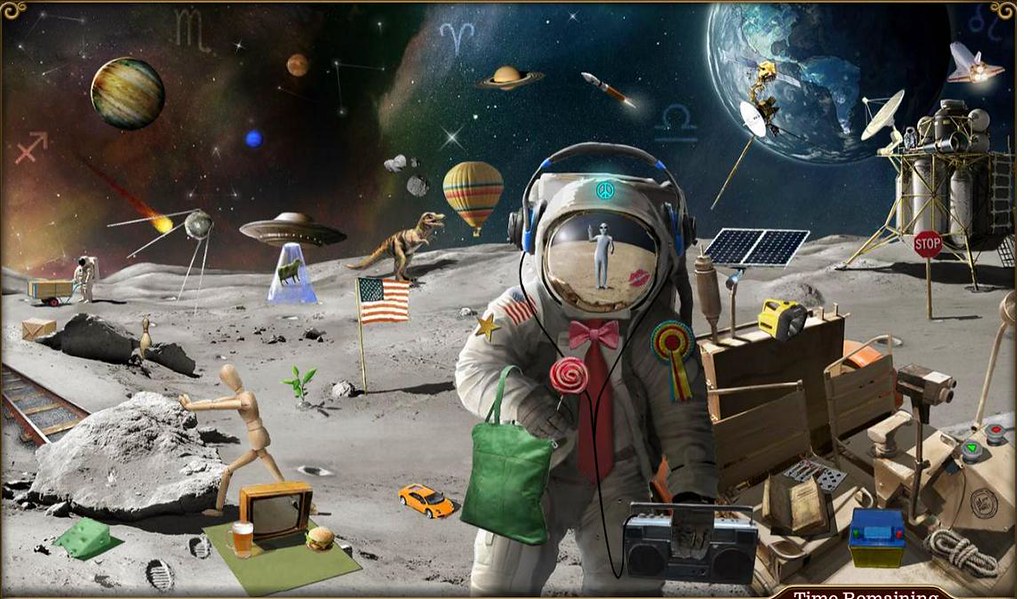
Photo: “LunarLanding – Gardens of Time” by mcscrooge54 is licensed under CC BY-SA 2.0.

Jerome Betts, ‘Ballade of Inevitable Extinction’

Where are the flushed and frantic teens,
The hormones’ fevered ebbs and flows?
(Fire buckets, water, verbal screens.)
The girls –good grief! – that parents chose
And others – how the mind’s eye glows! −
Who floated inches off the floor?
(Flout censor’s ruling – fish-net hose.)
With dodo, great auk, dinosaur.

Where are the doubtful magazines?
The female form from head to toes
(Dim lights. Spill simulated beans.)
In postures aimed to half-disclose
Behinds, aboves, and down belows,
With clefts and crevices galore?
(Check pressure here, in case it blows.)
With dodo, great auk, dinosaur.

Where are the eyeball-popping queens
Of X-films like the great Bardot’s?
(Props: G-string, well-packed blouse and jeans.)
Brigitte – with so much to expose
Far finer than the best French prose –
Removing most, and, sometimes, more . . .?
(Cue key-change, envoi, Villon, ‘snows’.)
With dodo, great auk, dinosaur.

Envoi
Prince, not again! The whole world knows
Time’s answer must be, as before,
(Stand by the curtain ! Down it goes!)
With dodo, great auk, dinosaur.

*****

Jerome Betts writes: “Ballade of Inevitable Extinction started off in callow youth as a sort of Finnegan’s Wake verbally mashed-up extravaganza sparked off by a news item about Brigitte Bardot. Then years later it became a rather clunky Spectator competition entry and even more years later evolved into something accepted by Kate Benedict for Tilt-A-Whirl and more recently by Beth Houston for her ‘Extreme Formal Poems‘ anthology.
Not only is the rhyme-scheme in English  a challenge but also getting some sort of development or progression into the three main stanzas (or even a coherent narrative as Joan Butler managed in her Ballade of the Ugly Sister in Lighten Up Online Issue 12 December 2010).
In this case, the suggestion of a three act play with stage directions and epilogue seemed a possible solution.”

Jerome Betts lives in Devon, England, where he edits the quarterly Lighten Up Online. Pushcart-nominated twice, his verse has appeared in a wide variety of UK publications and in anthologies such as Love Affairs At The Villa Nelle, Limerick Nation, The Potcake Chapbooks 1, 2 and 12, and Beth Houston’s three Extreme collections. British, European, and North American web venues include Amsterdam Quarterly, Better Than Starbucks, Light, The Asses of Parnassus, The Hypertexts, The New Verse News, and  Snakeskin.

Photo: “Faded Beauty – Beauté fanée” by monteregina is licensed under CC BY-NC-SA 2.0.

Short poem: ‘Death Spiral’

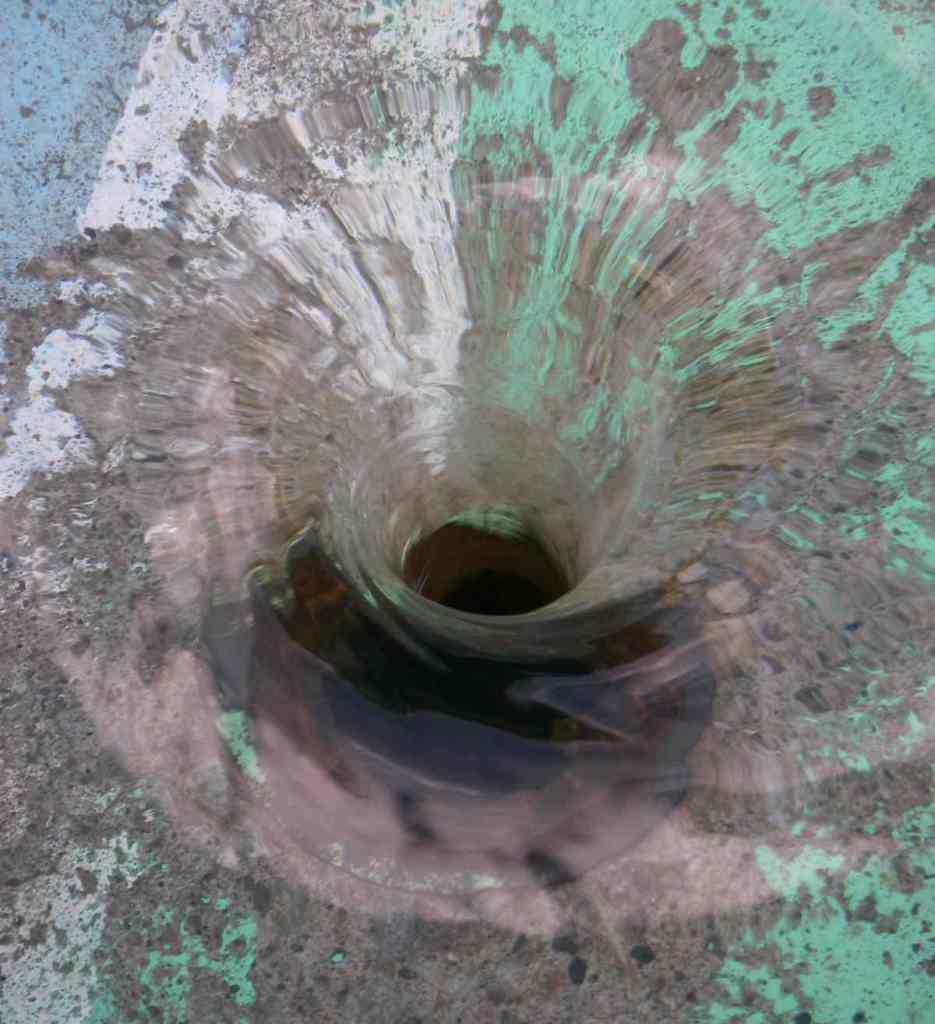
We spiral round the sun, like water
spirals round a drain;
herded like sheep to the slaughter,
it’s an old refrain–
what you coulda, what you oughta…
so few years remain.

*****

This short poem was recently published in The Asses of Parnassus – thanks, Brooke Clark! Btw sorry if the poem seems morbid – fall/winter has always made me reflective; I’ve been feeling time running out since my teens.

“File:Pool drain vortex as viewed from above the water at Grange Park wading pool.jpg” by Glogger at English Wikipedia is licensed under CC BY-SA 3.0.

Poem: ‘Ticking Away’

You have hopes. You don’t expect
that they’ll ever come to pass
but you drink, think and reflect
as you look into the glass…
And you wonder what will happen
while your life just ticks away:
Tick, tick, tick, tick… end of play.

Science’s prognostications,
things you’d pick up in a flash:
soon they’ll start rejuvenations
if you only had the cash…
Cash cuts those who’d live forever
from the rest as with a knife:
Tick, tick, tick, tick… end of life.

But you don’t like thoughts of dying
so you hope you’ve got a soul;
and though preachers are caught lying
Heaven seems attainable…
But there’s got to be a Heaven
or prayer’s just a waste of breath:
Tick, tick, tick, tick… towards death.

Though you think that you’re so clever,
you’ve got goals but not the How.
Play the lottery for ever
it must pay off – why not now?
But you never do the homework
so at question time you’re stuck:
Tick, tick, tick, tick… out of luck.

That affair you never had
with the person down the street
for you’re really not that bad
and besides, you rarely meet…
But it sits there like a present
that’s unopened on a shelf:
Tick, tick, tick, tick… end of self.

So there’s all the other options
for the things you’d like to do:
travel, study, home, adoptions,
building family anew,
but you’re aging while you’re thinking
and the chances go on by:
Tick, tick, tick, tick… till you die.

*****

On this funereal day I take happy morbid pleasure in remembering that we are all mortal. Let’s keep on ticking as long as we can! ‘Ticking Away’ was published in the most recent edition of David Stephenson’s ‘Pulsebeat Poetry Journal‘, a recent and welcome addition to the growing cadre of formal-friendly magazines. It’s a nonce form, shaped in the writing of it; the lines rhyming ABABCDD, and the metre being a rapid patter broken by the ticking in the last line of the stanza.

You could say it’s mostly written in incomplete trochaic tetrameter, the form of Longfellow’s ‘Hiawatha’

By the shore of Gitche Gumee,
By the shining Big-Sea-Water,
At the doorway of his wigwam,

But I prefer to read it with the rapid beat of W.S. Gilbert’s

I am the very model of a modern Major-General
I’ve information vegetable, animal, and mineral

which, technically, you could read as iambic octosyllable

I am the very model of a modern Major-General
I’ve information vegetable, animal, and mineral

but not all of those stressed syllables have equal weight. Gilbert’s lyrics are patter, built on highly stressed, semi-stressed and unstressed syllables. English poetry is flexible and chaotic, and its analysis can be contradictory, because the poetry is a fusion of casual Anglo-Saxon verse which counts stresses but not syllables, and formal French verse which counts syllables but not stresses. This mirrors the creation of English itself which is a fusion of various Germanic and Romance languages… with a dash of Celtic grammar thrown in. (Where do you think the pointless auxiliary verb “do” comes from in the phrase “Where do you think”, rather than a more straightforward “Whence think you”? Answer: Celtic.) But the educated literati of the past few hundred years learned all their analysis of grammar and poetry from the French who in turn were drawing on the Greeks and Romans. And some of that thinking is irrelevant to Germanic and Celtic structures.

TLDR: Write what feels natural, enjoyable and memorable. Personally, I’m always glad to remember I don’t have to write everything in iambic pentameter…

Photo: “Self portrait – Ticking away” by MattysFlicks is licensed under CC BY 2.0.