
Tag Archives: translation

Using form in translation: Virgil, tr. George Simmers, ‘Rumour’

Through Africa vile Rumour raced,
Of all the plagues the fastest-paced.
She’s supple, smart, light on her toes,
And gains momentum as she goes.
She may start small as creeping mouse
But soon she’ll overtop the house
Till, though in muck her feet may stand,
Her head is in Cloud-Cuckoo-Land.
Watch Rumour go! Her huge black wings
Hide fearful eyes, a tongue that stings,
Lungs that can bellow till they burst
And ears fine-tuned to hear the worst.
By night she’ll hiss round that odd place
Nor earth nor sky, but cyberspace,
And through those small hours she will keep
Alert and growing — she won’t sleep.
Come daylight she’ll observe with malice
Events in cottage and in palace.
Great cities then will shake in fear
At the enormities they hear,
And shudder when they taste the brew
In which she’s mixed the false and true.
Whenever men, fraught with disgust,
All eye each other with mistrust,
Great Rumour grins, her strength unfurled.
She relishes our post-truth world!

from Aeneid, Book Four

*****

George Simmers writes: “Plodding through a book of the Aeneid for O-level Latin when I was fifteen, many many years ago, I took a strong dislike to Virgil. But several decades later, a talk I attended made me think he might not be entirely tedious. The talk’s handout included a prose translation of this ‘Rumour’ passage. I decided to versify it myself, and found that it slipped quite easily into tetrameters. The eight-syllable line is fast and sharp, and avoids the temptation to ponderousness that always lurks within the pentameter.
Since then I’ve read more of Virgil, and have found that he is one of those poets whose writings have the knack of seeming topical. I have attempted some more translations. If I had to choose a top ten of poems that say something profound about the human condition, I would include his description of the souls purged of suffering, re-crossing the Styx to attempt a new life.”

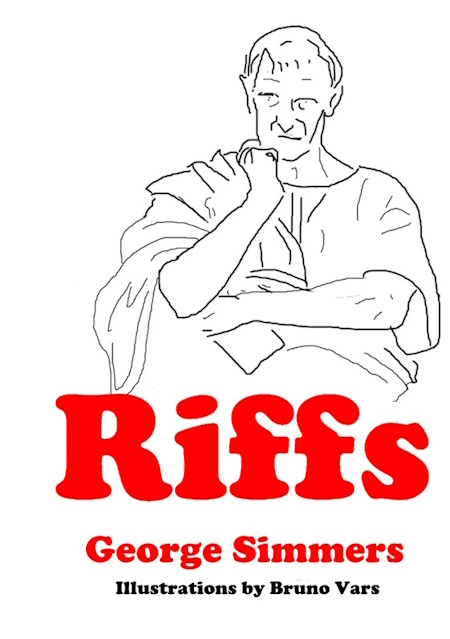
Editor’s note: Both ‘Rumour’ and the Styx-recrossing passage that Simmers mentions are in his recent volume of translations, Riffs, along with his translations from Ovid, Catullus, the Greek Anthology and Francois Villon. Riffs costs £5, and should be available from Amazon, but if you’d like a signed copy, email him: simmersgeorge@yahoo.co.uk and he’ll arrange one for you at no extra cost.

George Simmers used to be a teacher; now he spends much of his time researching literature written during and after the First World War. He has edited Snakeskin since 1995. It is probably the oldest-established poetry zine on the Internet. His work appears in several Potcake Chapbooks, and his recent diverse collection is ‘Old and Bookish’.

Photo: “Dark Angel” by Novafly is licensed under CC BY-SA 2.0.
Verse into Verse: George Simmers translates Catullus ‘VII’

Lesbia, you ask me quantify
How many of your kisses I
Might think enough. My answer? Count,
When you’re in Libya, the amount
Of tiny sand grains on the beach
Along the shining miles that reach
Between Jove’s shrine and Battus’s tomb.
Or count the stars that pierce the gloom
To stare all-seeing from above
Upon the privacies of love.
Let’s kiss and kiss with such excess
We’ll make all voyeurs’ minds a mess;
Add kiss on kiss, till we’ve a sum
So vast all gossips are struck dumb.

*****

This is one of the translations from Catullus to be found in the recently published pamphlet, Riffs, by George Simmers, editor of Snakeskin, the world’s longest-running monthly ezine for poetry. Riffs is a grab-bag of translations of poems that have appealed to him, from Ovid, Virgil, Catullus, the Greek Anthology and Francois Villon. For sample pages (featuring Ovid’s version of the myth of Narcissus) click here.

The plentiful illustrations are by Bruno Vars, whose pictures enlivened George’s previous pamphlet, Old, Old.

Riffs costs £5, and should be available from Amazon, but if you’d like a signed copy, email him: simmersgeorge@yahoo.co.uk and he’ll arrange one for you at no extra cost.

Robert Frost said that poetry is what gets lost in translation. George Simmers has tried to find it again. This is the ideal Christmas gift for the classicist in your life.

Poem: “Bee”

“July Honey Bee” by MattX27 
Through the honeyed halls of Autumn
Hums the angry ageing bee;
As its work faces fruition,
And its life, redundancy.

This little poem was originally published in Candelabrum, a 1970 formalist hold-out that ran for forty years in the UK under Leonard McCarthy. More recently, it was just republished in Jerome Betts’ latest Lighten-Up Online.

Epigrammatic couplets and quatrains, being rhyme- and stress-based, are common throughout Indo-European languages. They hold the same natural place that haiku, senryu and tanka have in syllable-counting Japanese. It is easier to learn by heart a poem whose form uses the natural strengths of the language, rather than something written in a language-inappropriate form.

Similarly, when reading a poem in translation, you get the ideas and the imagery but you normally lose the enhancement of mood caused by the metre, the rhythm of the verse, as well as by the rhyme. So ideas and imagery alone give you prose, not poetry.

Consider the differences in tone of gravity or levity set by rhythm in these opening lines (and you need to read them aloud–in your head if you can do that, otherwise really aloud, in order to hear the rhythm, the beat of the lines):

Let us go then, you and I,
When the evening is spread out against the sky...

I sprang to the stirrup, and Joris, and he;
I galloped, Dirck galloped, we galloped all three...

On the top of the Crumpetty Tree
The Quangle Wangle sat...

The first is meditative, the second full of action, the third is casual, informal… and those moods are set by the rhythm alone.

Metre is an essential component of English poetry. Make the metre-rule your yardstick. Don’t leave home without it.

Review: “Aniara” by Harry Martinson

Aniara has fascinated me for a long time because it combines three of my favourite literary interests: science fiction, poetry, and the works of Nobel Prizewinners.

Harry Martinson wrote the book in the 1950s, a decade after the bombing of Hiroshima and Nagasaki but before Sputnik launched the Space Age. It is the story of mass migration to Mars from the destroyed Earth, centred on a miles-long spaceship with thousands of emigrants that is knocked off course and is headed out of the solar system on a hopeless journey.

The existentialism of the situation – living lives of no destination in an inescapable vessel – is in practical terms no different from our own endless circling of the Sun… The issues of whether this feels different, and whether it should feel different, are never addressed but resonated with me nevertheless.

The characters are diverse and interesting. With the book having been written by a male, and with the narrator having a variety of sexual relationships with women, I was surprised to find that the recent film version has a female protagonist. Well, why not make it into a lesbian sf movie, though?

The book is divided into 103 ‘songs’ of half a page to seven pages in length – only 102 in the English translation by Hugh MacDiarmid and Elspeth Harley Schubert, as they and the author agreed that Song 42 is untranslatable.

This raises the question of what the verse is like in the original Swedish. A mixture of formal and free verse, apparently, but with much more rhyme and structure than in the translation. (That the translation is weaker is natural enough, but unfortunate). While I wait to find a full copy in Swedish (which I will be able to work my through, with the English translation in my other hand), I am glad to have found a Swede’s Goodreads review in English which gives samples of the poetry in both languages. (Thank you, Lisa!) For example:

“Försök till räddning genom tankeflykt
och överglidningar från dröm till dröm
blev ofta vår metod.
Med ena benet dränkt i känslosvall
det andra med sitt stöd i känslodöd
vi ofta stod.
Jag frågade mig själv men glömde svara.
Jag drömde mig ett liv men glömde vara.
Jag reste alltet runt men glömde fara. –
Ty jag satt fånge här i Aniara.”

In the MacDiarmid/Schubert translation:

“Attempts at respite through the flight of thought
and constant transference from dream to dream
was often our method of seeking relief.
With one leg steeped in a flood of feeling
and one supported by a lack of feeling
we often stood.
I questioned myself but quite forgot to answer.
I dreamt of life but quite forgot to live.
I ranged the universe–but could not travel farther
for I was imprisoned here, in Aniara.”

The MacDiarmid/Schubert translation is not great, as shown in this excerpt. Not only is there a general lack of rhyme, but the second-to-last line would translate correctly as “I traveled all around but forgot about danger”. The only justification for changing the meaning is to make the (very weak) rhyme of “farther” with “Aniara”.

But then again, translating poetry into a different language’s poetry is at least as difficult as translating a written story into a film… so, as for this translation: I’ll give it five (out of ten, for the try). But the original? From what I can see and guess, ten out of ten!