Tag Archives: using form

Using form: Ottava Rima: Max Gutmann, ‘Life, That Hack!’ (from Don Juan Finish’d)

If we could but instill in Life–that hack!–
The element’ry rules of composition,
Prevent the crude and sloppy maniac
From spoiling every scene with his tradition
Of shouting in our faces like a pack
Of drunken sailors wailing their rendition
Of “Captown Races” or “My Drawlin’ Clementime,”
Their rhythmic belching almost keeping them in time.

For Life to utilize the art of Art
Could help in many ways that we could mention.
Some structure and suspense would be a start.
To get us upright in our seats, fists clenchin’,
A little rising action would be smart
(Or something that would help us pay attention,
Instead of simply zoning out a lot
And missing half the details of the plot).

But Life, I fear, shall never learn to craft
A decent tale. (It hasn’t that ambition.)
It uses characters extremely daft,
And wastes far too much time in exposition.
It never bothers to revise a draft,
Too taken with its own first thoughts. Perdition!
Each aspect of the story is a shame–
And worst, the ending’s always just the same.

Max Gutmann writes: “Don Juan Finish’d fancifully completes Lord Byron’s unfinished comic epic. Excerpts have been contributed to Light, Lighten Up Online, Orbis, Slant, Think, the website of the Byron Society, and Pulsebeat, where ‘Life, That Hack!’ is among the excerpts to have appeared. The complete poem is still unpublished, though I privately printed some copies to share with friends and colleagues.
Like Byron’s poem, Don Juan Finish’d is often philosophical, at times facetiously, as here.”

Editor’s note: As with Byron’s original, Gutmann’s Don Juan Finish’d is written in ottava rima: eight-line stanzas in iambic pentameter rhyming ABABABCC, with the final line or two typically used to humorously deflate whatever more high-sounding statements were made earlier in the stanza.

Max Gutmann has worked as, among other things, a stage manager, a journalist, a teacher, an editor, a clerk, a factory worker, a community service officer, the business manager of an improv troupe, and a performer in a Daffy Duck costume. Occasionally, he has even earned money writing plays and poems.

Photo: “comedy/tragedy masks, waterfall” by milagroswaid is licensed under CC BY-SA 2.0.
Using form: Susan McLean, ‘What Goes: A Rondelet’

You were the one
who always told me what to do.
You were the one
who said I ought to buy a gun.
So when you said that we were through,
one of us had to go. I knew
you were the one.

*****

Susan McLean writes: “I have to credit Allison Joseph for introducing me to the rondelet, a French repeating-form poem that has not been in fashion for a very long time. She was teaching a workshop on repeating forms at the West Chester University Poetry Conference, and I was one of the students. The rondelet is a short form with such short lines and so many repetitions of the first line that it doesn’t give the writer much wiggle room for an interesting twist in the meaning of the repeated line. I settled on “you were the one” as my repeated line, because it is associated with the standard swoony romantic line, but it could easily change its meaning depending on the context. Once I chose “gun” as a possible rhyme for “one,” that word suggested to me a scenario in which the controlling partner in a relationship comes to regret influencing his partner to arm herself. The poem’s title is a pun. At first, it looks as though naming the form in the title is just an effort to identify an unfamiliar form, but if you say it aloud, it evokes the common phrase “what goes around comes around,” suggesting that the man’s comeuppance is partly his own fault. In French, “rondelet” means “a little circle.” This poem first appeared in New Trad Journal and was later published in my second poetry book, The Whetstone Misses the Knife.

Susan McLean has two books of poetry, The Best Disguise and The Whetstone Misses the Knife, and one book of translations of Martial, Selected Epigrams. Her poems have appeared in Light, Lighten Up Online, Measure, Able Muse, and elsewhere. She lives in Iowa City, Iowa.
https://www.pw.org/content/susan_mclean

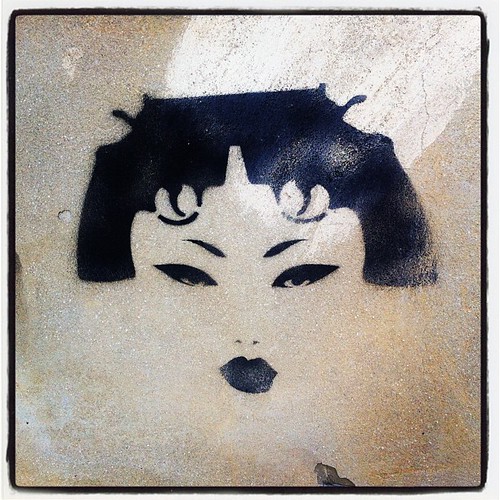
Photo: “#Siena #streetart #guns #woman” by Romana Correale is licensed under CC BY-ND 2.0.

Using form: Susan McLean, ‘Cul-de-Sac’

The man who had a perfect lawn
forced his three kids to toil outside
till every dandelion was gone.

His wife, gentle and put-upon,
dusted the trophies of his pride
(for tennis, not his perfect lawn).

His son, advancing like a pawn
to keep his father satisfied,
chose, when his girl and job were gone,

to hit a bridge (or gun) head-on.
The neighbors whispered “suicide”
while walking past that perfect lawn.

The youngest, timid and withdrawn,
lived with her parents till she died
of cancer, but the oldest, gone

for decades, had skipped town one dawn.
When she died too, her parents lied
that she was fine. Their perfect lawn
remains. But all the kids are gone.

*****

Susan McLean writes: “From the ages of six to sixteen, I lived on a suburban cul-de-sac, a more elegant term for a dead end. The neighbors I knew best, whose three children were around the same ages as the oldest three children in my family, came to symbolize for me the dark side of suburbia, the disturbing realities that lie behind the manicured exteriors and are never spoken of. Not until the father of that family died did we learn, from his obituary, that his oldest daughter, the one who was my age, had died several years earlier, of undisclosed causes. The mother, who played bridge weekly with my mother, had always said when asked about that daughter that she was ‘fine’.

I chose to tell this story in a variant on a villanelle in which only the last words of the repeating lines reappear: ‘perfect lawn’ and ‘gone’. That loosening of the form allowed more narrative to fill the lines, but the tolling repetitions of those words encapsulate, for me, the irony and tragedy of keeping up appearances in suburbia. The villanelle itself can be a straitjacket of a form, and the short tetrameter lines tighten it further, till it feels as though there is no way out.”

Susan McLean has two books of poetry, The Best Disguise and The Whetstone Misses the Knife, and one book of translations of Martial, Selected Epigrams. Her poems have appeared in Light, Lighten Up Online, Measure, Able Muse, and elsewhere. She lives in Iowa City, Iowa.
https://www.pw.org/content/susan_mclean

“An 8 Bedroom Vacation Rental” by Discount Vacation Rentals Online is licensed under CC BY 2.0.

Using form: Songs as poems: Janice D. Soderling, ‘Lookin’ For Lucinda G.’

Lucinda G. from Podunk City,
A gal what big-time mens call pretty.
Her lips is red.
Her eyes is dead.
I’m lookin’ for Lucinda.

Lucinda G., she be my sister.
One night she tell me in a whisper
She ain’t gon’ stay
She leave next day,
Cause Johnny drop Lucinda.

Lucinda G., she head for Dallas.
She get a job at Girlie Palace.
She write one time,
She doin’ fine.
The mens all love Lucinda.

Lucinda G., she made for lovin’.
But all she get is push and shovin’.
She write once more,
She ain’t no whore.
I’m lookin’ for Lucinda.

Lucinda G, she make big dough.
How she do it, I don’ know.
She say she soon
Come home. Real soon.
I’m lookin’ for Lucinda.

Lucinda G. from Podunk City.
She used to be what folks call pretty.
Tell me mister,
You seen my sister?
I’m lookin’ for Lucinda.

*****

Janice D. Soderling writes: “I like to try my hand at various genres, both poetry and prose, both light and serious. This sprouted in a songwriting workshop but later was published by Anna Evans, at Barefoot Muse. I’ve had a few Swedish poems set to music and one recorded which I used to hear on the radio every Midsummer weekend. Maybe some musician will find it worthwhile to set to music. That would be nice.”

Janice D. Soderling has published poems, fiction and translations in hundreds of print and online journals and anthologies over the years. Her most recent poetry collection is ‘Rooms and Closets‘ available at all online bookshops.

“Dallas at Twilight” by bdesham is licensed under CC BY-SA 2.0.

Using form: couplets: George Simmers, ‘Trigger Warning’

Reading this do not expect
An unconditional respect

This poem is an unsafe space
You may be told things to your face

This poem may not feel the need
To be polite about your creed

It may not think your origins
Excuse your weaknesses or sins

It maybe will not lend its voice
To validate your lifestyle choice

It may resist attempts to curb
Its power to worry or disturb

It may not think its task to be
To flatter your identity

Although its author’s male and white
It may perhaps assert the right

To speak of gender and of race.
This poem is an unsafe space

*****

George Simmers continues to be amazed and amused by the warnings that some University lecturers seem to think it essential to give their students.  He writes: “Last week there was a warning that Jane Austen’s novels contain some outdated sexual attitudes. The week before that, students thinking of taking a course on tragedy needed to be told that it might contain references to violence and other disturbing themes. The week before that someone was worried that Peter Pan contained material that some students might find it hard to cope with. Why is this? Are the lecturers afraid of legal action from the helicopter parents who are the plague of some University departments today? Or do they really feel that their students are all delicate blossoms? Or do the warnings reflect their own discomfort with the canonical material they are obliged to teach? In the past people often did not think or behave the way that responsible modern people think they should have. It must be worrying.”

Editor’s comments: Poems written as a string of rhyming couplets can quickly start to feel mechanical and boring, but they are very effective when a straightforward list of ideas is being presented, as in this poem by Simmers. ‘The Latest Decalogue‘ by Arthur Hugh Clough is a classic of good usage (and also a classic of “unsafe space”).

George Simmers used to be a teacher; now he spends much of his time researching literature written during and after the First World War. He has edited Snakeskin since 1995. It is probably the oldest-established poetry zine on the Internet. His work appears in several Potcake Chapbooks. ‘Trigger Warning’ is from his ‘Old and Bookish‘ collection of poems.
https://greatwarfiction.wordpress.com/
http://www.snakeskinpoetry.co.uk/

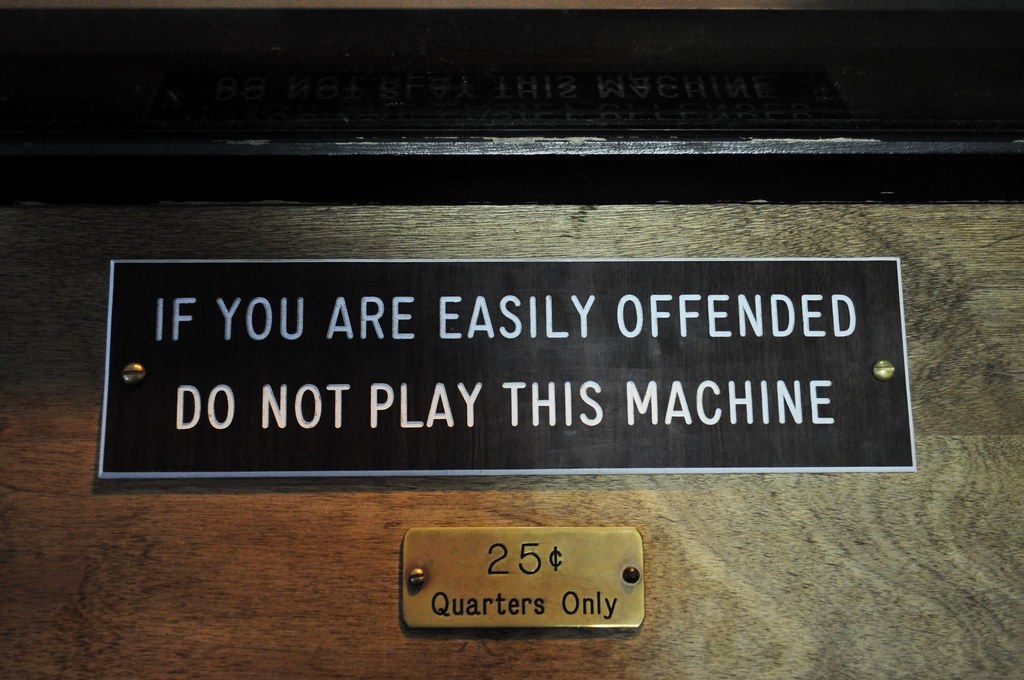
Photo: “trigger warning” by lostcosmonaut is licensed under CC BY-NC-SA 2.0.

Using form: anapest (anapaest): Susan McLean, ‘Illicit’

I needed to take a vacation from cake
so my diet would be more judicious.
But my plan was cut short by a chocolate fudge torte,
and the relapse was truly delicious.

Next it was cheese (such as triple-cream Bries
and Gruyères) that I vowed to avoid.
But I fell in the snare of a ripe Camembert.
It was bliss. My resolve was destroyed.

When the experts all said “To lose weight, give up bread,”
I thought that was a food I could shun.
I succumbed to the spell of the beckoning smell
of a freshly baked cinnamon bun.

I have found self-denial is not such a trial
and has unforeseen good effects.
True relish is hidden in all things forbidden.
Have I mentioned I’m giving up sex?

*****

Susan McLean writes: “Like many women, from my teens on, I had periods of dieting, followed by periods of eating normally and gradually regaining weight I had lost on the diets. That pattern can cause despair for many, but in my case, it made me notice how delightful a food becomes once it is forbidden. Diets are dull, and demonizing any particular kind of food is silly, so these days I don’t deny myself anything, but just cut back on the portions. Since the poem is about pleasure (and I once heard Dr. Joyce Brothers say that all pleasures are related to one another), I decided to write it in rollicking anapests, with lots of fun internal rhymes and polysyllabic rhymes.
This poem first appeared in Mezzo Cammin, an online journal of female formalist poets,
and later was published in my second book, The Whetstone Misses the Knife.”

Susan McLean has two books of poetry, The Best Disguise and The Whetstone Misses the Knife, and one book of translations of Martial, Selected Epigrams. Her poems have appeared in Light, Lighten Up Online, Measure, Able Muse, and elsewhere. She lives in Iowa City, Iowa.
https://www.pw.org/content/susan_mclean

Photo: “Joann’s cake: Now featuring every delicious thing at once” by ginnerobot is licensed under CC BY-SA 2.0.
Using form: choice of metre: John Beaton, ‘Request for a Dance’

Step with me, float with me, over the floor;
weave with me, waltz with me, out through the door;
slide to the deck where the crowdedness clears;
glide through the garden and tear off your fears.

Step with me, sneak with me, down to the lake,
onto its waters; the mirror won’t break;
lilt in a ball gown of luminous mist;
twirl till you’re breathless and need to be kissed.

Step with me, skim with me, let yourself go,
dazzling and dizzy, then flowingly slow;
whirl till our swirls make a maelstrom of night;
pass through the portal from here to delight.

Step with me, sway with me, feel yourself swing,
hammocked on rhythms of hearts on the wing;
move to the measures of seasons and years;
sweep to that island where time disappears.

Step with me, slip with me, up to its crypt,
quaff a last laugh from the pleasures we’ve sipped;
curtsey and smile at a parting of hands
joined in this dancing by two wedding bands.

*****

John Beaton writes: “Inspired by Richard Wilbur’s beautiful ‘For C,’ and by my own marriage, I wanted to write a poem about lifelong love. For the beginning, a wedding dance came to mind and that expanded into an extended metaphor. The theme needed a form that danced the reader along.
I adopted a four-line stanza rhymed aabb with the meter of each line being a form of dactylic tetrameter: DA-da-da, DA-da.da, DA-da-da, DA. To kick off each stanza dancingly, I used near-repetition in the first two dactyls. Then a lot of alliteration and internal rhyme help it swirl along.
The poem develops the dance into a shared lifelong experience, one that must end but does so with a sense of fulfilment and beauty. I’ve recited it at weddings.”

John Beaton’s metrical poetry has been widely published and has won numerous awards. He recites from memory as a spoken word performer and is author of Leaving Camustianavaig published by Word Galaxy Press. Raised in the Scottish Highlands, John lives in Qualicum Beach on Vancouver Island.
https://www.john-beaton.com/

Photo: “Wedding Dance” by DonnaBoley is licensed under CC BY 2.0.

Using form: villanelle: Melissa Balmain, ‘Villain Elle’

Whenever I wake up and don’t feel well,
I like to read a women’s magazine.
I know that I can count on Vogue or Elle,

Cosmo or Glamour, Self or Mademoiselle,
instead of pills, elixirs or caffeine,
whenever I wake up and don’t feel well.

Page Eight has bathing suits that look just swell
if you’re six foot and live on Lean Cuisine.
I know that I can count on Vogue or Elle.

Page Nine’s a list of “wardrobe musts” that sell
at reasonable prices—for a queen.
Whenever I wake up and don’t feel well,

Page Ten says how to age, yet stay a belle.
The photo? It’s a model of eighteen.
I know that I can count on Vogue or Elle

to make my time in bed such living hell,
I’m out of there in sixty seconds clean.
Whenever I wake up and don’t feel well,
I know that I can count on Vogue or Elle.

*****

Editor: The villanelle is a highly structured poem, its two key lines rhyming and repeating several times. One of its challenges is to make each repetition fresh and interesting, either by developing and deepening the context, or by varying the repeated lines slightly or, as with this one, by having the same words resonate differently. Here “I know that I can count on” gives an initial impression of a favourable attitude to women’s magazines, but at the end the words show total disgust. This ‘Villain Elle‘ is typical of Balmain’s twists and puns and absolute control of form.

Melissa Balmain edits Light, America’s longest-running journal of light verse. Her poems and prose have appeared widely in the US and UK. She’s the author of the full-length poetry collection Walking in on People (Able Muse Press), chosen by X.J. Kennedy for the Able Muse Book Award, and the shorter, illustrated The Witch Demands a Retraction: Fairy-Tale Reboots for Adults (Humorist Books). Her next full-length collection, Satan Talks to His Therapist, is due out in fall 2023.

‘Villain Elle‘ is from Walking in on People © Melissa Balmain, 2014. Used by permission of Able Muse Press.

Photo: “304/365 – 8/8/2011” by GabrielaP93 is licensed under CC BY 2.0.

Using form: Refrain; Nina Parmenter, ‘Sense’

I am a bag of chemicals
with charge for eighty years,
I am a gassy mirage
that winks as oblivion nears.
Around me swill the stars,
my thoughts, the gods and insanity,
and nothing makes sense but this leaf
as it dances, drunk on gravity.

I am a pointless voice track
on a puff piece of DNA,
I am the ooze that awoke
and decided to live anyway.
Around me swings the void,
nirvana and calamity,
and nothing makes sense but the sea
as it dances, drunk on gravity.

*****

Nina Parmenter writes: “In 2021, in my strenuous efforts not to write pandemic poems, I probably wrote a lot of pandemic poems. This one, about focusing on tiny moments in nature to avoid thinking about the big scary things is a great example! I made it a foreword to my collection ‘Split, Twist, Apocalypse‘ because its slightly jolly air of existential dread sets the tone for the book nicely, I think.”

Editor’s comment: As with popular songs as well as verse forms such as the ballade, villanelle, triolet and rondeau, the use of a refrain (whether exact or varied) strengthens the poem by bringing the conclusion of each stanza back to a core image or message.

Nina Parmenter has no time to write poetry, but does it anyway. Her work has appeared in Lighten Up Online, Snakeskin, Light, The New Verse News, Ink, Sweat & Tears, and the Potcake Chapbook ‘Houses and Homes Forever’. Her home, work and family are in Wiltshire.
https://ninaparmenter.com/

“Time Lapse of Stars During Earth’s Rotation” by Image Catalog is marked with CC0 1.0.

Using form: Roundel: Susan McLean, ‘No Thanks’

No one wants to be the damsel in
distress, the one in need of chivalry,
chained to a rock in nothing but her skin.
No!  One wants to be

the one who skirts the trap and steals the key,
testing the rope bridge with a shaky grin.
Whoever longs for victims he can free

is not a hero, but the villain’s twin.
So save yourself.  Don’t go expecting me
to play the clingy wimp, the might-have-been
no one wants to be.

*****

Susan McLean writes: “This poem got its start when I heard that Kirsten Dunst said, about playing Mary Jane in Spider-Man (2002), “I just don’t want to be the damsel in distress. I’ll scream on the balcony, but you’ve got to let me do a little action here.” It struck a chord with me. I was so tired of watching action movies in which the male hero does all of the derring-do and the female lead exists only to be saved, over and over again. Men still write, direct, and produce most films, so I guess it is not surprising that most movies reflect male fantasies. But women have fantasies, too, and screaming while I wait to be saved is not one of mine.
“The poem is a roundel, a poetic form invented by Algernon Swinburne. As in a rondeau, the poem has only two rhymes, and the first part of the first line appears twice more. Part of the fun of writing it lies in finding ways to vary the repeating line, and part lies in the challenge of finding five rhyme words for each rhyme. English averages fewer rhymes per word than French, the language in which the rondeau originally appeared. Swinburne chose to make the roundel shorter than the rondeau (which is fifteen lines long) in order to make it easier to write in English.
” ‘No Thanks‘ originally appeared in Mezzo Cammin, an online journal that features female formalist poets. It was also included in my second poetry book, The Whetstone Misses the Knife.”

Susan McLean has two books of poetry, The Best Disguise and The Whetstone Misses the Knife, and one book of translations of Martial, Selected Epigrams. Her poems have appeared in Light, Lighten Up Online, Measure, Able Muse, and elsewhere. She lives in Iowa City, Iowa.
https://www.pw.org/content/susan_mclean

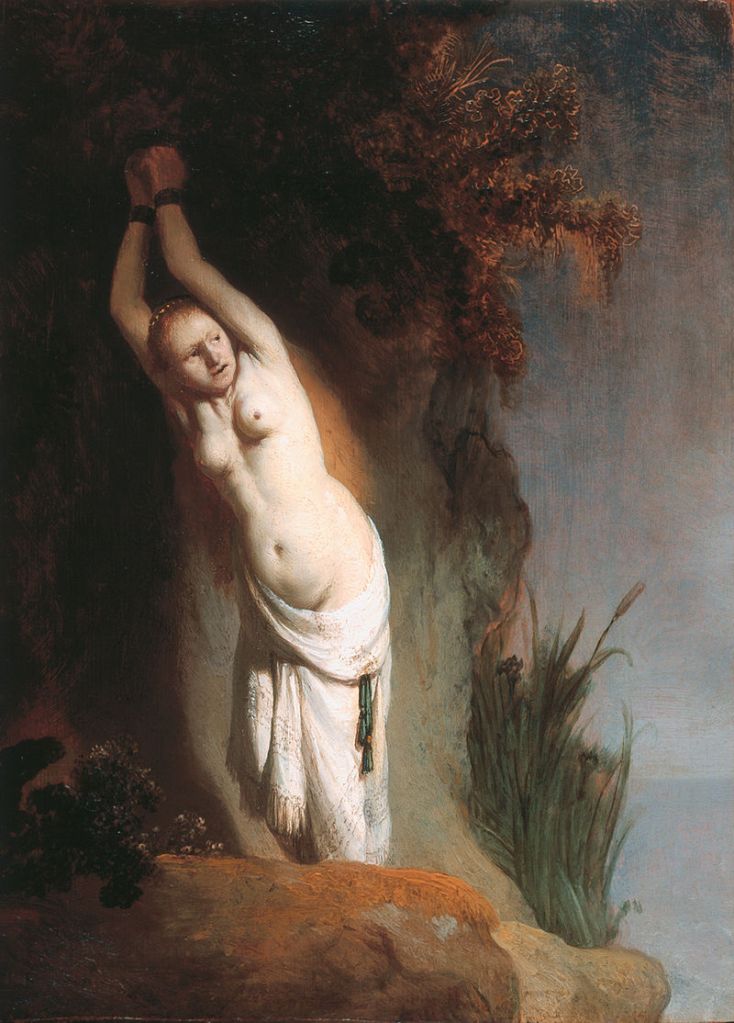
Painting: ‘Andromeda Chained to the Rocks‘ by Rembrandt Harmensz. van Rijn, ca. 1630