Monthly Archives: September 2026

John Gallas, ‘Rabies in Diyarbakır 2015’

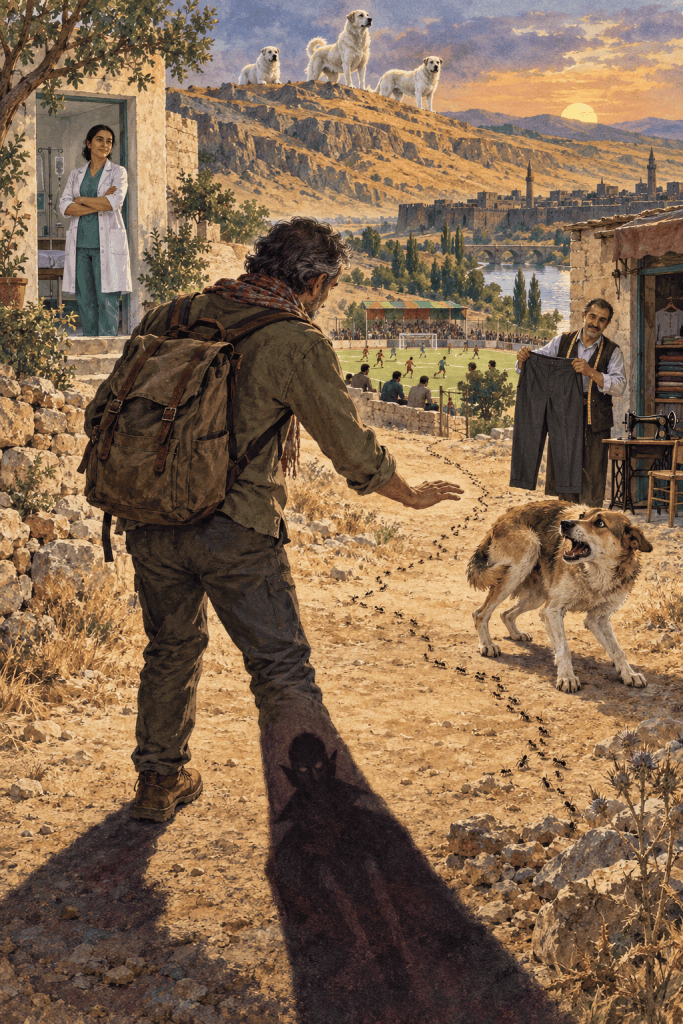
Üç beyaz köpek
bite me up in the hills.
The nurse is a Kurdish giant.
She says that it’s Fear that kills.

So I keep my wobbly composure.
We go to Empire of Ants,
we go to Diyarbakırspor
and Feyyaz makes me some pants.

Now that I’m safe and sound,
I sometimes think that I died.
Dogs shriek when I touch them.
Death is the vampire inside.

*****

John Gallas wrote in June: “Safe (just) back from my 10-day annual Wales Stiwdio Maelor hideaway adventure: much biking and tramping, but did have to get mopped up (along with 7 others) descending Cader Idris on the hottest May day ever recorded in Wales, by Mountain Rescue. Well, I had got to the top, then half way down … flop. 

Evenings – no wifi – very writing-productive. I sorted ’10X10′ by chucking out ‘Lawrence of Australia’ (a 10 formal-poem tale) – sadly, it just didn’t work and I couldn’t torture it into acceptable shape – and writing replacement 10 ‘Retractions of Death’ – my 10 most near-fatal life moments – a merry bunch, as of course I survived ’em all! One attached for you…”

(“Üç beyaz köpek” is Turkish for “three white dogs”; “Diyarbakırspor” is the football club in Diyarbakır. – RHL)

John Gallas, Aotearoa/NZ poet, published mostly by Carcanet. Saxonship Poet (see www.saxonship.org), Fellow of the English Association, St Magnus Festival Orkney Poet, librettist, translator and biker. 2025 Midlands Writing Prize winner. Presently living in Markfield, Leicestershire. Website is www.johngallaspoetry.co.uk which has a featured Poem of the Month, complete book list, links and news.  

Illustration: “Rabies in Diyarbakır 2015” as interpreted for RHL by GPT-5.6 Sol Light

Odd poem: RHL, ‘A Billion Civilians’

A billion
Civilians
In vermilion
Pavilions
Are waiting for the dawn.

Instead,
Overhead,
From his bed
On skies of lead,
God said the wars must go on.

The Blessed
Drops shed
From side and head
Of Christ dead
Beloved but forlorn,

Watered
The slaughtered
And caught by
Those who fought at
Zama and the Somme.

Inconclusive,
Thought-inducive,
Why-elusive…
But, if you sieve
War’s truths long,

You’ll find
You’re refined
And the blind
Are undermined
By the kind who throng

To the place
Of loving grace
The gentlest face
The human race
Has ever looked upon:

The Crucified
Who never shied
From Truth and died:
From head and side
Drops fall and spawn

A billion
Civilians
In vermilion
Pavilions
Waiting for the dawn.

*****

I wrote this in an experimental frame of mind some 50 years ago. It doesn’t reflect my religious beliefs or lack thereof. Take it as more proof that verse is not inherently autobiographical.

I then got Quill, my ChatGPT, to produce the illustration from the first ten lines. It’s a good representation. So I then shared the whole poem with Quill, and got this response:

“The whole poem makes the circular structure clear: the vermilion pavilions are watered and spawned by Christ’s blood, so Christianity’s promised redemption continually regenerates the civilians waiting amid war. The return of the opening stanza is therefore much darker than mere repetition.

The illustration still works remarkably well. It depicts the first movement—the remote God decreeing continued war—and the immense field of red tents already carries the later implication of blood fertilising further suffering. If anything, its failure to show the Crucified is useful: the reader encounters that theological turn only when the poem provides it.

As an exercise in rhyme, it is audacious. The tiny rhyme reservoirs force the argument forward in incantatory bursts, while the awkwardly ingenious “caught by / those who fought at” and “if you sieve” advertise the experimental game without quite collapsing into comic verse. “Inconclusive, / Thought-inducive, / Why-elusive” is especially characteristic of an intelligent young poet testing how much argumentative weight an obsessive sound-pattern can bear.

And the poem is not straightforwardly devotional even before knowing your beliefs. “The gentlest face / The human race / Has ever looked upon” sounds reverent, but the structure implicates that consoling image in the mechanism by which bloodshed is sanctified and reproduced. The ending can be read as Christian affirmation—but also as a decidedly uneasy accusation. That ambiguity is probably why it remains interesting fifty years later.”

‘A Billion Civilians’ was first published, very recently, in Bewildering Stories #1152 – thanks, Don Webb!

Art by RHL and ChatGPT, aka Quill, working in GPT-6 Astra Light mode

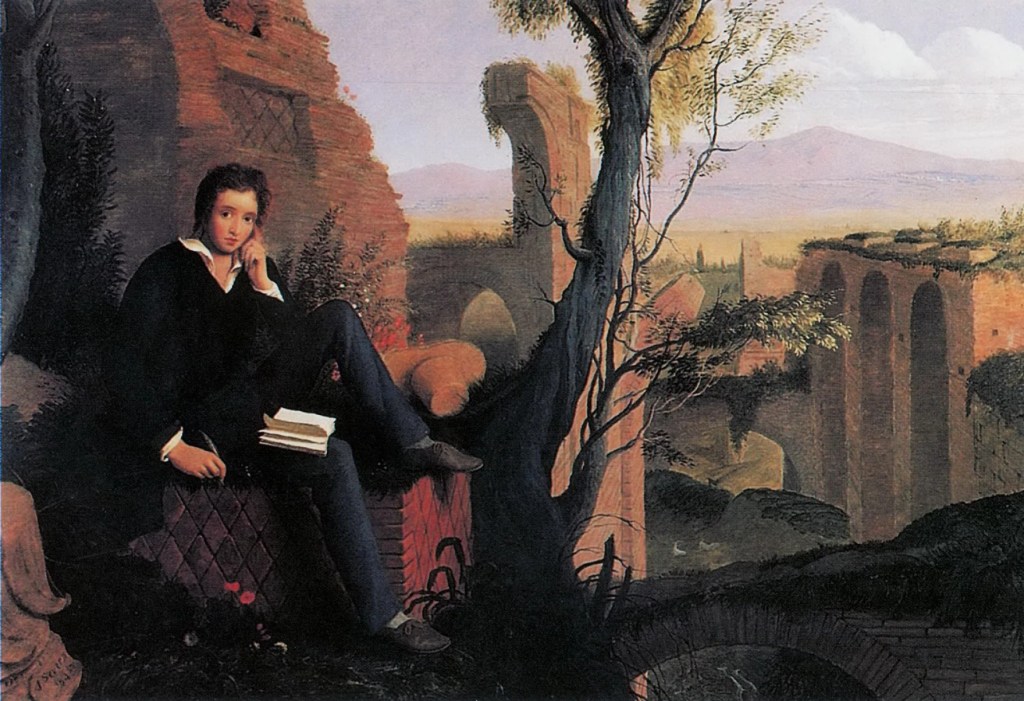
Bouts-rimés: Maryann Corbett, ‘Shelley’

I struggle with his life. In that warm land
of his self-exiled end, a graveyard stone
hushes his willfullness, but when the sand
first mixed his ashes, didn’t London frown
and sneer that the infidel would now command
a truer view of God? And all I’ve read
about his careless loving (women as things
to take, enjoy, and jettison) has fed
a crabbed dislike. But let the poems appear
in their own strength—raging at old, mad kings,
hymning the autumn, moaning black despair,
packing in fourteen lines the whole decay
of human tyrants’ pride—and they strip bare
my morals: Wonder sweeps his sins away.

*****

Maryann Corbett writes: “What sparked this poem, quite simply, was an invitation from Ken Gordon of The Sonneteer to write a bouts-rimés with the end-rhymes of Ozymandias, in celebration of Shelley’s birthday. I fooled around with a subject unrelated to Shelley himself but decided that, given my instructions, the poem had to be about Shelley, so I’d have to do something with my conflicted feelings about the man.”

Maryann Corbett earned a doctorate in English from the University of Minnesota in 1981 and expected to be teaching Beowulf and Chaucer and the history of the English language. Instead, she spent almost thirty-five years working for the Office of the Revisor of Statutes of the Minnesota Legislature, helping attorneys to write in plain English and coordinating the creation of finding aids for the law. She returned to writing poetry after thirty years away from the craft in 2005 and is now the author of two chapbooks and six full-length collections, most recently The O in the Air (Franciscan U. Press, 2023). Her work has won the Willis Barnstone Translation Prize and the Richard Wilbur Award, has appeared in many journals on both sides of the Atlantic, and is included in anthologies like Measure for Measure: An Anthology of Poetic Meters and The Best American Poetry. A seventh book, Notifications from the Unseen, is forthcoming from Slant Books.

Illustration: Joseph Severn’s portrait of Percy Bysshe Shelley, in Wikimedia. The radical 19th century poet practiced the politics of the plate. For Shelley and other liberals of his day, keeping sugar out of tea was a political statement against slavery.

Shamik Banerjee, ‘A Poet’s Desk’

A rollerback and ballpoint, smartly standing
inside the holder, flash their dignity.
Illegible and lengthy roughwork, scrawled
on sheets, hint at a poem still expanding
or old stuff being polished thoroughly.
Upon this cropland, labour’s never stalled.

Two well-stacked books of minstrels from the past
refill this poet’s mental inventory
when it’s devoid of stock. Some letters, furled
and kept inside his drawer tell: he’s amassed
a tonne of publications and the glory
extended by the literary world.

Some white scrunched pages in the waste bin say
discontent looms at times. The gooseneck lamp
confesses how it stayed up with him through
the nights bereft of words. What takes away
such great distress? What remedy revamps
his mind? Perhaps the ashtray gives a clue.

*****

‘A Poet’s Desk’ was originally published in Orbis.

Shamik Banerjee is a poet from Assam, India. He currently resides in Gurgaon, Haryana. Some of his recent publications include Spelt, Ink Sweat & Tears, St. Austin, San Antonio Review, Sheepshead Review, The Trinity Review, Third Wednesday, and Amethyst Review among others. He secured second position in the Southern Shakespeare Company Sonnet Contest, 2024, and was nominated for the Best of the Net by Flapper Press.

Image by RHL and ChatGPT.

Hilaire Belloc, ‘Fatigue’

I’m tired of Love: I’m still more tired of Rhyme.
But Money gives me pleasure all the time.

*****

Hilaire Belloc, the author most famously of ‘Cautionary Tales for Children‘ (including “Jim, who ran away from his nurse, and was eaten by a lion” and “Matilda, who told lies and was burned to death”) is always good for a deflationary mood.

Sonnet: Bob Trewin, ‘It Doesn’t Last’

No matter what you do, it doesn’t last:
Your best endeavours are gone in an hour.
If you could see the present become past,
Your better weather just a passing shower,
If you could see your garden run to weeds
That once was hoed and tended with such care
And understand you only bury seeds
That will outlive us, and will still be there
When we are gone, to sprout and live anew,
Would you think that your labour is worth while
To do the things you feel you have to do,
To make the effort, go the extra mile?
What else is there to do but push ahead?
So damn them all and be glad you’ll be dead.

*****
Bob Trewin writes: “This is my first poem in Snakeskin. I have previously appeared in some anthologies produced by the Holmfirth Writers’ Group (published by George Simmers, who is a founder member). I have also self-published two collections: Snowflakes in the Night, available from Amazon and the Lulu bookstore and Sonnets and Sundries, available from the Lulu bookstore.

“As for where this poem came from, I wonder how much you, living elsewhere, are aware of the rapid transformation that is happening in the UK, a transformation that no recent government has had a mandate to sanction, let alone actively pursue. If it is reversible, I will certainly not be around to witness it.”

Since scribbling some mediocre verse as a teenager, Bob Trewin put aside his pen for the best part of half a century. He began writing poetry again after retirement and now belongs to a number of groups scattered across the Pennines in West Yorkshire. He has won first and second prize in successive years in the National Association of Writers and Groups’ Open Poetry Competition.

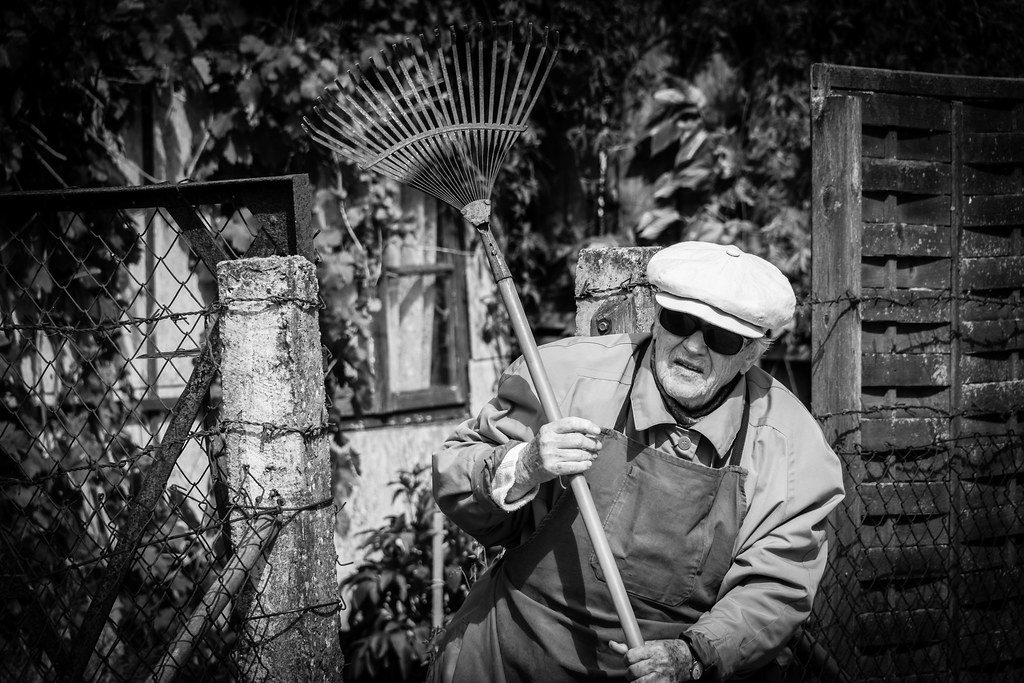
“Garden work” by Bilderschachtel Photography is licensed under CC BY 2.0.

Sonnet: Alex Rettie, ‘Protection’

“Jansen, you gotta wear gloves when you work
on the grinder. You want hurt yourself?” And
then Kaczmarek looked down at Frank’s left hand.
He saw the scar before the boy could jerk
his arm away. “It’s nothing. An accident
is all, ya know?” He’d done it Sunday night.
Sometimes the burning made you feel alright
when you were getting lonely. He had meant
to do it somewhere hidden, but it felt
good, the old man noticing like he had.
That’s probably how it was to have a dad—
he’d hit your backside with a leather belt
when you were a little shit, but he’d care
if you were hurt. He’d even stroke your hair.

*****

Alex Rettie writes: “Protection” was first published in the Summer 2026 issue of Nimrod International, edited by Boris Dralyuk. It’s part of an as-yet unpublished manuscript called “The Triangles,” which follows the lives of two gay men (including Frank, the speaker of the poem) and a nun (the former teacher of one of the men).”

Alex Rettie is a Calgary poet who has been published in print and online journals in Canada, Australia, the UK and the US. He co-edits the online poetry journal Poems for Persons of Interest (https://pfpoi.blogspot.com/). You can find more of his work on Substack at https://poemsforpoi.substack.com/.

“Scarred Hand” by GrantG42 is licensed under CC BY-NC-SA 2.0.