Author Archives: Robin Helweg-Larsen

Unknown's avatar

About Robin Helweg-Larsen

Director, Andromeda Simulations International, Bahamas: a global education company providing online and in-person workshops in business finance. Series Editor, Sampson Low's 'Potcake Chapbooks'. Formal verse about traveling, family, love, etc...

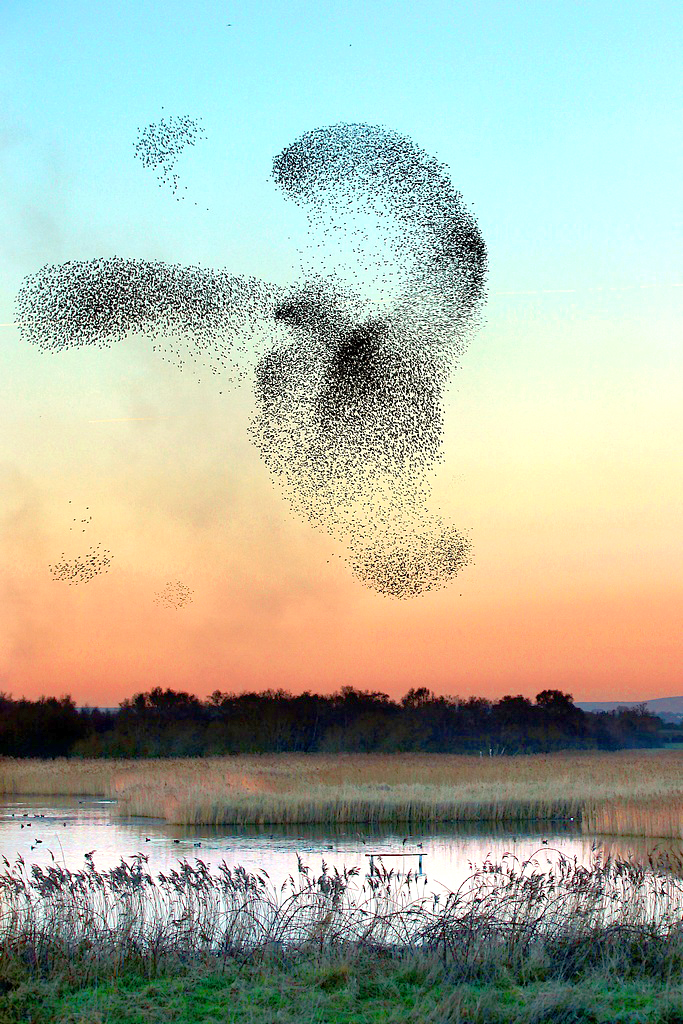
Using form: Iambic hexameter: Daniel Moreschi, ‘A Wing-stroked Spectacle’

Segmented sets of starlings sharply elevate
towards candescent skies, suspend, then circulate
in sync. Their wingspans whisper sunset symphonies
while manifesting silhouetted symmetries.

With poise, finesse and swiftness, they transform the air
into an ever-changing scape; this canvas where
each turn and swirl unfolds a painterly display:
a moving mural, rendered on a dying day.

The starlings coalesce to make a checkered veil.
They crown the clouds and skim across a coastal trail,
then separate as if surrendering to gusts,
and cover summits like a desert’s storm-flung dust.

With tapered pace, their fevered flights revert to long
glissades of shimmering shades; a showy dance along
a latent stopgap stage. They stir, careen, decline,
retracing what remains of lofty lazuline,

before it all becomes a screen of red-specked gold.
The starlings falter in its wake; they cannot hold
their elegance in fading light. Their spirals wane
in streaming chains. They spill in spates of jet-black rain.

*****

This poem was originally published by the Society of Classical Poets at the start of the year, after being awarded 4th place in their annual competition.

Daniel Moreschi writes: “Through its descriptions of the flights of starlings, this poem is intended to evoke reflections on how moments of beauty can be transient; the starlings’ flight patterns are fleeting and subject to change, much like all beautiful moments in life. I felt that verse written in alexandrines, brimming with fluidity, was an appropriate means to depict such an aerial display.”

Daniel Moreschi is a poet from Neath, South Wales, UK, who experienced a significant turning point when his ongoing battle with severe M.E. upended his life. However, during this period, he also rediscovered his passion for poetry, which had lain dormant since his teenage years. Writing has become a distraction from his struggles. Daniel has been acclaimed by over 80 poetry competitions and published in numerous NFSPS anthologies of prize-winning poetry, as well as by Lunar Codex, The Lyric, Society of Classical Poets, The Dawntreader, Westward Quarterly, Wishbone Words, The Chained Muse, Every Writer Resource, and an array of other journals and publications.
Instagram: @daniel.moreschi

Photo: “STARLING MURMURATION” by Tony Armstrong-Sly is licensed under CC BY-ND 2.0.
Weekend read: SF poem: RHL, ‘The Uncertainty of Light’

On an asteroid
there was an alien artefact.
If such it was… a droid…
I’ve no idea, in fact.
Its metal (leg?) seemed (deployed?)
and so I touched it, but responses lacked.

Once there were women; once I was a man
(touching a leg then always brought response)
before the search for life and light began
to change me into this dark renaissance.
The teacup storms on which I’ve tossed,
when she or I have bitched and bossed
till all the loves I’d ever marked
were all the women that I’ve lost.
They chose the certainty of Dark
over the uncertainty of Light.

The joys of life are what’s uncertain:
hopes of what’s behind the curtain,
knowing the results will grate
of things that you anticipate,
knowing your life could be wrecked
by what you never could expect.
And though you think you’re circumspect,
you can’t deflect, inspect, collect.
Knowing the harvest is unknown
with crops that grew from deeds you’d sown,
while all your greatest hopes and dreams
will be exceeded by the future’s smallest gleams.

Because change never stops, you find what matters
is never really known.
You may get verbal assurance of your future status,
but was it “throne” or “thrown”?
The only certainty would be
if, offered immortality,
you feared what such an altered world would lose, would save,
and chose instead to go into the Dark
with furnace no less dark than the grave
wherein there lies no risk of further blight.
Most people choose the Certainty of Dark
over the Uncertainty of Light.

But we who strive to stay alive
long enough for rejuvenation
hope, hope only, we will thrive,
post-humans in a re-Creation,
unknowing what our ape-based genes
will do with power dominance,
with war, with sex, Earth mined and undermined,
but glad to take the chance.
How else can we see scenes
of how it all turns out — destroyed? refined? —
unless we scrape through, level up with wounds and scars
and watch a world we love and leave behind?
So at last I am here, between the stars,
transiting the darkness of the Void,
the empty galaxy’s apparent night,
chanting the mantra that keeps spirits buoyed:
Let there be Post-Humanity’s own light!

Between the spiral arms in the near-void
there’s still thin light of distant galaxy and star,
still specks of dust, rarely an asteroid.
Earth left (millennia in old Earth years ago),
I cross the dark immortally, beyond, afar,
through what is darkness only to Earth-eyes
which myriad wavelengths up and down can’t know,
but which I now apprize.
Light here abounds,
and boundlessly surrounds, astounds.

Take the smallness from slight,
take the bad from the blight,
take the fear out of flight
and you’re left with the light, the light, the light.
We stumble from dark caves of night
into day, trying not to tumble;
our parents the dark; post-humans the light;
ourselves just the stumble.

*****

This poem (published in this week’s Bewildering Stories) is a response to conversations in which people have expressed pessimism about the value of life extension, rejuvenation, cryonic preservation and resuscitation… anything beyond the certainties of a clear end to life after a normal lifespan. “How will you… why would you… what if they… you won’t understand… you won’t have…” Ah, but everyone who has immigrated into a foreign culture has done this: had to learn a new language in order to find a job and start making friends and find out how everything works. Some of us are comfortable doing this; some people aren’t. I’ll take the uncertainty, and enjoy its discomforts… because it’s just so interesting!

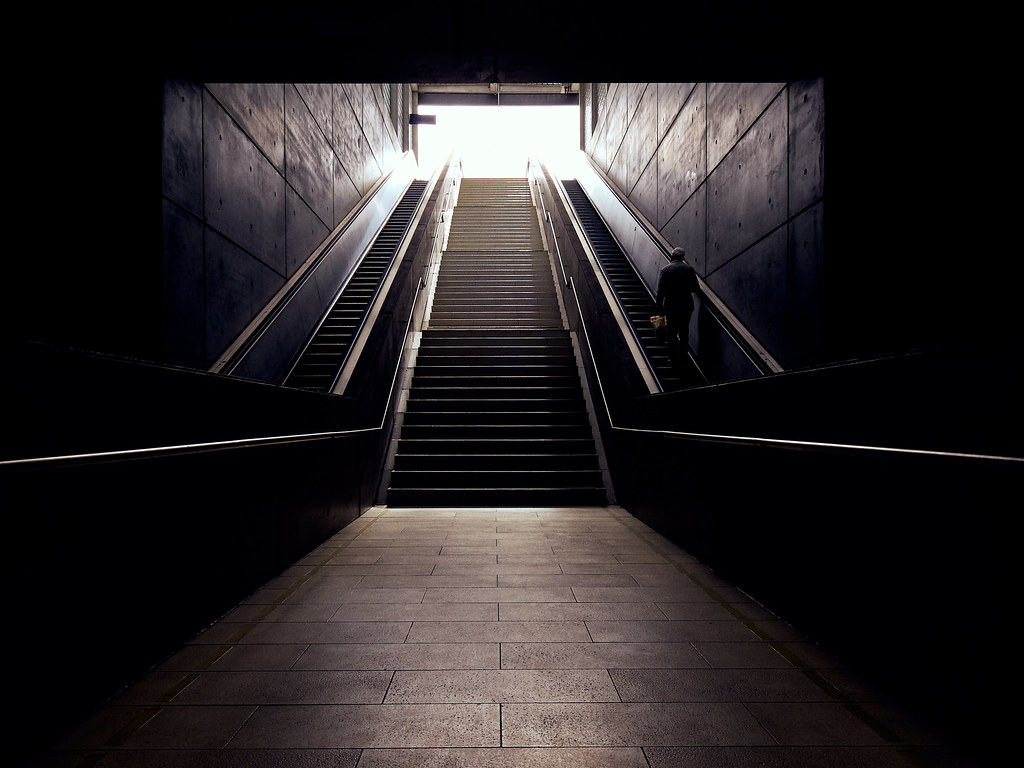
Photo: “Into the Light: The Future is Uncertain” by tenzin.peljor is licensed under CC BY-SA 2.0.

Using form: Songs as poems: Duncan Gillies MacLaurin, ‘But At Least I Had A Ball’

I’ve always loved to sing an’ dance.
I’m better at the first.
An’ given even half a chance,
I’m bound to do my worst.
I’ve struggled sometimes with romance,
succumbed to alcohol,
but at least I had a ball.

I liked to smoke a lot of weed
an’ hash while in my prime.
I’d barely write an’ hardly read,
just wasted space an’ time.
I didn’t think that I’d succeed
with anything at all,
but at least I had a ball.

I did some LSD an’ coke,
but didn’t dare touch smack.
The people on it weren’t a joke.
I’ve never sampled crack.
I still enjoy a drink an’ smoke.
Like everyone, I’ll fall,
but at least I had a ball.

I wasn’t any good at jazz.
I tried it on trombone.
I’ve stayed away from razzmatazz.
I’d rather be alone.
I’ll never be as famous as
that guy from Montreal,
but at least I had a ball.

I found myself in poetry,
then turned it into song.
I see it as my destiny.
It’s here that I belong.
I may end up in poverty
with nobody to call,
but at least I had a ball.

*****

Duncan Gillies MacLaurin writes: “I’ve been wanting to do songs like Cohen and Dylan for years – ones that have a repetend at the end, and I’ve finally achieved that.” This poem was published in the current edition of Snakeskin.

Duncan Gillies MacLaurin is a Scottish poet who was born in Glasgow in 1962. He studied Classics at Oxford, left without a degree, and spent two years busking in the streets of Europe. He met a Danish writer, Ann Bilde, in Italy in 1986 and went to live in Denmark, where he teaches English and Latin. His collection of 51 sonnets, I Sing the Sonnet (2017), is online at Snakeskin. He blogs here. His experiences as an ex-pat poet are described in the first issue of the e-zine, The Chimaera.

Photo: “We Had Some Wild Parties” by lyndawaybi3 is marked with CC0 1.0.

Sonnet: RHL, ‘The Days Have Come Unhooked’

The days have come unhooked from passing time,
its little Brio trucks are off their tracks;
the past and future mix to make their rhyme,
with pieces placed at random in fresh stacks.
Clear memories blend their present, future, past.
The days stretch out, and yet the months fly by –
you turn in circles, facing first, not last.
As childhood deepens, old age pools go dry.
Behind its smoke and mirrors, whores and pimps,
its harshly lovely playful attitude,
reality is thinning – you now glimpse
an indescribable infinitude.
The game is won – your enemies are no more,
yet you don’t end it while you max your score.

*****

Published in the Spring 2024 issue of The Road Not Taken.

Photo: “Brio freight train set” by Ben Sutherland is licensed under CC BY 2.0.

Light verse: Melissa Balmain, ‘Lament’

Mama never horsewhipped me
or shoved things up my fanny.
She wasn’t hooked on PCP
and didn’t bump off Granny.
Daddy never climbed in bed
to open my pyjamas.
He read me Charlotte’s Web instead;
the bed he shared was Mama’s.
In college, I did not turn tricks
or date warped literati.
I haven’t starved myself to sticks,
joined cults, or loved John Gotti.
The guy I married doesn’t drink,
or French-kiss other fellers.
It really makes me sad to think
I’ll never write best sellers.

*****

From Walking in on People © Melissa Balmain, 2014. Used by permission of Able Muse Press.

Melissa Balmain writes: “This is the first poem I ever published outside of a school journal–in Light, then known as Light Quarterly. Thanks in no small part to the encouragement of Founding Editor John Mella, I never looked back.”

Melissa Balmain’s third poetry collection, Satan Talks to His Therapist, is available from Paul Dry Books (and from all the usual retail empires). Balmain is the editor-in-chief of Light, America’s longest-running journal of light verse, and has been a member of the University of Rochester’s English Department since 2010.

Photo: “Sad child” by Lejon2008 is licensed under CC BY-NC-SA 2.0.

Political poem: George Simmers, ‘Navalny’

In memory of Alexei Navalny, killed at the IK-3 penal colony,
16 February, 2024.

1.
Rough and chivvying cold winds blow
The helpless dead leaves to and fro.
Leaves have no say in where they go
But we’re alive so can say no –
Let us praise those men who show
Resistance to the easy flow.

2.
Navalny, prisoner in the snow,
In numbing twenty-eight below,
Has paid the price for saying no;
He’s gone the way we feared he’d go.

That’s Putin, making sure all know
That retribution comes in tow
For those who won’t go with the flow.
‘All dissidents will finish so,’
The message is: ‘Go with the flow,
Or you too could end on Death Row.’

I imagine his warders: Did they know
A twinge of guilt at this, or show
Regret or shame? I doubt it. No –
Why should men let a conscience grow
When they can just go with the flow?
When life is so much easier so,
When every television show,
The papers and the radio
All radiate a conformist glow
Incessantly, so all men know
Life’s comfier with the status quo.
It’s only awkward sods say no,
Go their own way, not with the flow.
Those have a dangerous row to hoe,
And who can blame the average Joe
For on the whole deciding: ‘No,
That’s not for me. I’d rather toe
The line, collect my wages, know
I’m safe and needn’t undergo
What brave men have to suffer. No,
Go with the flow, go with the flow.’

3.
In Moscow brave girls risk a blow
By laying flowers in the snow
To honour him for saying ‘No’.
Brave girls. I admire them so.

*****

George Simmers writes: “This poem began because our local Arts Festival announced its theme as ‘Flow’. Which made me grumble a bit: was I supposed to write stuff about how nice it was that rivers flowed? Not my style. But then I thought about people who go against the flow by saying ‘No!’ and that suggested a subject and a rhyme scheme. It was only after I’d scribbled a few possible lines that I came across a photo of young women in Moscow placing flowers in the snow as tributes to the murdered Russian dissident, Alexei Navalny. In some towns, such protestors had been arrested or beaten up by the police.

“It’s thirty-odd years since I visited Russia. That was at the time of perestroika and hopefulness. We had a contact in Moscow who took us to see the sights, including the Arbat, a popular meeting- place. He said: ‘Can we stop and talk here for a few minutes? I ask because a few years ago If I had been seen here in conversation with a foreigner, I should have been arrested.’ Freedom was precious then, but repression returned.

“Navalny was a lawyer who campaigned against the corruption endemic in Russian political life. In 2020 he was poisoned with Novichok (probably by the Federal Security Service) ; after hospital treatment in Berlin that saved his life, he returned to Russia, even though he knew of the dangers. He was immediately arrested, and ended up in an Arctic Circle corrective colony. The exact circumstances of his death still remain unclear, but while in prison he had suffered from malnourishment and mistreatment.

“Writing this poem I remember Auden’s words: ‘Poetry makes nothing happen.’ Auden pointed out that political poems make the writer feel better, but have no positive effect in the real world. He was right, as usual, which is why I mostly avoid writing poems about politics. But I don’t really see this as a poem about Navalny. I could have chosen to write about Alan Bates and his twenty-five year battle for justice for postmasters, or about Kathleen Stock and others, who opposed the dangerous ideology of the Tavistock clinic. Going against the flow matters everywhere, not just Russia. The form is monorhyme, mostly because that’s how the poem started, and it wasn’t too difficult to keep going. Monorhyme is easier than it looks, so long as you choose the right rhyme word to start with. Don’t try it with ‘month’ or ‘silver’.

“Nalvalny’s death made a news splash in February, but since then more recent horrors have displaced it on the news pages. So maybe this poem will do a little good as a reminder of a brave man. Thank you for re-blogging it.”

The poem will be part of the film ‘Wordflow’ (a film by John Coombes with a soundtrack of stories and poems by Holmfirth Writers’ Group in a continuous showing from 10am-4pm), presented at the Holmfirth Arts Festival in Yorkshire on Sunday, June 16th, upstairs at the ‘Nowhere’ bistro, Norridge Bottom, Holmfirth, HD9 7BB.

George Simmers used to be a teacher; now he spends much of his time researching literature written during and after the First World War. He has edited Snakeskin since 1995. It is probably the oldest-established poetry zine on the Internet. His work appears in several Potcake Chapbooks, and his recent diverse collection is ‘Old and Bookish’.

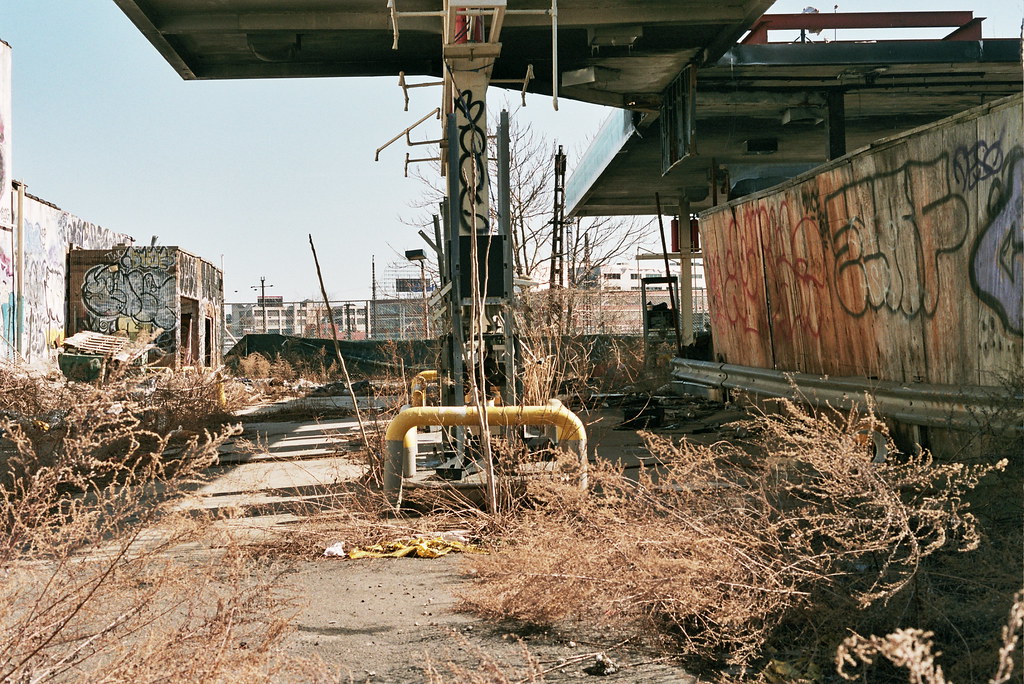
Kelly Scott Franklin, ‘Shell Station, Tennessee’

It was the ravage of the scene that shocked:
the concrete torn by trees and ragged grass,
red guts of fuel pumps over splintered glass,
the wreckage clawed by climbing vines and mocked
by moth and rust. There in concentric rings
obscene graffiti spelled out every sin.
(The smell of something even worse within.)
It’s like we saw into the death of things.
But what about the ruins I can claim?
What of the loves that I have let decay,
the hand withheld, the times I didn’t say
I’m sorry, didn’t pray for you by name?
We leave shell stations, call them what you will.
Neglect is the unkindest way to kill.

*****

Kelly Scott Franklin writes: “Originally sparked by an ekphrastic prompt over at Rattle Magazine (declined; first published in Ekstasis Magazine), this poem was ALSO inspired by a real abandoned gas station somewhere along the highway through the mountains on the way to Knoxville, TN. But I think it had been cooking in me for a while. I took a trip across the American heartland, from Southern Michigan to Central Kansas, and was absolutely depressed by the neglect and decrepitude. I stopped at a rest stop to use the restroom somewhere along the way. The restroom had a sign that said, “We take pride in the quality of our service. If anything in this restroom is not up to your satisfaction, please contact the management.” I looked around the restroom and there was garbage everywhere. Everywhere. It’s like people have stopped living the basic human things. The poem was also inspired by my troubled relationship with my late mother.”

Kelly Scott Franklin lives in Michigan with his wife and daughters. He teaches American Literature and the Great Books at Hillsdale College. His poems and translations have appeared in AbleMuse Review, Literary Matters, Driftwood Literary Magazine, Iowa City Poetry in Public, National Review, Thimble Literary Magazine, Ekstasis, and elsewhere. His essays and reviews can be found in Commonweal, The Wall Street Journal, The New Criterion, Local Culture, and elsewhere. 
https://www.hillsdale.edu/faculty/kelly-scott-franklin/

Abandoned Gas Station, 2013” by Genial23 is licensed under CC BY-NC-ND 2.0.

SF Poem: RHL, ‘Out Of Many…’

Two hundred million sperm
in one ejaculation;
and we are standing firm
and spouting with elation,
though but a single germ
survives to incarnation.

And much in nature throws
vast clouds into the ocean,
where myriad embryos
become a magic potion
consumed by all that goes
with food its only notion;

yet one or two survive
to adulthood and, later,
will make the species thrive
and serve up like a waiter
new young crowds that arrive
like cargo crammed on freighter.

This is how nature lives;
we should not think it foolish
eight billion of us gives
but forty fierce and mulish
posthuman narratives,
godlike as much as ghoulish,

in retrospect appearing nature’s plan
for how we cross to Nietzsche’s Superman.

*****

This poem was originally published in the Amsterdam Quarterly, although without the final couplet. I usually allow editors to make changes if they suggest them, and often the changes are an improvement that I retain. But in this case I’m afraid the science fiction speculation may be lost without those last lines: the idea that the present billions of us are on the point of being superseded by the first handful among us who achieve a godlike state of posthumanity… and that this ratio of 200,000,000 seeds being sacrificed to achieve one mature adult in the next generation is not unusual in nature.

Photo: “Stinging nettle stem with +/-15 billion seeds” by esagor is licensed under CC BY-NC 2.0.

Marcus Bales, ‘This Be The Verse’

Post this, post that, post-modernists –
   Denying narrative’s cabal.
The story that they tell insists
   It’s not a story after all.

New Criticism made them see
   That reading closely what was said
Meant cutting off biography,  
   And authors might as well be dead.

Like raisin oatmeal cookies, picked
   In hopes of chocolate chip, they bust
Your faith in how things seem. You’re tricked
   To only trust in doubting trust.

Without the person or the text,
   No human mind, no human heart,
I guess we know what’s coming next:
   Let the AIs do the art.

*****

Marcus Bales writes: “This is one of what I call my habitual poems. I have a perfectly good stand-alone idea, and start to work on it, but the parody turntable in my head takes over and the needle slides down into the groove and instead of stealing only the world-weary and faintly snarky Larkin tone it turns out I steal the whole poem. 

I have a file of these to be revised away from parody and into something that is less parodic, or at least less immediately noticeable as theft. 

The problem is I’m lazy about this stuff. There is a straightforward tradition of doing these kinds of parodicish things in song, called ‘filks’, and I’ve done some of them. It’s carried over into the same sort of thing in poems. The groove is there, the tonality is familiar, the original is familiar, and like the soap coming out of your hand in the shower, clunk, it hits the floor. 

So, since Robin asked me to write this, I’ve got a revised version for you. It loses some of the immediacy of Larkin’s opening, of course, but I’ll bet if you hadn’t got that in your head associated with this one first, this second version would only have marked a faint echo — and you might not of noticed how Larkinesque it is at all.”

Editor’s note: Bales revised the first and fifth lines; the originals read:
They fuck you up, post-modernists,
(…)
But others fucked them up to see

Hence his Larkin references.

Not much is known about Marcus Bales except that he lives and works in Cleveland, Ohio, and that his work has not been published in Poetry or The New Yorker. However his ‘51 Poems‘ is available from Amazon. He has been published in several of the Potcake Chapbooks (‘Form in Formless Times’).

Photo: “Post-Modern Urinal” by ~MVI~ (warped) is licensed under CC BY 2.0.

Using form: Ottava Rima: Max Gutmann, ‘Conscious Agents’ (from Don Juan Finish’d)

You sages aren’t surpris’d to learn that cowardice
Is courage. Truths illumine and conceal.
The dulcet affirmation and the sour diss
Can equally be true. That’s no big deal.
The world is full of paradox — and now word is
That even space and time may not be real.
We only think we see and smell and touch things.
The “world” is like, say, Donkey Kong and such things.

It’s all just icons on an interface:
The sound of rain, that contract you just sign’d,
The microbe on a slide, the feel of lace,
The smell of skunks, the corner you were fined
For parking at, your arm, the very space
You (think you) move through — products of your mind.
And even little quarks, atomic particles,
Are not, as thought, the fundamental articles.

No, “conscious agents” are what’s fundamental.
The theory says it’s they and they alone
We’re sure of. Space? Time? Objects? Incidental.
They hint at some reality unknown.
The dawn, the dung, the breeze, the brain, the lentil:
In all of these, our faith is overblown.
Those conscious agents compass us and we
Create those things — though not, um, consciously.

*****

Max Gutmann writes: “Don Juan Finish’d fancifully completes Lord Byron’s unfinished comic epic. Excerpts have been contributed to LightLighten Up Online, Orbis, Slant, Think, the website of the Byron Society, and Pulsebeat, where ‘Conscious Agents’ is among the excerpts to have appeared. Formalverse has also reprinted another excerpt. ‘Conscious Agents’ is part of a digression from the plot, digression being an aspect of Byron’s epic mimicked in Don Juan Finish’d.”

Max Gutmann has contributed to dozens of publications including New StatesmanAble Muse, and Cricket. His plays have appeared throughout the U.S. and have been well-reviewed (see maxgutmann.com). His book There Was a Young Girl from Verona sold several copies.

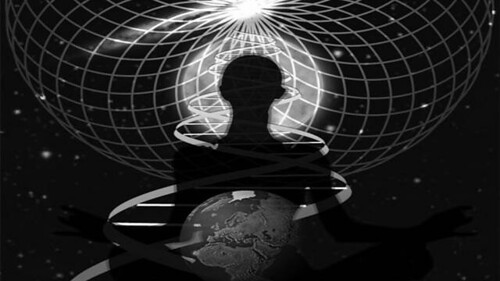
Photo: “Consciousness Awakening on Vimeo by Ralph Buckley” by Ralph Buckley is licensed under CC BY-SA 2.0.