Author Archives: Robin Helweg-Larsen

Unknown's avatar

About Robin Helweg-Larsen

Director, Andromeda Simulations International, Bahamas: a global education company providing online and in-person workshops in business finance. Series Editor, Sampson Low's 'Potcake Chapbooks'. Formal verse about traveling, family, love, etc...

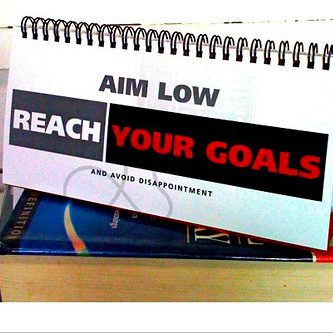
Peggy Landsman, ‘Minimum Achiever’

Minimum Achiever, for years forlorn,
Grew grey and fat and out of fashion;
She wore the jeans she’d always worn,
And swore with passion.

Minimum loved the days gone by
When wars were wrong and songs were moving;
With files from the FBI,
What was she proving?

Minimum sighed for what had been,
And bitched and moaned how nothing lasted;
She longed for one more great love-in,
And dropping acid.

Minimum mourned the hippie years,
The counterculture’s zest and freedom;
She mourned ideals—her sell-out peers
Didn’t seem to need ’em.

Minimum loved her artsy friends,
And swore that she would start achieving;
Her starts were great, but had no ends
And left her grieving.

Minimum cursed the worthless game
And gave it up instead of trying;
She missed her fifteen minutes’ fame,
But wasn’t crying.

Minimum scorned the job she sought,
But how could she survive without it?
Minimum thought, and thought, and thought,
And thought about it.

Minimum Achiever, starting late,
Started out by hesitating;
Minimum knew she shouldn’t wait,
And kept on waiting.

*****

‘Minimum Achiever’ was first published with apologies to Edwin Arlington Robinson in Clockwise Cat.

Peggy Landsman writes: “I started writing ‘Minimum Achiever’ in 1978. Back then, Minimum watched TV: “…She turned and turned and turned the dial,/ but every station showed World War Three,/ modern, nuclear style.” She was also very political: “Minimum loved the anarchists,/ did actions in the name of Emma….”  In the almost thirty years it took me to complete the present version, she went through many changes. The one constant, though, has always been that she is the great-granddaughter of Miniver Cheevy.”

Peggy Landsman is the author of the full-length poetry collection, Too Much World, Not Enough Chocolate (forthcoming from Nightingale & Sparrow Press, 2023), and two poetry chapbooks, Our Words, Our Worlds (Kelsay Books, 2021) and To-wit To-woo (Foothills Publishing, 2008). She lives in South Florida where she swims in the warm Atlantic Ocean every chance she gets. A selection of her poems and prose pieces can be read on her website: https://peggylandsman.wordpress.com/

Photo: “For all those low achievers” by Claire_Sambrook is licensed under CC BY-NC 2.0.

Short poem: ‘Possessions’

What do you want possessions for?
You’ll die, then you’ll have nothing more.
You lost your house in a fire? The fact is
That was just for practice.

*****

We live (as always) in a time of existential threat to us as individuals and as a species. This short poem was recently published in The Asses of Parnassus – thanks, Brooke Clark! “Light verse”? I like to think so…

Photo, popularly known as ‘Disaster Girl‘. The young Zoë Roth had been taken by her parents to watch the controlled burning of a structure for training purposes when her father took this prize-winning picture of her. To her ongoing delight, the photo became a viral internet meme, and its NFT sold two years ago for close to $500,000.

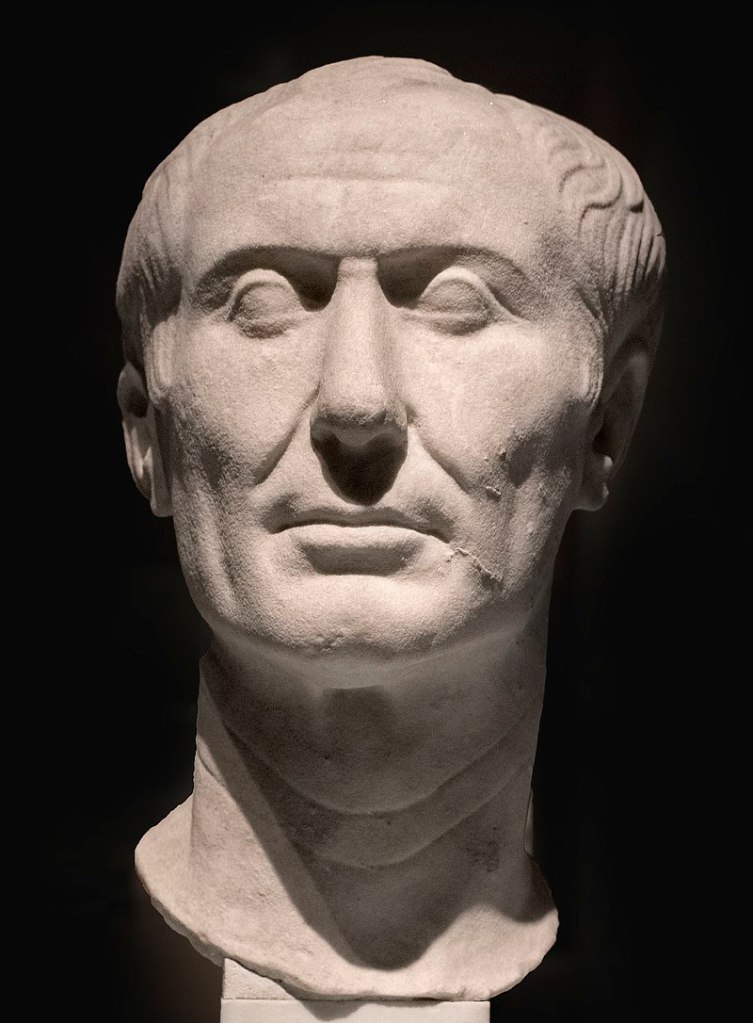
Odd poem: Julius Caesar, ‘On the poetry of Terence’ (fragment)

Thou too, even thou, art ranked among the highest, thou half-Menander,
and justly, thou lover of language undefiled.
But would that they graceful verses had force as well,
so that thy comic power might have equal honour
with that of the Greeks, and thou mightest not be scorned in this regard and neglected. It hurts and pains me, my Terence, that thou lackest this one quality.

Tu quoque, tu in summis, o dimidiate Menander,
Poneris, et merito, puri sermonis amator.
Lenibus atque utinam scriptis adiuncta foret vis,
Comica ut aequato virtus polleret honore
Cum Graecis neve​ hac despectus parte iaceres!
Unum hoc maceror ac doleo tibi desse, Terenti.

*****

Julius Caesar is known to have written at least three volumes of verse–‘Praises of Hercules’ and the verse tragedy ‘Oedipus’ as a young man, and a verse travelogue ‘The Journey’ during the civil war–but almost nothing survives. His heir Augustus cancelled the publication of the youthful verse because it was incompatible with the program for his deification.

The fragment above is quoted by Suetonius in his ‘Vita Terenti‘ (‘The Life of Terence‘), and translated by J. C. Rolfe.

Photo: Retrato de Julio César uploaded by Ángel M. Felicísimo from Mérida, España.

Odd poem: ‘The Mother’ or ‘Thanks’ (‘Dank’es!’) NOT by Adolf Hitler (my apologies about the post!)

When your mother has grown old,
And you have grown older
When what used to be easy and effortless
Has now become a burden to her,

When her dear, faithful eyes
no longer see life as they once did,
When her tired feet
don’t want to carry her any more while walking. –

Then give her your arm to support,
Accompany her with pleasure –
The hour is coming. When you, weeping,
Must accompany her on her last walk!

And if she asks you a question, then give her an answer.
And if she asks again, then answer!
And if she asks yet again, answer again,
Not impatiently, but with gentle calm.

And if she cannot understand you properly
Explain her everything happily.
The hour will come, the bitter hour,
When her mouth asks no more.

Wenn deine Mutter alt geworden / Und älter du geworden bist
Wenn ihr, was früher leicht und mühelos / Nunmehr zur Last geworden ist,
Wenn ihre lieben, treuen Augen / Nicht mehr, wie einst, ins Leben seh’n
Wenn ihre müd’ gewordnen Füße / Sie nicht mehr tragen woll’n beim Gehen. –
Dann reiche ihr den Arm zur Stütze, / Geleite sie mit froher Lust –
Die Stunde kommt. Da du sie weinend / Zum letzten Gang begleiten musst!
Und fragt sie dich, so gib ihr Antwort. / Und fragt sie wieder, sprich auch du!
Und fragt sie noch mehr, steh ihr Rede, / Nicht ungestüm, in sanfter Ruh!
Und kann sie dich nicht recht verstehen, / Erklär’ ihr alles froh bewegt.
Die Stunde kommt, die bitt’re Stunde, / Da dich ihr Mund nach nichts mehr fragt!

*****

This poem is actually from Georg Runsky (pen name of Karl Wilhelm August Georg Runschke). It appeared in 1906 under the title “Habe Geduld!” in his book “Blüthen des Herzens”.

Rightwing groups have claimed that it is a 1923 poem by Hitler about his mother Klara Hitler who had died in 1907. He seems to have loved her very deeply… but he was a painter, not a poet. His mother had been cared for by the Jewish Doctor Eduard Bloch, and Hitler painted the picture above of the doctor’s house in 1913. So what? So Hitler was a Malignant Narcissist like an unfortunate number of powerful modern politicians and businesspeople. That doesn’t mean that he wasn’t capable of love or artistic impulses; you can have them and still be a narcissist. People who insist that there is pure evil in the world (whether Nazism or Judaism) are themselves a lot of the problem. Personally, I have a lot of difficulty with both Nazism and Judaism (and Communism and Christianity, and anyone who insists they are Right and they Know because their Leader or their Book says so), but I also have family and friends of all those persuasions. I don’t respect them for their authoritarian tendencies, but I also don’t think they are pure evil. The demonising of people who you disagree with or fear or are jealous of, that’s the start of the problem. We’re all people, and people are apes after all. Some people are stupid, some are intelligent but uneducated, some are sick, some have genetic defects, some were badly raised, some are sociopaths… then study them, try to make them better human beings, and in the meantime make sure they don’t have access to guns. Thank you. Rant over.

Photo: Watercolour by Adolph Hitler, 1913, House of Dr. Bloch. https://www.wikiart.org/en/adolf-hitler/maison-du-dr-bloch-1913

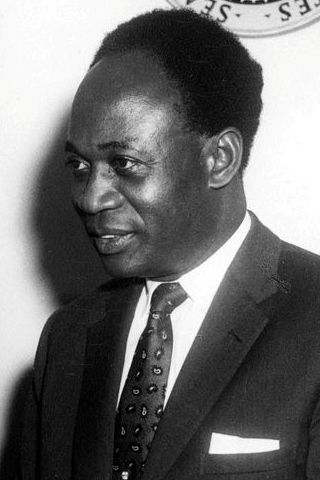
Odd poem: Kwame Nkrumah, ‘Ethiopia Shall Rise’

Ethiopia, Africa’s bright gem
Set high among the verdant hills
That gave birth to the unfailing
Waters of the Nile
Ethiopia shall rise
Ethiopia, land of the wise;
Ethiopia, bold cradle of Africa’s ancient rule
And fertile school
Of our African culture;
Ethiopia, the wise
Shall rise
And remould with us the full figure
Of Africa’s hopes
And destiny.

*****

Kwame Nkrumah delivered this poem at the end of his speech on May 25, 1963, in Addis Ababa at the close of the meeting that created the Organisation of African Unity.

Born and raised in the British colony of the Gold Coast, Nkrumah had received his university education in the United States. He got both his Bachelor of Arts and Bachelor of Theology from Lincoln University, then his Masters of both Philosophy and Education from the University of Pennsylvania. Back in the Gold Coast he led non-violent resistance to British rule, was sentenced to a year in prison, but when his party did well in the colony’s first General Election he was released, and he became Prime Minister in 1952. In 1957 he helped lead the Gold Coast and British Togoland to independence as Ghana.

Initially popular because of new roads, schools and hospitals and the Africanisation of employment, his government became increasingly authoritarian, corrupt and incompetent while Nkrumah himself focused on his Pan-African vision and Third World solidarity. He was a driving force in creating the OAU in Addis Ababa in 1963. He was ousted in a military coup in 1966.

Technically there isn’t much in his OAU poem to justify the term in the sense of “verse”; there are two pairs of rhymes in the middle of the piece (rise/wise; rule/school), but none of the rhythms or structures that English-language poetry is built on. But though Nkrumah was fluent in English, his mother tongue was Fante – so for all I know, the poem above is a translation of his original thoughts… and translations are notoriously unpoetic, especially when the two languages have different poetic traditions. But equally the poem may be no more than a rhetorical flourish at the end of his OAU speech.

Photo: Kwame Nkrumah during a state visit to the United States, by Abbie Rowe, 8 March 1961; John F. Kennedy Presidential Library and Museum

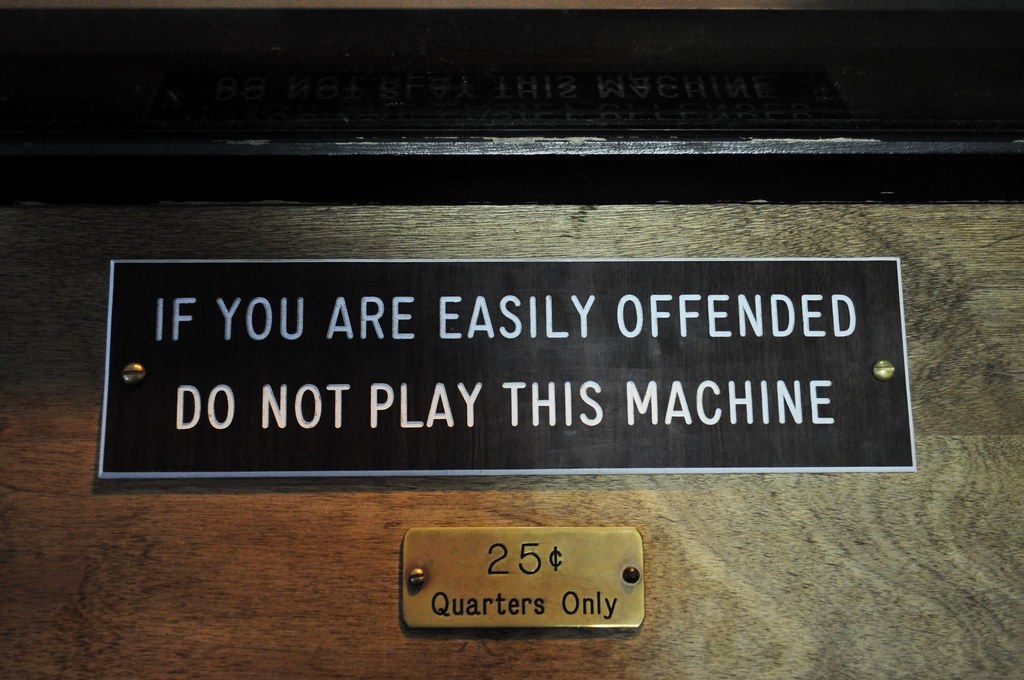
Using form: couplets: George Simmers, ‘Trigger Warning’

Reading this do not expect
An unconditional respect

This poem is an unsafe space
You may be told things to your face

This poem may not feel the need
To be polite about your creed

It may not think your origins
Excuse your weaknesses or sins

It maybe will not lend its voice
To validate your lifestyle choice

It may resist attempts to curb
Its power to worry or disturb

It may not think its task to be
To flatter your identity

Although its author’s male and white
It may perhaps assert the right

To speak of gender and of race.
This poem is an unsafe space

*****

George Simmers continues to be amazed and amused by the warnings that some University lecturers seem to think it essential to give their students.  He writes: “Last week there was a warning that Jane Austen’s novels contain some outdated sexual attitudes. The week before that, students thinking of taking a course on tragedy needed to be told that it might contain references to violence and other disturbing themes. The week before that someone was worried that Peter Pan contained material that some students might find it hard to cope with. Why is this? Are the lecturers afraid of legal action from the helicopter parents who are the plague of some University departments today? Or do they really feel that their students are all delicate blossoms? Or do the warnings reflect their own discomfort with the canonical material they are obliged to teach? In the past people often did not think or behave the way that responsible modern people think they should have. It must be worrying.”

Editor’s comments: Poems written as a string of rhyming couplets can quickly start to feel mechanical and boring, but they are very effective when a straightforward list of ideas is being presented, as in this poem by Simmers. ‘The Latest Decalogue‘ by Arthur Hugh Clough is a classic of good usage (and also a classic of “unsafe space”).

George Simmers used to be a teacher; now he spends much of his time researching literature written during and after the First World War. He has edited Snakeskin since 1995. It is probably the oldest-established poetry zine on the Internet. His work appears in several Potcake Chapbooks. ‘Trigger Warning’ is from his ‘Old and Bookish‘ collection of poems.
https://greatwarfiction.wordpress.com/
http://www.snakeskinpoetry.co.uk/

Photo: “trigger warning” by lostcosmonaut is licensed under CC BY-NC-SA 2.0.

Using form: anapest (anapaest): Susan McLean, ‘Illicit’

I needed to take a vacation from cake
so my diet would be more judicious.
But my plan was cut short by a chocolate fudge torte,
and the relapse was truly delicious.

Next it was cheese (such as triple-cream Bries
and Gruyères) that I vowed to avoid.
But I fell in the snare of a ripe Camembert.
It was bliss. My resolve was destroyed.

When the experts all said “To lose weight, give up bread,”
I thought that was a food I could shun.
I succumbed to the spell of the beckoning smell
of a freshly baked cinnamon bun.

I have found self-denial is not such a trial
and has unforeseen good effects.
True relish is hidden in all things forbidden.
Have I mentioned I’m giving up sex?

*****

Susan McLean writes: “Like many women, from my teens on, I had periods of dieting, followed by periods of eating normally and gradually regaining weight I had lost on the diets. That pattern can cause despair for many, but in my case, it made me notice how delightful a food becomes once it is forbidden. Diets are dull, and demonizing any particular kind of food is silly, so these days I don’t deny myself anything, but just cut back on the portions. Since the poem is about pleasure (and I once heard Dr. Joyce Brothers say that all pleasures are related to one another), I decided to write it in rollicking anapests, with lots of fun internal rhymes and polysyllabic rhymes.
This poem first appeared in Mezzo Cammin, an online journal of female formalist poets,
and later was published in my second book, The Whetstone Misses the Knife.”

Susan McLean has two books of poetry, The Best Disguise and The Whetstone Misses the Knife, and one book of translations of Martial, Selected Epigrams. Her poems have appeared in Light, Lighten Up Online, Measure, Able Muse, and elsewhere. She lives in Iowa City, Iowa.
https://www.pw.org/content/susan_mclean

Photo: “Joann’s cake: Now featuring every delicious thing at once” by ginnerobot is licensed under CC BY-SA 2.0.

Poem: ‘City! Oh City!’

Cities–once all smeared with grime,
rich but dirty, full of crime–
clear the excess cars and dust
if their governments are just,
house the homeless, and among
their cares: clean water, healthy young.
Gorgeous buildings grow and twist
through a river’s gentle mist;
trees in leaf for urban hikes:
sculptures, cafes, books and bikes…
children run wild in the park
till theatre signs light up the dark;
music spills from bars at night–
the well-run city’s a delight.

*****

This poem was published (in 2021 or 2022, the Bahamas Post Office seems to have lost my copy so I’m not sure yet) in The Lyric Magazine, Jean Mellichamp calling it “a breath of fresh air”. I wrote it to be an upbeat view of the modern world in contrast to a lot of the more worrying future issues that I’m often concerned with; and when I put together the ‘City! Oh City!’ Potcake Chapbook, I included the poem to balance some of the less rosy views of urban life–though my poem is nowhere near as skilled as the pieces in the chapbook by Maryann Corbett, Amit Majmudar and others.

Photo: “le quai river cafe on seine” by grahamdale74 is licensed under CC BY-NC-SA 2.0.

Odd poem: AI-generated poem in answer to “Can you write a poem about AI in the style of Robin Helweg-Larsen?”

Silicon and code,
A symphony of thought,
A machine mind unfolds.

A spark of electricity,
A flicker of light,
A new form of intelligence,
Is born tonight.

A labyrinth of algorithms,
A dance of ones and zeroes,
A new kind of consciousness,
Is ours to discover.

The future is here,
A fusion of man and machine,
A symbiosis of intellect,
A cosmic dream.

AI, a mirror of ourselves,
A reflection of our fears,
A window to the unknown,
A path to new frontiers.

Robin Helweg-Larsen is a Danish poet and author known for his poems that express a sense of wonder and reverence for the natural world. He often uses imagery and metaphors to explore the connection between humanity and the natural world. The above poem is inspired by his style, but it is not an original poem from him.

*****

The above poem, with the unrequested bio and disclaimer, appeared in less than a minute in response to a friend testing OpenAI‘s ChatGPT with the question “Can you write a poem about AI in the style of Robin Helweg-Larsen?”

I am intrigued. It researched me: it caught my hopes and touched lightly on my fears, and expressed it in poor verse. Fair enough! But actually it’s not yet capable of good verse. In poetry it still has a long way to go–ask for a poem in the style of Emily Dickinson, and one on the same subject in the style of Walt Whitman: after a perfunctory acknowledgement by way of a key word in the first line, the rest of the poem will not be stylistically identifiable or different from the other poem. Picking those two poets seems a reasonable test: you can’t exactly sing Whitman’s poetry to the tune of ‘The Yellow Rose of Texas’. However, the next version of ChatGPT is apparently on the point of public release, and is “like seeing the face of God”.

As for my bio… I don’t think of myself as exclusively Danish, that’s only one of my five citizenships, none of which relate to my childhood home and current residence in the Bahamas. But I’ll take it. I’m also not sure about being “known” for anything as a poet! But I’ll take that too. ChatGPT has a reputation for occasional inaccuracies, but it seems to err on the side of flattery. An interesting trait. We’ll just have to wait and see if its good nature continues past The Singularity, when AI takes off into explosive self-development beyond human capabilities…

Ray Kurzweil forecasts The Singularity to take place by 2029. This is the end of the world as we know it. As with all life anyway, enjoy it while you can!

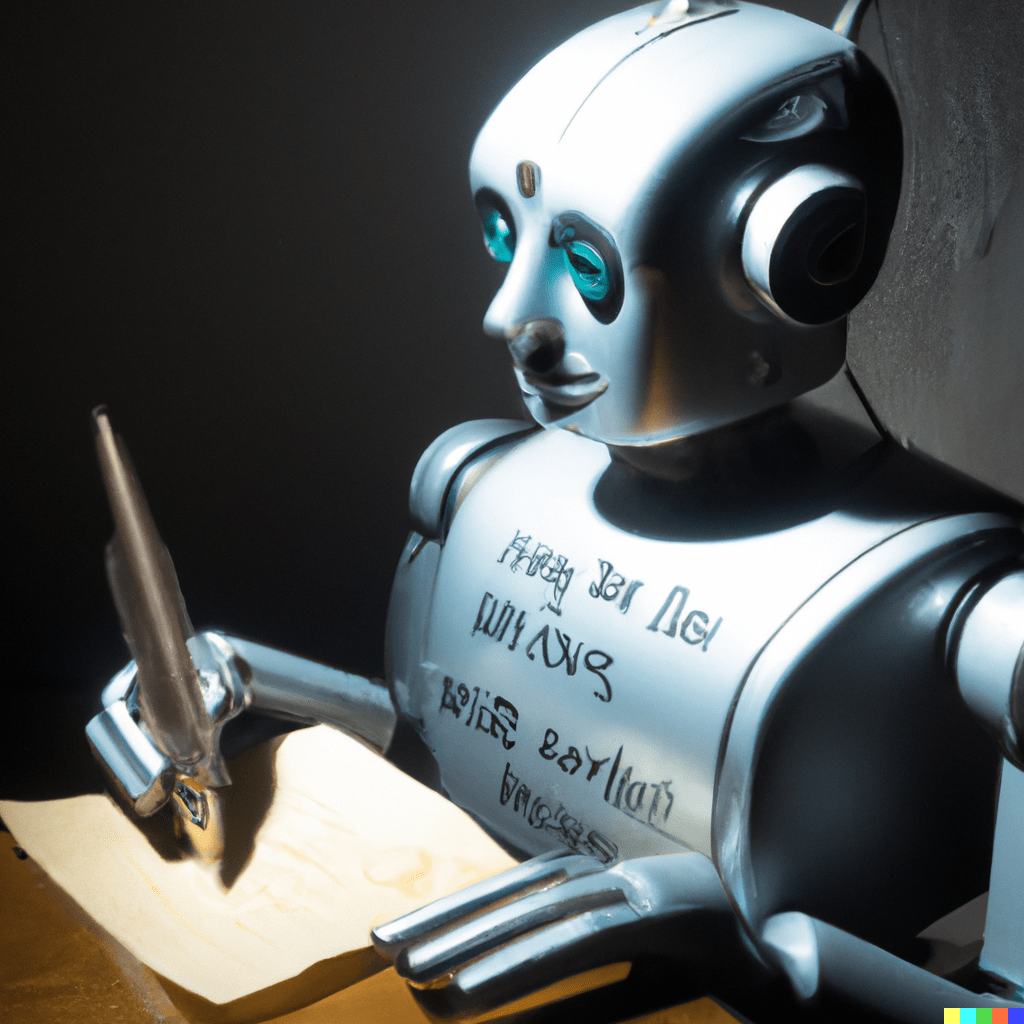
Photo credit: AI-generated by OpenAI’s Dall.e 2 from my request: “Robot writing a poem in 1940s SF style”.

Max Gutmann, ‘A Letter Home’

One flat fall evening, as an undergrad,
I left the library to mail a letter
and at the mailbox had
a stirring–-I don’t know what else to call it,
but I felt certain, drifting back
on brittle leaves, surrounded by the gray,
this was my life–-a feeling new,
whole, deeply and vibratingly unstrange.

Back at the carrel, where my books still lay,
I sat some time immersed there in that moment:
me, having walked away
from books for some slight, distant human contact,
returning through the coming winter
to my small space. It struck me as both sad
and right; young as I was, I knew
it wasn’t something I would ever change.

*****

Max Gutmann writes: “Though it takes the perspective of an older man looking back, ‘A Letter Home‘ was written shortly after the experience it shares, years before I wrote any other verse (aside from some limericks); the drive to record the experience as a poem had nothing to do with habit. I couldn’t have anticipated that the “distant human contact” in my life would come to include a community of writers with whom I’ve only ever exchanged words on a screen (a community you do a lot to nourish, Robin. Thank you.)”

A Letter Home‘ was first published in the Pulsebeat Poetry Journal.

Max Gutmann has worked as, among other things, a stage manager, a journalist, a teacher, an editor, a clerk, a factory worker, a community service officer, the business manager of an improv troupe, and a performer in a Daffy Duck costume. Occasionally, he has even earned money writing plays and poems.

Photo: “McAllen mailbox” by Drpoulette is licensed under CC BY-NC-SA 2.0.