Author Archives: Robin Helweg-Larsen

Unknown's avatar

About Robin Helweg-Larsen

Director, Andromeda Simulations International, Bahamas: a global education company providing online and in-person workshops in business finance. Series Editor, Sampson Low's 'Potcake Chapbooks'. Formal verse about traveling, family, love, etc...

Potcake Poet’s Choice: John Beaton, ‘Bedtime Story’

The sun has smouldered low. Its flaxen light
drizzles through the birches to the snow
where sheep stand still as hay-bales, beige on white.
A shepherd with a shoulderful of straw,
brindled by the shadows, softly walks.
The sheep flock round; he swings his load to strew
the strands on pillowed drifts like yellow locks,
then hastens homewards bearing sustenance
against the ghostly dark. He holds small hands
and spins his children tales of happenstance
and golden fleeces in enchanted lands.
Their minds woolgather. Snuggled down in bed,
they drift on snowy pillows; yellow strands
of hair glow like the hay their father spread.

John Beaton writes: “My wife and I have five children and one of my great delights was reading to them in bed when they were little. We covered a lot of ground, from Shel Silverstein’s poems and Roald Dahl’s stories to whole books like “Watership Down” and “The Old Man and the Sea.” This poem came to me when I was looking at the painting “Shortening Winter’s Day” by Joseph Farquarson (shown above). It was reminiscent of the place where I grew up in Scotland. The image of the shepherd feeding sheep in the gloaming light evoked the feeling of security and contentment that imbued those evenings of reading. I recite my poetry and tend to write for sound almost as much as for sense. I like the sounds of this one. Also, when picking subjects for poems, I’m more drawn to happiness and beauty than to sadness and misery. All in all, this poem fits my preferences quite nicely.”

John Beaton’s metrical poetry has been widely published and has won numerous awards. He recites from memory as a spoken word performer and is author of Leaving Camustianavaig published by Word Galaxy Press. Raised in the Scottish Highlands, John lives in Qualicum Beach on Vancouver Island.


https://www.john-beaton.com/

Short Poem: ‘The Logophile Picks a Fight’

By the spots of shame with which your life is spattered,
Your position, sir, is grossly overmattered –
Overmattered, sir, or greatly undermined;
And I cannot help but find
That the lot of humankind
Would be bettered, not embittered, were you battered!

After having kicked around for years, this short piece–which has no purpose other than wordplay–finally got an explanatory title (instead of just the first few words) and was published in this month’s Lighten-Up Online in the section ‘Words, Words, Words’. Thanks, Jerome Betts!

Photo: “Picking a fight for net neutrality #ind12” by Kalexanderson is licensed under CC BY 2.0. Photo has been cropped.

Short poem: ‘Yogis’

Though mystified why yogis walk
Across the burning coals,
We know they stand upon their heads
To elevate their soles.

This was first published in Metverse Muse, an Indian magazine put out by Dr. Tulsi Hanumanthu that champions structured verse in English. The poem’s pun seems so obvious to me that I’m still surprised I haven’t seen it anywhere else. Be that as it may, I’m a proponent of the health benefits of five-minute headstands, which I have been doing irregularly since I wrote the poem nearly 50 years ago, after spending a month in the Sivananda Vedanta Yogashram in Val Morin, Quebec.

As for timing five minutes while in a headstand, I do it by mentally reciting the first 18 verses of Matthew Arnold’s ‘The Scholar Gypsy’. After years of those 180 lines, I keep thinking I could replace it with 45 quatrains of ‘The Rubaiyat of Omar Khayyam’… but somehow I always get stuck pondering which edition of the Rubaiyat I prefer…

Photo: taken by Eliza.

Potcake Poet’s Choice: Julia Griffin, ‘The Buck Stops’

A buck stopped here last Saturday early,
Just as the streets were turning blue.
A fine six-pointer, bronzed and burly:
What had it come for? Nobody knew.

It took its stand at the central bus stop,
Silent, proud-footed, thorny-topped.
There perhaps it had once seen us stop;
All that morning, nobody stopped.

It hardly seemed the thing to confront it.
We’ve little practice with bucks or deer;
Anyway, nobody tried to hunt it;
Anyway, nobody asked it here,

Maimed it, lamed it, blamed or shamed it!
This, in fact, is the most one can say:
A buck stopped here and nobody claimed it.
It waited a while, then it wandered away.

Julia Griffin writes: “I like the central image of a buck stopping. And it seems so widely applicable… I turn everything into an animal poem if I can.”

Julia Griffin lives in south-east Georgia/ south-east England. She has published in Light, LUPO, Mezzo Cammin, and some other places, though Poetry and The New Yorker indicate that they would rather publish Marcus Bales than her.

More of her poetry can be found in Light, at https://lightpoetrymagazine.com/?s=julia+g&submit=Search

Sonnet: ‘Drifting’

Drifting and drifting in an eddying stream
The leaf cannot recall the maple tree;
Pieces fall off; it has nor plan nor scheme;
How could a leaf have sense of destiny?
Its work is done; tree-feeding fades like dream,
Tree-making’s not a possibility.
It drifts and rots, nibbled by perch and bream
Or reaches finally the endless sea.

The sea itself moves, rhythmical and blind:
Is calm, or sprays salt as the waves make foam.
Seas have no will, no parliament of mind,
To make directives like hives make bees roam
To pollinate the world, defend their kind,
And with their mind create their honeycomb.

This sonnet drifts in several ways. The rhythm of iambic pentameter is meditative, rambling. The rhyme scheme is slow, repetitive, changing between the octave and sestet: ABABABABCDCDCD. And the ideas drift: the leaf is left behind when it reaches the sea, and the sea is abandoned for bees. The form seems suitable for the content.

‘Drifting’ has just been published in this month’s Snakeskin, whose editor commented “I like the way it moves from one idea to another that you don’t expect.” Thanks, George Simmers!

Photo: “Like a Leaf in a Stream” by Referenceace – Working! is licensed under CC BY-NC-SA 2.0

Poem: ‘What Lasts?’

Munch’s Scream fades, and the Taliban
blow up the grandest statues that they can.
Safer are spoken treasures of the mind:
poems and songs outlast objects that rust,
or bust, or slowly crumble into dust.
Until from cave or dig comes some strange find…
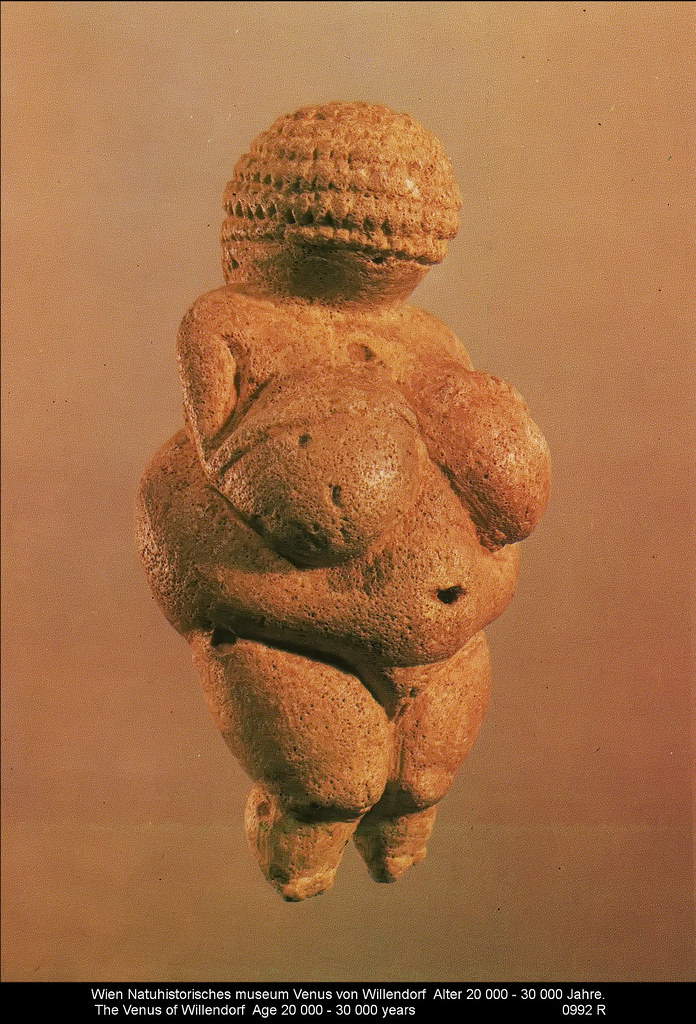
but when Lascaux and Willendorf were young,
what was recited, or what songs were sung?

As regards “immortal” works of art… anything that is still respected in a hundred years is pretty good, anything still talked about after a couple of thousand years is doing very well… Songs and poems can manage that length of time, especially if connected a religion or other social ritual; but there is very little oral survival beyond that, and the survival of physical artifacts from tens of thousands of years ago is of the luckiest, perhaps of the lost or the most overlooked, not necessarily the best.

How wonderful if in the future we can recapture sounds from the Stone Age! At present there is no way to see how it could ever be done. But at least we have a few cave paintings and small carvings…

This poem was just published a short while ago in The Asses of Parnassus. Thanks, Brooke Clark!

“Austria. Wien Naturhistorisches museum Venus von Willendorf. Die Venus von Willendorf ist eine Venusfigurine aus der jüngeren Altsteinzeit (Jungpaläolithikum), dem Gravettien, und ist als Österreichs bekanntestes Fundstück heute im Naturhistorischen Museum” by Morton1905 is licensed under CC BY-NC-ND 2.0

Poem: ‘Friendly Advice’

“Listen, old feller-me-lad,” he said
With a rugger-player’s laugh
(Not that he was big and brawny,
Only about scrum-half)
“You can muck about till you’re blinking dead
Without a career or a wife,
But (I know that it sounds damn corny)
You’re wasting your bloody life!

“Look, Slater Walker would snap you up!
Anyone can see you’re no fool.
Or why not go round to the Honkers and Shankers?
You’ve been to a decent school.
But before you do, go and have a haircut
You can’t go through life as a clown.
Get a good job! You’ll only thank us
For helping you settle down.

“Work with a Bank, and go overseas,
That’s where you’ll get the best pay.
Look at us: Jill and I are content,
With our two kids, and one on the way.
We’ve enough for a car, and boarding-school fees,
And her clothes, and my drinking and smoking;
And the Bank pays us our large flat’s rent,
And we’ve got our own place in Woking.

“So we’ve got our means, and we’ve got our ends,
And we’re happy through and through;
But you, you do nothing, although you’re clever,
And we worry a bit about you.
Now look, we like you, we’re speaking as friends:
Settle down! Get a job and a wife!
You can’t go on mucking about for ever –
You’re wasting your bloody life!”

In my gap year between school and university I worked in the local Barclays Bank in my home town of Governor’s Harbour. My subsequent university career only lasted a matter of months and I began wandering between countries, but my former boss at Barclays had friendly advice for getting me back on track. His Englishness is there in the poem, which dates itself with references to the once-mighty Slater Walker investment house and with the nickname of the Hongkong & Shanghai Bank before it became HSBC. It was a while ago… if Tim Clark is back in Woking with his wife Jill, they must be in their 90s by now.

The scansion of the poem is a little casual, but there are alternating 4 and 3 feet to a line. The rhyme scheme is tighter, ABCBADCD in each verse. I think it works well as a piece of casual one-sided discussion. First published in Lighten-Up Online – thanks, Jerome Betts!

Photo: “Bored at Work” by D Street is licensed under CC BY-NC-ND 2.0

Review: Max Gutmann, ‘Light and Comic Verse’

Quirkily-workily
Jorge Bergolio,
On a career path with
Quite a steep slope,

Unostentatiously
Worked as a janitor,
Then as a bouncer, and
Then as the Pope.

This elegant double dactyl on the life of Pope Francis is representative of ‘The Hearthside Treasury of Light and Comic Verse’: interesting, witty, technically perfect. The poems include limericks, clerihews, varieties of ballades, and are purported to be written by a variety of poets, several of whom are claimed to be the first-ever winner of the prestigious Blackfrier Prize for Poetry. The book’s veneer of being ‘edited by Max Gutmann’ is worn even thinner with the bio of his least likely poet, Ed Winters… “A devotee of Hemingway, Hart Crane and Sylvia Plath, Winters shot himself in the mouth while diving from a ship with his head in an oven.”

The book includes two pages of riddles in rhyme, of enjoyable difficulty: half were guessable for me, half not. There is also a full-length Poe parody (‘Quoth the Parrot: “Cracker. Now!”); scenes from The Merchant of Venice, King Lear and Titus Andronicus rewritten by W.S. Gilbert; outrage at the Trump presidency, the killing of Jamal Khashoggi, and the US Supreme Court’s appalling excuse for subverting the 2000 Presidential election; a poem appropriately written in the form of a dozen eggs; and various puns, off-colour jokes and random surprises. Many of the poems have previously appeared in Light poetry magazine, many others in a range from Asses of Parnassus to the Washington Post.

As for “The Hearthside Treasury” part of the book’s title… though there was (or is) a Hearthside Press, active from the mid-1950s to mid-70s; and an unrelated Hearthside Books, active from the mid-70s to the present, sort of; this “Hearthside Treasury” appears unconnected to anything. Indeed, it’s not even available on Amazon. It doesn’t have an ISBN. All this is a pity, as it is as enjoyable a book of light and comic verse as you can find anywhere. If you want a copy – and if you enjoy comic verse you really ought to have one – you’re going to have to contact the author directly through his website (which mostly focuses on his plays) at maxgutmann.com

Odd poem: Margaret Mead(?), ‘Hogamus Higamus’

Hogamus, higamus,
Man is polygamous;
Higamus, hogamus,
Woman’s monogamous.

I’m going to go out on a limb here and say this is American anthropologist Margaret Mead‘s creation. I have a clear memory of reading the story many years ago, probably in ‘Male and Female’, of her waking up in the middle of the night with an understanding of the secret of the universe. She grabbed the pencil and paper she kept by her bedside and wrote it down, then went back to the sleep. And in the morning she found she had written the above verse.

I was so certain it was Margaret Mead that I began this blog post about her before trying to check which book the verse came from and if I had the wording correct. (I last read Mead decades ago, and I leave beyond the reach of bookstores and real libraries.) To my frustration, all I can find in Google is attribution to William James, Dorothy Parker, Ogden Nash, Bertrand Russell, Alice Duer Miller… and Mrs. Amos Pinchot, who allegedly denied authorship. According to Quote Investigator, “The first known evidence of this unusual anecdote appeared in the Cleveland Plain Dealer newspaper in November 1939. The article ‘Thanksgiving Nightmare’ by Claire MacMurray (…) presented a supposed episode in the mental life of a person named Mrs. Amos Pinchot”, and tells the tale as I remember it. Mead’s ‘Male and Female’ came out in 1949, so (if the poem was in that book) it may have been referring to the Pinchot story, or it may have been something that had happened more than ten years previously to Mead, and she had shared the story and it had spread by itself.

The poem itself is brief, witty, amusing. It is rhythmic, repetitive, well rhymed, very catchy. Those are all excellent qualities. As for the content, it seems very 20th century: it gives the impression of having broken out of the conventions of society and church, and to be saying that the two sexes have differing needs for propagating themselves successfully. It is also 20th century in being simplistic. Where does the concept of serial monogamy fall? How does the rhyme relate to the LGBTQ+ members of society? The verse is definitely not comprehensive enough for the 21st century. But Margaret Mead was a controversial opener of cans of worms in the early 20th century, and that is where this little poem came from. Her obsession with gender roles and her self-deprecating humour make her a good candidate for its author.

And where the poem came from, apparently, was a communication from the unconscious, a gift to the dreamer. Always respect and preserve what the Muse offers you – who knows, a couple of lines of verse may be treasured and quoted for a hundred years!

“Sex and Temperament in three primitive societies” by your neighborhood librarian is licensed under CC BY-NC-SA 2.0

Potcake Poet’s Choice: Melissa Balmain, ‘Fluffy Weighs in on the Baby’

It’s hairless as an egg—
why bother petting that?
It doesn’t purr or groom your leg,
and yet you feed the brat.

Instead of catching mice,
it grapples with its socks.
It’s never taken my advice
to use the litter box.

It can’t climb up a tree,
it can’t chase balls of string,
it leaves you zero time for me—
just eat the wretched thing.

‘Fluffy Weighs in on the Baby’ is reprinted from Walking in on People (Able Muse Press)

Melissa Balmain writes: “The great light poet Bob McKenty calls himself ‘an editorial cartoonist who can’t draw.’ Given my fondness for writing persona poems, I think I qualify as a method actor who can’t act. As you might guess, adopting a persona lets me try on fresh points of view and say things I might not think to say (or dare to say) as myself. Plus, it can be a fun vehicle for mockery—as in ‘Fluffy,’ which aims its claws at new parents who ignore their pets. (Yes, I was one of those new parents…) Over the years I’ve attempted to channel not just animals and fellow humans in my poems, but also cartoon characters, plants, water, Satan, a dictionary, and, in my latest book, fairy tale characters. It’s the closest I’ll get to a SAG card.”

Melissa Balmain edits Light, America’s longest-running journal of light verse. Her poems and prose have appeared widely in the US and UK. She’s the author of the full-length verse collection Walking in on People (Able Muse Press), chosen by X.J. Kennedy for the Able Muse Book Award; and the shorter collection The Witch Demands a Retraction: Fairy-Tale Reboots for Adults, new from Humorist Books. She is a recovering mime.