Author Archives: Robin Helweg-Larsen

Unknown's avatar

About Robin Helweg-Larsen

Director, Andromeda Simulations International, Bahamas: a global education company providing online and in-person workshops in business finance. Series Editor, Sampson Low's 'Potcake Chapbooks'. Formal verse about traveling, family, love, etc...

Poem: ‘Body Surfing’

Standing hip deep in the sea
Is nice in itself, but the reason for being there
Is the wait for a big wave.

A wave rising, a sudden tower
Smooth with devouring power
But one you can launch yourself forward in tune with – and
Hurtle ecstatic, unseeing and breathless
For as long as breath can hold
Through the water and up along over and onto the sand,
Sand thick in your hair, jammed in every fold,
Scraped, battered and rolled,
Triumphant, beached, deathless.

For this the saint prays,
For this the artist stares open-eyed,
For this the poet lets wounds bleed unstanched,
For this: this hope of being launched,
Controlled and uncontrolled
By what can’t be withstood or denied.

(Or else you could duck under the wall,
Let it pass over while you count three,
Hear the boom of its crested fall,
Yourself unbroken, inactive, safe, free.)

The sea is always there
Whether or not you are in it
Standing hip deep in it
Waiting for the next big wave.

Another of my “Is it formal?” poems. How much rhyme, rhythm and consistent structure do you need in order to consider it formal? Where is the cut-off between form and free? I don’t know. But I felt the alternation – between quiet waiting sections and the breathless rush of a good wave – was an appropriate expression in itself.

The poem was originally published in Snakeskin. Thanks, George Simmers!

“Superman body position while body surfing” by benaston is licensed under CC BY 2.0
Poem: ‘Warfare’

The mother’s nightmare
The child’s terror
The rapist’s freedom
The girl’s death.
The killer’s ecstasy
The band’s brotherhood
The youth’s excitement
The dying breath.

The glory of the lucky
The scream of the unlucky
The lost limbs, blindness, madness
The lifelong PTSD, homeless in the streets.
The poet’s puzzle
The politician’s porn
The aphrodisiac
The power-soaked sheets.

The demagogue’s cause
The demagogue’s solution
The warmonger’s profits
The fearmonger’s skill.
The blacksmith’s trade
The scientist’s incentive
The human fascination
The tribe’s need to kill.

The acceptance by the boys
The eagerness of teens
The avoidance by the men
The manipulation by the old.
The girl’s adoration
The woman’s greed
The widow’s grief
The body cold.

The king’s invocation
The priest’s sanctification
The scared population
The desolation.

The peasant’s loss
The trader’s loss
The teacher’s loss
The city’s loss.

The mortician’s gain
The tombstone maker’s gain
The coffin maker’s gain
The graveyard’s gain.

The medal maker’s gain.

And over it all God sits in His rocking chair
On His front porch in the sky
Saying, A crop, a very fine crop, an excellent crop this year.

Sits in His deck chair to look at the warfare waves
In the shade of a cloud in the sky
Watching the sandcastles washing away.

Sits in the night coming down on the battlefield
Watching crows, ravens, hyenas, stray dogs
Men and women pulling gold teeth from the dead.

Sits in His laboratory, looking at His guinea pigs
Sits in His concert hall, listening to the music
Thinking, All this is so interesting
All this is so tragic
All so inspiring
How far will they get till they blow themselves up?
Will these ones escape? Will they figure it out?
Can they conquer themselves and discover the universe?

Maybe it’s out of line to put this poem into a ‘formal verse’ blog… But there are two points to consider. First, there is a lot of form in the outraged chant of the beginning half–rhyme, rhythm, balance, some alliteration. Second, transitioning from that form to a less structured meditation in itself a use of form; it transitions the entire poem from one viewpoint to another by making the two halves so different. That’s my argument, anyway. Is it reasonable?

The poem originally appeared in Bewildering Stories. Thanks Don Webb and John Stocks!

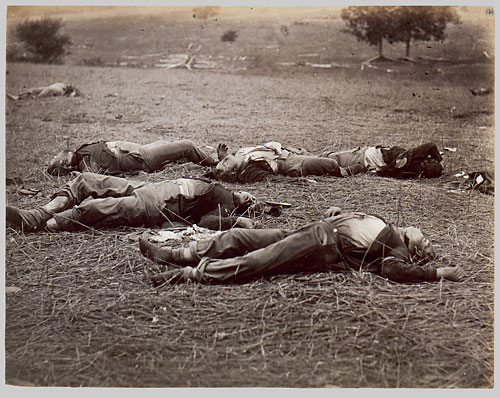
Photo: “Battlefield Dead After the Battle of Gettysburg” by elycefeliz is licensed under CC BY-NC-ND 2.0

Potcake Poet’s Choice: Bruce McGuffin, ‘Why It’s Important To Take Your Saxophone Hiking’

Whenever I go for a walk in the wood
I carry a saxophone, everyone should.
You need it in case you get caught unawares
By a band of unruly and ravenous bears.

When the bears leap from bushes intending to eat you,
You won’t have the time that it takes to retreat, you
Had better be ready to pull out your sax
If you don’t want to finish your day as bear snacks.

Play a song they can dance to, try Latin or swing.
Dancing bears like to rhumba, they might highland fling.
But beware, every bear is a dance epicure.
If you play Macarena they’ll eat you for sure.

Bruce McGuffin writes: “A respected poet1 once described Light Verse as “a betrayal of the purpose of poetry”. All I can say is whatever gave him the idea that poetry only has one purpose? With almost 8 billion people in the world there must be 8 billion plus purposes for poetry. Everybody wants to feel a little light and laughter now and then, and for me that’s one of the purposes of poetry. This silly poem (which originally appeared in Light Poetry Magazine, February 2020) about dancing bears, with its driving, almost chant-like, rhythm makes me happy whenever I read it. I hope it will make other people happy too.”

[1] Robin Robertson in Guardian Interview, September 28, 2018. 

Bruce McGuffin writes all kinds of poetry, but meter has a way of sneaking in even when it’s not invited, sometimes bringing rhyme along for the ride. His subjects range from the profound to the utterly frivolous with a decided tilt toward frivolous, which he justifies by claiming he writes for his own amusement. He divides his time between Lexington Massachusetts, where he has a day job as an engineer at a radio research lab, and Antrim New Hampshire, where he lives with his wife and pretends to be practical (when he’s not writing poetry). At work the practical engineers think he’s a theorist, and the theorists think he’s a practical engineer. His poetry has appeared in Light, Lighten Up Online, The Asses of Parnassus, Better Than Starbucks, and other journals.

Poem: ‘Zippori Story’

Context, people, context! Remember that
Herod was building his new royal city
Zippori some four miles from Nazareth
when Jesus was a child. And Joseph would
have walked there, worked there, daily; Jesus too.

When Judas of Galilee raised his revolt,
captured and burned it–Roman legions came,
defeated him, cast him in the Sea
of Galilee, a millstone round his neck,
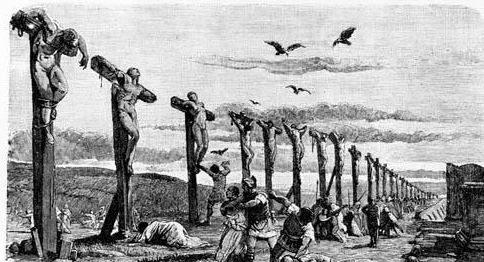
and crucified two thousand rebel Jews.

This was the year that Joseph disappears
from Gospel narratives, all unexplained.
When Jesus chased two thousand Legion pigs
over a cliff into that selfsame sea,
think retribution; think guerrilla strike.

The lack of stories and legends about Jesus’ step-father is one of the great Christian mysteries. He simply disappears from the narrative in the year of Judas of Galilee’s revolt, and is never mentioned again in polite society. Nor is Zippori ever mentioned in the Bible, either by that name or the Romanized Sepphoris, although it was the local capital of Galilee. I have laid out what seem to me obvious suspicions in The Gospel According to the Romans, and blogged about it here and there.

This poem was just published in The Road Not Taken, a Journal of Formal Poetry, in the section themed on ‘Replies’. My thanks to Dr. Kathryn Jacobs.

Review: ‘¡OHO!’ by Rex Whistler, words by Laurence Whistler

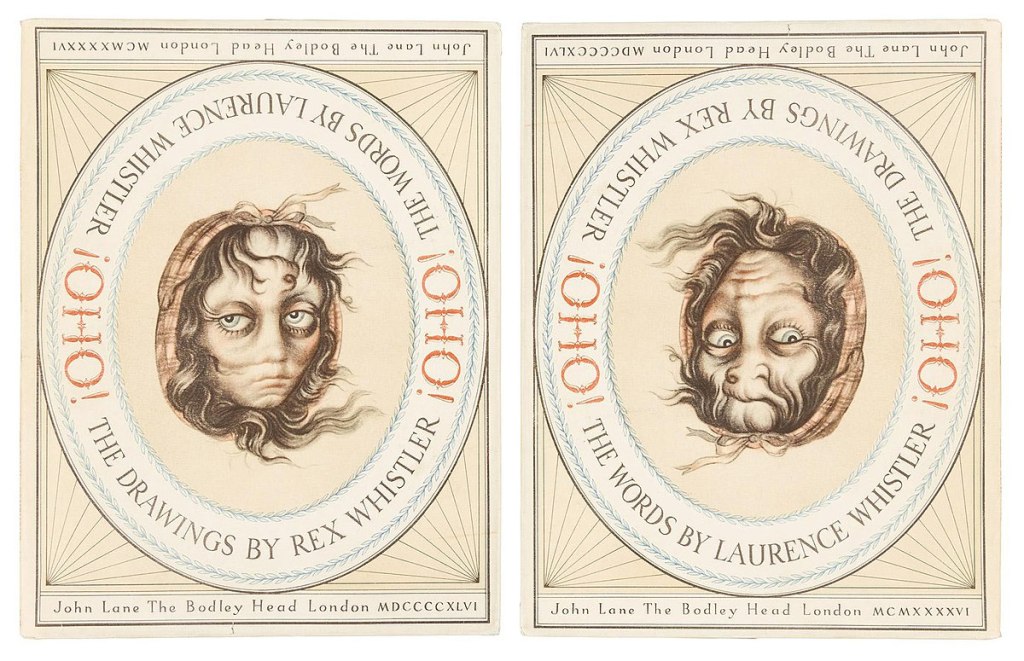
This is one of the most unusual volumes of poetry, because the poems are far less engaging and memorable than the illustrations for which they were made. The witty and whimsical British artist, Rex Whistler, produced a series of drawings of people which, when turned upside down, show a different but related person; his brother Laurence produced poems to describe the relationships. The front and back covers are identical–except that there is no front and back; the book can be opened and read from either end. There are two poems facing each illustration, the lower one describing the face you see, the upper one appearing upside down… until you turn the book around and find it describes the other face.

The nurse and the patient; the old man and the young one; the panicked householder calling the Fire Department and the fireman delighted to have work; the glum Mayor of Standon Ceremony and the gleeful Madam the Mayor of Stanster Reason… as for the cover illustration, the young and old women, Laurence Whistler begins the former’s poem:

The sisters truly thought she looked like that,
Cinderella, with her brush and pan,
Slip-slopping down-at-heel around the flat,
Ash-coloured where she sat,
Deep in some fatuous daydream of a Man.

The reverse poem is the Fairy Godmother’s, beginning:

Be home by twelve!
The one condition
For beauty tremulous
With ambition.

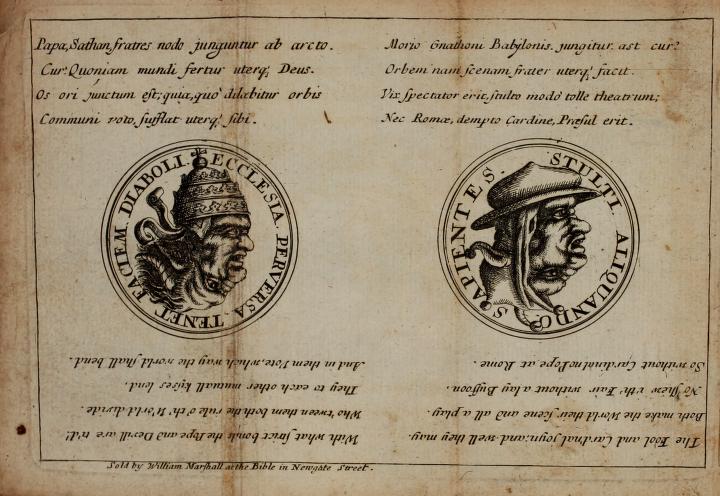
The drawings were inspired by this illustration in the 1682 book ‘The Church of Rome Evidently Proved Heretick’ by Peter Berault:

The ‘¡OHO!’ illustrations were done in the 1930s; Rex Whistler was killed in the Second World War, and the book with Laurence’s poems came out in 1946. A subsequent edition, ‘AHA’, was published in 1978 to include seven more of the double portraits, four very engaging, two less so, while one is an unprepossessing Henry VIII with Anne of Cleves; though without verses for any of them. But the poetry is clearly incidental, anyway… here is the sour Patient and upbeat Nurse:

It’s a wonderful book. As the publishers wrote: “However you put this book down it will lie face up, which is to say face down. And upside down is how it can never be slipped into a bookshelf.”

Potcake Poet’s Choice: Juleigh Howard-Hobson, ‘I’ll Keep My Ghosts’

“…presence, if it has been real presence, does not ever leave.”
–May Sarton

I’ll keep my ghosts. Each morning down we go
Through the hallway, where they begin to show
As grey reflections of themselves in frames
That do not answer when I call their names
But swirl and curve around me, to and fro.
Sometimes, in this house that they used to know
So well, their unseen numbers swell and grow
Until I am overwhelmed. All the same,
I’ll keep my ghosts–
By choice–for what else would I have? Hollow
Spaces between walls? Albums? And sorrow
That has no feeling to it left? Who blames
Me for my preference? I make no claims
That they bring only joy, but even so
I’ll keep my ghosts.

Juleigh Howard-Hobson writes: “It’s so hard to name a favorite poem of my own, (after all, they are all my favorite poetic children!) but this one, written a decade ago, is a little closer to my heart than the others.
Over time, I’ve collected quite a few post-card sized Edwardian portrait photographs, with their original frames, so I can hang them on my walls. These stranger’s images mix with my own vintage family photographs and after a while, they stop being photographs of strangers, they become photographs of familiar faces. After a longer while, some join my family ghosts. Which I find inspiring, if slightly unsettling. This rondeau owes its existence to my collection, both related and adopted.
The Rondeau, with its self-imposed restrictiveness that limits how far a poet may go before she or he must return to the refrain and readdress it, is one that I’ve always been fond of. When I was 16 I came across Dunbar’s “We Wear the Mask” and immediately sensed that the Rondeau was the perfect form for conveying the complicated simplicity of life (granted, I was a strange 16 year old). This one first appeared in Poets’ Touchstone 2010 having won 1st Prize in the 2010 Poetry Society of New Hampshire National Contest; later collected in my book The Cycle of Nine (RavensHalla Arts, 2012).”

Juleigh Howard-Hobson’s poetry has appeared in Valparaiso Poetry Review, Mobius, The Lyric, Dreams and Nightmares, 34 Orchard, Capsule Stories, Birds Fall Silent in the Mechanical Sea (Great Weather for Media), Lift Every Voice (Kissing Dynamite) and other places. Nominations include Best of the Net, the Rhysling, and the Pushcart. Her latest book is the Elgin nominated Our Otherworld (Red Salon). English born, US/Australian raised, she currently lives on an off-grid homestead in the middle of a dark woods in the Pacific Northwest USA, with her husband and her ghosts.

Contact: “I maintain an irregular Twitter presence as ForestPoet@PoetForest https://twitter.com/PoetForest where I follow every writer who follows me.”

Poem: ‘He Wanted a Writer’

He wanted a writer – she had to have money.
He wanted a writer – she had to be funny.
He wanted a writer to laugh with and drink.
He wanted a writer… but not one who’d THINK!!!

The suits of this world, whether moguls or morticians, pastors or politicians, tend to think of creative types as frivolous playthings. That’s their loss.

This little poem (whose genders switched back and forth in fluid fashion before settling down) was originally and suitably published in The Asses of Parnassus. Thanks, Brooke Clark. (Yes, That Brooke Clark!)

“Woman drinking wine while working on her laptop.” by shixart1985 is licensed under CC BY 2.0
Updated Call for Submissions: Potcake Chapbooks

I am always keen to read and consider rhymed and metered verse that has already been published. There are several chapbooks that are jostling in the queue for completion and publication:

Travels and Travails (travel)
City! O city! (urban life)
Just a Little Naughty
Portraits Unpleasant
Various Heresies (religion)
Lost Loves
The Horror of Spring! (seasons)

and there are more; but the last one, Rockets and Robots, wasn’t part of my original plans: I just ran across a bunch of Science Fiction poems that I liked, and they filled a chapbook nicely. So I’m an unashamed opportunist. I’ll modify my plans if I think something better is available. All the chapbooks listed above are nearly full already but, as with all of them, if I run across another poem I really like, I’ll include it. And if I receive enough good poems on an unplanned theme, that theme will get slotted in.

When there is enough good material on a single theme to fill 13 pages of a chapbook (still leaving room for Alban’s artwork, of course), then it may become the next project. But until a chapbook actually goes to print everything is subject to change. An even better poem may show up and displace one tentatively placed. A slew (or slough) of poems on a new theme may cause a reprioritisation of planned chapbooks.

This is one of the reasons that I prefer to consider only poems that have already been published–so that I don’t feel guilty about having a bunch of poems that will sit with me for months, years, and may or may not be included in the Potcake series. I have flagged a thousand poems that interest me; but I can only publish a dozen in a chapbook, and only a few chapbooks will get produced in a year.

Poems in the chapbooks run from two or three lines to some 40 lines in length–obviously, with space at a premium, poems over 20 lines and running over one page are less likely to be included… but it does happen. Other criteria: I’m looking for wit, elegance, a variety of traditional and nonce forms, a variety of voices and moods: happy, sad, angry, sardonic, meditative… anything interesting I can scrounge. If you have something you think I might like, on any topic, please send it along to robinhelweglarsen@gmail.com

I can’t promise to use it, but I will read it and reply!

Potcake Poet’s Choice: Geoffrey A. Landis, ‘If Angels Ate Apples’

If angels ate apples, potatoes and pears
they’d soon be chubby and cheerful as bears
nibbling knishes and other such things,
tickling your face with the tips of their wings.

If seraphim shouted and whistled at girls,
drank drafts from thimbles, all friends with the world
drained the best ale and chased it with rye,
then fluttered in circles while trying to fly.

Angels on tables! (Watch out for your glass!)
Slipping on puddles, right plop on their ass!
Laughing at music that only they hear,
then tweaking the barmaids a pinch on the rear.

Fuzzy fat angels, that’s something to see,
as they dance to the jukebox at quarter to three,
and ace out the pinball, a marvelous feat,
the lights and bells flashing (though sometimes they cheat).

If angels made merry, would that be so odd?
Must they always be solemn, to stay friends with God?
It’s a pity that Heaven is so far away
angels hardly ever come down and just play.

Geoffrey A. Landis writes: “It’s impossible to chose just one poem as a favorite, of course, and even if I could, which poem I’d pick would change from day to day, maybe even from minute to minute. Still, I’ve alway been fond about ‘If Angels Ate Apples’; it’s one that reads well out loud, and I had fun writing it. Mostly I was playing with meter and alliteration. I was happy that Gardner Dozois picked it up for Asimov’s Science Fiction, and since then it’s seen a couple of reprints.”

Geoffrey A. Landis is a rocket scientist who sometimes plays at being a science-fiction writer, and a science-fiction writer who sometimes plays at being a poet. In the process he’s picked up a handful of awards, ranging from science fiction’s Hugo and Nebula awards to the Science Fiction Poetry Association’s Rhysling award, and had his stories and poems appear in twenty languages. He lives in Berea, Ohio, with his wife (who is also a science fiction writer and a poet) and four cats.

Website: http://www.geoffreylandis.com/poetry.html

Odd poem: ‘Motor Bus’, macaronic poem by A. D. Godley

What is this that roareth thus?
Can it be a Motor Bus?
Yes, the smell and hideous hum
Indicat Motorem Bum!
Implet in the Corn and High
Terror me Motoris Bi:
Bo Motori clamitabo
Ne Motore caedar a Bo—
Dative be or Ablative
So thou only let us live:
Whither shall thy victims flee?
Spare us, spare us, Motor Be!
Thus I sang; and still anigh
Came in hordes Motores Bi,
Et complebat omne forum
Copia Motorum Borum.
How shall wretches live like us
Cincti Bis Motoribus?
Domine, defende nos
Contra hos Motores Bos!

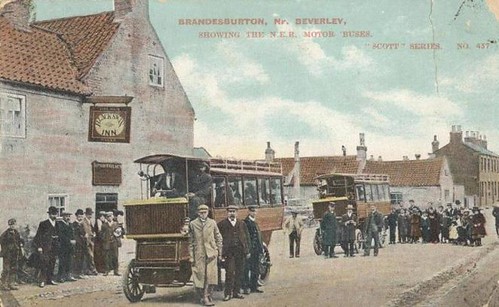
This elegant piece of nonsense was written in January 1914 to celebrate the introduction of a motorised omnibus service in the city of Oxford–hence the reference to two of its main streets, the Corn(market) and High Street. Noticing that both ‘motor’ and ‘bus’ could be the nominative singular of Latin nouns, Professor Godley wrote this series of couplets, declining and rhyming the nouns through all their presumed cases, singular and plural. (The poem presumes the old-fashioned English pronunciation of Latin with many hard vowels needed for the rhymes.) And why not? ‘Motor’ is Late Latin for ‘mover’, and ‘bus’ is a casual modern abbreviation of ‘omnibus’, Latin for ‘for everyone’. The entire piece is written in a mixture of English and Latin, and translates roughly as:

What is this that roars so,
Can it be a motor bus?
Yes, the smell and hideous hum
Indicates a motor bus!
In the Cornmarket and the High Street
Terror of the motor bus fills me:
To the motor bus I will call out
Lest I be killed by the motor bus–
You can be Dative or Ablative
So long as you let us live:
Where shall your victims flee?
Spare us, spare us, O Motor Bus!
So I sang; while still
Motor buses came in hordes
And the whole market place was filled
With a mass of motor buses.
How shall wretches like us live
Surrounded by motor buses?
O Lord, defend us
From these motor buses!

Macaronic, or mixed languages, literature has ancient roots, showing up wherever two languages overlap in one population for a while, frequently in verse, frequently for humorous effect: alternating Persian and Arabic verses or hemistichs of Saadi and Hafez; Rumi’s occasional mix of Persian, Arabic, Turkish and Greek; Indian poetry written in alternating indigenous Hindi and the Persian of the Mughal rulers; and Latin and vernacular languages throughout Europe at the end of the Middle Ages. Modern examples include the Beatles’ ‘Michelle’ and José Feliciano’s ‘Feliz Navidad’.

Photo: “Brandesburton, with NER motor buses 1915 (archive ref PO-1-18-1)” by East Riding Archives is marked with CC0 1.0