Category Archives: odd poems

Odd poem: Xi Jinping, ‘In Memory of Jiao Yulu’

Ten thousand miles away your soul has flown;
the rivers, mountains and land yearn for your return.
The people mourn the loss of a caring official,
tears flooding under the empress trees you planted.
Having dedicated your life to the desert,
to the betterment of people’s lives, your legacy lives on
no matter how many years come and go.

The moon shining bright as always,
I think of you and your life’s work.
You toiled long and hard, claiming no credit.
Serving and benefiting the people:
such was your ambition and is also mine.
Many a trickle will add a touch of green to the desert
and create a wellspring of hope.”

*****

Xi Jinping, born in 1953, has been the general secretary of the Chinese Communist Party and chairman of the Central Military Commission, and thus the paramount leader of China, since 2012. Since 2013, Xi has also served as the president of China.

Jiao Yulu was a Chinese politician, highly respected for his hard work even as he was dying of liver cancer in his early 40s.

From the Chinese Embassy in the US:
Xi Jinping has always held Jiao Yulu in high esteem and regarded him as a role model. At the time of writing this poem, Xi was the Party Secretary of Fuzhou. One night in July 1990, he read an article entitled “People Yearn for the Return of Jiao Yulu.” The poem was inspired as literary thoughts surrounding the deceased upright man welled up in Xi’s heart. When he inspected Lankao in 2014, Xi recalled emotionally how he learned from the example of Jiao Yulu more than 40 years ago. “On February 7, 1966, the People’s Daily carried a long article by Comrade Mu Qing and others entitled ‘Jiao Yulu: A Model County Party Secretary.’ Back then, I was a grade one student in junior high school. The teacher of political education choked with sobs while reading the article to us. I was deeply moved when I heard Comrade Jiao Yulu kept on working even in the late stage of liver cancer, pressing a stick against his liver to relieve the pain. The pressure from the stick wore a hole into the right side of his rattan chair over time.”

Jiao Yulu is no stranger to the Chinese people. After being appointed Party Secretary of Lankao County, he mobilized the local residents in a great struggle to tackle water-logging, sandstorm, and alkaline soil. Leading by example, he was always at the frontline at the height of sandstorms and in torrential rainfalls to identify the wind corridor, forecast quicksand and gauge flood waters. Amid blinding blizzards, he visited poor families to deliver food and financial relief to their homes. He was devoted entirely to all the people of his county but himself. Despite severe illness, he carried on work till the last moment of his life, and is revered as the “model county Party secretary.”

Odd poem: Sir Arthur Conan Doyle, ‘A Reminiscence of Cricket’

Once in my heyday of cricket,
One day I shall ever recall!
I captured that glorious wicket,
The greatest, the grandest of all.

Before me he stands like a vision,
Bearded and burly and brown,
A smile of good humoured derision
As he waits for the first to come down.

A statue from Thebes or from Knossos,
A Hercules shrouded in white,
Assyrian bull-like colossus,
He stands in his might.

With the beard of a Goth or a Vandal,
His bat hanging ready and free,
His great hairy hands on the handle,
And his menacing eyes upon me.

And I – I had tricks for the rabbits,
The feeble of mind or eye,
I could see all the duffer’s bad habits
And where his ruin might lie.

The capture of such might elate one,
But it seemed like one horrible jest
That I should serve tosh to the great one,
Who had broken the hearts of the best.

Well, here goes! Good Lord, what a rotter!
Such a sitter as never was dreamt;
It was clay in the hands of the potter,
But he tapped it with quiet contempt.

The second was better – a leetle;
It was low, but was nearly long-hop;
As the housemaid comes down on the beetle
So down came the bat with a chop.

He was sizing me up with some wonder,
My broken-kneed action and ways;
I could see the grim menace from under
The striped peak that shaded his gaze.

The third was a gift or it looked it-
A foot off the wicket or so;
His huge figure swooped as he hooked it,
His great body swung to the blow.

Still when my dreams are night-marish,
I picture that terrible smite,
It was meant for a neighboring parish,
Or any place out of sight.

But – yes, there’s a but to the story-
The blade swished a trifle too low;
Oh wonder, and vision of glory!
It was up like a shaft from a bow.

Up, up like a towering game bird,
Up, up to a speck in the blue,
And then coming down like the same bird,
Dead straight on the line that it flew.

Good Lord, it was mine! Such a soarer
Would call for a safe pair of hands;
None safer than Derbyshire Storer,
And there, face uplifted, he stands

Wicket keep Storer, the knowing,
Wary and steady of nerve,
Watching it falling and growing
Marking the pace and curve.

I stood with my two eyes fixed on it,
Paralysed, helpless, inert;
There was ‘plunk’ as the gloves shut upon it,
And he cuddled it up to his shirt.

Out – beyond question or wrangle!
Homeward he lurched to his lunch!
His bat was tucked up at an angle,
His great shoulders curved to a hunch.

Walking he rumbled and grumbled,
Scolding himself and not me;
One glove was off, and he fumbled,
Twisting the other hand free.

Did I give Storer the credit,spo
The thanks he so splendidly earned?
It was mere empty talk if I said it,
For Grace had already returned.

*****

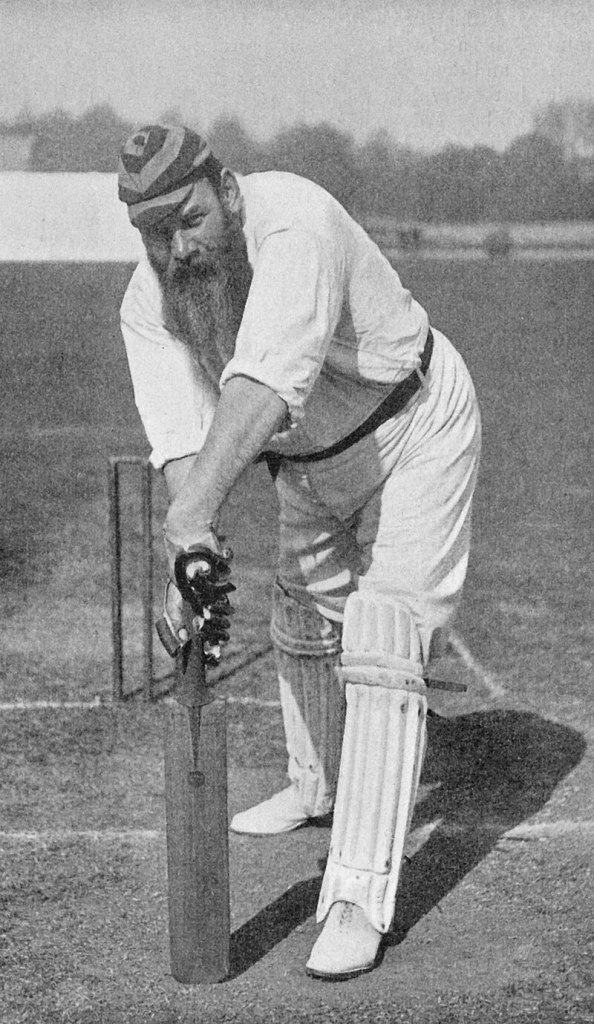
A Reminiscence of Cricket is a poem written by Arthur Conan Doyle. On 23-25 August 1900, Conan Doyle played in a first class cricket match against W.G. Grace where he scored 4, and took the wicket of Grace who had scored 110.

The creator of Sherlock Holmes, Sir Arthur Ignatius Conan Doyle played in ten first-class matches, mainly for the MCC, between 1900 and 1907. As a lower-order right-handed batsman and occasional slow bowler, he scored 231 runs, average 19.25, in 18 innings with a top score of 43. His only first-class wicket came against London County at Crystal Palace on 25 August 1900 when he had WG caught by the wicket-keeper off a skier for 110.

I found this poem with an extensive commentary by someone called Shamanth: “I’ve loved it primarily because of the allure of an amateur lifestyle that it portrays – an age where you could study medicine, play first class cricket, referee boxing bouts and marathons, and still produce brilliant literature, when you could live without sacrificing any dimension of your life, without putting your head down to specialize in any one field, when you did something simply because you loved it without having to forfeit other aspects of your life that you loved just as much. It makes you long for a lifestyle with such freedom.”

Credit: “From photo by E. Hawkins & Co., Brighton” – K. S. Ranjitsinhji, The Jubilee Book of Cricket Third Edition

Wordplay: Barbara Lydecker Crane, ‘Anna Graham’s Quirk’

Not verbose, she’s quite the obverse.
Anna Graham has one fixation—
rearranging conversation
as voices rant on. Here, ears rehearse

how letter counters can construe;
how each artist paints their traits;
how calipers find replicas for mates.
The game won’t wane—it spells anew.

Is she just wired or truly weird?
She does lament her mental quirk
at night. Some ghastly thing will lurk:
serpents in a dream appeared

with pertness. Asleep, she can’t outrun
a rioter, her editor . . .
a teardrop turning predator . . .
a charging gnu with loaded gun

Mornings end each nightly bout
as Anna walks the beach for miles,
where Laughing Gulls will make her smile.
Esprit persists… is that spelled out?

*****

Barbara Lydecker Crane writes: “I was unaware British people tend to pronounce this surname ‘Gray-um’ instead of the American ‘Gram’. I’m punning on the American pronunciation, and the poem won in the humor category of the Chicagoland Poetry Contest in 2021. Although I’m not nearly as obsessive as this fictional woman is about anagrams and “mirror words” (a pair that spell each other backwards), I enjoy such wordplay. My book BackWords Logic (Local Gems Press, 2017) is all quatrains that contain mirror words, with line drawings by Frances McCormick.”

In 2024 Barbara Lydecker Crane won the Kim Bridgford Memorial Sonnet Crown Contest and First Prize in the Helen Schaible Contest, modern sonnet category. She has twice been a finalist for the Rattle Poetry Prize. Able Muse recently published her fourth collection, You Will Remember Me

Photo: “An Anagram” by tcees is licensed under CC BY 2.0.

Odd, political poem: Emperor Qianlong, ‘My Feelings After the Ambassador of the Red-Haired English King, Macartney, Came to Pay Tribute and Give Offerings to Me’

Formerly Portugal presented tribute, now England is paying homage.
They have traveled further than Shu Hai and Heng-zhang;
My ancestors’ virtue must have reached their distant lands.
Though their tribute is nothing special, my heart approves sincerely.
Curios and their ingenious devices I do not prize.
Though what they bring is meager,
in my kindness to men from far away I make generous recompense –
Wanting to preserve my good health and power.”

*****

Original Poem:

《红毛英吉利国王差使臣马嘎尔尼奉表贡至,诗以志事》

  博都雅昔修职贡,英吉利今效荩诚。

  竖亥1横章输近步,祖功宗德逮远瀛。

  视如常却心嘉焉,不贵异听物翊2精。

  怀远薄来而厚往,衷深保泰以持盈。

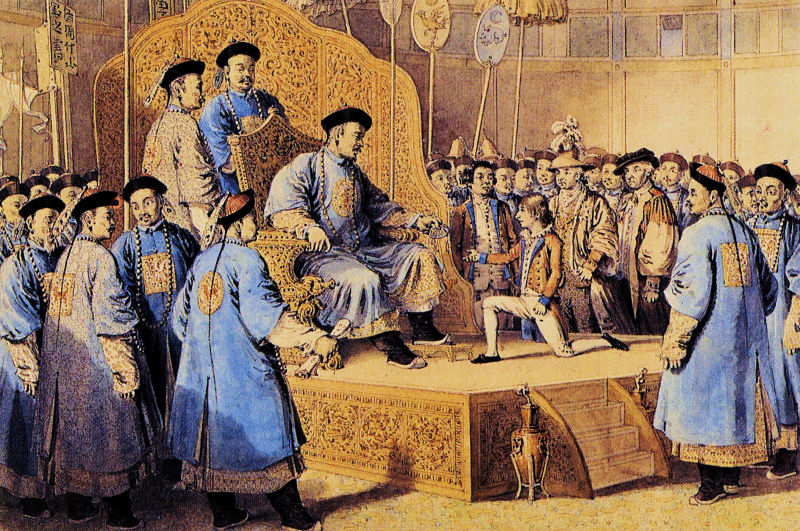
This poem was written by the Qianlong Emperor (25 September 1711 – 7 February 1799; also known by his temple name Emperor Gaozong of Qing, personal name Hongli) after his meeting with the British ambassador Lord Macartney at the Emperor’s grand tent in his Summer resort at Jehol (Chengde) on September 14th, 1793. The embassy was then sent back to Beijing, the Emperor followed and saw the previously prepared British gifts on September 30th. The gifts and embassy did not impress and so they were ordered home on the following day. The whole two-year expedition is detailed here.

Lord Macartney was not impressed either, and wrote: “The Empire of China is an old, crazy, first rate man-of-war, which a fortunate succession of able and vigilant officers have contrived to keep afloat for these 150 years past, and to overawe their neighbors merely by its bulk and appearance, but whenever an insufficient man happens to have the command upon deck, adieu to the discipline and safety of the ship. She may perhaps not sink outright; she may drift some time as a wreck, and will then be dashed to pieces on the shore; but she can never be rebuilt on the old bottom.”

Illustration: William Alexander’s drawing of the reception of the Macartney embassy to China. Young Thomas Staunton (kneeling not kowtowing) receives a gift from the Emperor. Image by William Alexander available under a Creative Commons License

Odd, political, semi-formal verse: Aung San Suu Kyi, ‘In The Quiet Land’

In the Quiet Land, no one can tell
if there’s someone who’s listening
for secrets they can sell.
The informers are paid in the blood of the land
and no one dares speak what the tyrants won’t stand.
In the quiet land of Burma,
no one laughs and no one thinks out loud.
In the quiet land of Burma,
you can hear it in the silence of the crowd

In the Quiet Land, no one can say
when the soldiers are coming
to carry them away.
The Chinese want a road; the French want the oil;
the Thais take the timber; and SLORC takes the spoils…

In the Quiet Land….
In the Quiet Land, no one can hear
what is silenced by murder
and covered up with fear.
But, despite what is forced, freedom’s a sound
that liars can’t fake and no shouting can drown.

Free bird toward to a free Burma

My home…
where I was born and raised
used to be warm and lovely
now filled with darkness and horror.

My family…
whom I had grown with
used to be cheerful and lively
now living with fear and terror.

My friends…
whom I shared my life with
used to be pure and merry
now living with wounded heart.

A free bird…
which is just freed
used to be caged
now flying with an olive branch
for the place it loves.

A free bird toward a Free Burma.

Why do I have to fight???

They killed my father a year ago,
And they burnt my hut after that
I asked the city men “why me?” they ignored
“I don’t know, mind your business,” the men said.
One day from elementary school I came home,
Saw my sister was lifeless, lying in blood.
I looked around to ask what happened, if somebody’d known,
Found no one but living room as a flood.
Running away by myself on the village road,
Not knowing where to go but heading for my teacher
Realizing she’s the only one who could help to clear my throat,
But this time she gave up, telling me strange things in fear.
Why, teacher, why.. why.. why?
I have no dad nor a sister left.
To teach me and to care for me you said, was that a lie?
This time with tearful eyes she, again, said…
“Be a grown one, young man,
Can’t you see we all are dying?
And stop this with your might as soon as you can,
For we all are suffering.”

*****

Aung San Suu Kyi is the daughter of Aung San, who negotiated Burma’s independence from the UK in 1947 (but was assassinated the same year). Aung San Suu Kyi was the leader of the National League for Democracy when it won 81% of parliamentary seats in the 1990 General Election, causing the ruling military junta to nullify the elections and put her under house arrest for most of the next 21 years.

She was awarded the Nobel Peace Prize in 1991; but claims she chose non-violence as an expedient political tactic, stating in 2007, “I do not hold to nonviolence for moral reasons, but for political and practical reasons.” Several of her international honours have been withdrawn in response to her perceived failings regarding ethnic minorities in Myanmar; she remains politically active and under attack in the courts.

I don’t know enough about her and her situation to have an opinion about her, other than “it’s complicated”.

Odd poem: Barack Obama, ‘Underground’

Under water grottos, caverns
Filled with apes
That eat figs.
Stepping on the figs
That the apes
Eat, they crunch.
The apes howl, bare
Their fangs, dance,
Tumble in the
Rushing water,
Musty, wet pelts
Glistening in the blue.

*****

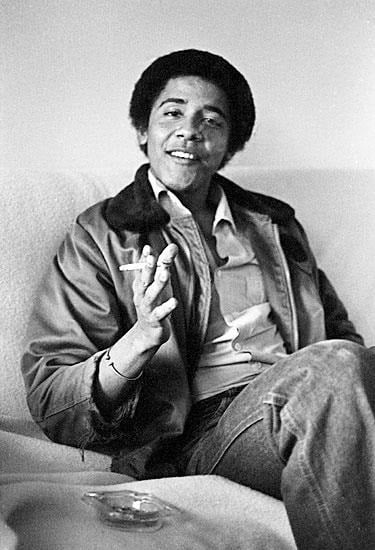
A 1981 poem by future President of the United States Barack Obama, originally published in the journal Feast and featured in The New Yorker in 2007. You can forgive a 19- or 20-year-old for a lot of what they wrote… and after all, it’s better than anything we’ve seen from Donald Trump.

Using form: Odd Sonnet: Brian Bilston, ‘Neither Rhyme Nor Reason’

To make poems rhyme can sometimes be tough
as words can seem to be from the same bough,
yet each line’s ending sounds different, though,
best covered up with a hiccough or cough.

Was this upsetting to Byron or Yeats?
Dickinson, Wordsworth, Larkin or Keats?
Did they see these words as auditory threats?
Could they write their lines without caveats?

What does it matter when all’s said and done
if you read this as scone when I meant scone?
It’s hardly a crime. There’s no need to atone:
language is a bowl of thick minestrone.

So mumble these endings into your beard –
this poem should be seen, rather than heard.

*****

Brian Bilston is a poet who knows it. He writes about the human condition, relationships, and buses. Agent: Jane Finigan (email: info@lutyensrubinstein.co.uk)

Photo: Brian Bilston, Facebook

Short poem: RHL, ‘Heart Attack’

Lust –
Thrust –
Bust –
Dust.

*****

One of the things that intrigues me is the way certain word endings fall into groups, evoke a common mood, sometimes seem to tell their own story. Some of these groups seem natural with overall positive “light, bright, flight, height, white” or negative “dusty, musty, fusty, gusty”; “bumble, crumble, grumble, fumble, stumble, tumble” connotations… but I acknowledge that with the first set I’m ignoring “blight, night, shite” and so on. Some seem random, especially perhaps when the different spellings suggest unrelated origins: “beauty, duty, fruity, snooty,” but still lead to a story.

Happily, I’m not alone in these idle thoughts. Melissa Balmain’s Tale of a Relationship in Four Parts comes to mind… and from Maz (Margaret Ann Griffiths) we have ‘The Drowning Gypsy’:

Flamboyant
Clairvoyant
Unbuo
o
o
o
o
y
a
n
t

Maz’s work is collected in ‘Grasshopper‘; Melissa Balmain’s poem is collected in ‘Walking in on People‘ from Able Muse Press; ‘Heart Attack’ was recently in The Asses of Parnassus.

Photo: “heart-attack” by Pixeljuice23 is licensed under CC BY-SA 2.0.

Odd poem: Marilyn Monroe, ‘Rhyme’

From time to time
I make it rhyme
but don’t hold that kind
of thing
against
me—
Oh well, what the hell,
so it won’t sell.
What I want to tell—
is what’s on my mind:
‘taint Dishes,
‘taint Wishes,
it’s thoughts
flinging by
before I die—
and to think
in ink.

*****

Marilyn Monroe read voraciously and wrote somewhat epigrammatically. She was friends with Dorothy Parker and Carson McCullers, and many other literary figures through her work as well as her marriage to Arthur Miller. Apart from movie scripts, she read widely: Thurber and Bemelmans, Dostoevsky and Camus, Yeats and Frost, Lewis Carroll and Harold Robbins and Rudolf Steiner and Sigmund Freud… In 1999 hundreds of her books were auctioned by Christie’s in New York. The whole list, together with more of her poems and epigrams and photos and mentions of literary friends can be found here in The HyperTexts.

Photo: Marilyn Monroe reading in the woods, from The HyperTexts.

Weekend read: Odd poem: Joseph Stalin, ‘The Outcast’

He knocked on strangers’ doors,
Going from house to house,
With an old oaken panduri
And that simple song of his.

But in his song, his song—
Pure as the sun’s own gleam—
Resounded a truth profound,
Resounded a lofty dream.

Hearts that had turned to stone
Were made to beat once more;
In many, he’d rouse a mind
That slumbered in deepest murk.

But instead of the laurels he’d earned,
The people of his land
Fed the outcast poison,
Placing a cup in his hand.

They told him: “Damned one, you must
Drink it, drain the cup dry…
Your song is foreign to us,
We prefer to live in a lie!”

*****

Ioseb Besarionis dze Jughashvili was a Georgian romantic poet who led a million-dollar heist that killed 40 people and funded the Bolshevik revolution. We know him as Joseph Stalin. His story is fascinating… and he is the model for the anti-hero Cassian Andor (Diego Luna) in the Star Wars spin-off TV series Andor.

The BBC has an excellent background article on him and the Andor connection: https://www.bbc.com/culture/article/20250417-how-a-young-joseph-stalin-inspired-star-wars-series-andor:
Yes, the troubled outlaw beloved by Star Wars fans everywhere is based in part on one of history’s most notorious mass murderers, as the series’ creator, Tony Gilroy, has acknowledged. “If you look at a picture of young Stalin, isn’t he glamorous,” Gilroy said in an interview in Rolling Stone in 2022. “He looks like Diego!”

The above poem and two others, all translated by David Shook, can be found here: https://molossusexperiment.tumblr.com/fall1/stalin. The link also contains Shook’s observations on Stalin’s qualities as a poet, and on his persecution of poets like Osip Mandelstam for the Stalin Epigram:
... the ten thick worms his fingers,
his words like measures of weight,

the huge laughing cockroaches on his top lip,
the glitter of his boot-rims.

Ringed with a scum of chicken-necked bosses
he toys with the tributes of half-men.
..

Not having found a title for Stalin’s poem, in this blog post I titled it ‘The Outcast’, though I considered ‘Panduri’.

Photo: “David and Panduri” by sarah&patrick is licensed under CC BY-NC-SA 2.0.