Category Archives: Poems

Susan McLean, ‘Received Wisdom’

Unpacking it, we wondered who had sent it
and why they felt we needed it. We thought
we’d managed fine without it. Had they meant it
as tribute or rebuke? We had been taught
to view unsought donations with suspicion.
Inspecting it, we found a hairline crack.
It doesn’t suit our taste or disposition.
In short, we must insist they take it back.

*****

Susan McLean writes: “Finding new meanings in old phrases is one of my favorite games. In the case of the poem’s title, I was thinking about how each generation wants to pass along advice to the next generation, which the next generation tends to reject. Advice always feels like criticism, however well intended it may be. Moreover, the world is changing so fast that advice that worked for one generation no longer fits the reality of the next generation.

“The alternating feminine and masculine rhymes in the poem are meant to mimic the interplay between two generations, or any two groups that have differing views. ‘Received Wisdom’ was originally published in Free Inquiry and later appeared in my second book of poems, The Whetstone Misses the Knife.”

Susan McLean has two books of poetry, The Best Disguise and The Whetstone Misses the Knife, and one book of translations of Martial, Selected Epigrams. Her poems have appeared in Light, Lighten Up Online, Measure, Able Muse, and elsewhere. She lives in Iowa City, Iowa.
https://www.pw.org/content/susan_mclean

Photo: “sauce tureen 2, hairline” by pgintx1128 is licensed under CC BY-SA 2.0.

Richard Fleming, ‘Time’

Screenshot 2023-07-30 at 19.15.56.png

He took the time to take the time
and taking it, although a crime,
was what he felt he had to do
so, whilst one might well take the view
that stealing time left others short,
he’d answer with a sharp retort
that time and tide wait for no man
and man must take what time he can.

*****

Richard Fleming writes: “This poem, written in response to a prompt in the form of an image of a man carrying a large clock, is primarily a piece of nonsense-verse and an exercise in word-play, two forms of writing that I particularly enjoy. That it rhymes and scans is something of a bonus.”

Richard Fleming is an Irish-born poet (and humorist) currently living in Guernsey, a small island midway between Britain and France. His work has appeared in various magazines, most recently Snakeskin, Bewildering Stories, Lighten Up Online, the Taj Mahal Review and the Potcake Chapbook ‘Lost Love’, and has been broadcast on BBC radio. He has performed at several literary festivals and his latest collection of verse, Stone Witness, features the titular poem commissioned by the BBC for National Poetry Day. He writes in various genres and can be found at www.redhandwriter.blogspot.com or Facebook https://www.facebook.com/richard.fleming.92102564/

Prose, really: RHL, ‘Time is the Measurement’

Time is the measurement of rearranging atoms.
Atoms are rearranged like blocks, and that is time.
Putting the blocks back as they were before is not going back in time.
There is no past,
there is no future,
there is only the eternal present.
There was a past, there will be a future… but you can’t get there from here,
except as the atoms rearrange.

A time machine would have to rearrange the atoms
of the world,
of the galaxy,
of the entire universe,
to put every particle back into some prior arrangement.
The calculations, let alone the actions, would be… difficult.

It is no wonder that we have never seen visitors from the future.
They don’t exist. There is no future, and there is no past.
There is only the eternal present.
Enjoy it.

*****

This “poem” was just published in Consilience, “the world’s first peer-reviewed science and poetry journal”. In addition to a poem, the journal requires a comment focusing on the science behind the poem. So here is
“The Science.
Time may be a dimension and a useful concept, but it is not a dimension in the sense of something that one can move back and forth in. We measure time with atomic clocks, which produce electromagnetic radiation that atoms in the clock absorb. Cesium atoms absorb microwaves with a frequency of 9,192,631,770 cycles per second, which then defines the international scientific unit for time, the second. Accurate time like this has helped to prove Einstein’s theories about time moving at different rates when clocks are moving at different speeds. Without accurate clocks and an understanding of Einstein’s theories about the speed of light and space-time, we wouldn’t have the Global Positioning System (GPS), which uses clocks in space and on the ground to show you where you are.”

There are limits to the amount that can be written in the Science section, so I haven’t gone into rambling speculation about the subjective aspect of time which appears to speed up as we get older. My suggestion is that we experience a ‘Subjective Time Unit’ as a constant amount of thought-processing. Say as a teenager you process 100,000 bits of information in a second (that’s a random number, but you get the point). Then as you age and the brain physically deteriorates, perhaps by age 50 it takes you two seconds to process that amount of information. You would feel the external world cycling twice as fast between day and night, because it would happen with the passing of half as many STUs. You would still think as logically, but time would feel like it was speeding up. The use of pharmaceutical uppers and downers will also change how much time you feel passes (by impacting how rapidly you are processing information), as will being half asleep (time slides by rapidly) or being in an adrenaline-enhanced emergency (time will appear to slow down).

But these are all mere speculations about the subjective nature of time, different from the question of the objective nature of time itself.

Photo: “LunarLanding – Gardens of Time” by mcscrooge54 is licensed under CC BY-SA 2.0.

Melissa Balmain, ‘Bird in the Hand’

It doesn’t caw or hunt or fly.
It can’t peck anybody’s eye,
or even grow a single lousy feather.
One-clawed, no match for any tom,
it’s stranded on a leafless palm,
regardless of the season, time or weather.

Yet what’s the bird that, all alone,
sticks up for you when gibes have flown
and you don’t care to verbalize or linger;
when someone’s mocked you to your face
or cut you off or swiped your space –
what bird? The one that moonlights as a finger.

*****

Melissa Balmain writes: “I’m pretty sure this would have been the Sphinx’s riddle if she had guarded the Brooklyn Bridge.”

‘Bird in the Hand’ was first published in The Rotary Dial and is collected in Walking in on People © Melissa Balmain, 2014. Used by permission of Able Muse Press.

Melissa Balmain’s third poetry collection, Satan Talks to His Therapist, is available from Paul Dry Books (and from all the usual retail empires). Balmain is the editor-in-chief of Light, America’s longest-running journal of light verse, and has been a member of the University of Rochester’s English Department since 2010. She will teach a three-day workshop on comic poetry at the Poetry by the Sea conference in Madison, CT, in May 2024.

Photo: “A bird in hand” by Whatsername? is licensed under CC BY-SA 2.0.

Sonnet: Shamik Banerjee, ‘A Lesson From Zaheer, Our Fishmonger’

All things are measurable, son: the food
You have, the sprawling mains, for man has power
Over the world; He deems what’s bad or good;
Determines if a plant should wilt or flower.
But ordeals measure us—we take the test
Of mercy when affliction’s cavalry
Threatens to loot the kindness off one’s chest
As in the massacre of ’83,
When every lane had reeked of Muslim blood,
My Abba Jaan had fallen to the sword
Held by your neighbours; trembling on the mud,
He mumbled, “What’s my sin? My faith? O’ Lord,
Don’t charge them for their deeds.” Love was his wish
That lives through me, for I still feed them fish.

*****

Shamik Banerjee writes: “This poem was first published in Fevers of the Mind. The incident described by our fishmonger is the Nellie Massacre, which took place in central Assam (an Indian state) during a six-hour period on February 18, 1983. The massacre claimed the lives of 1,600–2,000 people. The victims were all Muslims. Abba Jaan is an affectionate term for one’s father (used by Muslims).”

Shamik Banerjee is a poet from India. He resides in Assam with his parents. When he is not writing, he can be found strolling the hills surrounding his homestead. His poems have appeared in Fevers of the Mind, Lothlorien Poetry Journal and Westward Quarterly, among others and some of his poems are forthcoming in The Hoogly Review, Dreich and Sparks of Calliope.

Photo: “Old man inside Jamu Masjid, Fatapur Sikri” by nilachseall is licensed under CC BY-NC-ND 2.0.

RHL, ‘Walking then Running’

Like ants searching randomly across a table
like water dribbling across uneven ground
and pooling here, running to the side,
filling and flowing to the next dip,
so we have walked out of Africa
for a hundred, two hundred thousand years,
over the hills, around the coasts,
seeking the greener grass, the next best land,
glad of a tree, glad of a cave,
catching the lightning for our own hearth,
settling, pooling, then spilling out
over the next hill, round the next headland,
following bird flight, following game herds,
exploring then leading then fetching our families,
finding and fighting with those who were there before,
killing or trading, absorbing or raping,
loving, despising the different, the ogres and trolls,
like a stain spreading out round the world,
and walking then running up as though to take a free kick,
walking then running up as though to bowl,
walking then running as along a diving board to
bounce once, twice in the air and launch into space…
Here comes, there goes the human race.

*****

The future is unknowable beyond the point where AI becomes more intelligent than humans, and autonomous. Enjoy what you have now, you will be nostalgic for it soon enough…

I wrote this piece as a long rambling exploratory sentence which picks up speed and purpose towards the end and a concluding rhyme. This (not exactly formal) poem was first published in Bewildering Stories a few years ago.

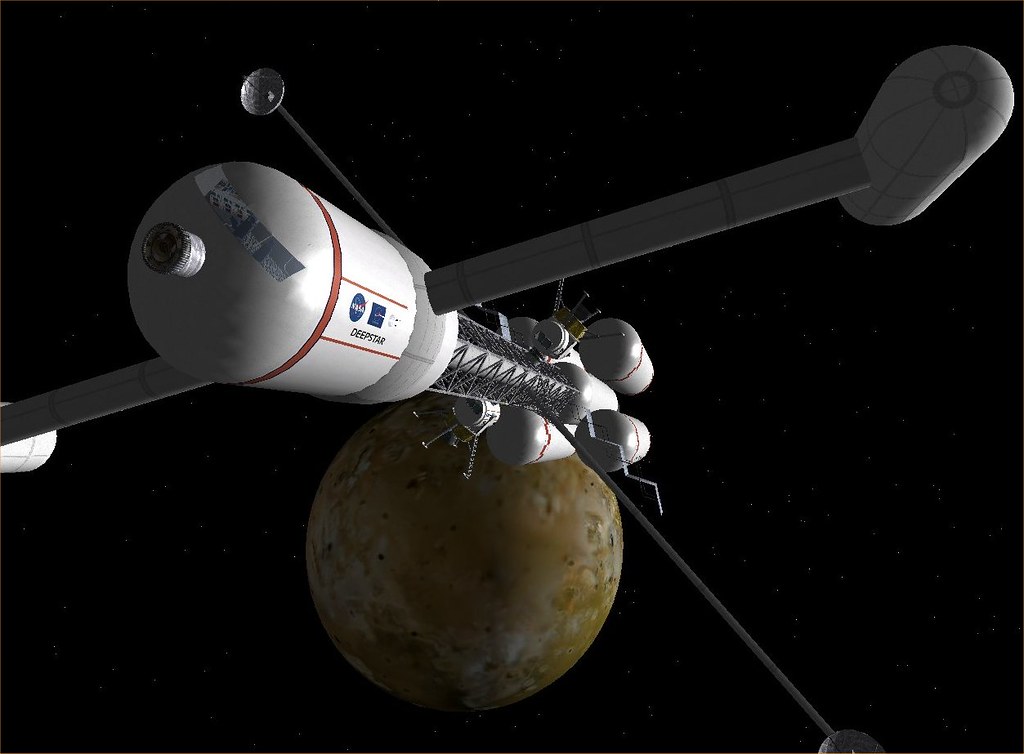
Aboard Starship Hedonian – The Terminators [809]” by TimWB2020 is marked with CC0 1.0.

Using form: John Beaton, ‘Legacy’ (excerpt)

Inside his penthouse office
he views his Inuit artwork,
carvings from a culture
reduced to buy-and-hold,
then scans the evening city,
his bar chart on the skyline
where real estate has grown his stake
but cost him bonds he’s had to break –
he hadn’t meant to so forsake
his parents. They looked old

that day outside the croft house
when cowed farewells were murmured
as cattle lowed in wind blasts
keening from the sea.
His mother and his father
stood waving from the porch step;
next year she’d crack her pelvic bone,
when winter iced that slab of stone,
and never walk again. I’ll phone,
and he was history.

(…)

He downs his drink and glances
again at his computer –
an email from a neighbour:
Your father died last night.
He’d lately gotten thinner
and seldom had a fire on –
what little peat he had was soft.
Some things of yours are in the loft
so mind them when you sell the croft.

The city lights are bright;

he turns again and faces
his metamorphic sculptures
of walruses in soapstone
that never will break free
from rock that locks the sea waves –
past fused against the future.
Another gin? That’s six. Or eight?
So be it. Clarity’s too late.
His real estate’s no real estate –
he’s left his legacy.

*****

John Beaton writes: “This is a composite. Elements of it are taken from my life but I’ve borrowed significantly from the trajectories of others, especially some of my father’s contemporaries who left Camustianavaig physically but never in their hearts. There are also aspects of the lives of some people I’ve known in business. 

I worked out the form so that each stanza would start out steadily and rhythmically for six trimeter lines then build pace for three rhymed tetrameter lines and rein to a halt with a single trimeter line that has a masculine rhyme with line four. Even though they limit word-choices, I thought feminine endings for the first three lines and lines five and six were worth it for the rhythm. And I like how they form a sort of rhyme and closure gradient with lines four and seven to ten.”

John Beaton’s metrical poetry has been widely published and has won numerous awards. He recites from memory as a spoken word performer and is author of Leaving Camustianavaig published by Word Galaxy Press, which includes this poem. Raised in the Scottish Highlands, John lives in Qualicum Beach on Vancouver Island.
https://www.john-beaton.com/

Photo: “‘V for Vendetta’, United States, New York, New York City, West Village, Skyline View” by WanderingtheWorld (www.ChrisFord.com) is licensed under CC BY-NC 2.0.

Verse into Verse: George Simmers translates Catullus ‘VII’

Lesbia, you ask me quantify
How many of your kisses I
Might think enough. My answer? Count,
When you’re in Libya, the amount
Of tiny sand grains on the beach
Along the shining miles that reach
Between Jove’s shrine and Battus’s tomb.
Or count the stars that pierce the gloom
To stare all-seeing from above
Upon the privacies of love.
Let’s kiss and kiss with such excess
We’ll make all voyeurs’ minds a mess;
Add kiss on kiss, till we’ve a sum
So vast all gossips are struck dumb.

*****

This is one of the translations from Catullus to be found in the recently published pamphlet, Riffs, by George Simmers, editor of Snakeskin, the world’s longest-running monthly ezine for poetry. Riffs is a grab-bag of translations of poems that have appealed to him, from Ovid, Virgil, Catullus, the Greek Anthology and Francois Villon. For sample pages (featuring Ovid’s version of the myth of Narcissus) click here.

The plentiful illustrations are by Bruno Vars, whose pictures enlivened George’s previous pamphlet, Old, Old.

Riffs costs £5, and should be available from Amazon, but if you’d like a signed copy, email him: simmersgeorge@yahoo.co.uk and he’ll arrange one for you at no extra cost.

Robert Frost said that poetry is what gets lost in translation. George Simmers has tried to find it again. This is the ideal Christmas gift for the classicist in your life.

Using form: Semi-formal: RHL, ‘Hunting’

The Osprey splashes, misses, and flies by
skimming the waves, rising, five yards away.
What’s its success rate? Does it care?
The Stingray searches, gliding, mouth to sand
five yards beyond the shallows where I stand.
Its Roomba-work’s its own affair.
The water splishes, burbles random rhythms.
The sun confuses, over-hot, then hidden.
The Oystercatcher calls. The Osprey rocks
on its branch in a casuarina,
flaps down-beach to another.
Along the margins of the shore, alone, each stalks.
They hunt for food
and I hunt them for what they mean, or could.

*****

There are elements of the sonnet about this semi-formal poem: it’s in iambics (though with uneven lengths of line); it has rhyme (though some only slant rhyme, and not patterned); it has 14 lines and a final couplet (though not with a clear volta where you would hope, after the 8th line). But I think the disjointed nature of the poem, its stop-and-go lines of different length, is suitable for the nature of the hunt: the searching, the sudden swoop, the pause, the restarting. In that sense the form is appropriate for the subject matter, and therefore good. It may be that I was too lazy to beat the whole thing into pentameters with a regular rhyme scheme… but it may also be that this was the right place to stop for this particular poem.

‘Hunting’ was originally published in Obsessed With Pipework, and has just been reprinted in Green Ink Poetry (motto: “We Welcome Chaos, Calamity, And The Natural World. Hope Punks & Witches” in their current collection with the theme of ‘Forage’.

Photo: “Osprey” by Mick Thompson1 is licensed under CC BY-NC 2.0.

Formless poem: RHL, ‘Marty Ravellette’

The man with no arms sat on the stool in the diner;
he was shoeless: How else could he drink his coffee,
eat his scrambled eggs?

The man with no arms parked his truck and got out barefoot.
He fired up his chainsaw; he had a landscaping business.
With the log out of the way, he could cut the grass,
push the lawnmower around with his chest.

The man with no arms saw the woman in the burning van,
barefoot, he kicked in the window, so his wife
could reach in and unlock the door, help the woman escape.

Somewhere Kipling’s Creator of All Things must have told him “Play –
play at being who you are,” and he played.

Somewhere Lear’s Aunt Jobiska must have told him “This is the best.”
And he lived, happy with who he was, glad for no arms
because no arms made him who he was, and he liked who he was.

Nor was the man with no arms alone.
The boy with no hands sat in the laundromat, knitting.
He had metal pincers. His mother was washing the clothes.
The girl with two heads, or rather the twins with only one body,
they live, argue, love, share.
And the men with no legs have a chance to run faster than all,
will require a new type of Olympics.
And the child born to die – does that disturb you, “the child born to die”?
The child born to die is me and is you, is all humans, all life,
all planets, stars, galaxies, all.
Listen to Lear’s Aunt Jobiska: This is the best.
Listen to Kipling’s Creator of All Things, and play.

*****

Marty Ravellette was a highly respected inhabitant of Chapel Hill, North Carolina, where he lived the last 16 years of his life – running his landscaping business, taking a break in a local diner, frequently a guest lecturer in journalism at UNC. He was a Baha’i convert, and a hero.

Occasionally I break my own rules about poetry, and write a poem in a style which I consider to be really flash fiction (or flash non-fiction in this case). The things I had to say didn’t present themselves in anything hinting at traditional verse, and therefore I just said them as best I could. But both Snakeskin and The HyperTexts consider it poetry, so I won’t argue. I’m not sure it should be in the formalverse.com blog, however…

Photo: Figure 8 Films