Category Archives: Poems

Poem: ‘Gods On Trial’

When all the old gods go on trial, loud cursed
In the High Court of Public Thought Review,
Jehovah (tribal god of bronze age Jews)
Stands of his vast pretentiousness accused:
Claims he created Heaven and Earth
When he was born six thousand years ago!
(Can’t define Heaven, doesn’t even know
If there’s a difference between Earth and Universe.)
God of the Christians and the Muslims too!
Won’t do anything against the AI
Displacing all the gods. Thor in the dock
Scratches his bull-neck, Odin his empty eye,
Zeus his cock.
The gods are human, know they face death, forgotten
As any carven deity, buried, rotten.
Concerned, they fidget restlessly –
Only Jehovah, the least self-aware,
Storms he’s exempt, blusters with beard and hair,
Thinks his small tribe is all that there can be.

I have a lot of sympathy with apocalyptic thinking: the end of the world as we know it is always happening, being replaced by something with unfamiliar and disturbing aspects. All the old ways are always ending. And those who grow up with the new ways, which is all children, mature and age and find their ways displaced in turn. But the scale of displacement varies… a war raging across your homeland is worse than a wave of new immigrants, though both of these are familiar problems. But the rise of AI and a host of new technologies, and the wholesale washing away of gods and pre-scientific explanations, is leading to a future where not even the make-up of the human can be known for sure. The gods shrink and become amusing.

The poem was originally published in Snakeskin. It’s a bit slapdash, mostly in iambic pentameter, mostly rhyming, but not technically great. But then, I was always one of those students whose report cards read “Could try harder”, “Could do better”.

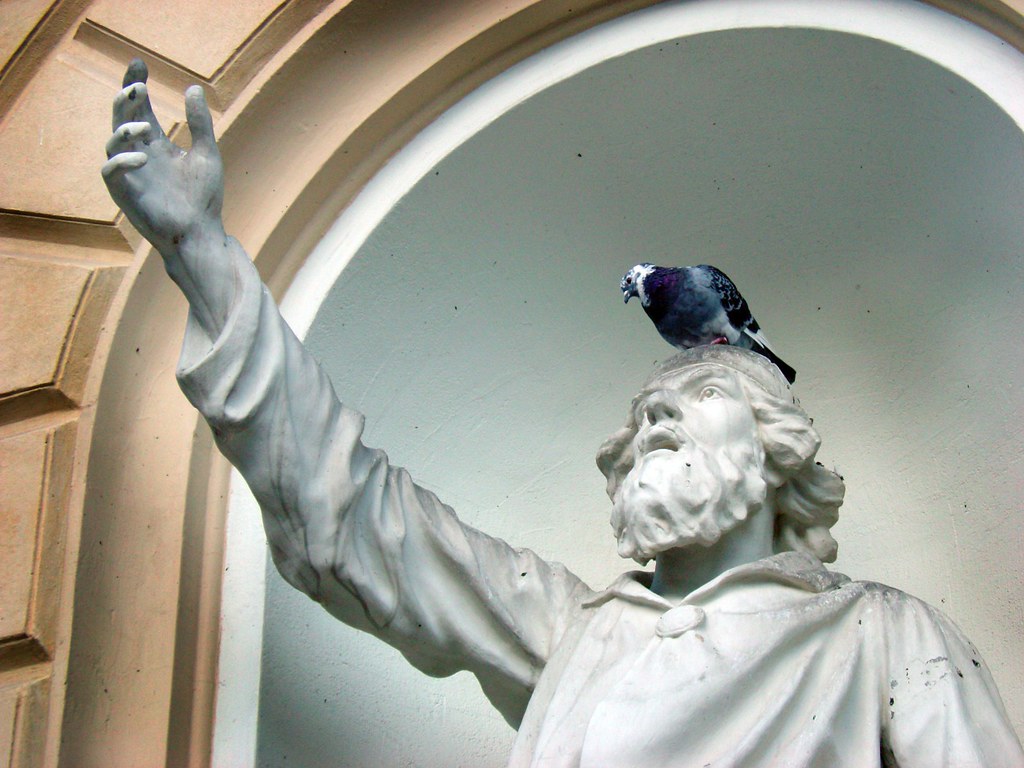
Photo: “Wäinämöinen” by Teppo is licensed under CC BY-NC 2.0

Potcake Poet’s Choice: ‘Scenes From A Marriage II’, Kathy Lundy Derengowski

When, at last, auditions ended
parts were cast and roles assigned.
By the time the vows were taken
expectations had declined.

She replaced the silk with sweatshirts
He drank beer instead of wine,
They had tired of pretending
Both agreed that it was fine.

Sometimes laundry went unfolded,
furniture grew thick with dust.
They had made accommodations
Every happy couple must.

When her garden went unweeded
when he failed to take out trash
they hung in there, through the hard times
long on love, though short on cash.

Through the years of strife and struggle,
obstacles they couldn’t plan
they held fast, to face the future-
each the other’s biggest fan.

Leading man and leading lady
both had heard the casting call.
Their romantic comedy
became the envy of us all.

Kathy Lundy Derengowski writes: “I selected this poem for submission, because it is one that just “fell into place” and because it still captures the essence of a satisfying marriage.”

Kathy Lundy Derengowski’s work has appeared in Summation, California Quarterly, Silver Birch Press, Autumn Sky Daily, Turtle Light Press, the Journal of Modern Poetry, as well as the latest Potcake Chapbook, ‘Houses and Homes Forever‘. She has won awards from the California State Poetry Society and was a finalist in the San Diego Book Awards poetry chapbook category.

Although she does not have a website or blog, you can find a reading of a few of her earlier poems on YouTube under Kathy Lundy Derengowski.

Poem: ‘Unexplained’

I’ve only once in my six decades–
Years spent in many lands and islands–
Had a crow fly to and caw at me…
It flew ahead and cawed from a second tree…
Then flew ahead to a fence post,
Cawed a third time as we came close.
Then flew away. This in the driveway
Of a well-treed hotel outside Nairobi.
Kenyans have no tradition of the crow
As messenger of death… but we sure do.
We checked the time: 1:05 pm.
As it turns out, that was the moment when
In the night in British Columbia
My favourite in-law, my children’s grandmother,
Died.

This is not exactly formal poetry… I can read it with four beats to a line, but only just; and as for rhyming couplets, yes, it has them, if you’re prepared to allow “rhymes” like driveway-Nairobi. Normally the needs of rhyme and meter will shape the finish of my poems, may alter its details, often add to its meaning in the process. But with this one, it was more important to me to stay as exact to the event as possible. I’ve short-changed the description by leaving out the presence of my wife Eliza, who was also close to my ex-mother-in-law; and a couple of other British Columbia-related coincidences that occurred in the previous hour in Kenya.

This poem was published appropriately enough in ‘Bewildering Stories‘. My suspicion is that everyone on very rare occasions experiences some woo-woo event that defies logic or probablility. In this case, say the event lasts a minute; to be generous to the gods of chance, let’s say it was accurate to within an hour on Molly’s death. Say I’ve been awake 16 hours a day for 60 years since childhood: that’s over 350,000 hours. Say that half a dozen people who I’ve felt really close to have died in that time. The chance that the one and only time a crow very deliberately comes up to me and caws three times is in one of the half-dozen hours that someone close has died, is therefore less than one in 50,000. That’s not impossible, of course. There are one-in-a-million lightning strikes and lottery wins. But crows have a reputation for doing exactly this.

I reject a mystical solution. I want to know the science of what happened. My purely speculative guess is that some quantum entanglement happens between people who are close (especially twins, or mother and child) and when there is a change of state in one, it registers with the other. Further speculation: that crows are so sensitive to the smell of death that they can register it in the changed state of a living but quantumly entangled person. Sorry, that’s admittedly unscientific, but at least it’s an attempt at a material rather than a spiritual answer.

Anyway, it happened.

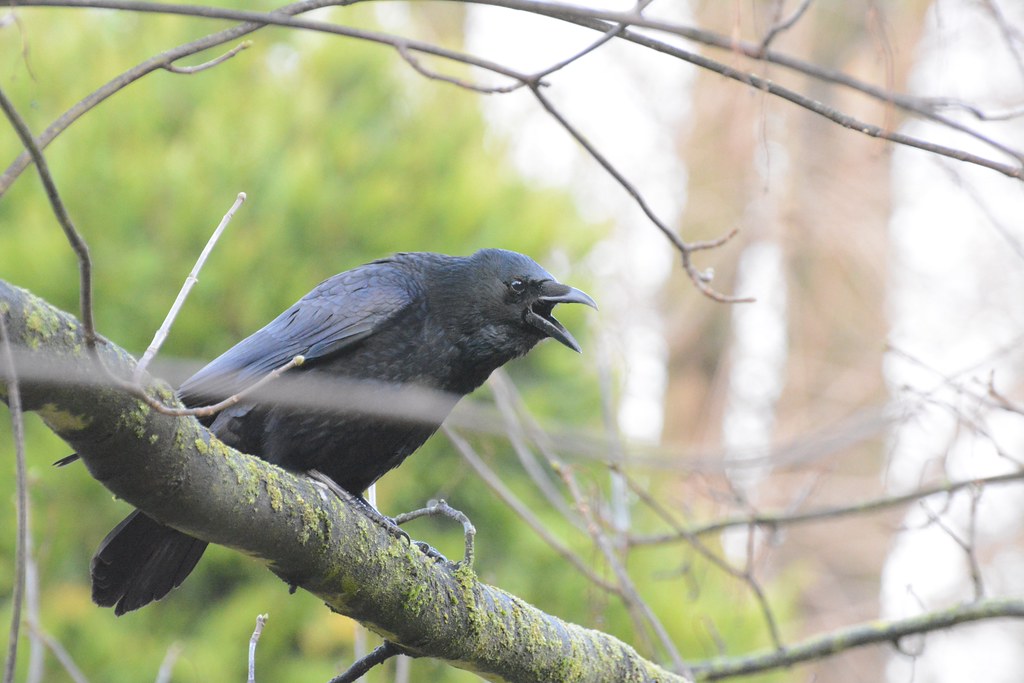
“Carrion crow, cawing” by Drbrown1970 is licensed under CC BY-NC-SA 2.0

Odd poem: ‘I Am The Greatest’ by Cassius Clay

This is the legend of Cassius Clay,
The most beautiful fighter in the world today.
He talks a great deal, and brags indeedy
Of a muscular punch that’s incredibly speedy.
This brash young boxer is something to see
And the heavyweight championship is his destiny.

This kid fights great. He’s got speed and endurance.
But if you sign to fight him, increase your insurance.
This kid’s got a left, this kid’s got a right,
If he hit you once, you’re asleep for the night.
And as you lie on the floor while the ref counts 10,
You pray that you won’t have to fight me again.

The fistic world was dull and weary,
But with a champ like Liston, things had to be dreary.
Then someone with color and someone with dash,
Brought fight fans a-runnin’ with plenty of cash.
For I am the man this poem is about,
The next champ of the world, there isn’t a doubt.
I am the greatest!

As an 18-year-old, Cassius Clay won boxing gold in the 1960 Rome Olympics. Three years later, when he was on the verge of fighting the heavily favoured Sonny Liston for the World Heavyweight title, he produced this poem, and issued it with modifications as the flipside of a single (covering ‘Stand By Me’ on the A side). I had a copy of that 45 when I was a teenager in England, but who knows what happened to it.

He had a street-smart way with words, a natural ability to rap: rhyme, rhythm, wit and a big ego. It wasn’t for nothing that he was known as the Louisville Lip. They were all good defences in his battles outside the boxing ring, where he confronted white racism. His heavyweight titled was stripped from him when he refused to fight in the Vietnam War, saying “Viet Cong never called me ‘nigger’.” He changed his name to Cassius X when he joined the unorthodox Nation of Islam, then changed it again to Muhammad Ali as a more standard Sunni Muslim. Prevented from fighting throughout his late 20s, he returned and regained his title–but he had lost what would probably have been his most successful years.

He was a popular favourite around the world.

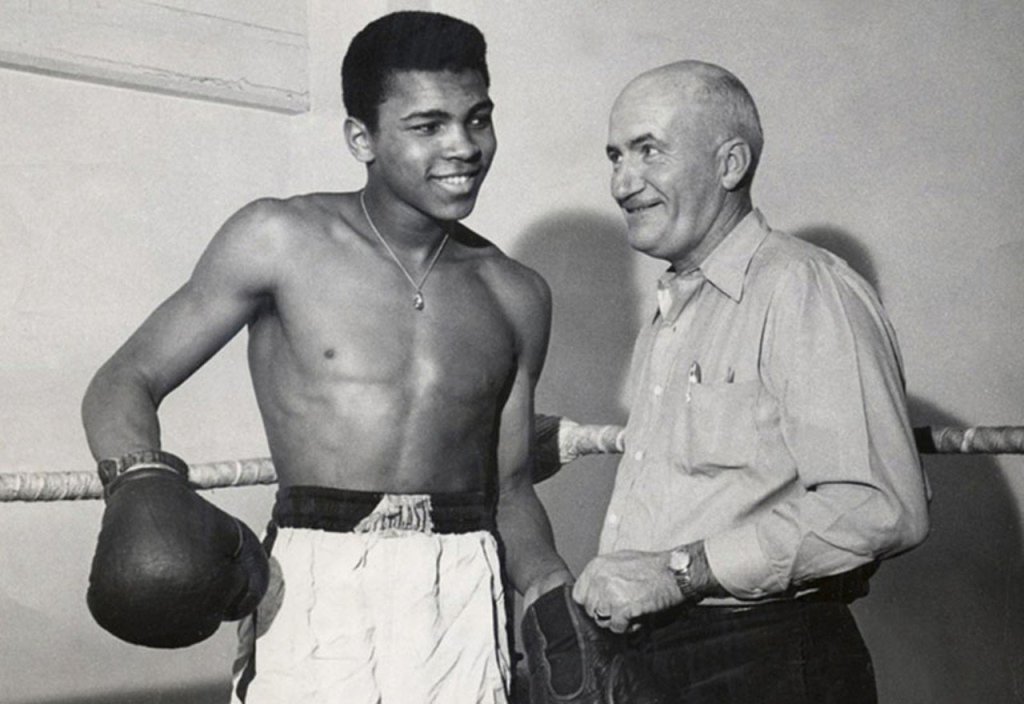
Photo: Cassius Clay with his trainer Joe E. Martin, the Louisville cop who redirected the 12-year-old’s anger into learning to box.

Odd poem: ‘Life’ by Ronald Reagan, age 17

I wonder what it’s all about, and why
We suffer so, when little things go wrong?
We make our life a struggle,
When life should be a song.

Our troubles break and drench us,
Like spray on the cleaving prow
Of some trim Gloucester schooner
As it dips in a graceful bow.

Our troubles break and drench us
But like that cleaving prow,
The wind will fan and dry us
And we’ll watch some other bow.

But why does sorrow drench us
When our fellow passes on?
He’s just exchanged life’s dreary dirge
For an eternal life of song

What is the inborn human trait
That frowns on a life of song?
That makes us weep at the journey’s end,
When the journey was oft-times wrong?

Weep when we reach the door
That opens to let us in,
And brings to us eternal peace
As it closes again on sin.

Millions have gone before us,
And millions will come behind
So why do we curse and fight
At a fate wise and kind

We hang onto a jaded life
A life of sorrow and pain
A life that warps and breaks us,
And we try to run through it again.

Let’s face it, it’s doggerel–the meter comes and goes, sometimes three and sometimes four stresses in a line; the second and fourth lines in each stanza rhyme, but there is a lot of repetition. However, kudos to a 17-year-old to put together a strong, optimistic view of life, part faith-filled, part commonsense, a view that he retained throughout his life. Ronald Reagan (as illustrated in The Hypertexts) was a charming, witty, self-deprecating person.

On the other hand, he was largely responsible for the destruction of the American middle class, the increasing inequality of American society, and the beginning of the breakdown of public services by defunding – now impacting public education, environmental protection, etc. His foreign policy was riddled with lies and law-breaking. And on the personal level, he was not a good parent.

But he did try writing poetry as a teenager…

Sonnet: ‘The Body Retreats’

Loss of response of toes, legs turned to jelly,
we’re fighting rearguard actions through the body:
the hair deserting, skin becoming shoddy,
strengths all withdraw – to reinforce the belly.
Under sustained attacks, the ankles fail,
cannot provide support. Legs mutiny,
they seize the muscles when no scrutiny
at night stops leg cramps grabbing to impale.

Stamina fading in both heart and lung,
sex organs weakened, bold lusts dying back,
skull’s the last stronghold where all force retreats.
With fading senses out the window flung,
success is redefined not as Attack,
but barely maintained memory and wits.

In the aftermath of the no-holds-barred wrestling match for the US Presidency by Trump and Biden, both septuagenarians, let us remember that they are past the “threescore years and ten” that humans are allocated by the Bible–to which both wrestlers profess to adhere. Things are going downhill at this point, regardless of how much care you take.

It’s time for science, the medical profession and gengineers specifically, to step up and give us all the tools to stop us ageing. Thank you, and I personally would appreciate it sooner rather than later!

This sonnet was originally published in Snakeskin, currently prepping for its 25th anniversary as a monthly online poetry magazine–likely the oldest such in the world!

“Getting old in dignity…” by ЯAFIK ♋ BERLIN is licensed under CC BY-NC-SA 2.0

Odd poem: Hemingway’s last poem, untitled

If my valentine you won’t be,
I’ll hang myself on your Christmas tree.

This is the 88th and last poem of the ‘Complete Poems’ of Ernest Hemingway (edited with introduction and notes by Nicholas Gerogiannis). Given that Hemingway ended his life by suicide, this might seem a worrying final poem; but he wrote it five years before his death, and it was truly light-hearted.

He was living with his fourth wife, Mary Welsh Hemingway, at “Finca Vigía” (“Lookout Farm”), a 15-acre property he bought and lived in for 22 years. She writes that he became so fond of the Christmas tree that he wouldn’t allow it to be removed for months after Christmas. This was his 1956 Valentine for her.

Hemingway’s poems are unremarkable at best (despite Eliot having apparently told him that he had promise as a poet). They are not what he won the Nobel Prize for in 1954. But if you like reading biographies, reading his poems is an interesting way of finding out about his thoughts and activities.

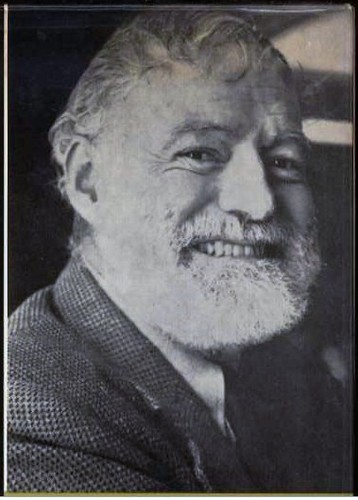
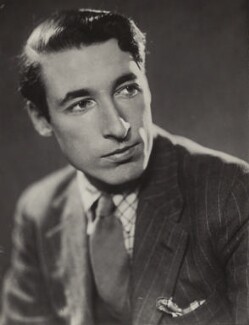
Photo: “Ernest Miller Hemingway” by tonynetone is licensed under CC BY 2.0

Poem: ‘The Future as Event’

The future like an avalanche
is roaring down the sky.
If you’ve prepared no hiding place
then be prepared to die.
You never reason why.

The future like a question mark
is scything humankind.
If you can see, then handle it –
you’ll be cut down if blind.
The future doesn’t mind.

The future like a giant wave
is heading for the shore.
If you can ride that wall-like wave
it’s no wall, but a door
into forever more.

I was looking for one of my poems that might be appropriate for the aftermath of the 2020 US election, regardless of any of the possible outcomes. This is the best I could find: no matter who wins which election in any country in the next couple of decades, the world is going to be struggling to play catch-up with enormous changes happening in the climate, the sea, cyber warfare, space militarisation, A.I., genetic modifications… Trump, Biden, BoJo, Putin, Xi, they are all corks on an ocean with a hurricane coming.

‘The Future as Event’ was originally published in the much-lamented ‘Rotary Dial’, produced in Toronto by award-winning poets Pino Coluccio and Alexandra Oliver. A delightful monthly of formal verse, it ceased without warning. So it goes.

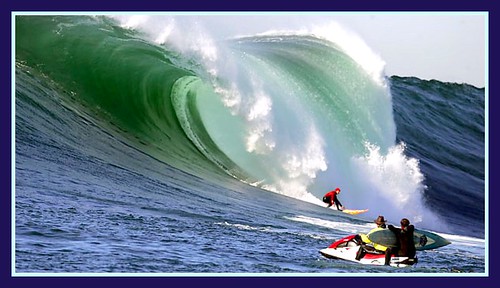
Photo: “Giant waves at Half Moon Bay in Calif.” by robertg6n1

Review: ‘Selected Poems’ by Louis MacNeice

Louis MacNeice was born in 1907. By his early 30s he had published four volumes of verse (as well as other material), sufficiently good and well-received for him to publish this early selection in 1940. The tone is set with the opening lines of the first piece, ‘An Eclogue for Christmas’:

A:  I meet you in an evil time.
B:                                The evil bells
    Put out of our heads, I think, the thought of everything else.
A:  The jaded calendar revolves,
    Its nuts need oil, carbon chokes the valves,
    The excess sugar of a diabetic culture
    Rotting the nerve of life and literature.

Throughout the book we have the passage of time with the deterioration of society, culture and one’s own life, expressed in a blending of old and new images, in rhyme. They are poems of the 1930s, of the Great Depression and the imminent war, all from the same man, all on the same theme.

And yet one or two stand out: ‘The Sunlight on the Garden’ is one of the best poems in the English language, casting a spell with its dazzling intricate rhymes sustained over four stanzas, insightful, wistful, immediately memorable, endlessly anthologised. It relates specifically to his first wife having left him – he wrote this “love-song” for her after their divorce was finalised.

The sunlight on the garden
Hardens and grows cold,
We cannot cage the minute
Within its nets of gold,
When all is told
We cannot ask for pardon.

‘Bagpipe Music’ is also very commonly anthologised because of its bounce, cynicism and humour:

The Laird o' Phelps spent Hogmanay declaring he was sober,
Counted his feet to prove the fact and found he had one foot over.
Mrs. Carmichael had her fifth, looked at the job with repulsion,
Said to the midwife 'Take it away; I'm through with over-production'.

A good question, then, is why these two poems stand out against the rest in the book. What makes them so successful, with their very different moods? I think their common quality, largely lacking in all the other pieces, is that they are very easy to learn by heart and recite, they are almost singable even on a first reading. Pure poetry.

Odd poem: by a young pirate, before his hanging

In youthful blooming years was I,
When I that practice took
Of perpetrating piracy
For filthy gain did look.
To wickedness we all were bent,
Our lusts for to fulfil;
To rob at sea was our intent,
And perpetrate all ill.

I pray the Lord preserve you all
And keep you from this end;
O let Fitz-Gerald’s great downfall
Unto your welfare tend.
I to the Lord my soul bequeath,
Accept whereof I pray;
My body to the earth beneath:
Dear friend, adieu for aye.

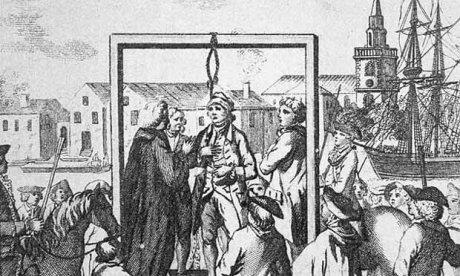
Written by the 21-year-old John Fitz-Gerald of Limerick, Ireland, apparently on the night before his execution. It is quoted in The Pirates of the New England Coast, 1630-1730 (Rio Grande Press, 1923), which in turn is proudly excerpted by the Online Review of Rhode Island History, as well as by David Cordingly’s extensive history and analysis of the Golden Age of piracy, Under the Black Flag.

On 11th June 1723, Captain Peter Solgard, commander of His Majesty’s Ship Greyhound, a man-o-war, engaged two pirate sloops off Long Island, New York, capturing one of them, Ranger, and taking 37 of its 48 crew alive. He brought them in to Newport, Rhode Island, and they went on trial the following month. Those who could show that they had been forced to join the pirates and had not taken part in violence were released, but the pirate captain and 25 others–including our young poet, of course–were “hanged by the neck until dead” on 19th July 1723, between twelve and one o’clock in the afternoon.