Remember, dear, when this was the one way to make a disk sing? Full-size, not compact— and both the disk and player would obey only if you possessed your share of tact: You’d lift the tone arm, puff a bit of air across its fragile needle to remove new dust, or use a brush of sable hair to coax it out. After each vinyl groove was polished with the softest chamois cloth, you’d spin a record on its table, place the needle over it, light as a moth— you must remember! For the way you trace the path of every melody I store shows gentleness I’ve never known before.
Claudia Gary writes: “In case anyone still thinks art and science belong in different categories, it may help to remember that long before there were computer nerds, there were music nerds (audiophiles). Back then, enjoying high fidelity sound at home required paying close attention to detail and taking good care of fussy, sensitive machines. They may not have been as cavalier as today’s machines that demand upgrades at their own convenience; but yesterday’s machines did need a lot of TLC in exchange for beautiful music. And so does love.”
Claudia Gary lives near Washington, D.C., in Northern Virginia, and teaches workshops on Villanelle, Sonnet, Natural Meter, Poetry vs. Trauma, Poetry for Musicians, etc., at The Writer’s Center (writer.org) and elsewhere, currently via Zoom teleconference. Author of Humor Me (David Robert Books, 2006, in which Phonograph was published), and of chapbooks including Genetic Revisionism (2019) and Bikini Buyer’s Remorse (2015), she is also a health science writer, visual artist, and composer of tonal chamber music and art songs. See pw.org/content/claudia_gary; follow her on Twitter at @claudiagary.
This morning, at my garbage can, just underneath the lid, two snails in the embrace of love connubially hid.
Who knows what dangers they had passed, how high they had to climb, in order to achieve at last this interchange of slime?
I left you unmolested, snails, beneath your plastic shelf, because on Friday nights I look ridiculous myself.
Gail White writes: “This is a favorite light verse of mine, first published in Light. Our sexual nature gives us something in common with even the lowliest life forms, a fact which caused me to spare the snails from eviction.”
Gail White is the resident poet and cat lady of Breaux Bridge, Louisiana. Her books ASPERITY STREET and CATECHISM are available on Amazon. She is a contributing editor to Light Poetry Magazine (lightpoetrymagazine.com). “Tourist in India” won the Howard Nemerov Sonnet Award for 2013. Her poems have appeared in the Potcake Chapbooks ‘Tourists and Cannibals’, ‘Rogues and Roses’, ‘Families and Other Fiascoes’ and ‘Strip Down’. https://www.amazon.com/Asperity-Street-Gail-White/dp/1927409543
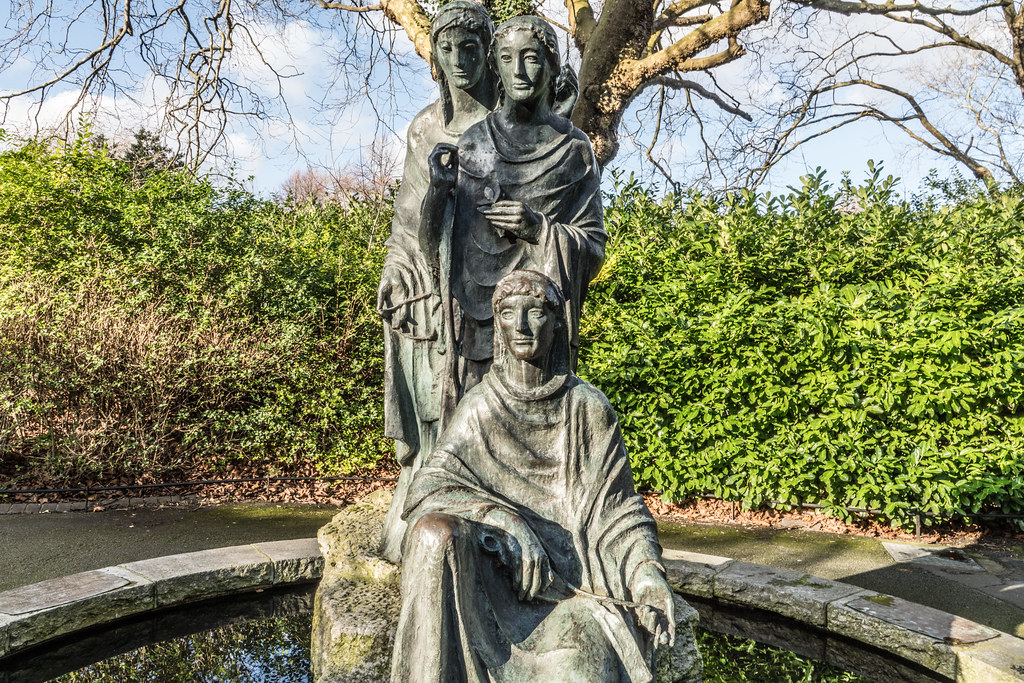
Young Clotho spins new Thread of Life, She holds Fate’s spindle taut. Precise Lachesis measures life’s strand’s length, Thus governs lifetime’s span and lot. And Atropos, death’s agent, cuts The mortal thread that Clotho wrought.
When I first burst from mother’s womb, Three Fates were watching o’er my room. Lachesis doled me ample thread, And so, in time, I grew to be The mother of my own young Three.
Upon my bosom all three drank; They slept and flourished there. Across Ten years, four jobs, three homes – I nursed Away their sorrows, hurts, and scares.
And now I know our nursing age (Which one year past, met poignant end) Was in itself a life, a thread, Spun, drawn, and sheared by three small Fates.
My eldest son precisely spun That nursing thread with infant’s cord. His warm-breathed suckling sutured closed The wound my late son’s loss exposed.
My younger boy, for four years straight, Was nursing life’s allotting Fate. He lengthened thread, bridged start and end – Became his sister’s nursing mate.
My Three’s sole girl, at three years old, Adroitly sheared our tender twine When, blonde crown bowed, she deftly swore, “I don’t need boo-boo anymore.”
And from these Fates I deem my Three, I’ve learned the joys of genesis – I’ve learned there’s silent eloquence In birth, in growth – in severance. From newborn’s threaded cry all Three Ascend—beginning, middle, end.
Mindy Watson writes: “The Three is an internally/intermittently rhymed poem in (mostly) iambic tetrameter, equating my three children to three Greek Fates who taught me, via our respective breastfeeding “threads,” to cherish all beginnings, middles, and ends. I’m enduringly sentimental about this one, which represents not only my first published poem (originally appearing in the Quarterday Review’s October 2016 Samhaim issue) and my first creative post-grad school venture (although I’d majored in nonfiction/science writing rather than poetry)—but also my first attempt at articulating (and externalizing) my children’s and my seemingly endless nursing journey… a year after its bittersweet conclusion.”
Mindy Watson is a formal verse poet and federal writer who holds an MA in Nonfiction Writing from Johns Hopkins University. Her poetry has appeared in venues including Snakeskin, Think Journal, the Poetry Porch, Orchards Poetry Journal, Better Than Starbucks, Eastern Structures, the Quarterday Review, and Star*Line. She’s also appeared in Sampson Low’s Potcake Poets: Form in Formless Times chapbook series and the Science Fiction and Fantasy Association’s 2019 Dwarf Stars Anthology. You may read her work at: https://mindywatson.wixsite.com/poetryprosesite.
I do what I don’t If I can’t and then could. I wouldn’t say won’t When I mustn’t but should.
Do I never need not Any time that’s all now? Should I get what I’ve got Nowhere here but not how?
When the whos turn to whom As I do till I die, I will rumor the room And stop asking why.
David Galef writes: “Nohow, besides being a homage to Cummings, is the kind of celebration of sound and sense that people always seem to enjoy. First published in Blue Unicorn.”
David Galef has published over two hundred poems in magazines ranging from Light and Measure to The Yale Review. He’s also published two poetry volumes, Flaws and Kanji Poems, as well as two chapbooks, Lists and Apocalypses. In real life, he directs the creative writing program at Montclair State University. www.davidgalef.com
Indescribable—our love—and still we say with eyes averted, turning out the light, “I love you,” in the ordinary way
and tug the coverlet where once we lay, all suntanned limbs entangled, shivering, white… indescribably in love. Or so we say.
Your hair’s blonde thicket now is tangle-gray; you turn your back; you murmur to the night, “I love you,” in the ordinary way.
Beneath the sheets our hands and feet would stray to warm ourselves. We do not touch despite a love so indescribable. We say
we’re older now, that “love” has had its day. But that which Love once countenanced, delight, still makes you indescribable. I say, “I love you,” in the ordinary way.
Michael R. Burch writes: “These are some tidbits about the poem: This was my first villanelle and it’s missing a tercet. The missing tercet was pointed out to me by the formalist poet Richard Moore, who said he still liked the poem. I didn’t feel that I had anything to add, so I left the poem as it was. I’ve never been a stickler for the rules, anyway. ‘Ordinary Love’ was originally published by The Lyric. It later won the 2001 Algernon Charles Swinburne Poetry Award, was published by Romantics Quarterly, which had sponsored the contest, and RQ nominated it for the Pushcart Prize. The poem has been translated into Hungarian, as noted below. That’s not too shabby for my first villanelle! Here is the complete publication history: Published by The Lyric, Romantics Quarterly, Amerikai költok a második (in a Hungarian translation by István Bagi), Mandrake Poetry Review, Carnelian, the Net Poetry and Art Competition, Famous Poets & Poems, FreeXpression (Australia), PW Review, Poetic Voices, Poetry Renewal, Poem Kingdom and Poetry Life & Times; also winner of the 2001 Algernon Charles Swinburne Poetry Award sponsored by Romantics Quarterly and nominated for the Pushcart Prize. The last time I checked online, it returned nearly 10,000 results for the first line.”
Michael R. Burch is an American poet, editor and translator who lives in Nashville, Tennessee with his wife Beth, two outrageously spoiled puppies, and the ghost of a hamster, Olive, murdered by a former canine family member. For an expanded bio, circum vitae, career timeline, reviews, interviews and other information of interest to scholars, please click here: Michael R. Burch Expanded Bio. To read the best poems of Mike Burch in his own opinion, with his comments, please click here: Michael R. Burch Best Poems.
And malt does more than Milton can To justify God’s ways to man. —A. E. Housman
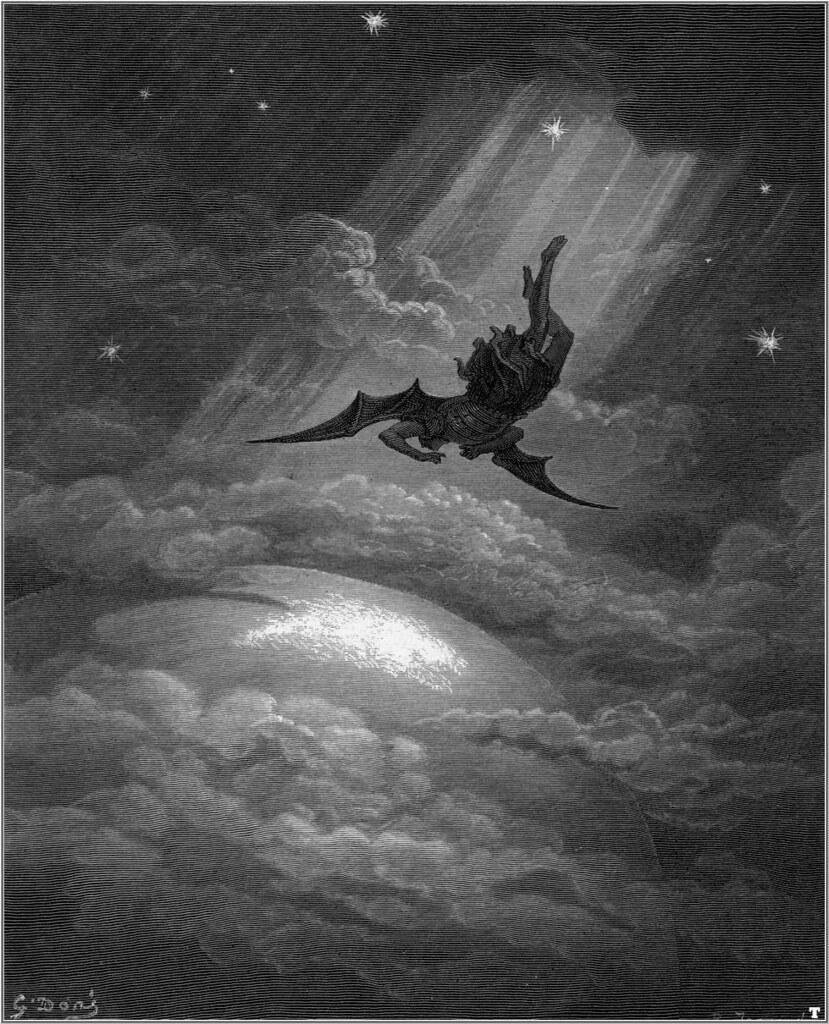
When I am beaten down by work and love, And others head for local dives to drink, I clench my soul and strive to rise above, For stimulating words to make me think. O show me Milton’s paradisial route, Far airier than the foamiest of stout. Of man’s first disobedience and the fruit Are all I need and all I care about. A bottled brew’s sufficient for the poor In spirits, not for spirituality. How can a tankard filled with beer quench more Than slaking drafts of a theodicy? I’d bring it to the bar, but I get looks When I enact the fall from all twelve books.
David Galef writes: “Justification is both an appreciation and dig at Milton, an attitude older than Samuel Johnson’s comment about Paradise Lost, ‘None ever wished it longer than it is.’ It came out in Light.”
David Galef has published over two hundred poems in magazines ranging from Light and Measure to The Yale Review. He’s also published two poetry volumes, Flaws and Kanji Poems, as well as two chapbooks, Lists and Apocalypses. In real life, he directs the creative writing program at Montclair State University. www.davidgalef.com
I lived as best I could, and then I died. Be careful where you step: the grave is wide.
Michael R. Burch writes: “This original epigram once returned over 90,000 results for its second line and still returned over 4,200 results the last time I checked. The epigram began as “Epitaph for a Child of the Holocaust” and was set to music by Sloane Simon after the Pittsburgh synagogue shooting.
It has been published by Romantics Quarterly, Poetry Super Highway, Mindful of Poetry, Poets for Humanity, The New Formalist, Angle, Daily Kos, Katutura English (Namibia), Genocide Awareness, Darfur Awareness Shabbat, Viewing Genocide in Sudan, Setu (India), Brief Poems, Better Than Starbucks and ArtVilla; also translated into Romanian by Petru Dimofte, into Turkish by Nurgül Yayman, into Czech by Z J Pinkava, into Indonesian by A. J. Anwar.”
Michael R. Burch has over 6,000 publications, including poems that have gone viral. His poems have been translated into fourteen languages, incorporated into three plays and two operas, and set to music by seventeen composers. He also edits TheHyperTexts.
Always in shadow, on the edge, the light falling on someone else. I’m used to it— fidus Achates, and half-acolyte. Besides, the sidelines are a safer bet so I survive—at least, upon the page, though never in imagination. The curtain falls: I vanish with the stage. Even Rosencrantz and Guildenstern live on in other times but I—the dutiful and sober pal, the philosophic friend— dissolve. I fade. Meanwhile, the beautiful capture your soul beyond the play’s neat end where I’m to set, with due fidelity, the record straight. You won’t remember me.
D.A. Prince writes: “In the middle of a lively debate about which actor had played the definitive Hamlet, I realised I had no memory at all of any actor playing Horatio. There would have been an equal number, obviously. Horatio is on Elsinore’s battlements in the opening scene, questioning the existence of ghosts, and he’s there in the final scene, surrounded by corpses, giving the penultimate speech. In between he hovers in Hamlet’s shadow, necessary but—if I’m a typical theatre-goer—unmemorable. He doesn’t even get to cross the stage in Tom Stoppard’s Rosencrantz and Guildenstern are Dead. The world is full of people like Horatio so I thought I would give him a brief acknowledgement: for turning up, for hanging on, for being there.”
D A Prince lives in Leicestershire and London. Her first appearances in print were in the weekly competitions in The Spectator and New Statesman (which ceased its competitions in 2016) along with other outlets that hosted light verse. Something closer to ‘proper’ poetry followed, with three pamphlets, followed by a full-length collection, Nearly the Happy Hour, from HappenStance Press in 2008. A second collection, Common Ground, (from the same publisher) followed in 2014 and this won the East Midlands Book Award in 2015. HappenStance published her pamphlet Bookmarks in 2018 and will bring out a further collection in 2022. There’s just the little matter of a title to resolve first.
Illustration: Hamlet and Horatio in the Graveyard (Eugène Ferdinand Victor Delacroix)
I see the waitress cock her head to try to figure out what I just said. Across the booth my husband will not meet my eye until she leaves to place our order. Sauce for goose and gander holds that I will get a turn to laugh (or not) at him. Neither of us can hide where we are from. I let him think his accent less than mine—either of us can drawl a syllable into a sentence. Fine. Most locals here speak plain Midwestern as they welcome others who seek remedies for matters inhumane. How I may talk does not mean one iota when visiting Rochester, Minnesota.
Jane Blanchard writes: “The Kahler Grand Hotel appeared in Third Wednesday (Winter 2020) right before COVID-19 changed all of our lives. This sonnet discloses how Jimmy and I tried to cope with a different medical crisis several years earlier. A little humor can go a long way when dealing with a scary situation. To this day we appreciate the many kindnesses shown to us when we were very vulnerable and very far from home.”
A native Virginian, Jane Blanchard lives and writes in Georgia. Her latest collection with Kelsay Books is Never Enough Already (2021).
Amidst a sere Midwestern winter night December 1917, she’s born, A staunch Germanic woman’s child. Bedight In dearth and loss, she learns too young to mourn A mother’s death. She knows a woman must Prepare the meals, evoke good cheer, and thrust Her bitter tears inside where no one sees. She weds a Coast Guard vet and oversees His household — bears three girls, subsists on grace. And steadfast ‘til succumbing to disease, Upon her own, she wears her mother’s face.
Unwanted infant hurtles toward the light In 1944, her mam too worn And poor to greet her daughter with delight. The wealthy gent who claims the babe has sworn To sate her whims, exchange her doubts for trust. But Virgin-named, she’s Snake incarnate, trussed In greed. She flaunts her swindling expertise, Yet knows that costly baubles won’t unfreeze Her heart, or fill an absent mother’s space. And void, despite full coffers overseas, Upon her own, she wears her mother’s face.
She’s born in 1945, clasped tight Within her mother’s arms. And ne’er forlorn, This nurtured daughter dreams she’ll wed a knight Who’ll grant her nuptial bliss, and — fast foresworn To loyalty — a doe-eyed child who’ll just Love her. When falseness renders faith to dust And pregnant prayers produce no guarantees, She nonetheless adheres to memories Of Mother’s happy tales. She weighs her case, Then smiling, phones adoption agencies. Upon her own, she wears her mother’s face.
From birth, a target of her small town’s spite, She sprints through cornfields, fleeing bullies’ scorn, Hurled stones, and taunts of “freak”! Wisconsinite In ragtag 1980s garb, she’s borne Her share of tyranny. Her heart’s robust Enough to weather gibes, but grief’s the gust She can’t withstand. At forty-one, she frees Herself and downs the sleeping pills that squeeze Her breath away. Her mother deems her base Look odd, but with some rouge — an eyebrow tweeze — Upon her own, she wears her mother’s face.
Abandoned infant left upon a white Korean orphanage’s stoop, she’s shorn Of roots upon her trans-Pacific flight To Heartland serendipity. She’s torn Between identities, but must adjust: Refute all claims of foreignness. Nonplussed, Her heart aligns to these: Wisconsin cheese And apple pie. She’d always deemed “Chinese” A slight, but now she sees each buried trace Of her within her children’s eyes. And pleased, Upon her own, she wears her mother’s face.
A steadfast matron, serpent quick to tease, She’s part Korean, one-eighth Japanese, Idealist, rebel geek without a place — My post-millennial, she’s all of these. Upon her own, she wears her mother’s face.
Mindy Watson writes: “I’m probably most proud of this chant royal titled ‘Her Mother’s Face’ that narratively links the most influential women in my life, ultimately culminating in my daughter’s overall connection to her (mostly unknown) maternal lineage. It was an unconventional topic for me (as my go-to inspirations are normally bugs, science, mythology, etc. and I’ve a hard-wired aversion to delving into my lost cultural roots—Midwestern U.S. white Protestant upbringing and all that), but it just intuitively sprang from the 11-line stanza/repeated refrain/converging envoi-type structure. Humorously, the poem’s impetus was a poet e-friend of mine mentioning that this form (I’d never heard of) was the most difficult he’d ever tried and hadn’t ever conquered—so of course I took that as a dare/challenge, lol… but I ended up unexpectedly enjoying the composition process (and reminiscing about a few souls lost too soon. Also I disagree with my friend—I personally think pantoums are among the most vexing forms…”
Mindy Watson is a formal verse poet and federal writer who holds an MA in Nonfiction Writing from Johns Hopkins University. Her poetry has appeared in venues including Snakeskin, Think Journal, the Poetry Porch (where ‘Her Mother’s Face’ was first published, April 2018), Orchards Poetry Journal, Better Than Starbucks, Eastern Structures, the Quarterday Review, and Star*Line. She’s also appeared in Sampson Low’s Potcake Poets: Form in Formless Times chapbook series and the Science Fiction and Fantasy Association’s 2019 Dwarf Stars Anthology. You may read her work at: https://mindywatson.wixsite.com/poetryprosesite.








 Form in Formless Times